
A beginner's guide
Do You Need an Altar to Meditate? Making a Practice Space at Home
Begin with a workable seat and learn what Tibetan shrine objects represent before choosing an altar, offerings, or a place for prayer.
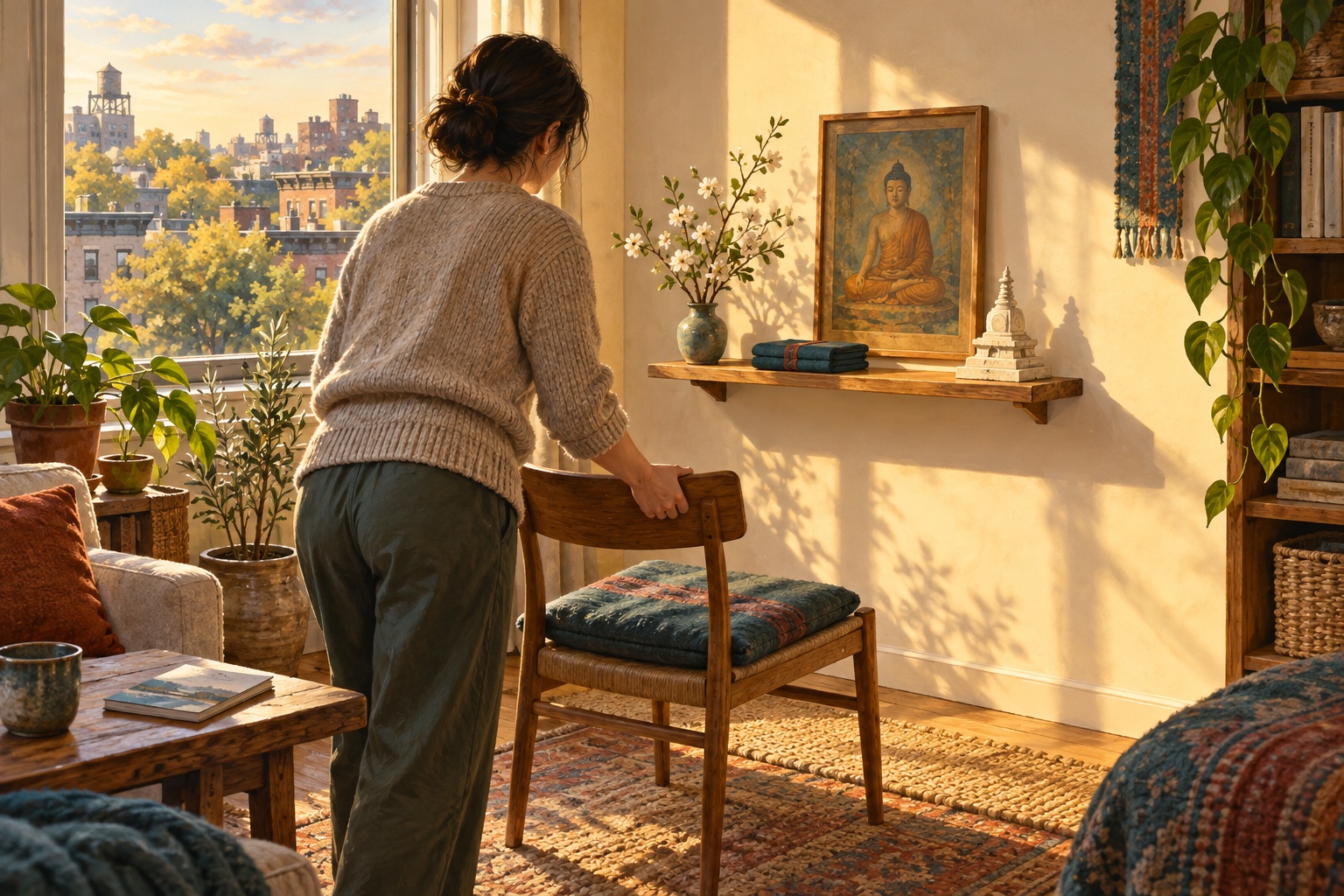
You can begin basic sitting meditation with a suitable seat and a little time. A dedicated altar becomes relevant when you want to establish a devotional practice or follow a community's shrine customs. These are related decisions, but you do not have to make them on the same afternoon.
Before buying anything, decide what you want the space to support. Sitting with the breath, studying a text, and reciting the Seven-Line Prayer place somewhat different demands on a room. A chair, a clear surface for a booklet, and enough light to read may serve your first sessions well.
Start with the place where you will sit
Plum Village's introduction to sitting meditation explicitly includes a chair among the available positions. It recommends an upright, relaxed posture and adjusting the body if sitting becomes painful. Its breathing instructions ask practitioners to notice the breath as it is, without controlling it. [1]
Try the seat you already own before ordering a cushion. Can you remain upright without straining to hold yourself there? Can you place your booklet where you can see it without bending over? Does the position allow you to get up comfortably? Those questions are more useful than whether the corner resembles a photograph of a meditation room.
If the same chair serves meals or work, choose a small preparation you can repeat: clear the table, put the booklet in place, and move the phone out of reach. This is a practical suggestion for organizing your time, rather than a rule from a Buddhist text.
A home practice space can be modest
Thich Nhat Hanh's Making Space: Creating a Home Meditation Practice, published by Parallax Press in 2011, introduces the idea of a breathing room alongside sitting, walking, and everyday mindfulness. Plum Village describes the book as a guide for people living alone or with a family. [2]
In a shared home, decide on arrangements with the people who live there. “I will use this corner from seven to seven-ten” gives a housemate something concrete to work with. A folded blanket and a book stored together may be easier to maintain than a permanent display that causes disagreement.
If you have room for a small reading surface, keep it within comfortable reach. Put your translation, phonetic text, and a pencil there. A beginner learning a prayer often needs to pause and check a line; arrange the furniture for that task.
What a Tibetan Buddhist altar represents
FPMT's The Preliminary Practice of Altar Set-up & Water Bowl Offerings explains three common shrine objects: a Buddha image represents enlightened body, a Dharma text represents enlightened speech, and a stupa represents enlightened mind. In its single-level arrangement, the text sits to the viewer's left, the Buddha image in the center, and the stupa to the viewer's right. [3]
The booklet allows a Dharma text in any language and a photograph of a stupa. It recommends a clean, respectful place, with sacred objects higher than the head of someone seated before them. These details belong to the Tibetan Buddhist approach presented by FPMT; another community may guide you differently. [3]
If you are drawn to a shrine, begin by learning what its objects mean. Ask a center which image or text it recommends and how it cares for them. This gives a purchase a purpose and helps you avoid collecting unfamiliar sacred objects simply because they look beautiful.
Offerings involve care over time
The same FPMT booklet describes offerings as a practice of generosity. Its introductory guidance calls for clean, fresh offerings and discusses the daily attention given to an altar. A formal water-bowl practice has its own preparation and removal instructions, which the booklet explains in detail. [3]
Before adding bowls, flowers, or food, consider whether you can care for them. Where will you pour the water? When will you change it? Who will look after the arrangement while you travel? Read the instructions for the practice you choose and ask about anything you do not understand.
A lit candle or burning incense also changes how you must use the room. Keep flame away from paper and curtains, and stay present while it burns. If you cannot do that, leave it unlit and ask your community about an appropriate alternative.
A beautiful arrangement can have mixed motives
In “The Perfect Altar,” first published in Mandala in 2008, Ven. Tenzin Chönyi tells of a practitioner who prepared impressive offerings for a visiting benefactor, then recognized that he wanted admiration. Her article uses the episode to examine motivation and the way pride can enter religious observance. [4]
That question can be asked gently at home. Does the arrangement help you remember to practice? Are you willing to dust it when nobody is visiting? Do you know what the objects represent? The answers may lead you to keep a carefully tended shrine or to simplify an arrangement you cannot maintain.
A first setup for learning the Seven-Line Prayer
For an introductory session with this site, put a chair or cushion where you can read comfortably. Open the prayer page, bring the translation into view, and listen to the recording. If you use a phone for audio, silence unrelated notifications before you begin. Keep a printed copy nearby if switching between the player and the words becomes distracting.
Read the seven lines slowly enough to identify whom they address and what they ask. Our pronunciation guide explains how to work with a recording when the written syllables are unfamiliar. You can also read our introduction to Buddhist prayer if the devotional language raises questions.
Give the arrangement a week of ordinary use before adding more. Notice whether the text is easy to see, whether the time suits your household, and whether you return to the seat. Those observations will tell you what the space needs next. If your interest grows into a formal practice, bring those questions to a teacher who can help you establish it.
Sources and further reading
- Plum Village, The Art of Mindful Living. Sitting meditation and mindful breathing sections; includes chair sitting and adjusting posture.
- Thich Nhat Hanh, Making Space. Plum Village book description. Parallax Press, 2011; ISBN 9781937006006. The full book was not used as a source.
- FPMT, The Preliminary Practice of Altar Set-up & Water Bowl Offerings. 2016 edition, printed pages 5–8: practice space, body/speech/mind objects, respectful placement, and offerings.
- Ven. Tenzin Chönyi, The Perfect Altar. First published in Mandala, June–July 2008; reflection on motivation and ritual.
Written with AI assistance and checked against the sources linked above. This introduction offers context for visitors; instruction in a lineage's formal practices belongs with a qualified teacher.