
A beginner's guide
Your First Visit to a Tibetan Buddhist Center: What to Expect
Choose a beginner session, understand common customs, and know what to ask about seating, prayer books, bows, and chanting.
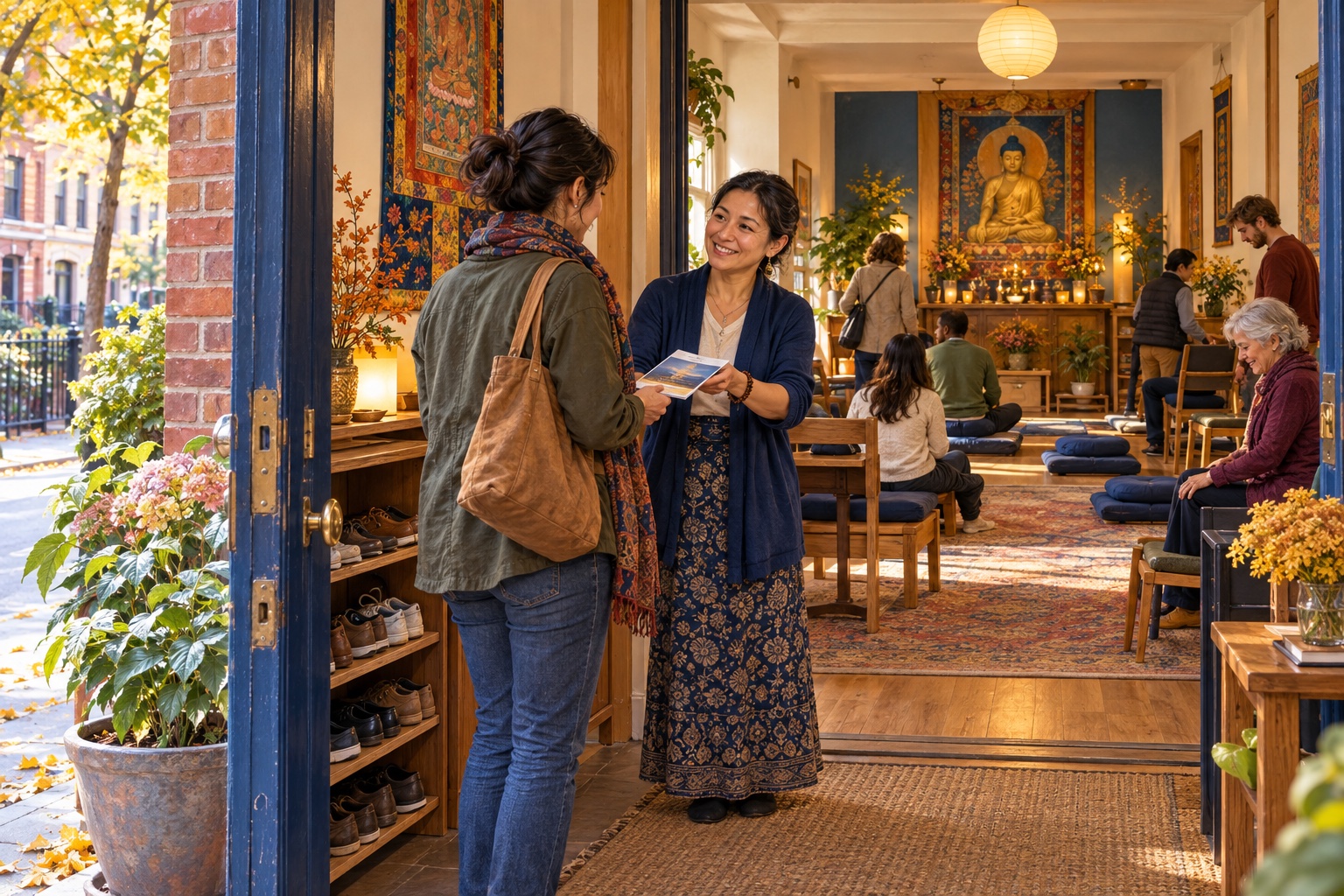
Before your first visit to a Tibetan Buddhist center, find out which event you are attending. A beginner meditation group, a public teaching, a prayer gathering, and a retreat can use the same room and have very different formats. The event description is your best starting point.
This guide brings together examples from several communities. Their customs overlap, but the host center's instructions take precedence over a general article. A short message to the organizer can settle most practical questions before you arrive.
Choose a session that welcomes beginners
Look for an explicit description of the audience and format. Tergar Miami, for example, describes its gatherings as self-contained sessions combining guided meditation with discussion, open to people without previous meditation experience. That tells a newcomer much more than the word “practice” on a calendar. [1]
Another group may ask for an introduction beforehand. Tergar Brussels requests a short email before a first visit, including whether the person has meditated before. Its page also distinguishes open practice from study sessions that have prerequisites. [2]
For any listing that mentions empowerment, transmission, vows, or prior study, ask the organizer whether you may attend and what participation involves. The existence of a public calendar entry does not answer those questions.
Confirm the practical details
Check the current time, address, registration procedure, cost, and language of instruction directly with the center. If a website lists several activities, confirm which room or entrance serves your session. For online events, ask when the joining link is sent.
Accessibility questions are easiest to address in advance. Ask about step-free access, chairs, toilets, and any seating arrangements you need. If you use supportive footwear that you cannot remove, mention it before arriving so the host can explain the options.
Allow a little time to introduce yourself before the session begins. A useful opening is simply that it is your first visit and you would appreciate help finding a seat and the relevant text.
At the door: shoes, phones, and seating
Gaden Shartse Thubten Dhargye Ling's published etiquette asks visitors to remove shoes, silence phones, and avoid pointing the soles of their feet toward the altar. It also asks for respectful clothing and care around sacred books and images. These are concrete customs you may encounter in a Tibetan Buddhist practice room. [3]
Watch for signs and ask where to leave your belongings. Choose clothing that allows comfortable sitting and movement. Keep a layer available if the room is cool. If a chair is better for your body, ask for one rather than assuming that everyone must sit cross-legged.
A working monastery has additional spaces and routines. Kagyu Samye Ling's visitor guide distinguishes public areas from accommodation and retreat spaces. During teachings or retreat periods, it asks day visitors to keep disruption to a minimum and remain near the back of the temple. [4]
What if other people bow?
Hilary Herdman's Samye Institute guide, written from the Chokling Tersar tradition, explains the custom of three prostrations in relation to Buddha, Dharma, and Sangha, the Three Jewels. It also explicitly tells newcomers to take their time and avoid feeling pressured to prostrate. The same guide includes chair sitting among the available postures. [5]
If you are unsure, observe respectfully and ask about the gesture afterward. A first visit is an opportunity to understand what people are doing. Copying an unfamiliar movement hurriedly may leave you with less understanding than watching attentively.
Handle the prayer booklet with care
A booklet may be waiting on a cushion or handed out at the entrance. Ask which page the group will use and where to place it when you sit. FPMT's Discovering Buddhism at Home guidelines ask that Dharma texts be kept off the bare floor, not stepped over, and not used as a surface for food or other objects. A clean cloth or text table can support them. [6]
If you need to leave your seat, put the booklet on an appropriate surface before standing. At the close, return it where the host indicates. These small actions show care for something the community regards as a support for study and practice.
Chanting may be part of the session
A Tibetan Buddhist gathering may include verses before and after a teaching or meditation. Herdman's guide explains these as ways to establish motivation and conclude with dedication. It describes chanting in Tibetan, a local language, or both, and notes that a ritual practice text may be read when the recitation moves too quickly to follow aloud. [5]
Ask whether the booklet includes an English translation and phonetics. If the sounds are unfamiliar, follow the meaning and listen. Our pronunciation article explains how those phonetics differ from written Tibetan transliteration.
In a community with devotion to Guru Rinpoche, you may hear the Seven-Line Prayer. Learning its meaning beforehand can help you recognize its reference to the Lotus-Born and its final request for blessings. Other centers will use other prayers or a different session structure.
Afterward, ask one specific question
Choose something you encountered: the meaning of a verse, the name of an image, or which session is suitable next. If the organizer is busy putting things away, ask when questions are usually taken. Confirm whether the event has a fee, a suggested donation, or another arrangement before making assumptions about future visits.
Later, note what you understood and what remained unclear. Was the session intended for your level? Could you hear the instruction? Did you have an opportunity to ask about participation? Use those observations to choose your next visit. Our teacher and center directory can help you look for communities, and each community's current information will help you decide how to approach it.
Sources and further reading
- Tergar Miami Practice Group. Example of a group explicitly welcoming beginners and describing guided meditation and discussion. Check current arrangements directly.
- Tergar Brussels Practice Group. First-visit contact request and distinctions between open practice and courses with prerequisites.
- Gaden Shartse Thubten Dhargye Ling, Center Etiquette. Published local guidance on footwear, phones, feet, clothing, books, and sacred images.
- Kagyu Samye Ling, Visiting Guide & Siteplan. Public and restricted spaces, etiquette, and arrangements during teachings.
- Hilary Herdman, Rituals at Tibetan Buddhist Dharma Centers. Samye Institute, February 27, 2022. Chokling Tersar context; prostrations, seating, chanting, and practice texts.
- FPMT, Discovering Buddhism at Home: Guidelines. Printed page 13, Basic Dharma Etiquette. Cited for handling texts, rather than historical contact or course information.
Written with AI assistance and checked against the sources linked above. This introduction offers context for visitors; instruction in a lineage's formal practices belongs with a qualified teacher.