
A beginner's guide
Is Guru Rinpoche the Same as Padmasambhava? A Guide to His Names
Meet the Lotus-Born through his Sanskrit and Tibetan names, historical sources, sacred biographies, and the details of his familiar image.
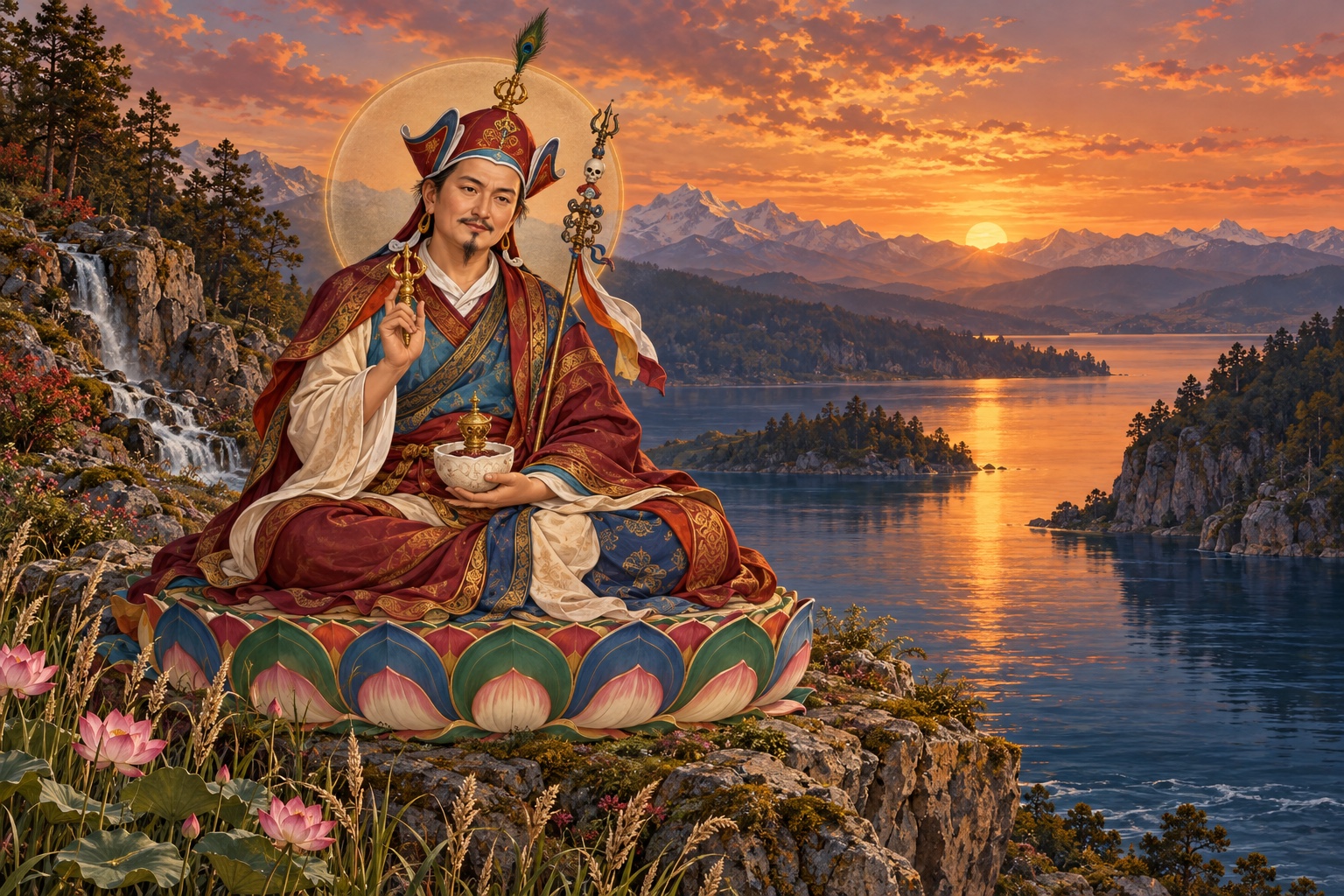
Guru Rinpoche and Padmasambhava refer to the same teacher. You may also encounter Pema Jungné, the Lotus-Born, or Guru Padma while reading about him. Some are translations, some are titles of respect, and others belong to particular accounts of his life and manifestations.
Learning the first few names makes the Seven-Line Prayer easier to follow. It also helps when a book, museum label, and recorded teaching seem to introduce three different people.
The names you will meet first
In their essay for the Rubin Museum's Project Himalayan Art, Daniel A. Hirshberg and Elena Pakhoutova identify Padmasambhava as the Sanskrit name and Pema Jungne as its Tibetan counterpart. They translate Padmasambhava as Lotus-Born and describe Guru Rinpoche as Precious Guru. [1]
- Padmasambhava: the Sanskrit name, often used in books and museum collections.
- Pema Jungné: the Tibetan name, also written Pema Jungne or Pema Jungnay in phonetic English spellings.
- Lotus-Born: the English meaning of the name.
- Guru Rinpoche: a reverential title, commonly rendered Precious Guru or Precious Teacher.
These different labels can appear together. The Metropolitan Museum of Art calls one sculpture The Spiritual Master Padmasambhava and identifies him in its description as Guru Rinpoche. The object is a fourteenth-century copper-alloy sculpture from Western Tibet or Ladakh, with copper and silver inlay, catalogued as 2012.459. [2]
Why “Lotus-Born” matters
The lotus is part of his sacred biography. In the treasure tradition's account summarized by Himalayan Art Resources, he appears on a lotus in Lake Dhanakosha as an emanation of Amitābha. The same catalogue notes a different account within the Nyingma oral tradition, where he is born as the son of a king or minister in northern India. Buddhist accounts of his life therefore do not all begin in the same way. [3]
On this site, The Lotus-Born presents an illustrated traditional account. Read its images and narrative with that designation in mind. A devotional biography communicates how a tradition understands its teacher, including events received as sacred and extraordinary.
What historians can establish
Jacob Dalton's peer-reviewed biography for the Treasury of Lives distinguishes the historical teacher from the extensive literature surrounding him. Dalton reports scholarly agreement that an Indian tantric master named Padmasambhava visited and taught in Tibet in the late eighth century. He identifies tenth-century Dunhuang manuscripts among the earliest surviving evidence for his activities. [4]
Among those manuscripts is Pelliot tibétain 44, which concerns Vajrakīlāya practice and includes an account of Padmasambhava in India and Nepal. Dalton then traces the expansion of the biography through the Copper Palace associated with the twelfth-century treasure revealer Nyangrel Nyima Wozer, and later works. [4]
This chronology helps you ask a precise question of a source. Is it discussing evidence for an eighth-century visit, translating a later sacred biography, or explaining how practitioners approach Guru Rinpoche today? Each can contribute something useful, provided its purpose is clear.
How to recognize the familiar image
In his common form, Guru Rinpoche is usually shown as a mature teacher with a moustache and small goatee. Jeff Watt's iconographic guide for Himalayan Art Resources describes a vajra in the right hand and a skull cup with a long-life vase in the left. A khatvanga staff rests against the left shoulder. His lotus hat is topped with a half-vajra and a feather. [5]
The hands do not always occupy the same positions. Watt identifies common variants with the vajra at the heart, extended toward the knee, or raised at the side. He also distinguishes the familiar main form from specialty and meditational forms. [5]
When viewing an unfamiliar painting, look at the hat, implements, posture, and surrounding figures together. Then check the catalogue description. A single resemblance is a starting point for identification.
Why there are eight manifestations
The names expand beyond translations and honorifics. Hirshberg and Pakhoutova explain how the eight names became a standard set connected with key moments in the sacred life story. Their essay studies a carved stone image dated to the late thirteenth century or later, with a central figure and surrounding manifestations. Some aspects appear as monks or kings; others are fierce. [1]
A newcomer need not memorize every form before beginning to read. When another name appears, check whether it labels the teacher generally or a particular manifestation. Our illustrated account of the eight manifestations offers a next step.
Recognizing him in the Seven-Line Prayer
The prayer's fourth line names the Lotus-Born. Its closing mantra invokes Guru Padma. In a teaching reported on the Karmapa's official website, the first lines are explained as a compact account of Guru Rinpoche's deeds and qualities, followed by the wish to practice according to his example and the request for blessings. [6]
Keep those connections in view while you listen to the prayer. Pema Jungné in the Tibetan line, Lotus-Born in the English translation, and Guru Rinpoche in the introduction all lead you back to the same figure. With the names identified, you can give more attention to what the prayer asks and what following his example might mean.
Sources and further reading
- Daniel A. Hirshberg and Elena Pakhoutova, Padmasambhava and His Manifestations. Project Himalayan Art, Rubin Museum of Art, 2023. Names and the development of the eight manifestations.
- The Metropolitan Museum of Art, The Spiritual Master Padmasambhava. Object 2012.459; fourteenth century, Western Tibet or Ladakh.
- Jeff Watt, Padmasambhava, item 538. Himalayan Art Resources. Catalogue distinguishes oral and treasure-tradition birth accounts.
- Jacob Dalton, Padmasambhava. Treasury of Lives, published 2014, updated 2024. Historical evidence and later biographical development.
- Jeff Watt, Padmasambhava: Iconography. Himalayan Art Resources; main form, attributes, and variants.
- The Seven-Line Supplication to Guru Rinpoche. Official Karmapa website; account of a teaching explaining the seven lines.
Written with AI assistance and checked against the sources linked above. This introduction offers context for visitors; instruction in a lineage's formal practices belongs with a qualified teacher.