
A beginner's guide
How to Use Mala Beads for Buddhist Prayer: A Beginner’s Guide
Understand what to count, why bead totals and handling vary, and how to approach the Seven-Line Prayer with a mala or a simple counter.
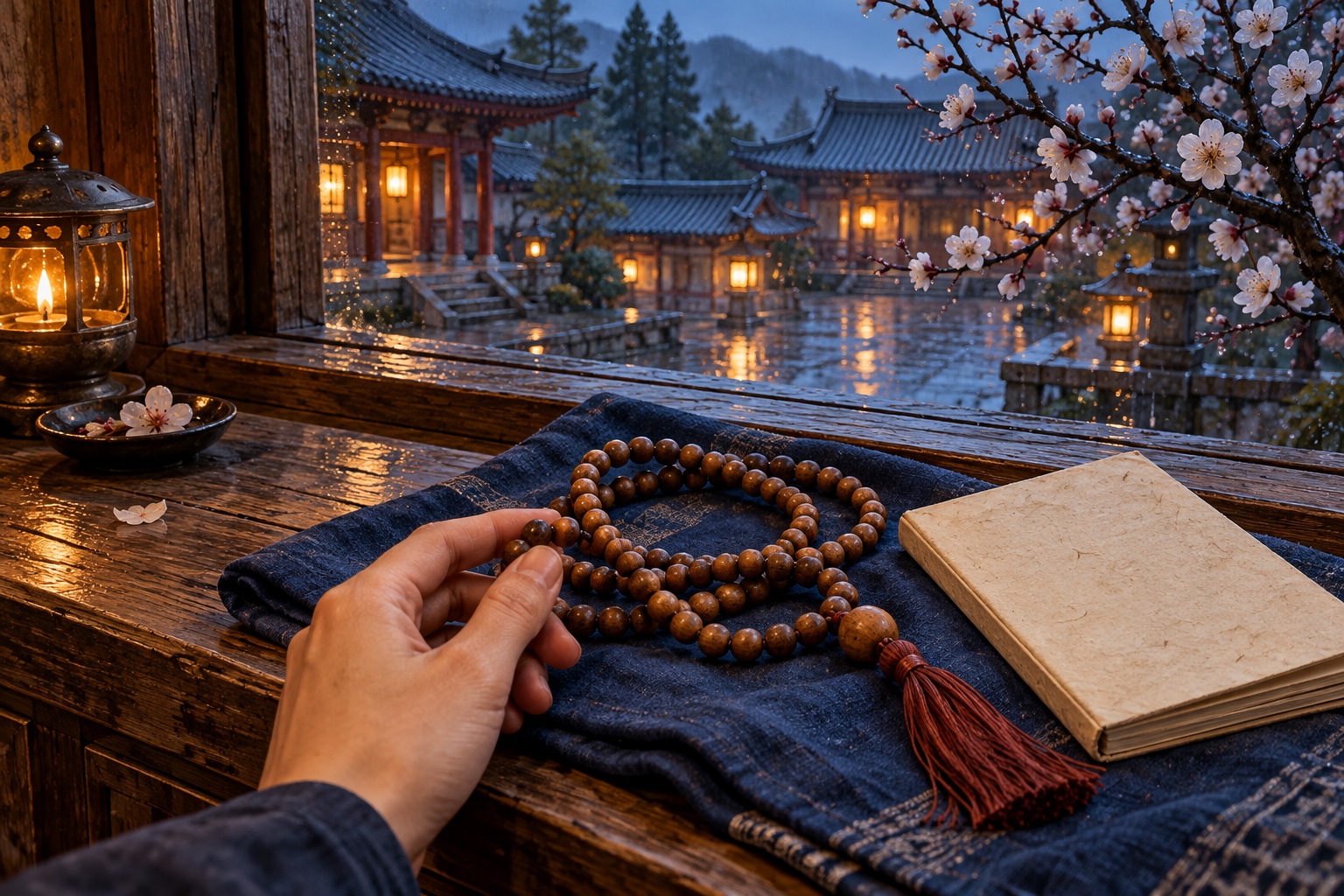
A mala is a strand of beads used to keep count during recitation. The Lama Yeshe Wisdom Archive gives the Tibetan name as threng wa, with the written transliteration phreng ba. Its glossary defines the object by its use: counting mantras. [1]
If you are beginning to learn the Seven-Line Prayer, a mala can help you keep track without repeatedly checking a number on a screen. First decide what you are counting and whether you are learning informally or following a specific practice instruction. That distinction affects the details.
Understand the unit before moving a bead
A complete prayer, a mantra, and a set of verses can each be treated as a unit in different practices. Do not assume that moving a bead after every line is equivalent to counting a complete prayer.
For the informal learning approach on our prayer page, one recitation means going through the prayer, including its short closing mantra. You can mark that complete recitation once on the page's counter or keep an informal tally with beads. A teacher overseeing an accumulation may give a different instruction about what counts and how to record it.
Begin slowly enough to keep the words and the count together. If you are still checking every syllable, leave the counting aside for a session and use the printed text. Learn the sequence before adding another task.
Why people often mention 108 beads
Samye Institute's introduction to Tibetan Buddhist rituals describes a mala with 108 beads and says that practitioners may recite a full round of a mantra. It also makes clear that a person can recite without using a mala. [2]
Physical bead totals and the number recorded for a formal practice are questions to confirm with the relevant teacher. As one example of a different specification, FPMT's The Preliminary Practice of Vajrasattva recommends a mala of 111 beads in its retreat procedures. That instruction belongs to that retreat context. It should not be transferred automatically to every prayer or every center. [3]
If you already own beads, count them once outside the session and note the number. Decorative separators, a terminal bead, and any side counters can make a strand less obvious to count than it looks. Ask how your community uses each part.
Learn the handling from the practice you are doing
Instructions about hands and fingers can be quite specific. In Lama Zopa Rinpoche's 1977 teachings from a nyung nä retreat at Lawudo, the discussion of Kriya Tantra places the beads on the ring finger and describes holding them with the right hand at the heart. The transcript also notes that use of the left hand is acceptable in a cited tradition. [4]
This example explains why an internet instruction presented as the single correct way may conflict with something you see at a center. Ask the instructor to demonstrate the handling for your practice, including what to do on reaching the larger terminal bead. Watch once, then try it slowly while someone can check.
For informal familiarization, avoid pulling hard on the strand or trying to move faster than your recitation. You should be able to hear the words and handle the beads without making either task a struggle.
What the small side counters are for
Some Tibetan malas have additional strings of small counters ending in a tiny vajra or bell. In his teaching on samaya-substance malas, Tulku Migmar explains their use in recording repeated rounds and larger totals. He also discusses a movable clip for keeping track after the side counters have been used. [5]
Those additions serve a counting purpose within a broader ritual setting. If your current aim is to learn the words and recite a few times, you can leave that equipment for later. A simple record will be easier to understand than a counting system you have not learned.
A published accumulation is not a universal entry requirement
The Dudjom Ngondro Program at Pema Osel Ling publishes Lama Sonam Rinpoche's request that prospective ngöndro practitioners accumulate 10,000 recitations of the Seven-Line Prayer. The page explicitly distinguishes a request from a requirement. It also supplies teaching and reading resources. [6]
That is a useful model of how to read a numerical recommendation: identify who gave it, which students it concerns, and whether it is required. A number copied without that information tells a beginner much less.
If you participate in a group accumulation, ask whether to submit literal recitations, completed rounds, or a total calculated according to the group's convention. Keep that convention beside your record so you do not have to reconstruct it later.
Choose the next step that matches your purpose
If pronunciation is your main difficulty, work with one recording and its accompanying text. If you know the words and want to maintain a small daily practice, decide whether a physical strand or the site's counter helps you attend to them.
If you are entering a formal practice, bring the beads you own and ask about materials, handling, counting, and care. A short demonstration can answer questions that several conflicting written guides leave unresolved. The useful mala is the one you know how to use for the practice you are actually doing.
Sources and further reading
- Lama Yeshe Wisdom Archive, mala (Skt). Definition and Tibetan terminology.
- Hilary Herdman, Rituals at Tibetan Buddhist Dharma Centers. Samye Institute, 2022; Malas and Mantras section.
- FPMT, The Preliminary Practice of Vajrasattva. 2010 edition, printed page 164, The rosary. Cited for a retreat-specific bead recommendation.
- Lama Zopa Rinpoche, Visualization and Mantra Recitation. Lawudo, June 1977. Transcript from Ven. Thubten Chodron’s notes; Kriya Tantra handling example.
- Tulku Migmar, Teaching on Samaya Substance Malas. Samye Institute teaching transcript; side counters and a clip for larger accumulations.
- Dudjom Ngondro Program, The Importance of the Seven Line Prayer. Pema Osel Ling; Lama Sonam Rinpoche’s requested, optional preparation for prospective ngöndro practitioners.
Written with AI assistance and checked against the sources linked above. This introduction offers context for visitors; instruction in a lineage's formal practices belongs with a qualified teacher.