
A beginner's guide
What Does Taking Refuge Mean in Buddhism? The Three Jewels Explained
Understand Buddha, Dharma, and Sangha, the intention behind a refuge prayer, and the questions to ask before a formal refuge ceremony.
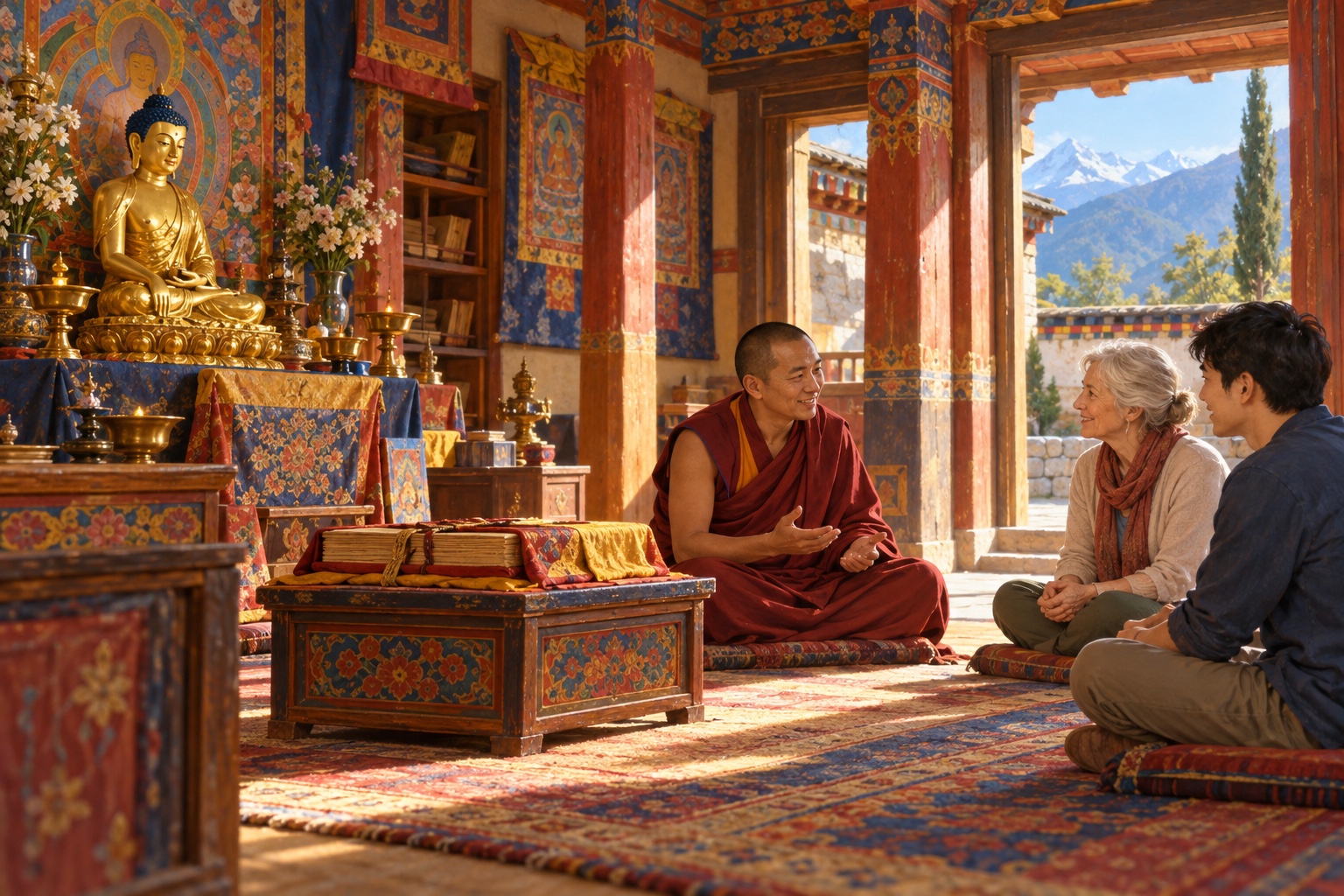
A Buddhist event begins with a refuge prayer. Everyone around you seems to know it. You recognize the word “Buddha,” but wonder what you would be agreeing to if you joined in.
Taking refuge means turning to the Buddha, Dharma, and Sangha as the guiding basis of Buddhist practice. These are the Three Jewels. In Matt Lindén's introduction for Study Buddhism, refuge is an active commitment: one puts the teachings into practice rather than expecting the Buddha or Buddhist friends to do the work on one's behalf. [1] Understanding those three terms helps you follow a prayer and decide what you wish to undertake.
The Buddha: the teacher and the possibility of awakening
In an introductory explanation, the Buddha is the awakened teacher who shows a way beyond suffering. [1] Refuge places confidence in that teaching and its aim. A statue can remind a practitioner of the Buddha, but the object on the shelf and the qualities it represents are different things.
Tibetan commentaries develop this distinction in considerable detail. Dzatrul Ngawang Tenzin Norbu's commentary on the familiar refuge-and-bodhicitta prayer identifies the Buddha as teacher, the Dharma as protection, and the noble Sangha as guides. It distinguishes sources of refuge from their visible representations, including images and written texts. [2]
For an introductory conversation, you might ask a teacher which qualities of the Buddha their refuge instructions emphasize. You will learn more from a particular explanation than from trying to settle every Buddhist account of awakening before attending a class.
The Dharma: teachings you study and a path you practice
“Dharma” can refer to the Buddha's teachings. In refuge commentaries it also has a precise meaning connected with the path and the ending of suffering.
Ngawang Tenzin Norbu discusses both the transmitted teachings and what practice brings about. His account links the scriptural collections with training in ethical discipline, meditation, and wisdom, then explains the Dharma Jewel in terms of the truths of cessation and the path. [2]
This matters when you hear someone say they take refuge in the Dharma. They are expressing reliance on something to learn, examine, and cultivate. Owning a book gives access to words; following its instruction involves decisions about conduct and attention. Lindén's introductory account makes the practical point directly: confidence in the Buddha and supportive companions still leaves each person responsible for using the teachings. [1]
The Sangha: check which meaning is being used
At a local center, “our sangha” often means the community of practitioners. Lindén uses the term broadly for monks, nuns, and Buddhist companions whose practice can encourage others. [1]
In a technical explanation of refuge, the Sangha Jewel can mean noble beings with advanced spiritual attainment. Dodrupchen Jigme Tenpai Nyima's Brief Explanation of Taking Refuge describes noble beings possessing uncontaminated wisdom; it includes several categories rather than equating this Jewel with everyone who attends a center. [3]
Both usages occur in Buddhist settings. A group's welcome email may use the everyday community meaning, while a commentary uses the technical one. Ask which meaning is intended before assuming the passages disagree.
Refuge includes intention
Dodrupchen explains refuge through intention and hope directed toward the Three Jewels as sources of aid and protection. His discussion of “going” for refuge uses the ordinary example of a person intending to drink water: the mind turns toward something on which it means to rely. [3]
This gives you a useful question when reading a refuge prayer: “What am I intending by these words?” You can study the vocabulary before deciding whether you are ready for a formal undertaking. If you are unsure how to participate during a service, speak with the host before it begins.
Ask about the ceremony and the commitments separately
Alexander Berzin notes that cutting a lock of hair and receiving a Dharma name are not essential elements of taking refuge. His explanation also distinguishes refuge training from other vows. [4] Visible features of a ceremony do not tell you everything about its commitments.
FPMT's beginner guide discusses the five lay precepts separately and describes a ceremony in which a participant may take all five, a selection, or none. The listed precepts concern killing, taking what has not been given, sexual misconduct, lying, and alcohol. [5] Ask the teacher how the particular ceremony you plan to attend is arranged.
Useful questions include: Which commitments will be explained? Are lay precepts included? Is there a daily practice afterward? Can someone attend as an observer? Request the explanation in a language you understand, with time to ask about anything unclear.
Where the Seven-Line Prayer fits
The Seven-Line Prayer addresses Guru Rinpoche. A refuge prayer names the sources in which a Buddhist takes refuge. Learning one does not remove the need to understand the other; they serve different purposes in a practice session.
When you find a teacher or visit a center, bring both questions: “How do you explain refuge?” and “How is the Seven-Line Prayer used here?” Their answers can place the prayer you are learning within a broader course of study and practice.
Sources and further reading
- Matt Lindén, What Is Refuge?. An introduction verified and approved by Alexander Berzin.
- Dzatrul Ngawang Tenzin Norbu, Brief Commentary on the Refuge & Bodhichitta Prayer. Translated by Adam Pearcey, 2009; revised version dated 2025. Explains the Three Jewels and their representations.
- Dodrupchen Jigme Tenpai Nyima, Brief Explanation of Taking Refuge. Translated by Adam Pearcey, 2022. See the objects, essence, and literal meaning of refuge.
- Alexander Berzin, Actions for Training from Taking Refuge. Discusses formal refuge, optional ceremonial features, and refuge training.
- FPMT Mandala, Which Vows Are Which? A Beginner’s Guide. June 2006. See the five lay precepts and the choices described for participants in a refuge ceremony.
Written with AI assistance and checked against the sources linked above. This introduction offers context for visitors; instruction in a lineage's formal practices belongs with a qualified teacher.