
A beginner's guide
How to Try Walking Meditation When Sitting Feels Restless
A practical first walking meditation, with specific guidance on pace, turning, attention, and why Buddhist teachers give different breathing instructions.
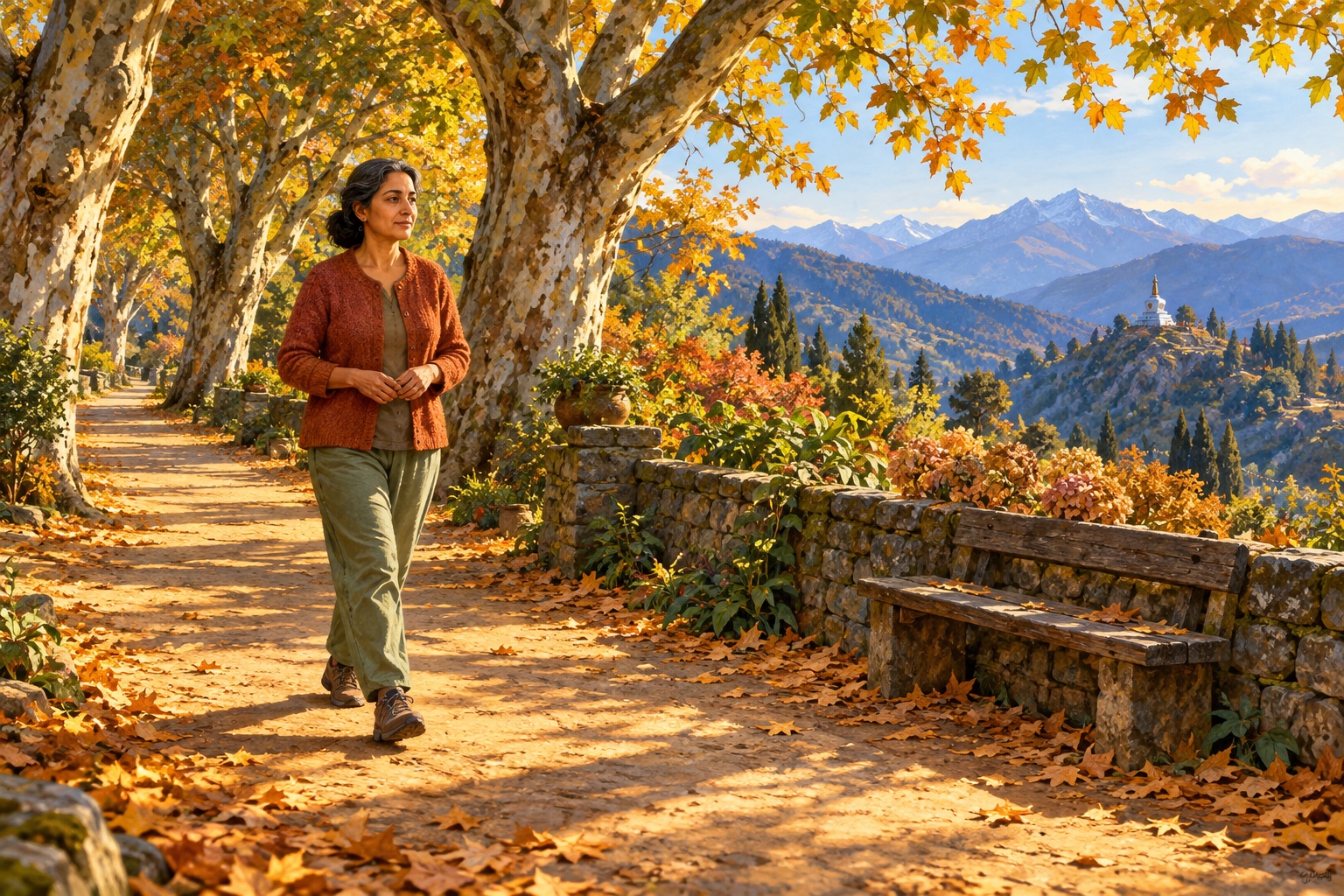
You sit down to meditate and spend the next few minutes shifting your knees, checking the clock, and planning an errand. A walking practice gives you another posture to try. You can attend to movement without waiting until you feel settled enough to sit.
Walking meditation has a place in Buddhist practice independent of anyone's difficulty with cushions. In the Satipaṭṭhāna Sutta, awareness of walking appears alongside awareness of standing, sitting, and lying down. The instruction concerns knowing what the body is doing. [1] A beginner can start with that modest task: know the next few steps as they happen.
Choose a place where you can pay attention
A level stretch of garden path or an uncluttered corridor gives you a beginning and an end. Check the surface, remove obstacles, and choose somewhere you can turn without stepping into other people. Keep your eyes open while moving. Traffic crossings, uneven trails, and crowded pavements demand attention to navigation; choose a simpler setting for your first attempt.
In With Each & Every Breath, Thanissaro Bhikkhu suggests a path of 20 to 70 paces, straight if possible, with an L or U shape as an alternative. He allows a normal pace or a slightly slower one. His instructions also acknowledge that some people find sitting easier after walking, while others carry the steadiness of a sitting session into their walk. [2]
You need not obtain a garden of that length before trying a few attentive steps. In a smaller room, turns will come more often. Notice whether the space allows comfortable movement; do not shorten your stride into an awkward performance to make it look meditative.
Follow one set of instructions at a time
Teachers differ on the relationship between walking and breathing. Plum Village invites practitioners to coordinate them gently: perhaps two or three steps on an inhalation and three or four on an exhalation, depending on their natural rhythm. Its guidance includes feeling the feet touch the ground and allowing awareness of the whole walking body, nearby sounds, and the landscape. [3]
Thanissaro's April 2025 instructions offer a different approach. Choose the breath or the feet as your main object; there is no requirement to synchronize them. For attention to the feet, a simple mental word can accompany each step, such as “left” and “right.” He also gives the traditional meditation word Buddho, divided between successive steps. [4]
These are identifiable teaching choices. If counting steps per breath makes you strain, you can use the feet as your object and leave breathing alone. If you attend a guided session, follow that teacher's method long enough to understand it before adding instructions from another source.
A short first session
The following five-minute outline is a suggested starting arrangement for this article, using attention to the feet. The duration is a convenient trial length, not a traditional requirement.
- Stand at your starting point. Notice where your shoes or bare feet meet the surface. Let your hands rest in a comfortable position.
- Begin at an easy pace. Feel one foot leave the ground and the other receive your weight. You can use the mental labels “left” and “right” if they help you remember the task.
- Know when attention has wandered. If you discover you have been rehearsing a conversation, return to the next footfall. There is no need to reconstruct every step you missed.
- Include the turn. At the end, stop, notice your posture, turn with care, and begin again. Let that brief pause remind you what you are practicing.
- Finish standing. Feel both feet on the ground before checking your phone or starting another activity.
Adjust the length to your circumstances. If walking is uncomfortable or unsuitable, the early discourse also includes standing, sitting, and lying down. [1] A particular way of moving is not an entrance examination for Buddhist practice.
Notice what happens at the end of the path
Turns offer a useful point of observation. Perhaps you forget the exercise as soon as you turn, or hurry toward the far end as though finishing the length were the assignment. Try beginning each length with a clear intention to stay with your chosen object until the next turn. That is how Thanissaro frames the task in his 2025 teaching. [4]
Afterward, make one specific observation: “I remembered my feet more often on the return,” or “I rushed when I heard someone approaching.” This gives you something to explore next time. You do not need to decide whether you achieved a special state.
Give prayer its own moment
If you are exploring the Seven-Line Prayer, you could finish your walk, sit down, and read its translation once. That arrangement lets you give the words your full attention without juggling a prayer sheet, watching your route, and counting steps at the same time.
The walking instructions above come from the sources named here. Adding a reading afterward is an optional way to arrange your time, rather than a claim that those teachers prescribed a Seven-Line Prayer walking practice.
Sources and further reading
- Satipaṭṭhāna Sutta, MN 10. Translated by Thanissaro Bhikkhu. See the section on the four postures.
- Thanissaro Bhikkhu, With Each & Every Breath: Basic Instructions. See Walking Meditation for path length, pace, and the relationship between sitting and walking.
- Plum Village, Walking Meditation. Instructions from the Plum Village tradition, including natural coordination of breathing and steps.
- Thanissaro Bhikkhu, Q & A, April 24, 2025, Afternoon. Desires for the End of Desire. Includes choosing feet or breath, optional mental labels, and intention for one length of the path.
Written with AI assistance and checked against the sources linked above. This introduction offers context for visitors; instruction in a lineage's formal practices belongs with a qualified teacher.