
High above the forests of Kongpo, in south-eastern Tibet, there was once a small hermitage whose door had been sealed shut with clay. Behind it, the old accounts say, a monk practised alone for seventeen years.
His name was Jatsön Nyingpo, "Rainbow Essence." He lived from 1585 to 1656, and he is remembered for a treasure called the Könchok Chidü, "the Union of the Precious Ones," a cycle of teachings with Guru Rinpoche at its heart. This is his story, told as simply as I can from the sources.
A child of Kongpo
Guru Rinpoche, Padmasambhava, is the "Lotus-Born" master to whom the Seven-Line Prayer is addressed. The tradition holds that in the eighth century he and his disciple Yeshe Tsogyal hid teachings to be found in later ages. These hidden teachings are called terma, "treasures," and those who reveal them are tertöns, treasure revealers.
Jatsön Nyingpo was born in 1585, the Wood Bird year, at a place called Waru Namtsal in Kongpo, a green land of forests and rivers. His father was Chökyong Gönpo and his mother Namlang Butri. Jamgön Kongtrul, the nineteenth-century master who gathered the lives of the treasure revealers, regards him as the rebirth of Nyang Tingdzin Zangpo, one of Guru Rinpoche's own disciples in the days of the old Tibetan kings.
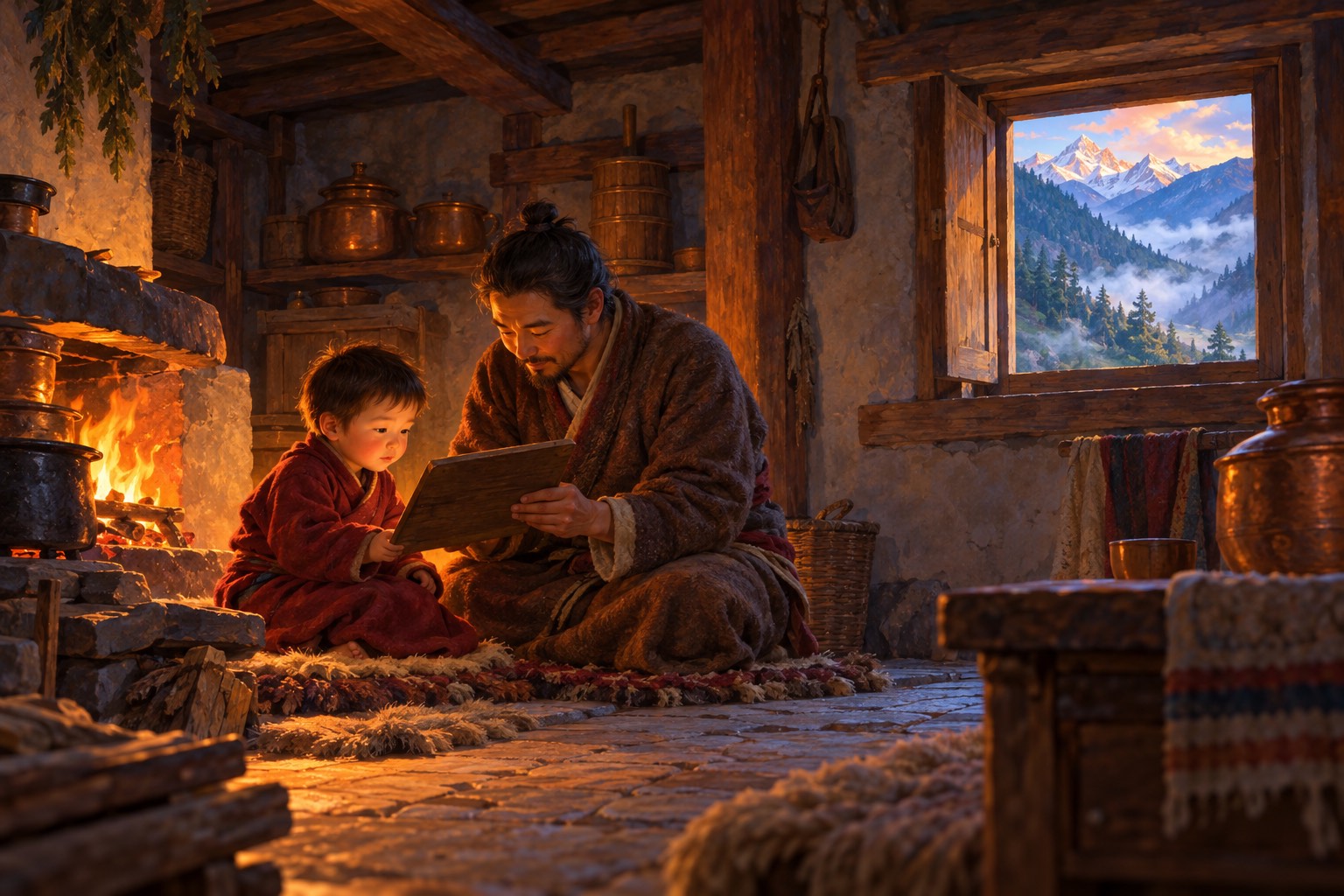
Kongtrul says the boy loved the Dharma, the Buddha's teaching, from his earliest years, and that by the age of three he could read letters after only being shown them. He adds that the child left many prints of his hands and feet in stone, a kind of sign the tradition often tells of its saints.
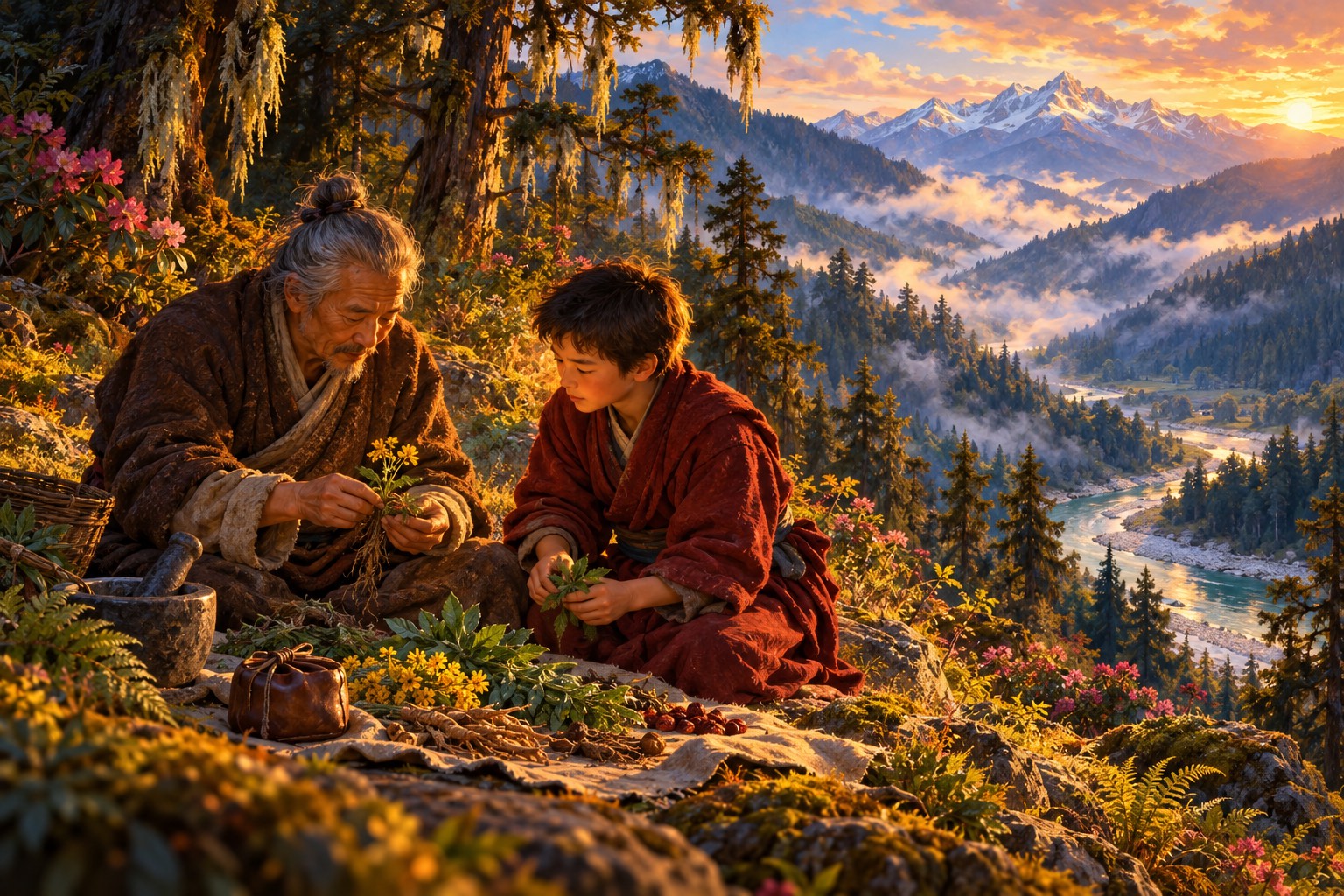
From twelve until twenty he studied hard, and above all he studied medicine, the healing science of Tibet, until he became skilled in it.
The pull of the Guru
During those same years, Kongtrul writes, the young man met Orgyen Rinpoche again and again, sometimes in waking experience and sometimes in dreams. Orgyen Rinpoche, "the Precious One from Oddiyana," is another name for Guru Rinpoche.

A strong wish to be free of worldly life rose up in him, together with a deep sadness at its sufferings. Kongtrul says he came to see home, friends and every ordinary comfort as a pit of fire, and that he fled to the Dharma.
He went to a master named Mipham Tashi Lodrö. The account tells a gentle story here: around the time the young man came, the lama dreamed that some women brought him an old stupa built by Guru Rinpoche and asked him to consecrate it again. When he did, it blazed with light, and he understood that a fortunate student was coming.
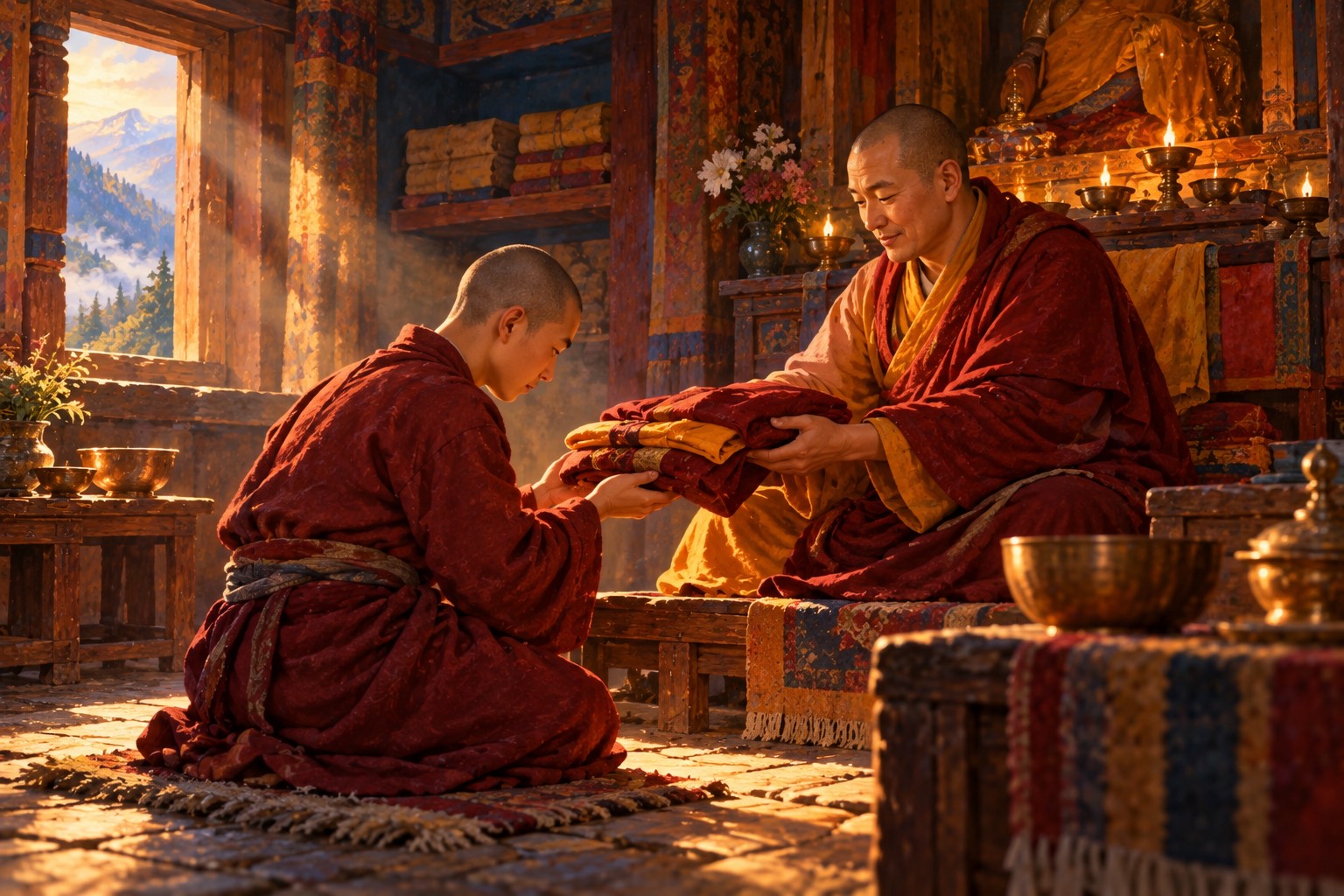
Mipham Tashi Lodrö ordained him and gave him the name Ngawang Chögyal Wangpo. Later he received full ordination as a gelong, a fully ordained monk, from a master called Lhatsewa. He studied with many other teachers too, in both the older and newer schools of Tibet.
The Treasury of Lives notes that he was one of the few treasure revealers who was a fully ordained monk. Many tertöns lived as lay yogis with families. Jatsön Nyingpo kept his vows all his life, and Kongtrul says he guided his students in the same simple, disciplined way.
Seventeen years behind a sealed door
Then he went into retreat. For seventeen years, the accounts say, he stayed in sealed retreat, the door of his hermitage closed with clay.
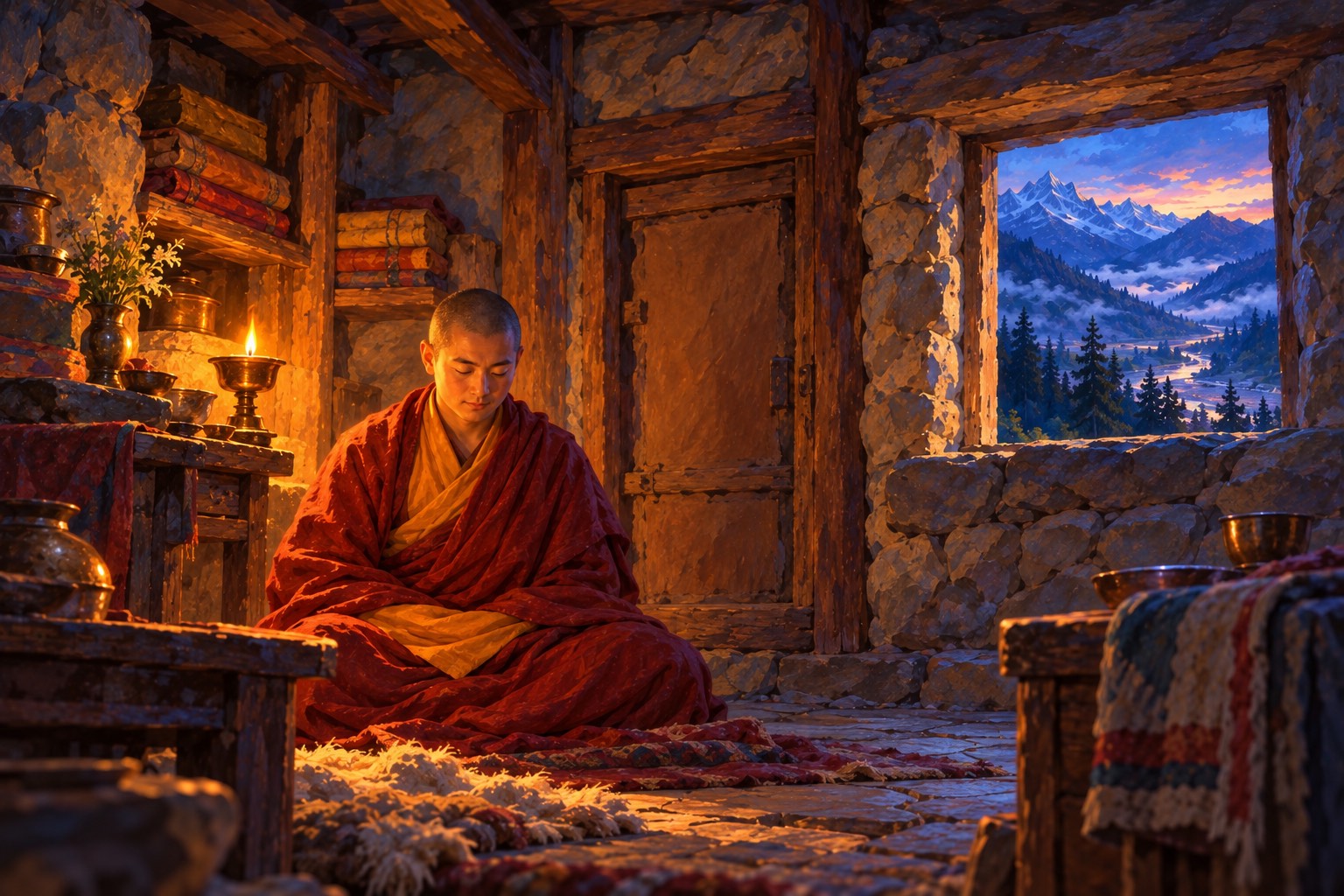
Kongtrul tells us that prophecies about treasures came to him many times in those years, and that he paid them no attention. He simply kept practising. When he had completed a vast number of recitations for Vajrapani, a bodhisattva of awakened strength, his teacher Mipham Tashi Lodrö urged him to act at last.
A little bird of metal
So, in the Iron Monkey year, 1620, on the tenth day of the first month, he took up his first treasure. Kongtrul says that from inside a tiny metal bird, no bigger than a sparrow chick, came a treasure list in Yeshe Tsogyal's own hand. He was thirty-six.
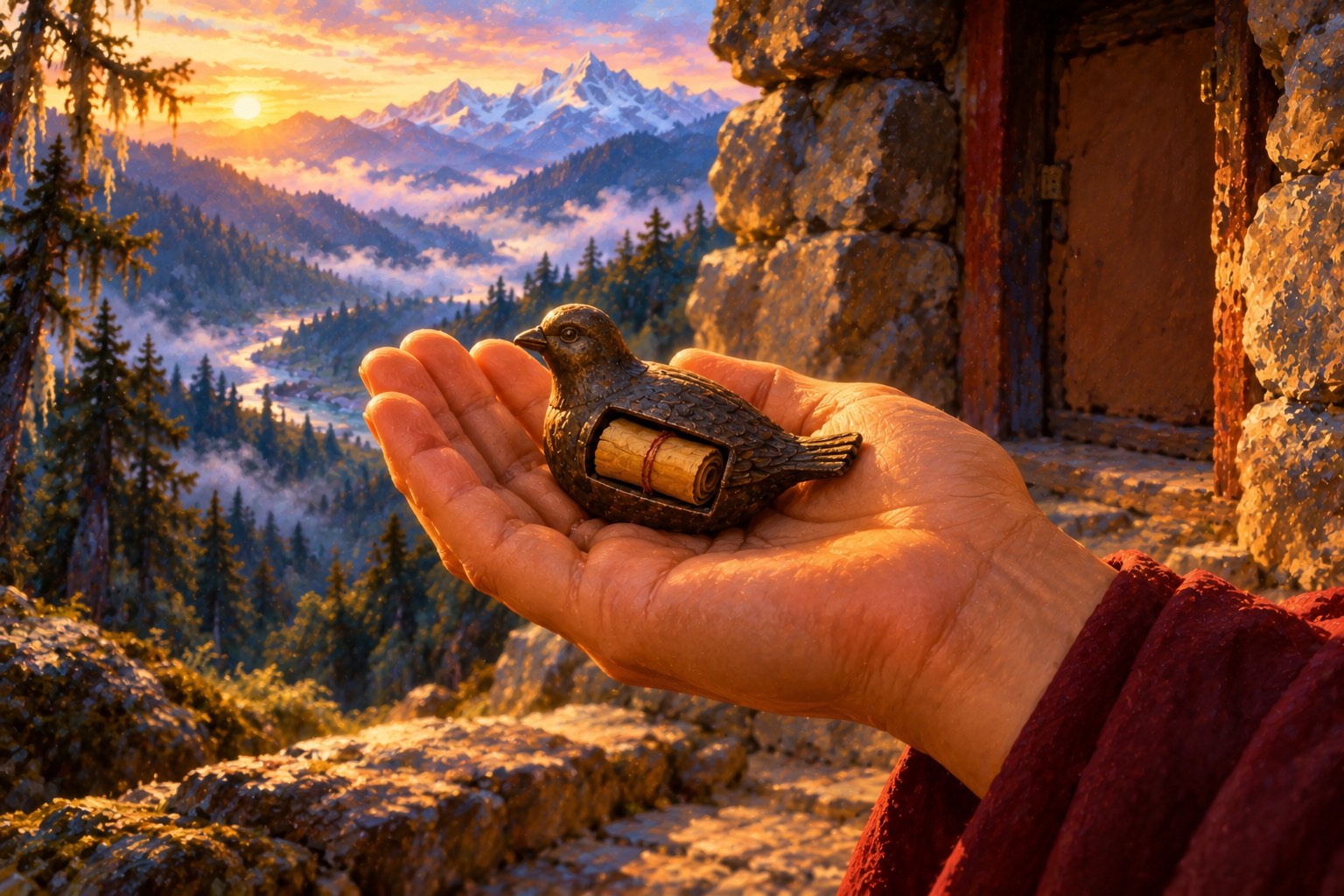
Following that list, at a rocky place Kongtrul calls Draklung Homtrang, at what he names an "iron gate," Jatsön Nyingpo received the Könchok Chidü. The Treasury of Lives dates the find to the time of his retreat or soon afterwards; the sources do not agree on every detail of the timing, and I have not tried to settle it.

Translators render the name in several ways: "the Union of the Precious Ones," "the Embodiment of the Three Jewels," or "the Universal Embodiment of the Precious Ones." Rigpa Wiki describes it as a practice concentrating on Padmasambhava. It is meant to be received from a qualified teacher, so this page names it and says nothing of its practices.
Kongtrul says it was a secret treasure. Jatsön Nyingpo first practised it fully himself and kept it sealed for a time, before sharing it with others.
A horse on the cliff
Over the years he revealed many more treasures in Kongpo and beyond. Most were found openly, before crowds; only a few, like the Könchok Chidü, were secret. Kongtrul tells one story with real relish.
At a mountain called Nyemo Lhari, some local people feared that taking out a treasure would drain the goodness of their land, so they set armed men to guard the spot. Then, the account says, the tertön rode his horse straight up a sheer cliff as smooth as a mirror, where not even a bird could climb, leaving hoofprints in the rock. He took the treasure in an instant and rode away. The guards stood stunned, and later, Kongtrul says, they came to have faith.

This is the tradition's way of telling us about his strength of mind. I pass it on as Kongtrul tells it.
A house of practice, and many students
He founded a retreat centre at Bangri Jokpo, a sacred place that he himself opened, on high and secluded ground. Kongtrul says it was still kept up in his own day by the master's family line and his reincarnations. So he is often called Bangri Rigdzin, "the awareness-holder of Bangri."
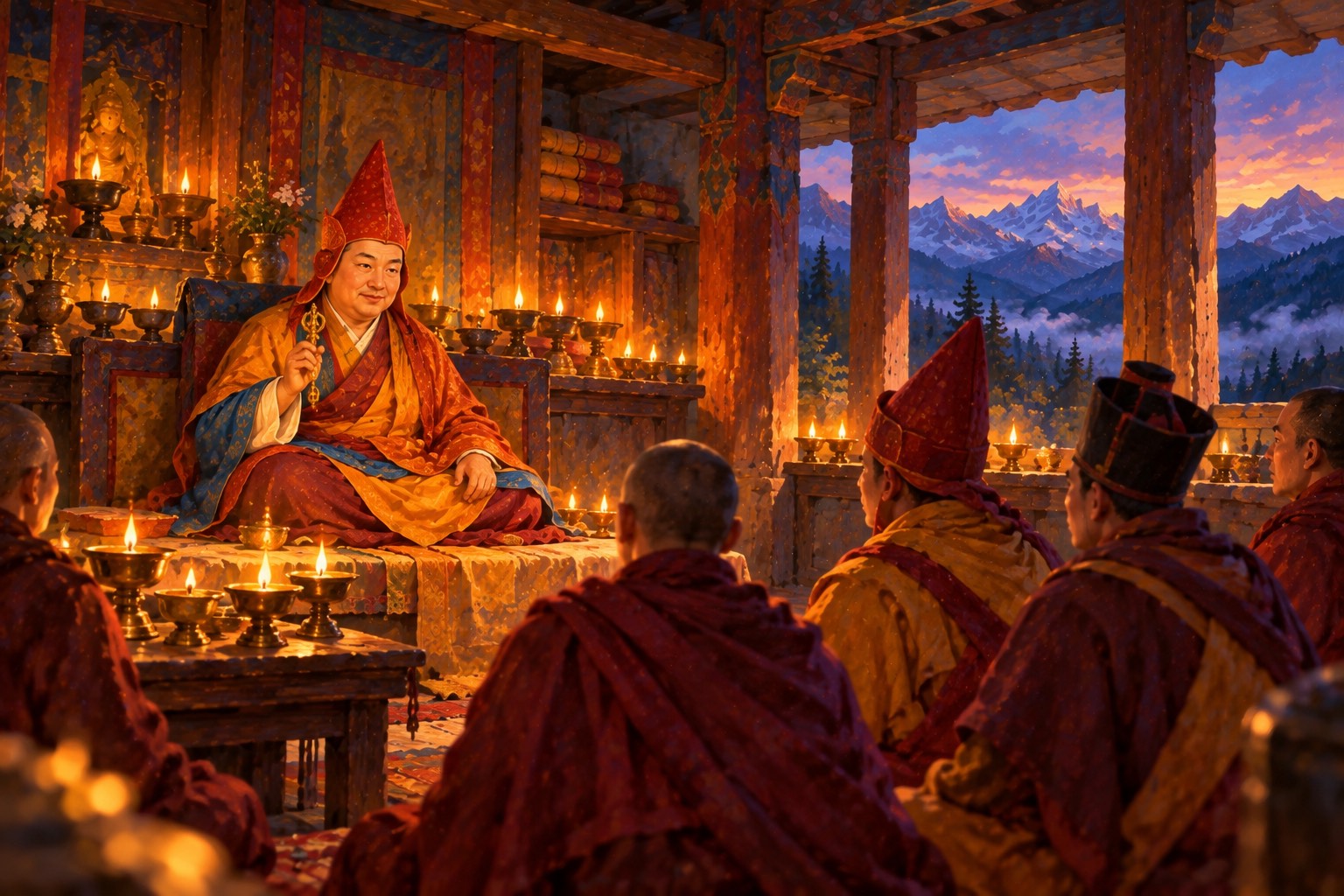
His students came from many traditions. Kongtrul and the Treasury of Lives name leaders of the Kagyu schools: the Karmapa and the Shamarpa of the Karma Kagyu, Gyaltsab Drakpa Döndrub, Chökyi Drakpa of Drigung, and Paksam Wangpo, head of the Drukpa Kagyu. They also name the Nyingma master Rigdzin Ngagi Wangpo of Dorje Drak, the meditation teacher Tsele Natsok Rangdrol, and Lhatsün Namkha Jigme, who is remembered for opening the hidden valleys of Sikkim.
Some of these masters were older than he was, so "student" here means those who received his treasures, not always the young sitting before the old.
One student was a young treasure revealer named Düddul Dorje. Rigpa Wiki says that in troubled times Jatsön Nyingpo sent him toward Pemakö, a hidden valley in the great gorges of the Tsangpo river, to open the way there. Jatsön Nyingpo had himself revealed one of the first guidebooks to that land.

How the treasure travelled
Düddul Dorje later settled at Katok, an old Nyingma monastery in eastern Tibet. Katok's own history says he had received the entire treasure lineage of Jatsön Nyingpo, and that his treasures, with those of his student Longsal Nyingpo, became central to Katok. A Könchok Chidü lineage prayer by the Katok master Rigdzin Tsewang Norbu runs through both of them.
Among Düddul Dorje's disciples, the same history names Rigdzin Kunzang Sherab, the founder of Palyul Monastery, and the Rangjung Yeshe Wiki lists Jatsön Nyingpo's treasures among the practices of the Palyul tradition. Through the Kagyu masters who received it, the cycle also took root in the Kagyu schools.
Kongtrul gives the most moving witness. He says he received all six volumes of the master's treasures, held the Könchok Chidü as the heart of his own daily practice, and saw signs of its blessing. He also writes, as I read him, that the circumstances of this treasure's discovery were not the most fortunate kind, yet because Jatsön Nyingpo's aspiration and training were so strong, and because he practised his treasures to the end, they spread widely without regard to school.
Jatsön Nyingpo died at Bangri Jokpo in 1656, at seventy-two by Tibetan reckoning. The accounts say that signs and wonders were seen, and that he passed knowingly into a pure realm.
What remains
I found no source linking Jatsön Nyingpo or the Könchok Chidü to the Seven-Line Prayer itself, so I will not claim one. What joins them is simpler: both turn the heart toward Guru Rinpoche. One small thread is that Kongtrul also asked for a regular practice and offering on the tenth day of the month, the day the tradition keeps for Guru Rinpoche. If the Könchok Chidü calls to you, that is a door to open with a teacher, and the Find a Teacher page can help.
About the art
Jatsön Nyingpo is drawn from two traditional paintings on Himalayan Art Resources that agree closely: a nineteenth-century painting from eastern Tibet in the Rubin Museum of Art (item 1035, also the portrait on his Lotsawa House page) and a painting sold at Christie's in 2024 (item 25087). Both show a round, gentle face, a tall red pointed hat with side flaps of the kind often called a pandita hat, the layered red, orange and yellow robes of a fully ordained monk, a small vajra raised in the right hand, and in the left hand a phurba, a short three-sided ritual dagger, whose handle in these paintings takes the shape of a black scorpion. On this page the dagger is kept small and simple, and it appears only in the portrait, never in use.
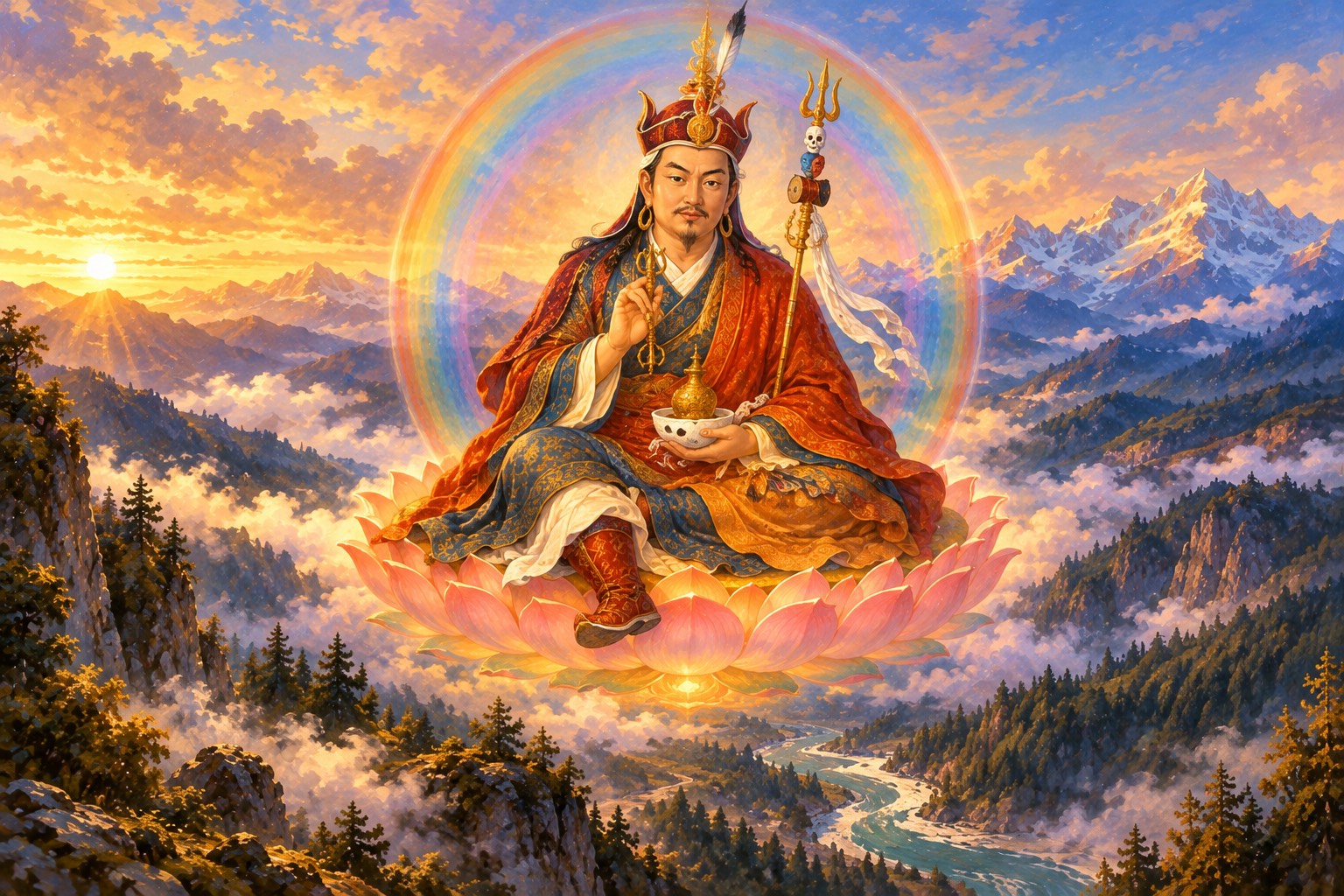
The vajra (dorje) is a ritual sceptre with five curved prongs at each end, a symbol of what cannot be broken. In the scenes of his youth he wears no hat: first a village boy's plain wool robe, then, from his ordination, the shaved head and maroon and saffron robes of a monk. Guru Rinpoche appears twice, small in a dream and once in his main form, with the lotus hat, vajra, skull cup holding a long-life vase and the staff called the khatvanga, within a sphere of rainbow light.
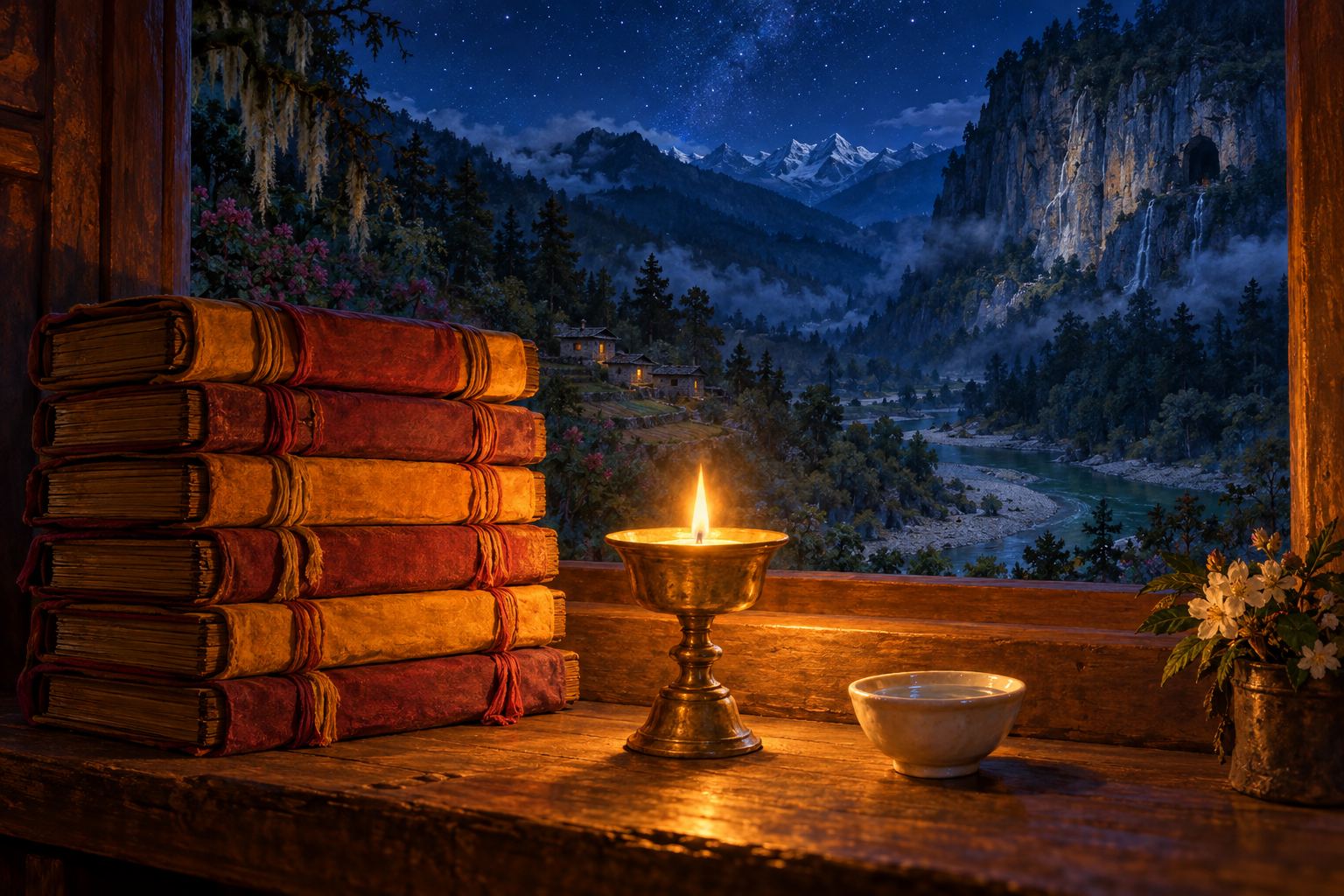
Kongpo is shown as it is, green, forested and misty. No photographs or descriptions were available for the gorge at Draklung Homtrang, the cliff at Nyemo Lhari or Bangri Jokpo, so those places are careful reconstructions. Düddul Dorje is suggested by a generic figure of a lay treasure revealer seen from far away. Books are shown as Tibetan pecha, loose leaves between boards wrapped in cloth, and no writing appears anywhere. The practices of the Könchok Chidü are not pictured.
Why this matters for practice
Jatsön Nyingpo's great treasure gathers everything around Guru Rinpoche, the same master the Seven-Line Prayer calls on. His life shows a steady, unhurried kind of devotion: years of quiet practice, prophecies set aside, and a treasure shared only after he had lived it himself. You do not need seventeen years in retreat to begin; reciting the prayer once is already a way of turning toward the same blessing.

If something in this story stayed with you, perhaps the young man who saw the world as a pit of fire, or the seventeen quiet years behind a sealed door, you might pause here and recite the prayer once. No retreat is needed, only a moment and a willing heart.
Sources and further reading
- Jatsön Nyingpo (Letro Lingpa), from Jamgön Kongtrul's Lives of the Hundred Tertöns (Rinchen Terdzö vol. 1, pp. 501–507), Tibetan text with a Treasury of Lives excerpt, Tsadra Foundation, Khyentse Lineage wiki (via web.archive.org)
- Teacher: Jatson Nyingpo (set page with biography extracted from the Treasury of Lives), Himalayan Art Resources
- Teacher (Lama) – Jatson Nyingpo, item 1035 (Rubin Museum of Art P2001.10.1) and item 25087 (Christie's, New York, 2024), Himalayan Art Resources
- Jatson Nyingpo (person page), Treasury of Lives (via web.archive.org)
- Jatsön Nyingpo; Könchok Chidü, Rigpa Wiki (via web.archive.org)
- Jatsön Nyingpo Series (author page), Lotsawa House
- Könchok Chidü Lineage Prayer, by Katok Rigdzin Tsewang Norbu, trans. Adam Pearcey (2022), Lotsawa House
- Duddul Dorje, Kathok Nyingma Buddhist Centre, Singapore (Katok history pages)
- Palyul Monastery, Rangjung Yeshe Wiki (via web.archive.org)
- Gyamtso, L. M., Rainbow Essence: The Life and Teachings of Jatsön Nyingpo (KTD Publications, 2017)
This retelling is waiting to be read by a knowledgeable practitioner. Where the traditional accounts differ, the story says so; if you notice a mistake, please tell us through Share Your Story.