
On a mountain in southern Tibet, almost seven hundred years ago, a boy of fifteen is said to have brought a hidden teaching into the light. Centuries later it would travel around the world under a name he never knew: the Tibetan Book of the Dead.
The boy is remembered as Karma Lingpa. This is his story, and the story of his book, told as gently as I can. If you have come here because someone you love has died, or because you are thinking about death, you are very welcome. Nothing on this page asks anything of you.
A treasure hidden in the hills
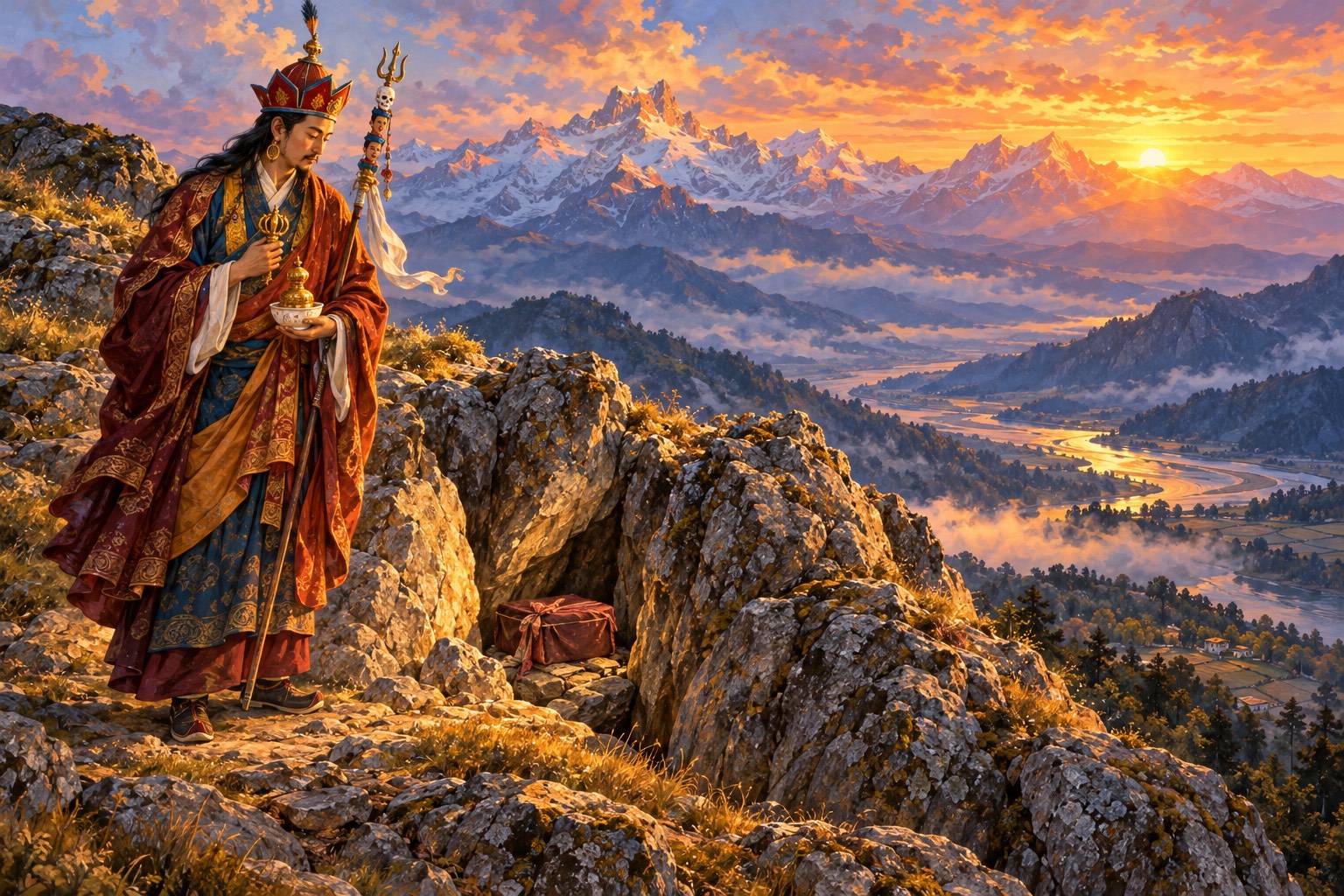
The tradition says the teaching began in the eighth century with Guru Rinpoche, Padmasambhava, the "Lotus-Born" master to whom the Seven-Line Prayer is addressed. He gave it, his disciple Yeshe Tsogyal wrote it down, and it was hidden in the Gampo hills of Dakpo, in southern Tibet.
Teachings hidden in this way are called terma, "treasures." The tradition holds that Guru Rinpoche concealed many of them in rocks, lakes and the minds of his students, to be found by tertöns, treasure revealers, when the time was right.
It also says the future finder was present at the hiding. Karma Lingpa is remembered as the rebirth of Chokro Lui Gyaltsen, one of the Tibetan translators who studied with Guru Rinpoche.
A boy from Dakpo
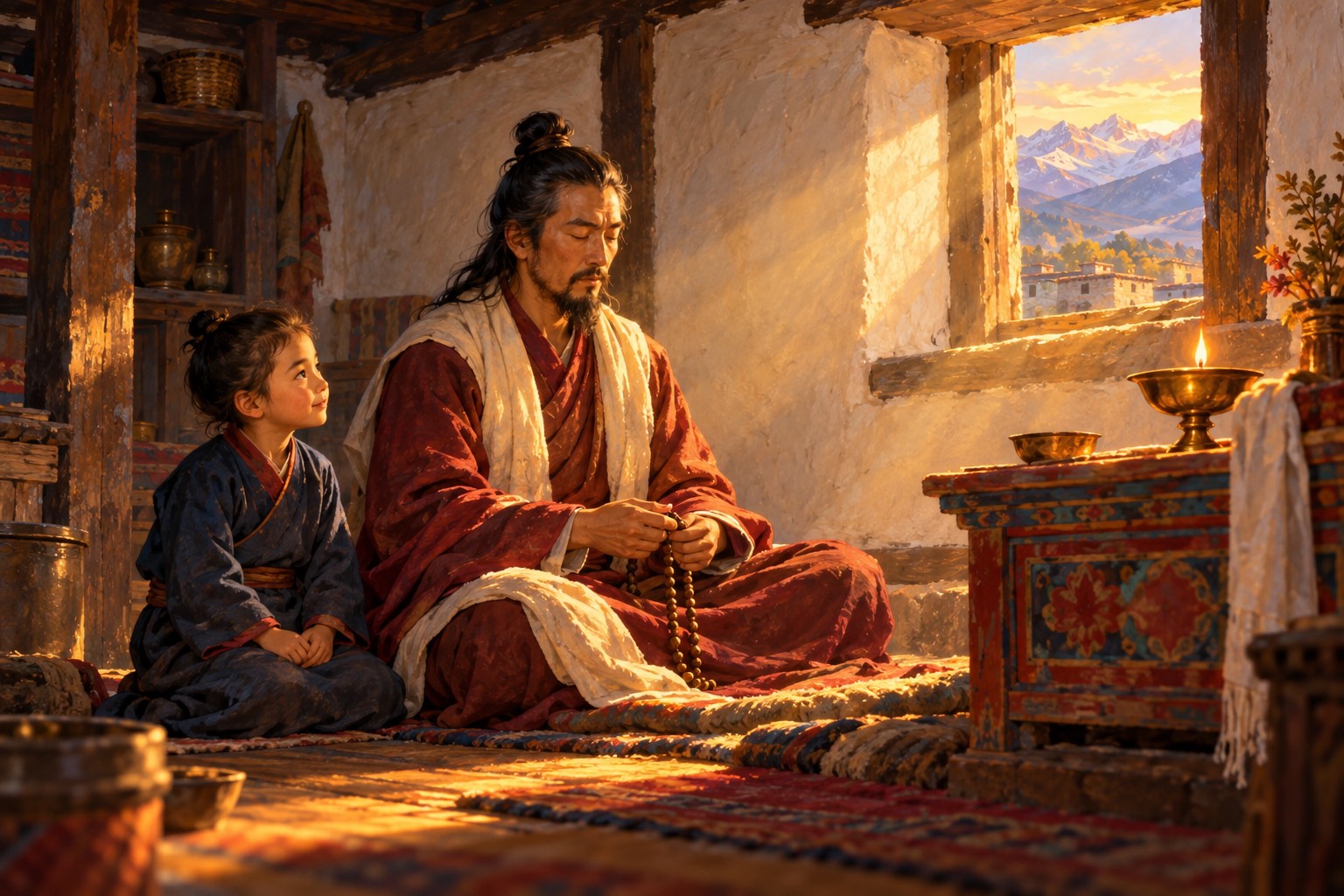
The nineteenth-century master Jamgön Kongtrul, who gathered the lives of the treasure revealers into one great collection, says Karma Lingpa was born in Upper Khyerdrup in Dakpo. He was the eldest son of Nyida Sangye, a respected yogi.
His father is remembered too. A teaching he revealed on phowa, a practice connected with the moment of death, later became the basis of a great gathering held by the Drikung Kagyu monasteries. Care for the dying, it seems, ran in the family.
Karma Lingpa did not become a monk. Kongtrul calls him a mantra holder, a ngakpa: a lay practitioner of the tantras who lived as a householder.
His dates are uncertain. Many books give 1326 to 1386; the Treasury of Lives, a scholarly online encyclopedia of Tibetan lives, places him simply in the fourteenth century.
The mountain like a dancing deity

When he was fifteen, Kongtrul writes, the prophecies and the right circumstances came together. On Gampodar, a mountain whose shape is said to resemble a dancing deity, he brought several treasures to light.
The same hills were already holy. Two centuries earlier, Gampopa, the great Kagyu master, had founded his monastery of Daklha Gampo there, and Gampodar lies within its lands.
Among the treasures was a large cycle called the Zhitro Gongpa Rangdrol, "the Self-Liberated Wisdom of the Peaceful and Wrathful Deities," often shortened to Karling Zhitro, "Karma Lingpa's Peaceful and Wrathful." In the tradition's view, these deities are the forms in which the mind's own awakened nature can appear. Their practices are received from a teacher, not from a page, so this story leaves them there.
Inside the cycle was the text that would become famous: the Bardo Tödrol Chenmo, "the Great Liberation through Hearing in the Bardo."
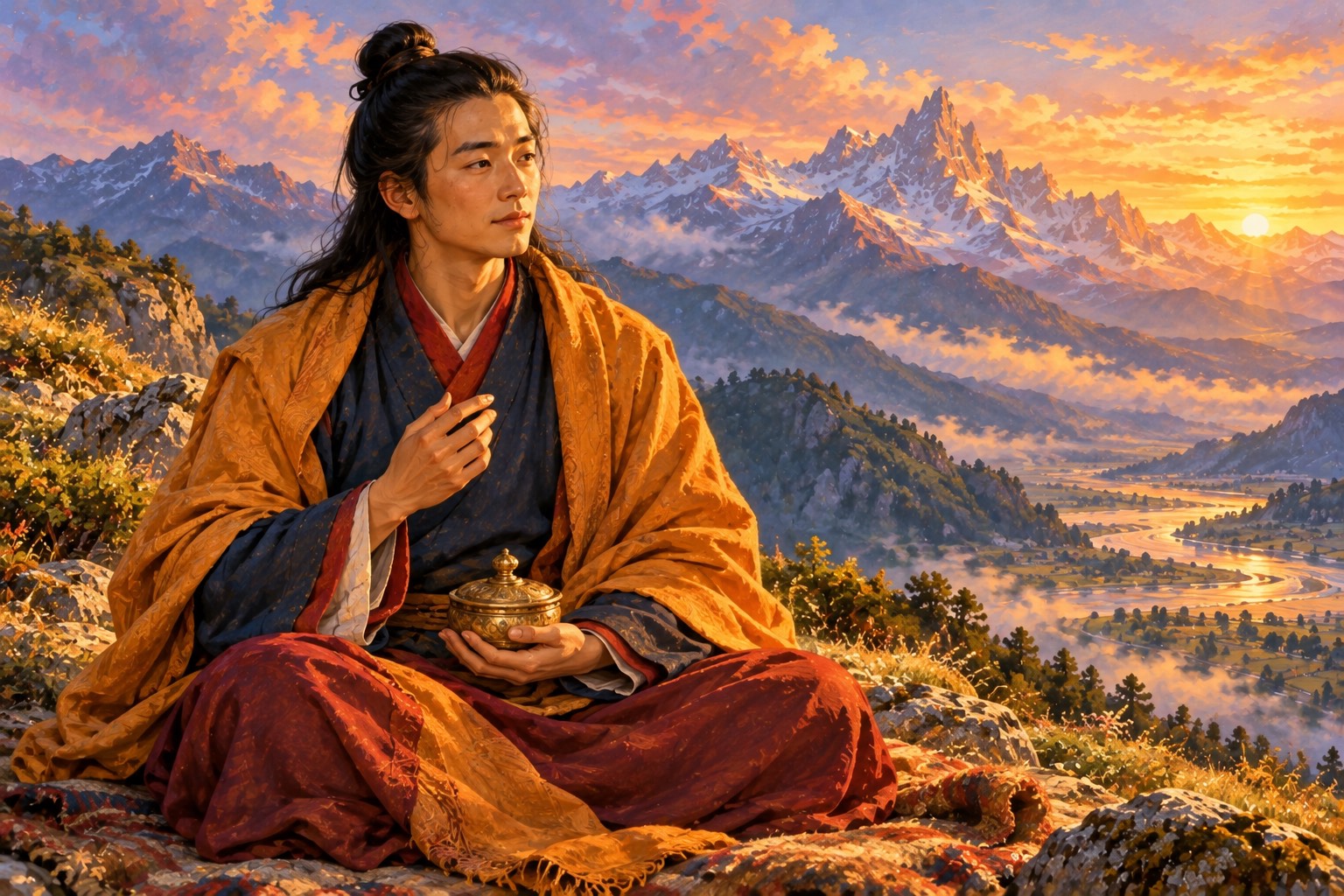
An eighteenth-century painting now in the Rubin Museum shows him as later artists pictured him: a young layman with his hair tied up on his head, a saffron shawl over a dark gown, one hand raised as if speaking, and in his lap a small golden casket, the sign of a treasure revealer.
What the bardo is

Bardo means "in between." Rigpa Wiki, a Buddhist reference site, describes it as a gap: the space after one situation has ended and before the next begins.
Most often the word means the time between death and the next birth. But the teachings say there are bardos all through life. Karma Lingpa's own root verses name six: this life, dreams, meditation, dying, the luminous nature of reality, and becoming, the stage before a new birth.
In the tradition's view, each in-between is also an opening. When the familiar has fallen away and the next thing has not yet arrived, the mind is said to be unusually open, and its true nature unusually close.
So the Liberation through Hearing is not, at heart, a book only about death. It is a book about passages, and about how a steady, familiar voice reading aloud can keep someone company through one.
How it is used belongs with teachers. If you would like to care for a dying or departed loved one in this way, a qualified lama is the right guide, and the Find a Teacher page can help you look for one.
A secret kept in one line
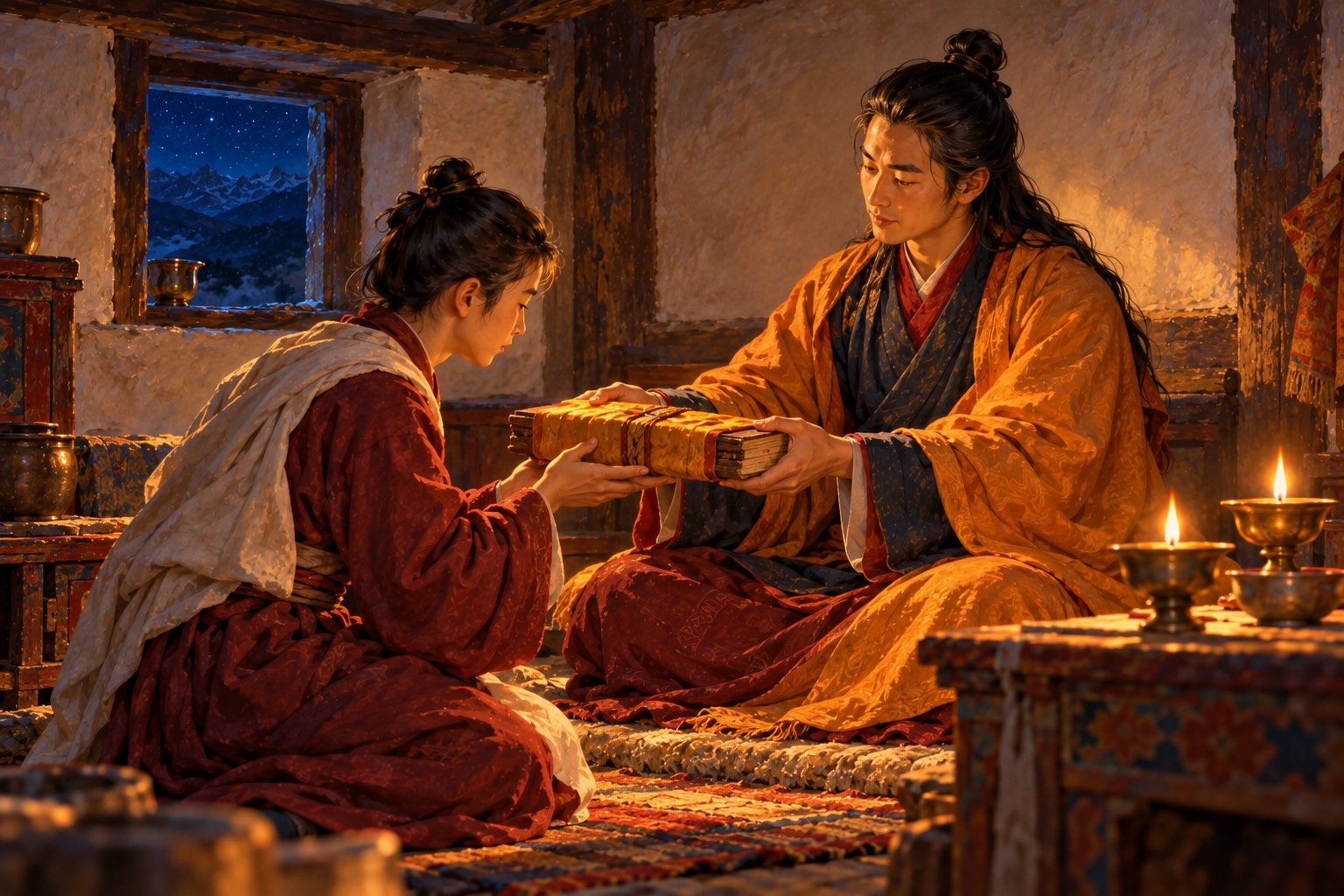
Kongtrul says Karma Lingpa gave part of his treasures to fourteen close disciples. But the Self-Liberated Wisdom cycle he gave to his son, Nyida Chöje, alone, and sealed it: for three generations it was to pass from one holder to one holder only.
His own life, Kongtrul adds, ended before every foretold circumstance could come together, including his meeting with the companion prophesied for him. Modern historians who have read the old life stories believe he died young and that his end was a sorrowful one. The details are uncertain, and it seems kindest to leave them there.
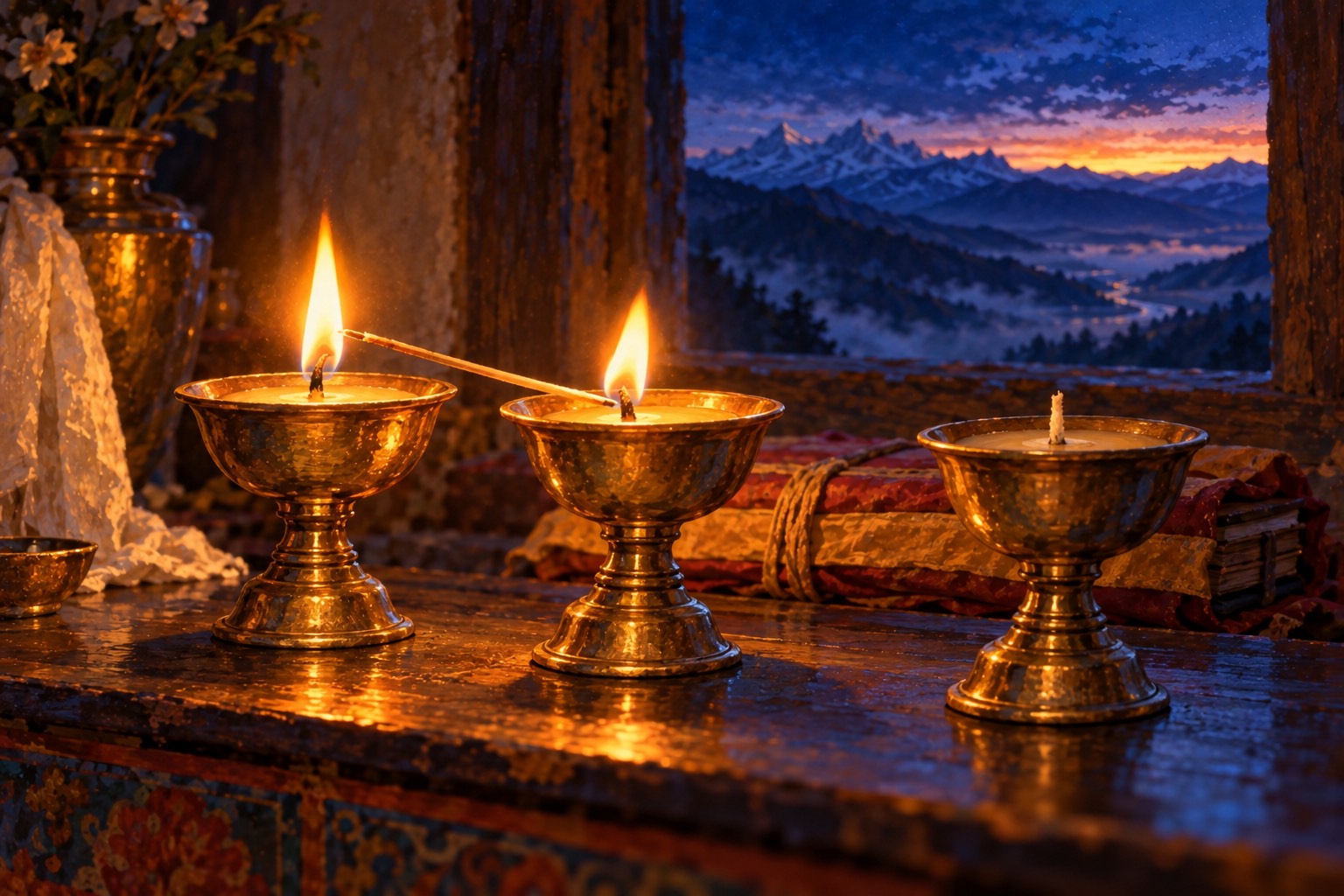
What is clear is that the teaching outlived him. Like a flame passed from one lamp to the next, it went quietly from father to son and on to the next holder, for three generations.
From Dakpo to the world

The third holder, Namkha Chökyi Gyatso, remembered as Gyarawa, began to share it widely. From him, Kongtrul says, it spread through the provinces of central Tibet and far into Kham, in the east. Chögyam Trungpa later wrote that it was long held in the Kagyu monasteries of Surmang, his own home.
The collection also grew. The historian Bryan Cuevas, in The Hidden History of the Tibetan Book of the Dead (2003), traces how later followers arranged and added to it. In the late seventeenth century the treasure revealer Nyima Drakpa compiled the version of the Liberation through Hearing that most later printings follow.
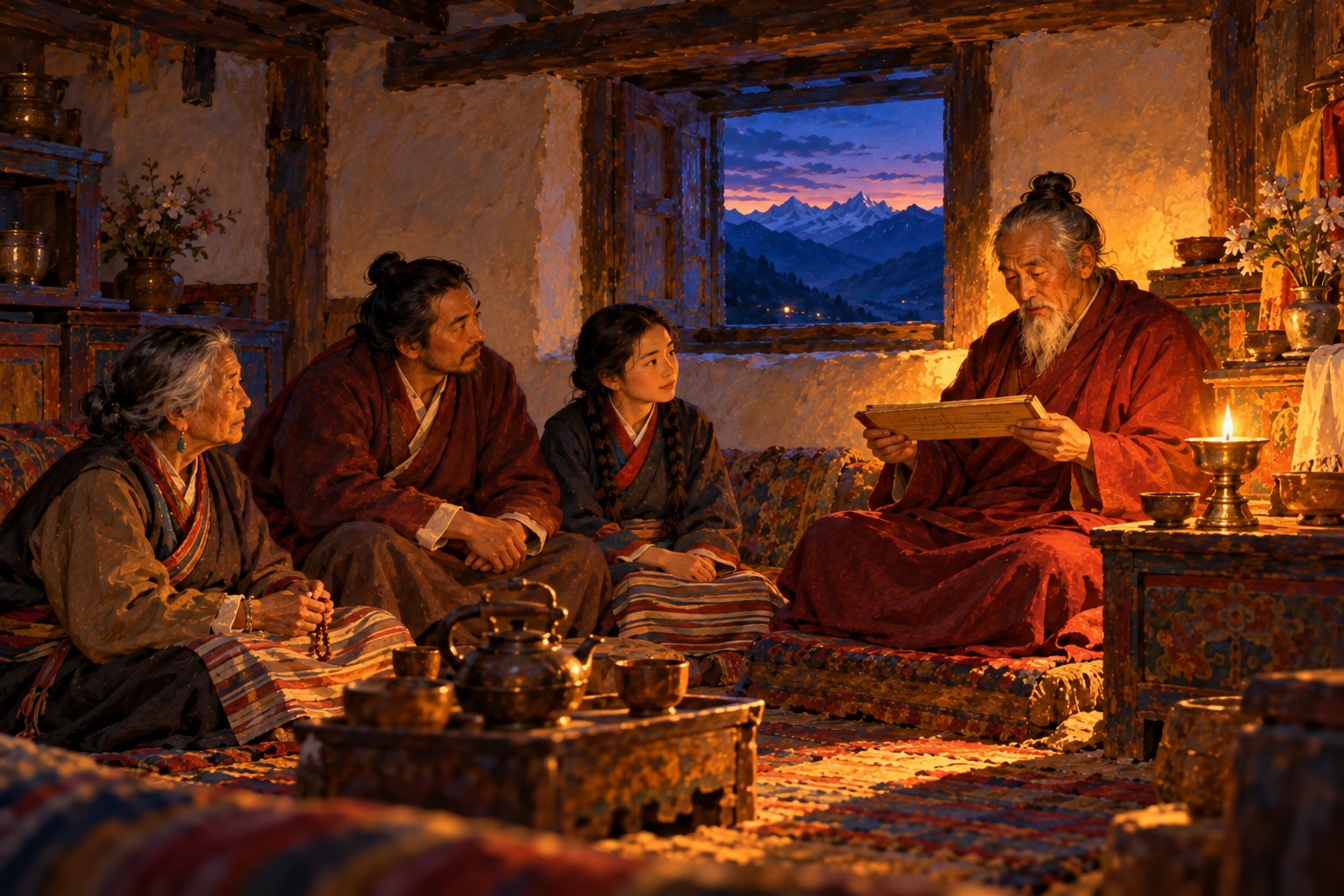
In Tibetan homes it became a book read aloud. Rigpa Wiki, following Sogyal Rinpoche, describes a teacher or spiritual friend reading it to a person as they die and after death. Other writers stress the readings by a lama in the weeks after a death, traditionally up to forty-nine days. Either way, the idea is a tender one: someone stays close, and keeps speaking.
The "Tibetan Book of the Dead"
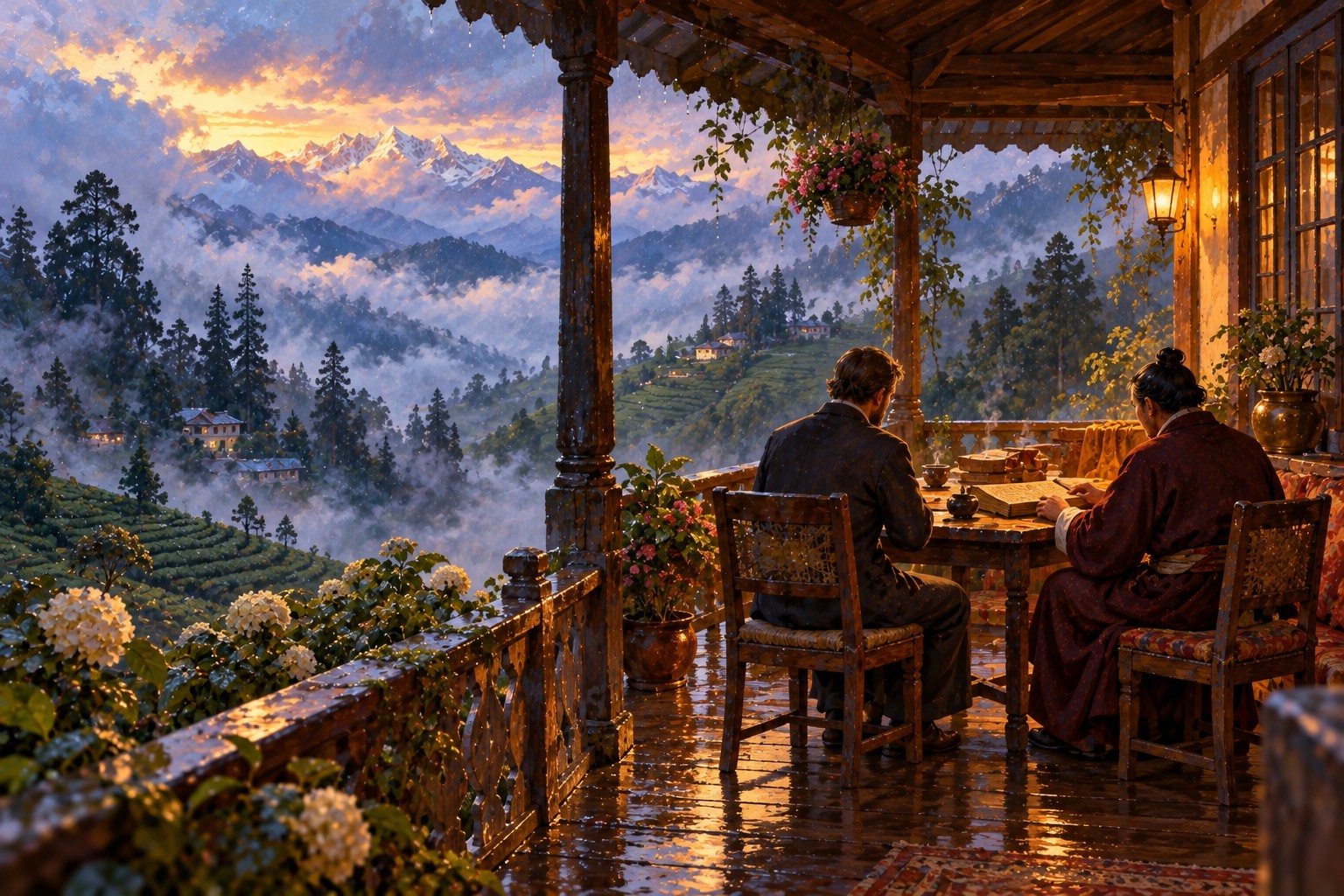
In 1919, in Darjeeling, the American traveller W. Y. Evans-Wentz obtained a copy of Nyima Drakpa's edition. He worked on it with Kazi Dawa Samdup, a Sikkimese schoolmaster, who translated while Evans-Wentz edited. Kazi Dawa Samdup died in 1922; the book appeared in 1927.
Evans-Wentz called it the Tibetan Book of the Dead, after the Egyptian Book of the Dead. The name stuck, though nothing like it appears in the Tibetan title. His book translated only part of the cycle, and later scholars note how much it was shaped by his own Theosophical ideas.
Later translations came closer to the tradition. In 1975 Francesca Fremantle and Chögyam Trungpa published theirs. Robert Thurman's followed in 1994. In 2005 Penguin published the first complete English translation of the cycle, by Gyurme Dorje, edited by Graham Coleman and Thupten Jinpa, with an introductory commentary by the Dalai Lama.
Back to the Seven-Line Prayer

One of Karma Lingpa's treasures sits very close to this site. In The Benefits of the Vajra Guru Mantra, translated by Heidi Nevin for Lotsawa House, Yeshe Tsogyal asks Guru Rinpoche about the mantra that closes the Seven-Line Prayer, and he calls it "the word of truth."
Its closing note says Karma Lingpa copied it down from a golden scroll. However we understand that, it means the boy on the mountain is one of the voices through which Tibetans came to love the mantra so many of us still recite.
The prayer itself ends by asking Guru Rinpoche to come and grant his blessings. People have said those words at every kind of in-between: at dawn and at nightfall, at a birth, beside a sickbed, after a loss.
About the art
Karma Lingpa is drawn from the only traditional portrait I found: a small figure in an eighteenth-century painting in the Rubin Museum (Himalayan Art Resources item 194), reproduced on Lotsawa House. It shows a young, beardless layman with his hair in a high topknot, a red collar, a dark gown, a saffron shawl and a red lower robe, one hand raised as if teaching and a round golden casket in his lap. The casket is the sign of a tertön, a treasure revealer. He wears no monk's robes because Jamgön Kongtrul describes him as a lay mantra holder.
Gampodar is shown as a long, high ridge in the green, partly wooded hills of Dakpo above the Yarlung Tsangpo. Kongtrul and Francesca Fremantle both say the mountain resembles a dancing deity, so one crag's outline hints at a dancing figure, without any face or carved shape. No photograph of the summit was available, so the landscape is a careful reconstruction.
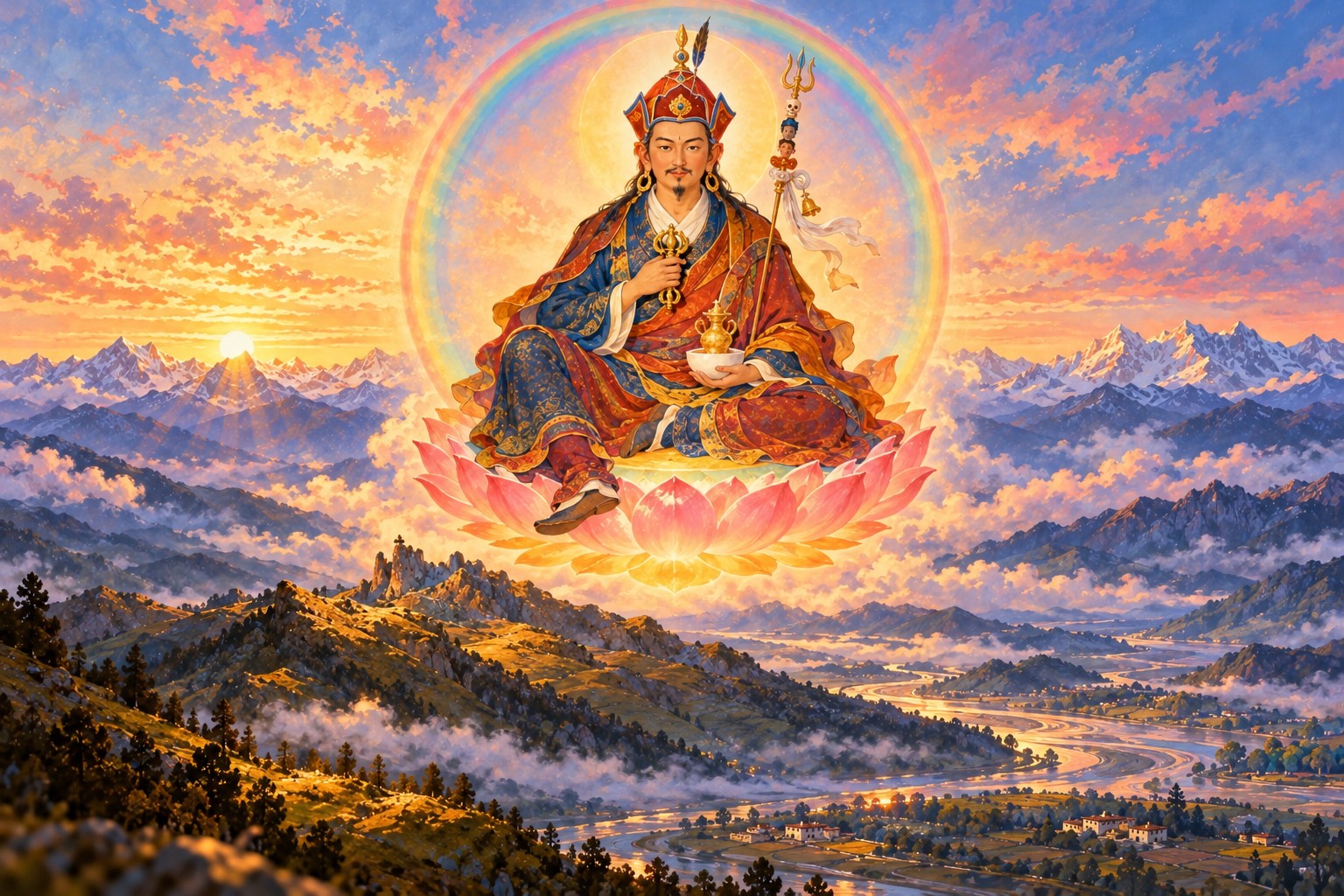
The treasure is shown as a small casket or book wrapped in cloth, and books appear as Tibetan pecha: long, narrow loose leaves kept between boards and wrapped in cloth. No writing appears on them, because this site never places script in its pictures. The lamps are Tibetan butter lamps, brass bowls on a stem with a single wick. Guru Rinpoche appears twice in his main form: once standing as he hides the treasure, and once seated on the lotus inside a rainbow sphere, holding the vajra at his heart and the skull cup with a long-life vase.
The deities of the bardo described in the Peaceful and Wrathful cycle are not pictured. Those images belong with teachers and practice, and this page uses dawn, lamps, mountain passes and closed books instead.
Why this matters for practice
The Seven-Line Prayer ends by asking Guru Rinpoche to come and grant his blessings, and Karma Lingpa's treasures are among the clearest places where the tradition imagines that blessing reaching people in their in-between moments, including the hardest one. One of them praises the very mantra that closes the prayer. You do not need to understand the bardo teachings to begin: reciting the prayer once, for yourself or for someone you love, is already a way of keeping company with them.

If something in this story touched you, perhaps because of someone you miss, you might light a lamp or simply sit quietly for a moment, and recite the prayer once. You can offer it for them, for yourself, or for anyone standing in an in-between place tonight.
Sources and further reading
- Karma Lingpa, from Jamgön Kongtrul's Lives of the Hundred Tertöns (Rinchen Terdzö vol. 1), Tibetan text with summary, Tsadra Foundation, Khyentse Lineage wiki
- Karma Lingpa (person page) and Rigdzin Nyima Drakpa, by Bryan Cuevas (2014), Treasury of Lives
- Karma Lingpa; Bardo; Tibetan Book of the Dead, Rigpa Wiki (Internet Archive snapshots, 2024)
- Karma Lingpa (author page); The Benefits of the Vajra Guru Mantra, translated by Heidi Nevin (2002); The Root Verses on the Six Bardos, translated by Adam Pearcey (2016), Lotsawa House
- Mahottara Heruka (Buddhist Deity), 3 Faces, item 194, Himalayan Art Resources
- The Hidden History of the Tibetan Book of the Dead, by Bryan J. Cuevas (Oxford University Press, 2003), Book
- The Tibetan Book of the Dead: First Complete Translation, translated by Gyurme Dorje, edited by Graham Coleman with Thupten Jinpa, introductory commentary by the Dalai Lama (Penguin, 2005), Book
- Whose Book of the Dead?, by Roger R. Jackson (2011), Lion's Roar
- Tibetan Book of the Dead, by Joshua J. Mark (2021), World History Encyclopedia
- Karma Lingpa; Bardo Thodol; Daklha Gampo Monastery, Wikipedia
This retelling is waiting to be read by a knowledgeable practitioner. Where the traditional accounts differ, the story says so; if you notice a mistake, please tell us through Share Your Story.