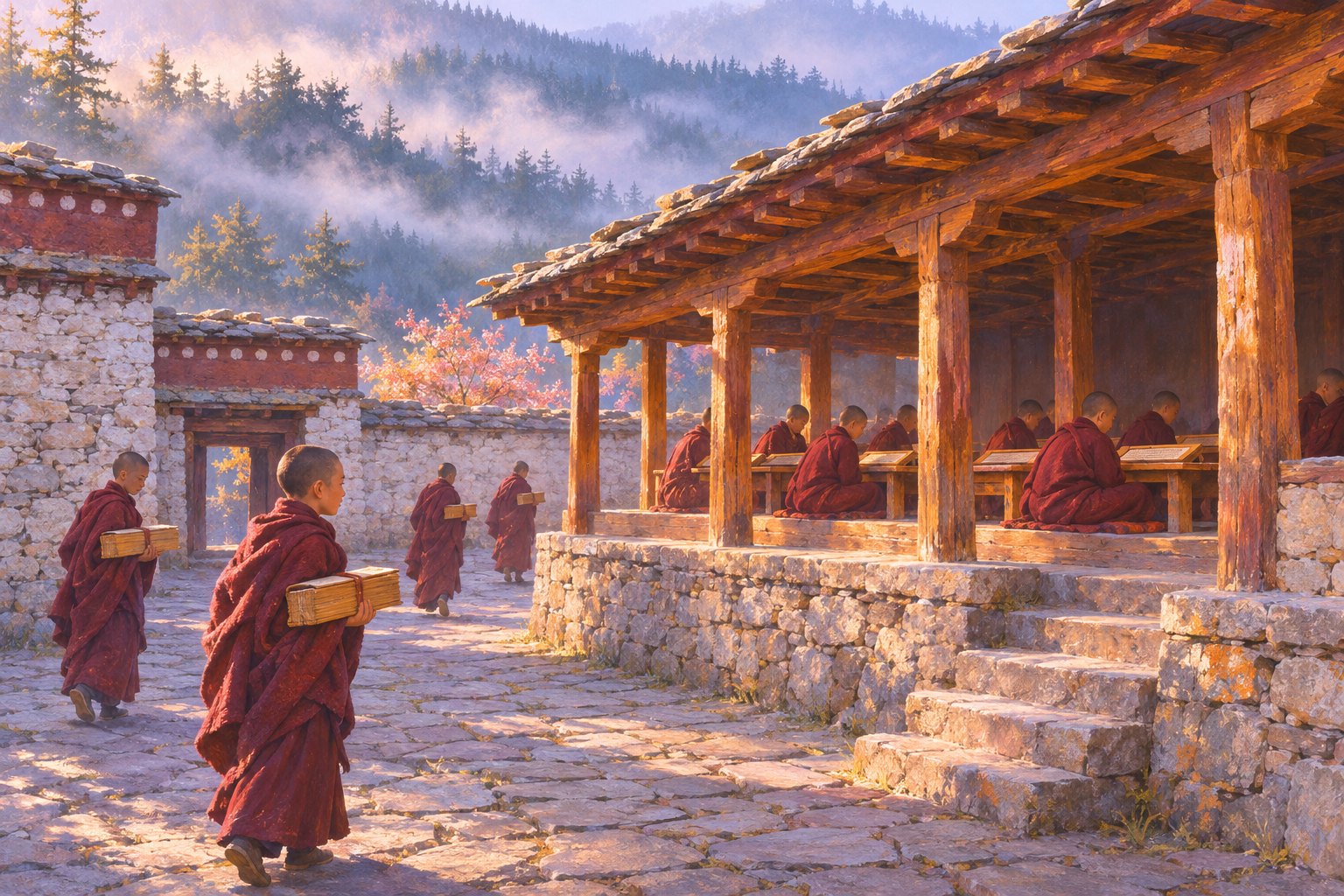
A classroom can travel
Some teachers leave a place. Others leave a way for people to study wherever they are. Khenpo Shenga, who lived from 1871 to 1927, helped make the thirteen great Indian texts central to the learning of generations of Tibetan monks. His explanations could remain with students after the sound of a particular lesson had ended.
The story begins with that modest kind of endurance. A student returns to a book and finds help beside the difficult passage. Someone has taken care over what the next reader will need. The classroom can then extend beyond its walls, carried in books and in the people who learn from them.
The teacher who had teachers
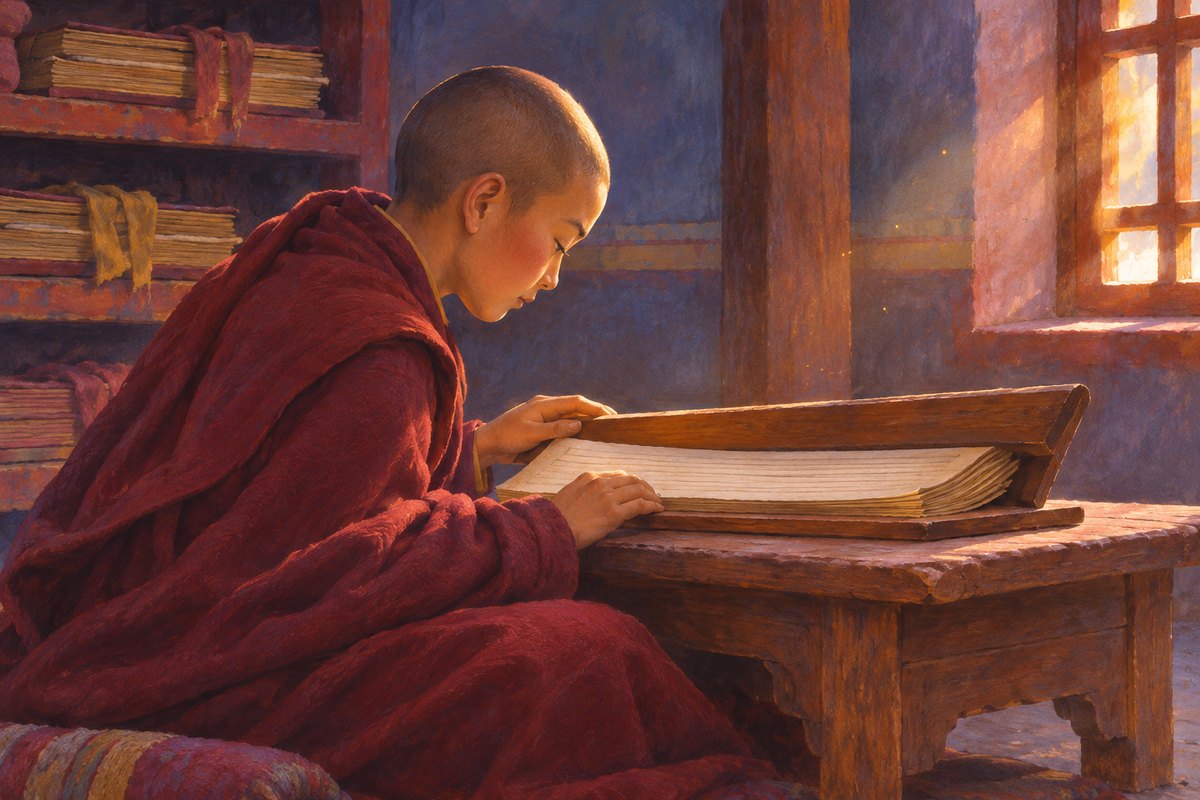
Shenga is also known as Shenpen Nangwa. Treasury of Lives identifies his connections with both Nyingma and Sakya and records him as the nineteenth khenpo of Śrī Siṃha college at Dzogchen. Among his teachers it lists Orgyen Tendzin Norbu and Mipham. His learning did not begin with an isolated collection of his own ideas.
For the reader, those relationships give the work its depth. Behind the teacher at the low desk are other teachers, and behind the books are earlier explanations. We do not need to imagine a childhood vow or an unrecorded conversation to understand the responsibility he later took on.
Thirteen does not mean a small shelf
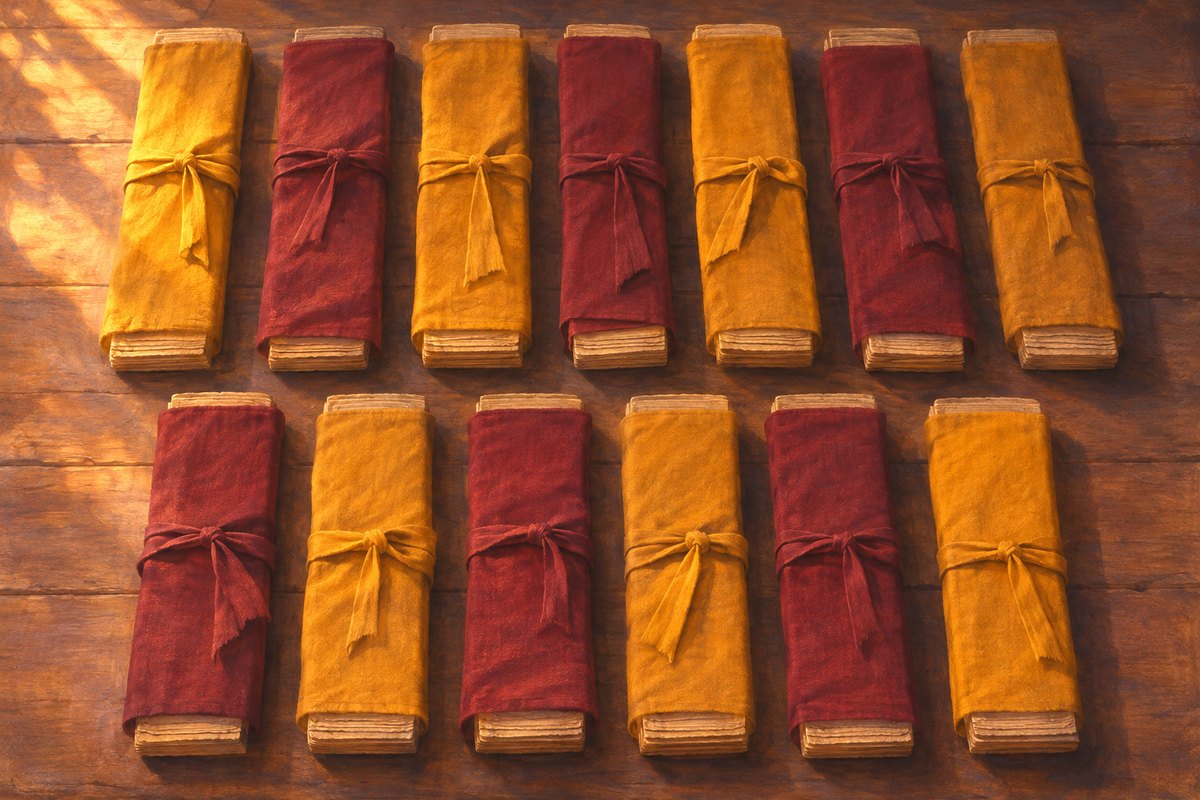
The thirteen great texts form a programme of study, not a promise of thirteen thin physical books. They reach across monastic discipline, the analysis of experience, philosophical view, and the bodhisattva’s path. Bodhisattva means someone who seeks awakening for the benefit of beings.
A list that broad can feel forbidding to a newcomer. Yet its breadth also tells us what the educational work was for: the student was to encounter different parts of Buddhist understanding together. The painted bundles stand for the curriculum. Their arrangement is an image for the story, not a bibliographical count of the volumes needed for every edition.
Explanations beside the words
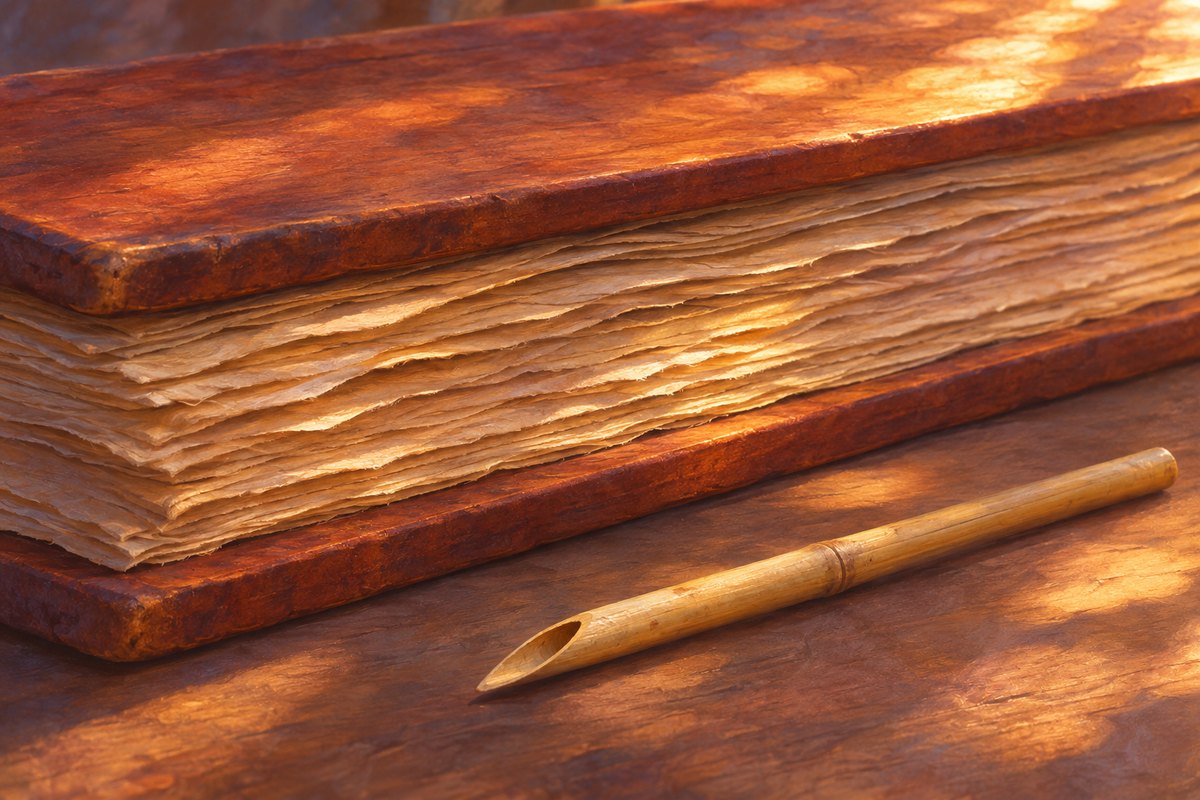
Adam Pearcey’s introduction describes Shenga’s commentaries as selections from Indian explanations inserted alongside the root texts. Much of the work lay in choosing and arranging what would help a reader understand. The books gave a student access to earlier voices rather than replacing them with an entirely new treatise.
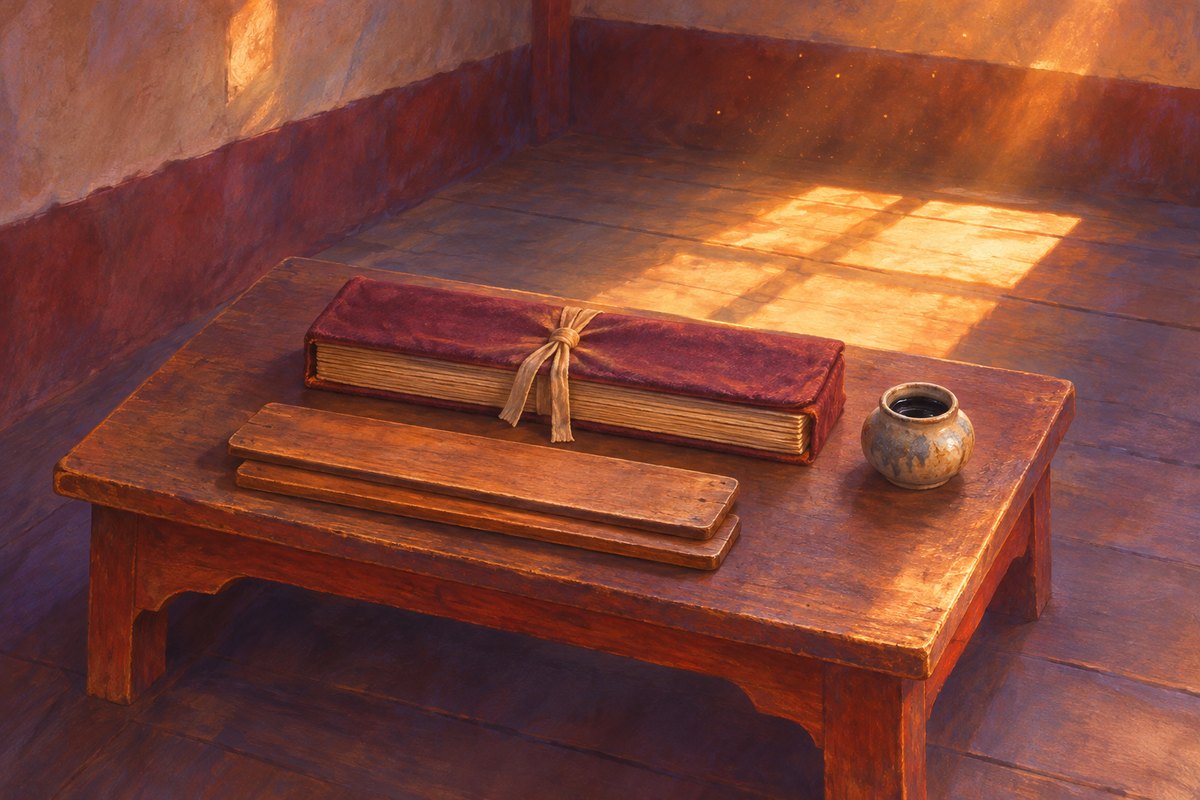
There is a quiet generosity in that kind of work. The explanation does not have to draw attention to the person who prepared it at every turn. It can direct the reader back toward the text. This is the reflection offered by the close image of paper edges and wooden boards: patient preparation made available to someone else.
The college at Dzogchen
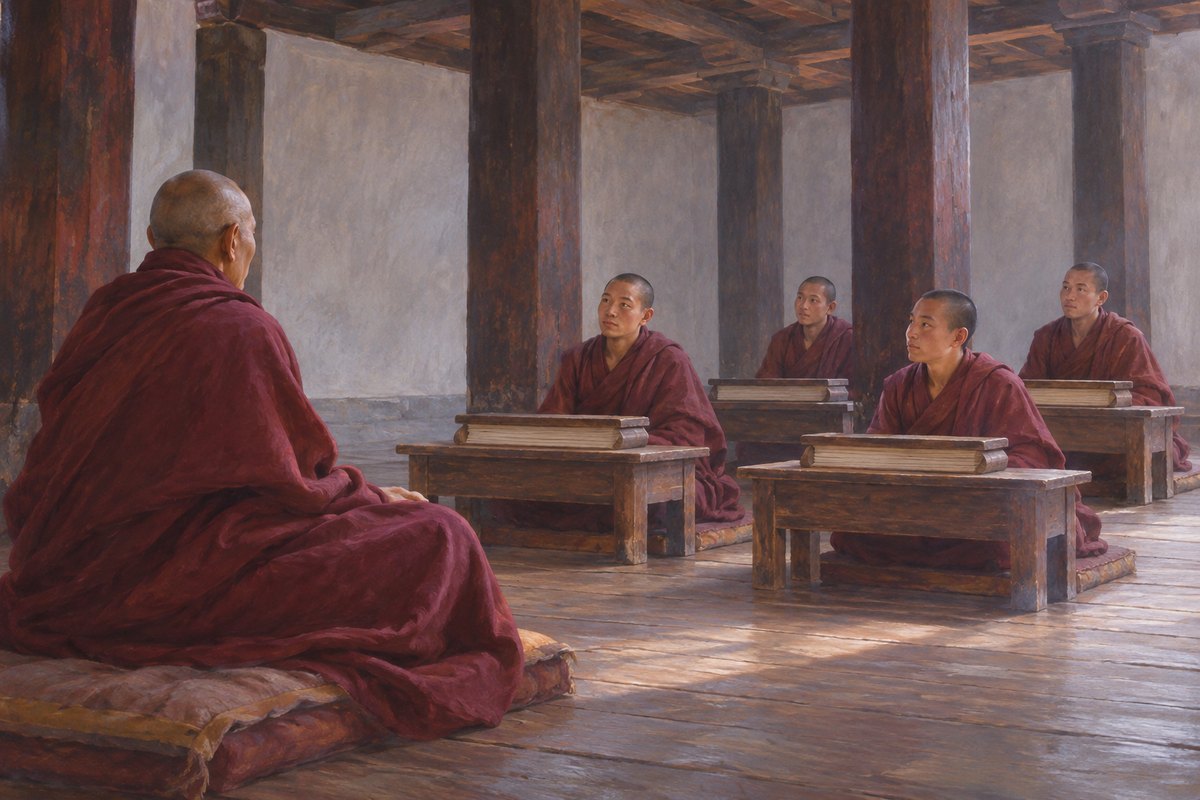
Tib Shelf remembers Shenga as a major figure in the renewal of monastic education and as a teacher of Dzogchen, the Great Perfection. His scholarship belonged within a life of practice. The college was one place in which the work of preserving and understanding the teachings became a shared undertaking.
A classroom can be pictured without inventing a particular lesson. The illustrations use anonymous teacher and students, with books closed or turned away so that no false Tibetan script appears. What matters in the scene is the relationship: someone explaining, others attending, and enough time being given for an unfamiliar text to become more intelligible.

Work at Palpung
Pearcey places the composition of many of the commentaries during Shenga’s years at Palpung, between 1910 and 1918, at the request of Situ Pema Wangchok Gyalpo. The earlier history of the explanations is less certain; the introduction treats their connection with preceding teachers cautiously.
That distinction gives the story a clear shape without making every detail equally secure. There was a period of writing, a request from another master, and a purpose beyond the room in which the pages were prepared. Where the record becomes tentative, the telling can remain tentative too. Respect for a lineage includes care with what we say we know about it.
The books go further
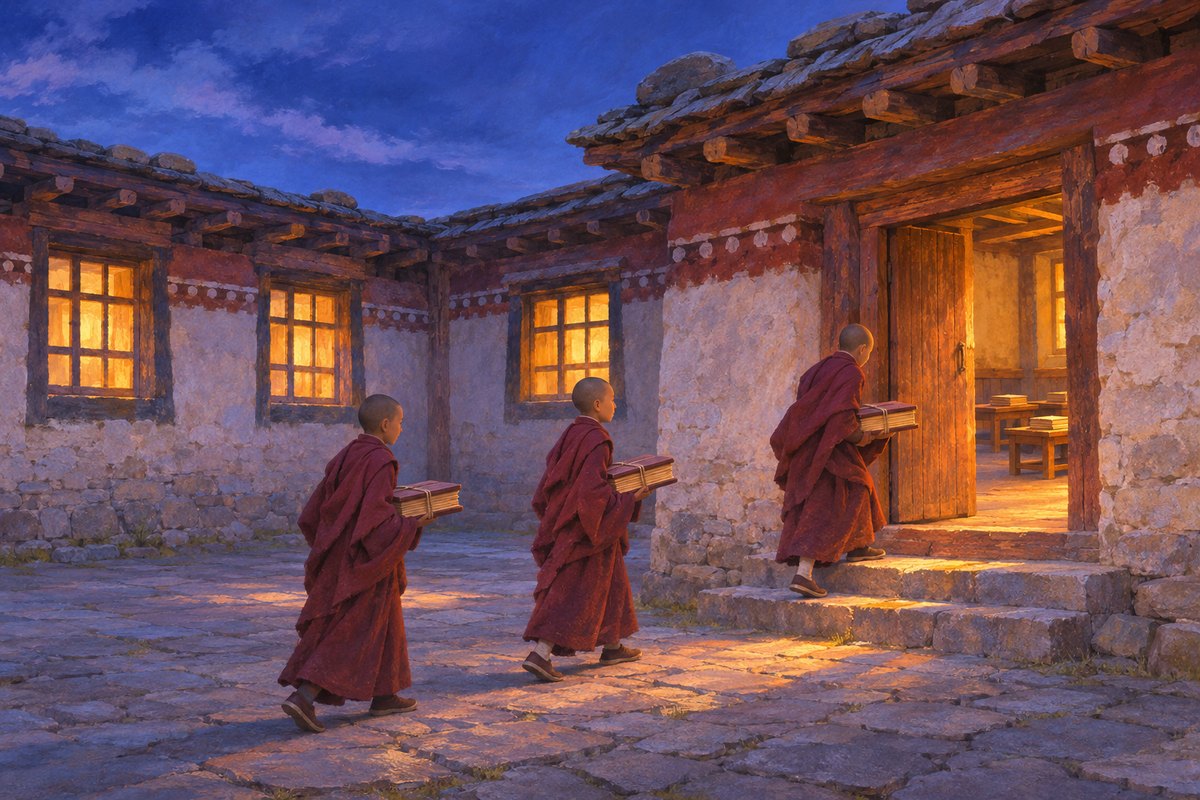
The commentaries became central at Kham-jé college at Dzongsar, which Shenga founded in 1918. Tib Shelf also describes his wider teaching activity across Tibet, Bhutan, and Sikkim. His educational work reached people in several settings and crossed the boundaries of a single institution.
The journey image is therefore a fitting pause in the story, though it does not claim to reconstruct one documented trip. Books have to be carried, explained, received, and used. Their influence is not accomplished by their existence alone. Behind a curriculum’s later importance are many acts of teaching that a short biography cannot name one by one.
A monk asks for a few words
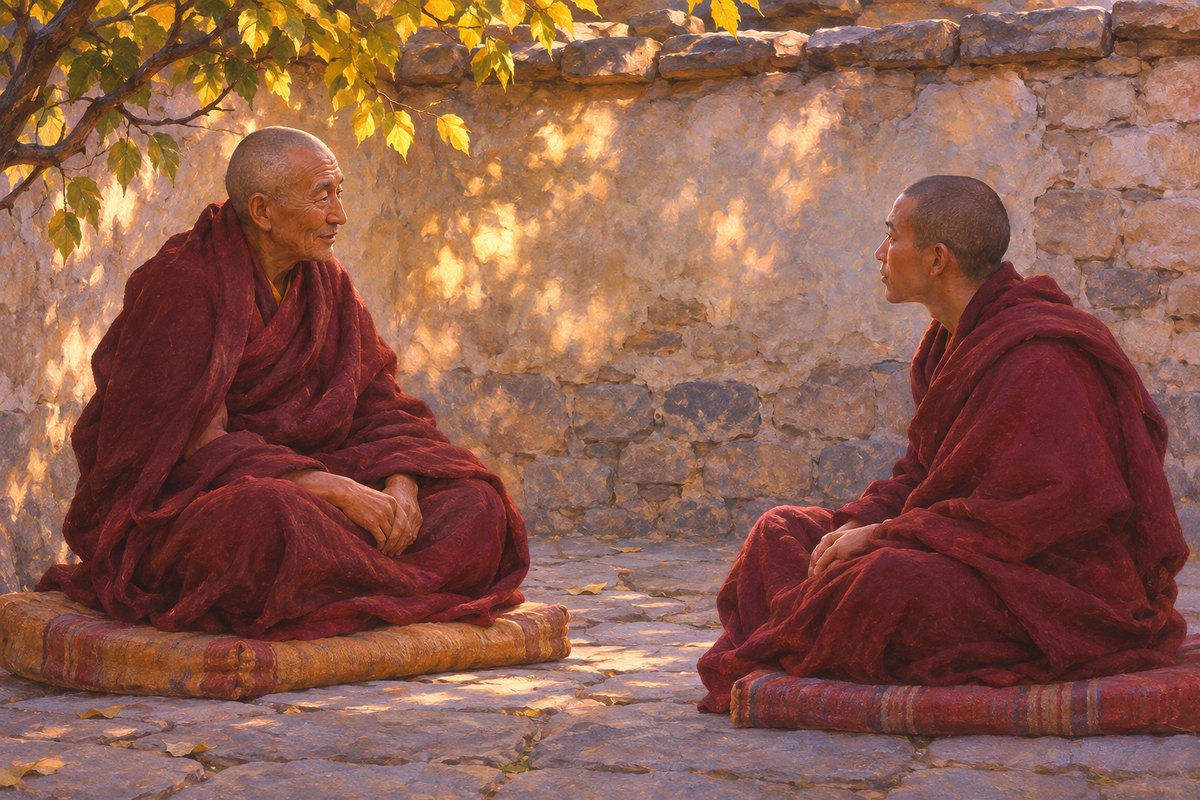
Another of Shenga’s works brings the scale down to a single request. The colophon to The Three Noble Principles says that a monk following the Karmapa asked for a few words of guidance. Shenga responded with brief advice about the beginning, main part, and conclusion of practice.
The beginning gives importance to bodhicitta, the intention toward awakening for others’ benefit. The conclusion concerns dedicating virtue beyond oneself. A teacher associated with a large programme of study also answered a request for something concise. The contrast is not between valuable and useless learning; it is between different forms of help, suited to what someone asked.
What he admired
In his praise of Longchenpa, Shenga begins by remembering Guru Padmasambhava’s kindness. He honours Longchenpa’s learning together with discipline, compassion, devotion to a teacher, and life in retreat. The admiration makes the purpose of study visible: knowledge belongs with the qualities by which a teaching is lived.
That connection keeps this story within the Nyingma library. Shenga’s broad associations did not erase his reverence for the Ancient Translation tradition and its great masters. His own words show the relationship more clearly than a modern label alone could do. The scholar who helped others read also tells us whom he looked toward.
A place for the next reader
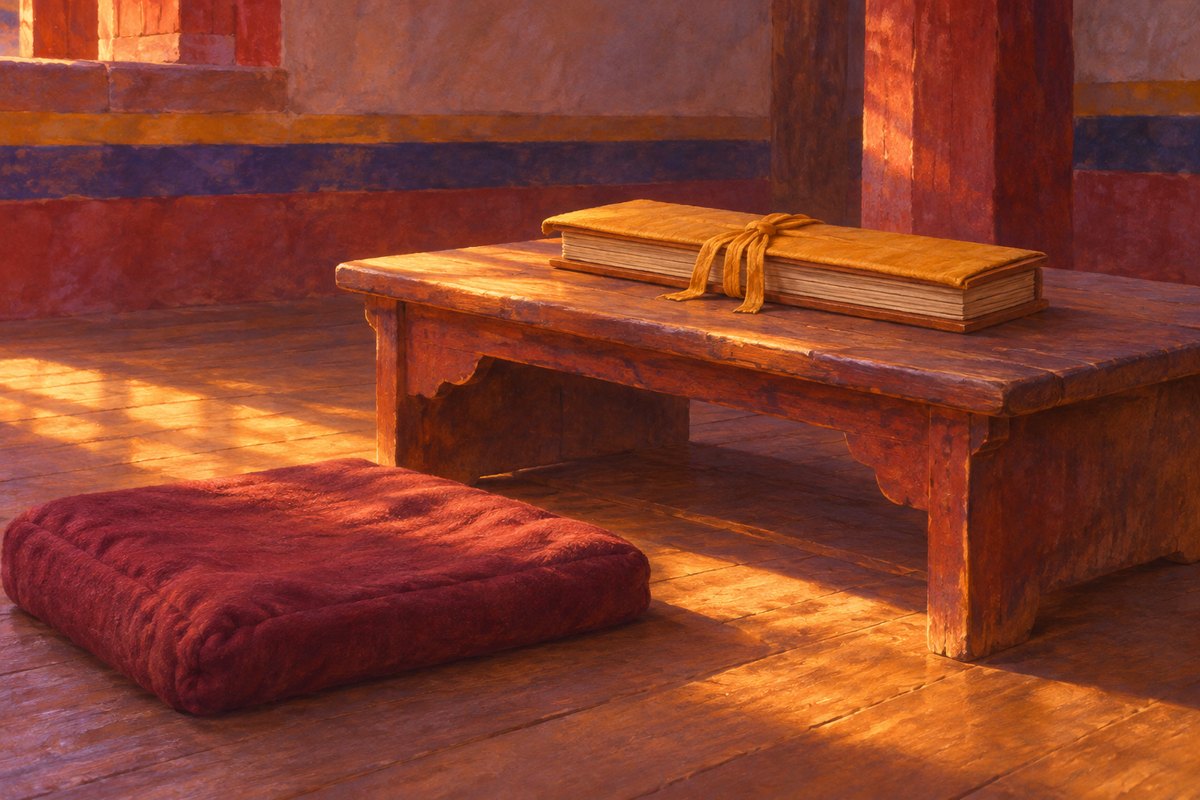
Shenga died in 1927. The books and explanations continued into classrooms he would not see. In the final painting, an empty cushion waits beside a low desk. It is a symbolic ending: someone else will have to take the place, open the book, and begin learning.
The sixth line of the Seven-Line Prayer expresses the wish to follow Guru Rinpoche. Here that wish meets the patient work of making teachings understandable and available. This is a thematic connection, not an invented account of Shenga reciting the prayer. For someone returning to practice, a place prepared for the next student may be an encouraging image: there is still somewhere to begin.
About the art
These AI-painted illustrations show anonymous period figures, not authenticated portraits. Architecture, workrooms, and arrangements of objects are atmospheric reconstructions; their exact historical appearance is not claimed.
Books are represented as long, flat Tibetan pecha bundles, covered by wooden boards and cloth. Writing is omitted from the images. The pictures illustrate the source-based account and its clearly symbolic details; they do not supply evidence for unrecorded scenes.
Why this matters for practice
The sixth line of the Seven-Line Prayer expresses the wish to follow Guru Rinpoche. This Nyingma lineage story invites reflection on receiving teachings with care and helping them reach others. It offers no promise of outcomes and no substitute for personal guidance; the Find a Teacher page can help readers begin looking for that guidance.

If something in this story moved you, you might pause and recite the Seven-Line Prayer once.
Sources and further reading
- Khenpo Shenga, Tib Shelf
- Introduction to the Thirteen Major Texts, Lotsawa House
- Khenpo Zhenga Zhenpen Chokyi Nangwa, Treasury of Lives
- The Three Noble Principles, Lotsawa House
- In Praise of Longchenpa, Lotsawa House
- Khenpo Shenpen Nangwa Series, Lotsawa House
- Seven-Line Prayer, Lotsawa House
This retelling is waiting to be read by a knowledgeable practitioner. Where the traditional accounts differ, the story says so; if you notice a mistake, please tell us through Share Your Story.