Two summers at the wall
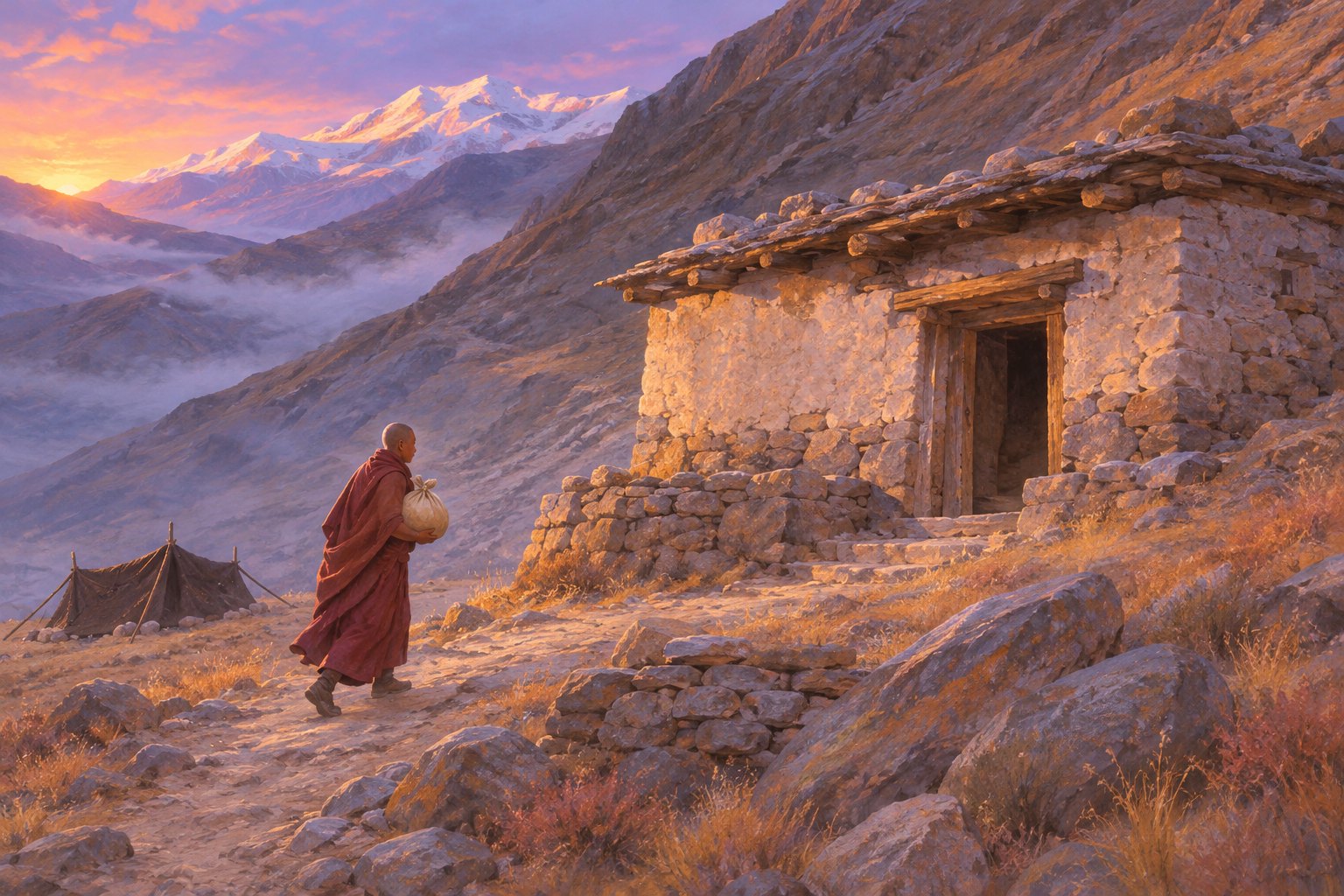
Before the travelling camp and the famous students, there was work to be done. Longchenpa’s biography of Kumāradza remembers two summers spent painting murals. He had little to offer his teacher Melong Dorje in possessions, but he had learned a craft. His hands could serve where his purse could not.
It is a small, useful doorway into a great Nyingma master’s life. A later reader meets him first through a place in a lineage. This episode lets us meet him through labour: the skill a person already has, put patiently at the service of what he hopes to learn.

The painter and the student
Kumāradza lived from 1266 to 1343. Treasury of Lives places him in both Nyingma and Pakdru Kagyu settings and lists him as an artist. His best-known students include Longchenpa and the Third Karmapa, Rangjung Dorje. Those relationships belong to the history behind the story, before later generations made the names familiar.
His name is often explained as Youthful King. Nothing in the painter’s episode suggests a royal household. The dignity of the account lies elsewhere: he was willing to begin as someone who received instruction, worked, and depended on others. That contrast is a reflection on the story, rather than another event added to it.
A skill that could be given
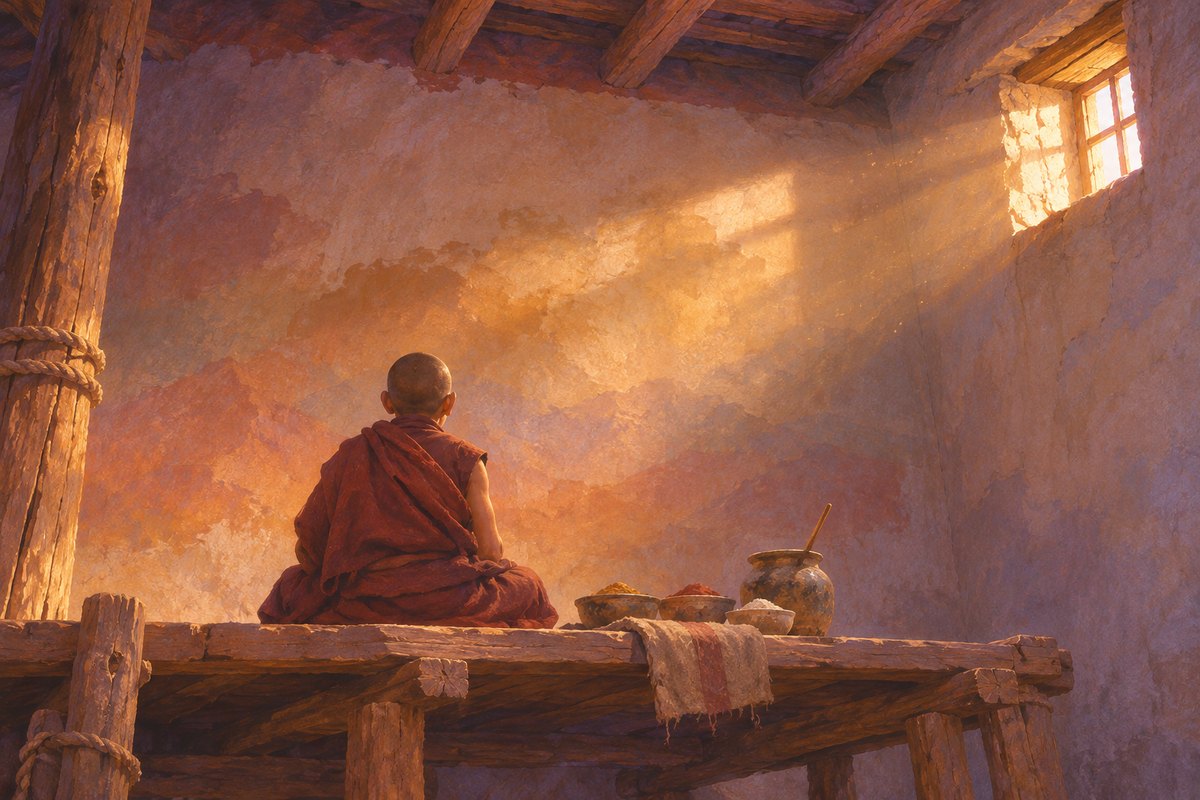
Longchenpa records that Kumāradza had learned painting. When he came to serve Melong Dorje at Kharchu, this became a practical offering. The biography locates the mural work in a house called Bumchung; it does not supply a picture of the completed walls for us to reproduce.
The illustrations therefore keep the painter’s tools and unfinished background in view. A brush, a pigment dish, a plastered surface: ordinary things, but enough to make the word service less abstract. We need not imagine what he said as he painted, or assign a particular sacred figure to a wall whose appearance we cannot establish.
The barley
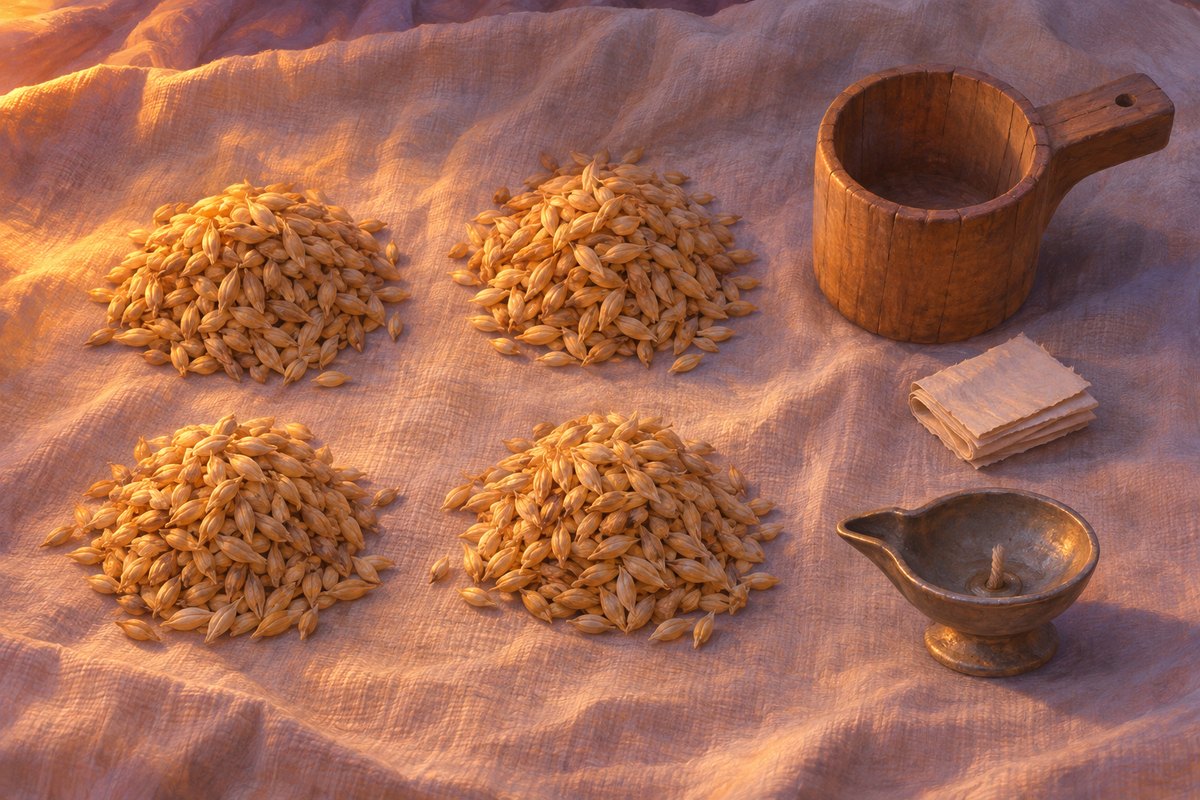
For that work he received four measures of barley. In Longchenpa’s account, two went toward paper, while the remainder supported lamp fuel and food. Those plain expenses reveal how learning had to be sustained. A text needed something to be written on, light enough to see, and a person able to continue.
Here is the detail that stays with the reader: the earnings do not become a reward at the end of the story. They become the conditions for its next part. Barley, paper, light, and food belong to one chain of effort. The picture shows them together symbolically, not as a record of the exact vessels he used.
The work after the work
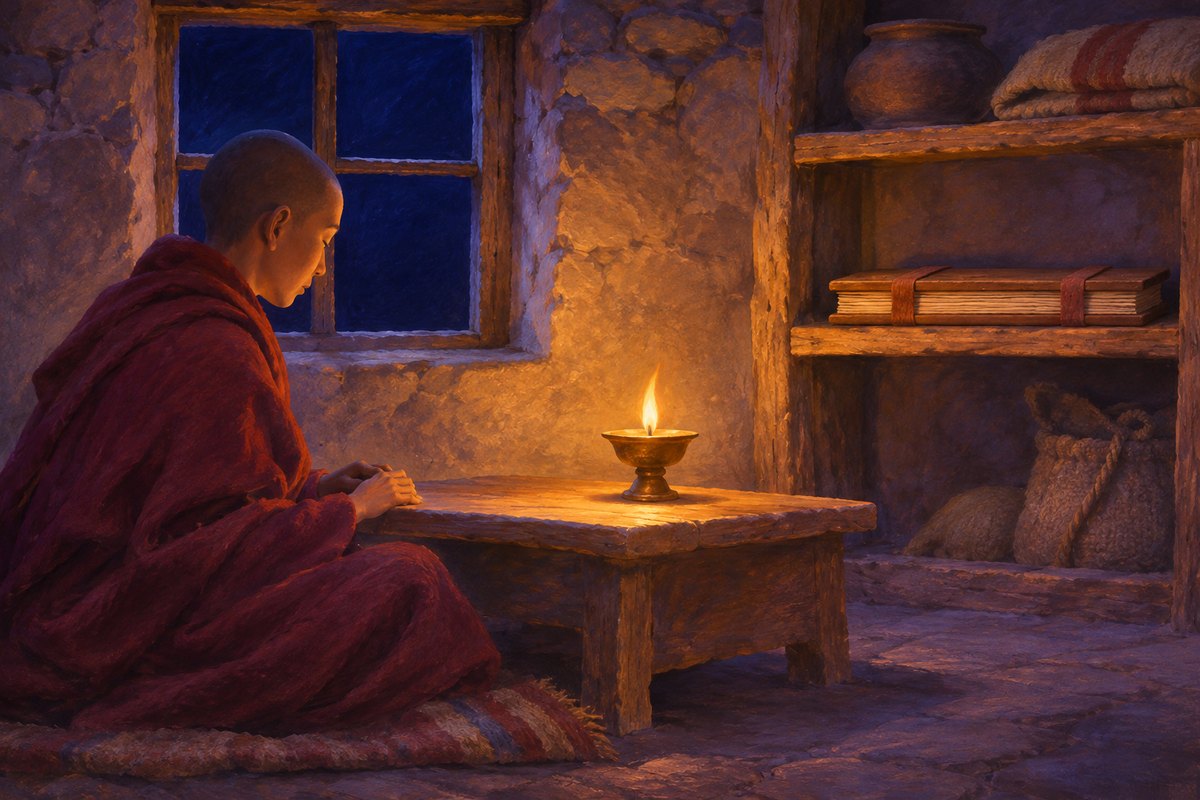
He copied texts at night. The mural painting and the copying belong to the same period of service in the biography. We are not given the contents of a particular evening’s pages, so the paintings show paper edges and closed book bundles rather than invented Tibetan writing.
Day work followed by night work can sound heroic at a comfortable distance. It also asks a quieter question of a reader: what makes something worth returning to when it is no longer new? The story offers no bargain that effort will purchase realization. It records a student who kept making room for the teachings amid the material needs of his life.
Melong Dorje
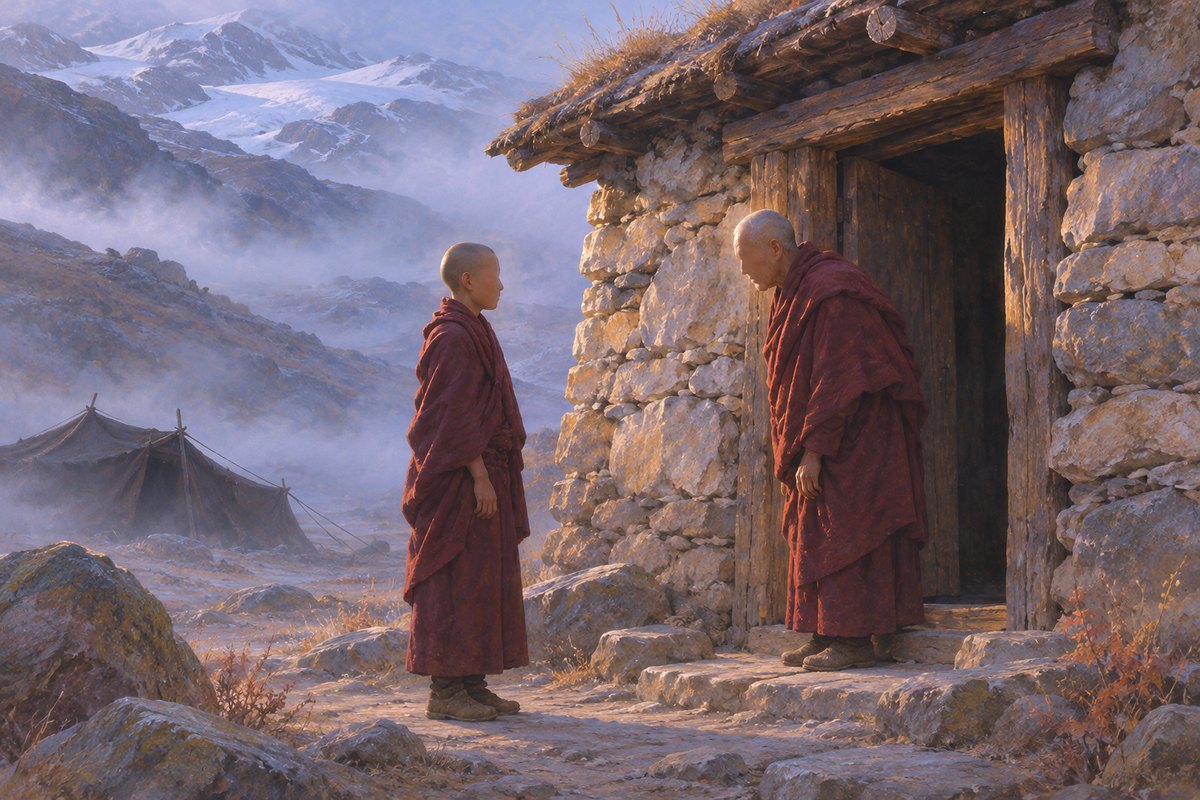
In the lineage account published by Chagdud Gonpa, Melong Dorje is the root teacher around whom this period of learning gathered. That account remembers eight years of service and a teacher pleased with his student’s perseverance. The encouragement was directed toward the welfare of beings, not simply the student’s private distinction.
A root teacher is the teacher of deepest importance in a practitioner’s spiritual formation. The word can be heard too quickly, as another title to remember. Beside the painter’s labour, it points to an actual relationship extended over time. This story honours that relationship without turning its advanced instructions into directions for a reader.
Beyond the painted room
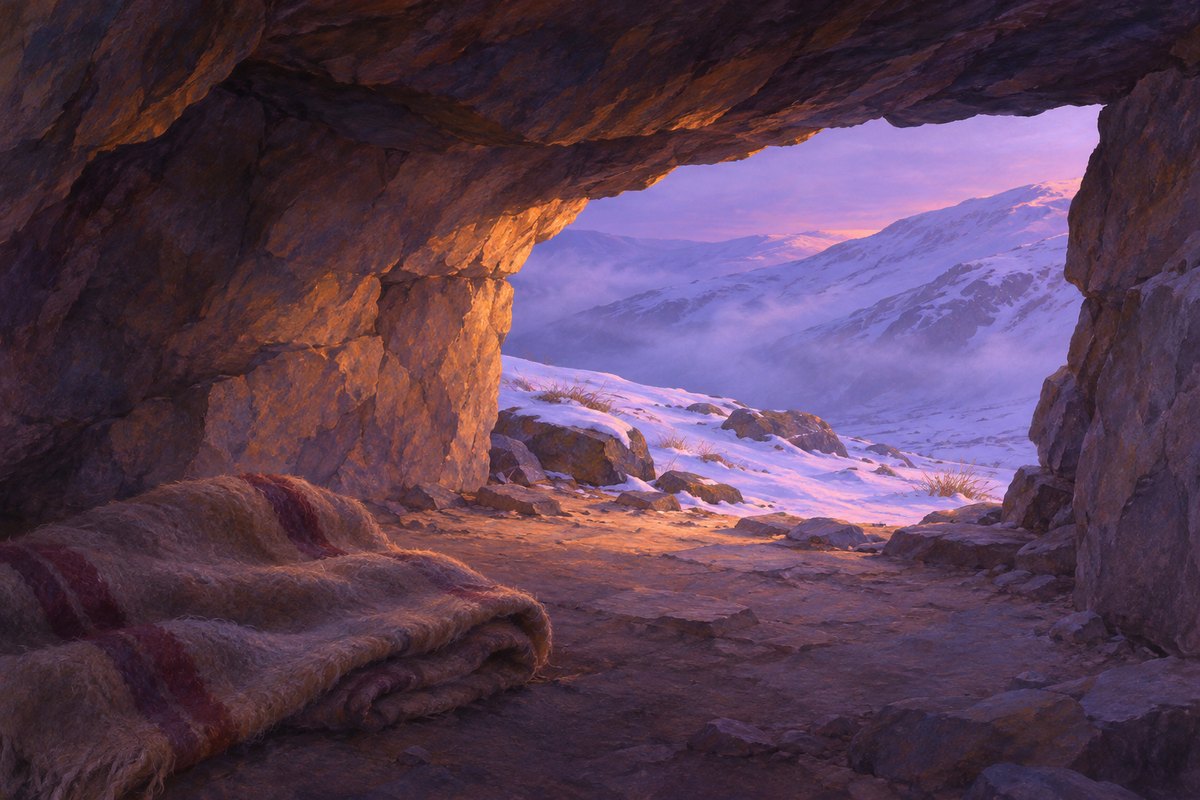
The accounts next open onto caves, lakes, and journeys. Longchenpa remembers a winter in a cave associated with Guru Rinpoche; Lama Drimed describes months beside Turquoise Lake. They also preserve visionary episodes, which belong to the devotional testimony of the tradition.
The pictures here stay with shelter, mountains, water, and the small human presence among them. They do not attempt to manufacture proof of a vision. The change of setting matters even without spectacular imagery: the painter’s apprenticeship did not end with a comfortable institution becoming permanently his. The remembered life continued into solitude and movement.

The camp that kept moving
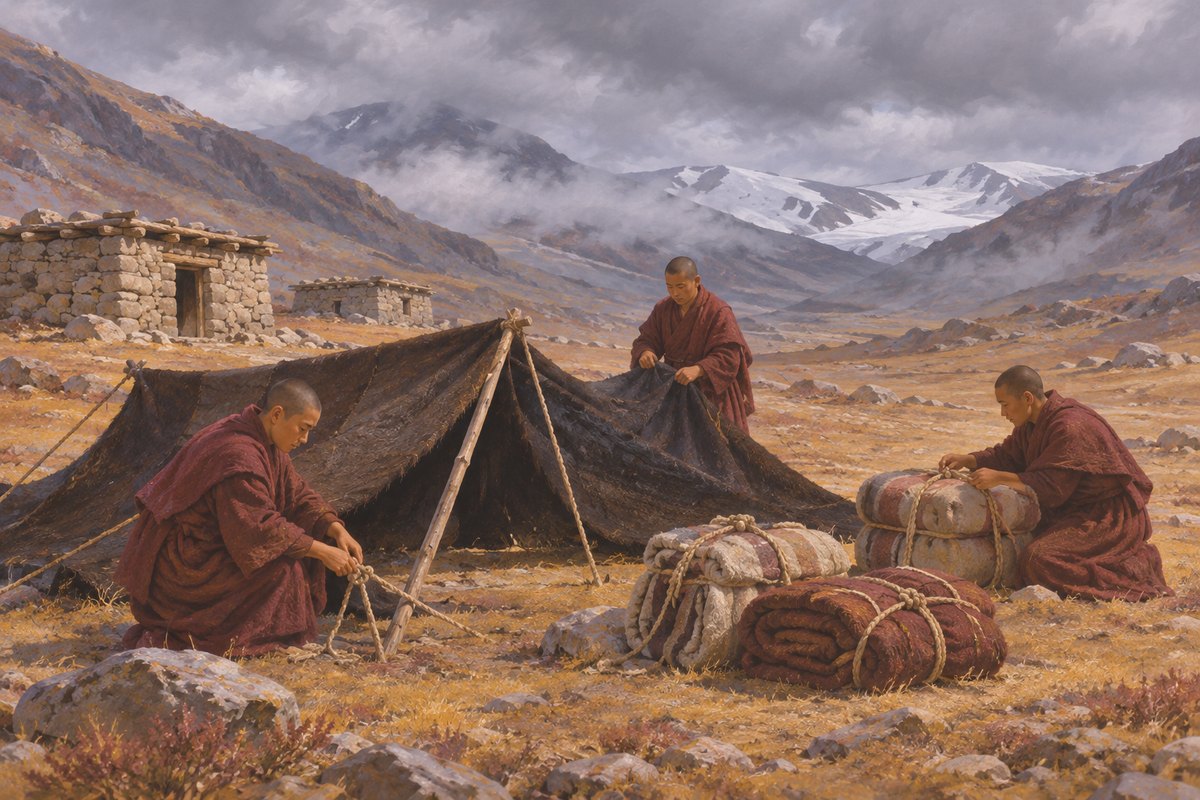
Lama Drimed’s account describes a teacher who often lived with very little shelter and did not stay long in one place. His students moved with him. In that telling, the travelling camp is part of their training in not becoming attached to a settled home.
A moving camp changes the way we picture transmission. The teaching is not identical with the room in which it was first heard. It can be carried by people who pack their belongings and continue together. That is the reflection offered by the image of folded blankets and a lowered tent; no particular day of packing is being claimed.
Room for other lives
Longchenpa also remembers measures to protect travellers and animals, including restrictions on hunting and fishing. The biography’s praise of Kumāradza reaches beyond the circle of people who received his most demanding teachings. Its remembered compassion has consequences for creatures who could never enter a classroom.
That detail belongs beside the barley and the paper. The purpose of a life of learning cannot be measured only by how much one person receives. In the story’s own frame, what was received was to benefit others. The travelling teacher and the working student are therefore not separate figures in the reader’s mind; one life connects them.
What reached Longchenpa
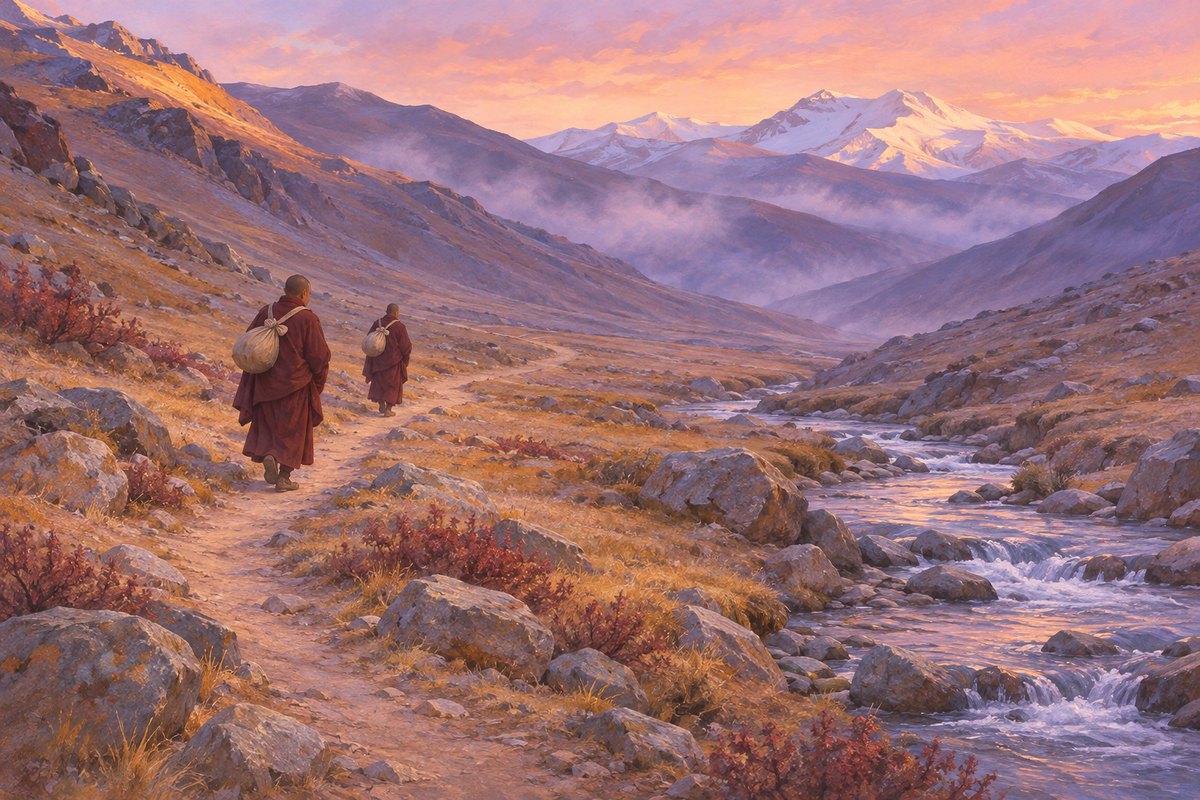
Longchenpa’s biography ends by acknowledging what he himself received from this teacher. His account lets a later reader stand at one remove from a living relationship: the student telling us about the person who taught him. It is one reason this life remains more than a name in a list.
The sixth line of the Seven-Line Prayer expresses the wish to follow Guru Rinpoche. Kumāradza’s story offers a setting in which to consider that wish: offering a skill, continuing to learn, and remembering whom the work is for. The connection is thematic; no occasion of recitation has been invented. A brush, a little grain, and paper bought for the night can remain a beginning.
About the art
These AI-painted illustrations show anonymous period figures, not authenticated portraits. Architecture, workrooms, and arrangements of objects are atmospheric reconstructions; their exact historical appearance is not claimed.
Books are represented as long, flat Tibetan pecha bundles, covered by wooden boards and cloth. Writing is omitted from the images. The pictures illustrate the source-based account and its clearly symbolic details; they do not supply evidence for unrecorded scenes.
Why this matters for practice
The sixth line of the Seven-Line Prayer expresses the wish to follow Guru Rinpoche. This Nyingma lineage story invites reflection on receiving teachings with care and helping them reach others. It offers no promise of outcomes and no substitute for personal guidance; the Find a Teacher page can help readers begin looking for that guidance.

If something in this story moved you, you might pause and recite the Seven-Line Prayer once.
Sources and further reading
- Biography of Kumārādza, from The Jewel Rosary History, Lotsawa House
- Lineage Holders of Inherent Truth, Chagdud Gonpa Foundation
- Kumāradza, Treasury of Lives
- Seven-Line Prayer, Lotsawa House
This retelling is waiting to be read by a knowledgeable practitioner. Where the traditional accounts differ, the story says so; if you notice a mistake, please tell us through Share Your Story.