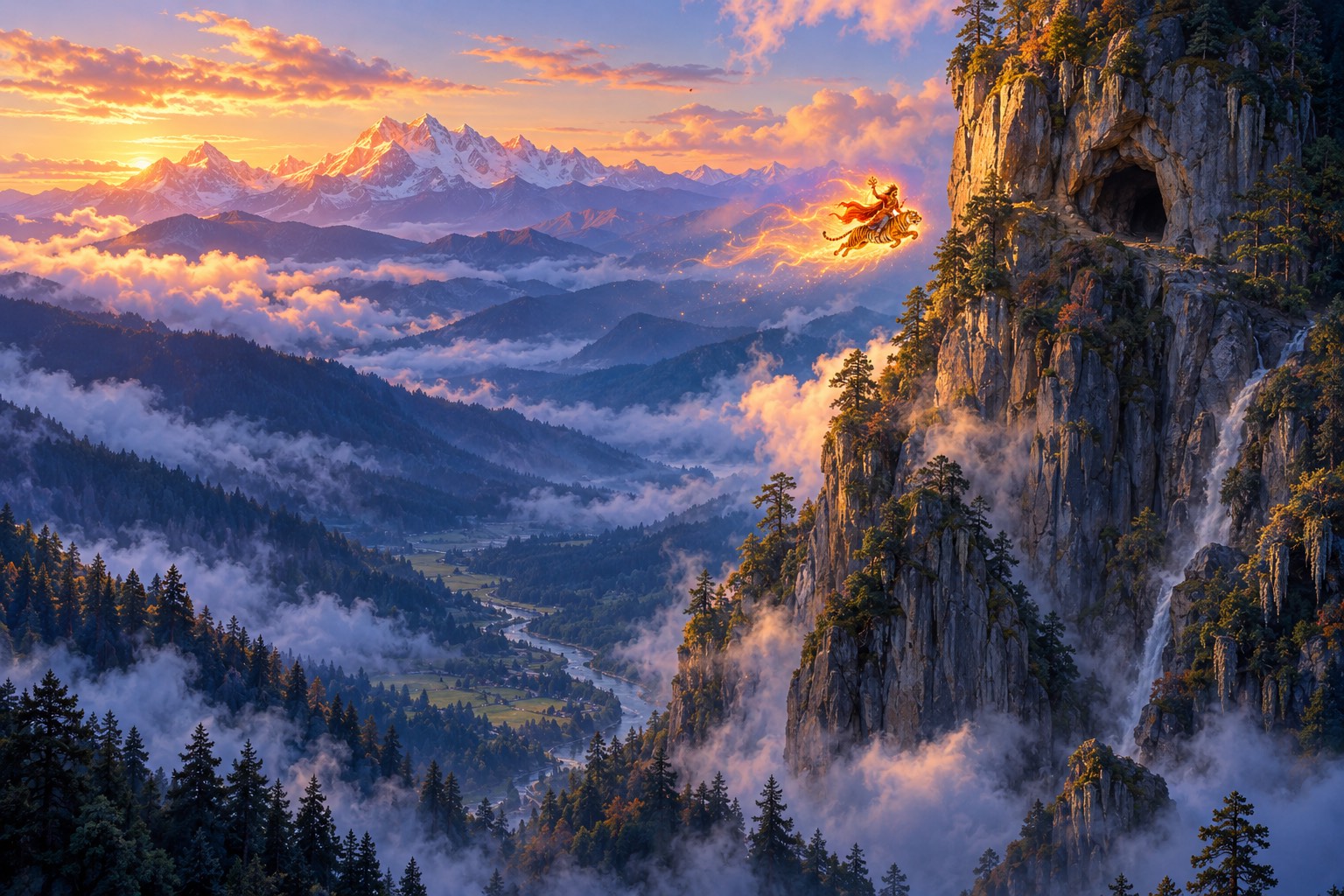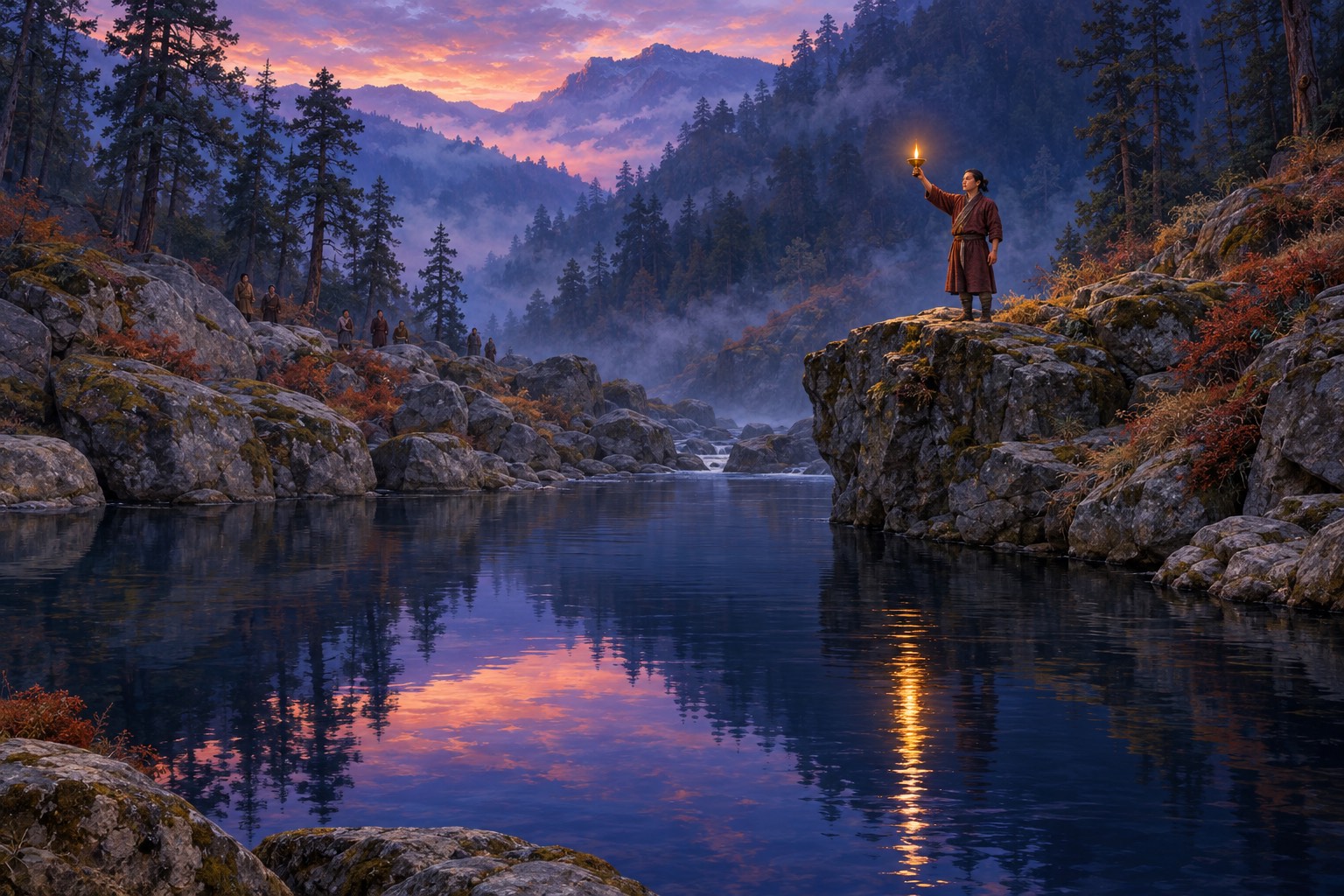
In the Chokhor valley of Bumthang, in central Bhutan, a reddish cliff rises above the river, and three whitewashed temples stand against its foot. Together they are called Kurjey Lhakhang. Kur means body and jey means imprint, the trace something leaves behind.
Inside, the tradition says, is the cave where Guru Rinpoche sat in meditation until the rock kept the shape of his body. The story of the Tiger's Nest touches on it briefly. Here it is told more slowly, with the threads that different tellings add, and a gentle word about where they part ways.
A king in the Iron Castle
Long ago, the story goes, Bumthang had a king remembered as Sindhu Raja. Other tellings call him Sendha Gyalpo or Sendha Gyab. One written version, a short text the historian Michael Aris linked to the circle of the treasure revealer Pema Lingpa, makes him a prince from India.
In that version he loses a war, flees north with eighty followers, and takes over a great fortress called Chakhar, the Iron Castle. An older written account, which Aris traced to a twelfth-century text, knows nothing of India. Its king, called Se'darkha, is simply a ruler of Bumthang.
Aris thought the Indian prince grew into the story over the centuries. He doubted the events happened as told, but found in them memories of very old Himalayan customs. Either way, this is a story the people of Bumthang have kept close for a very long time.
Grief and a stolen life
The best-known telling begins with a war against a king to the south, remembered as Naoche, "Big Nose." Before the fighting, Sindhu Raja prayed to the local guardian spirits to protect his son, Taklha Mebar. The son was killed all the same.
Wild with grief, the king turned on the spirits who had failed him. In the oral telling he had their shrines pulled down. In Aris's written version he stopped honouring his guardian deity and did things that offended them all.
 Illustration in preparation
The chief of these spirits was Shelging Karpo, a powerful local deity of Bumthang. He answered by seizing the king's sog, his life force, the vital energy that, in Himalayan understanding, holds body and mind together.
The king sickened. The written version says his flesh wasted away until only skin and bone were left. Healers, astrologers and local shamans all tried, and none could help.
Illustration in preparationA measure of gold dust
At last someone at court remembered a master living in a cave at Yangleshö in Nepal: Padmasambhava, Guru Rinpoche, the "Lotus-Born." The accounts agree that a messenger was sent to invite him with a measure of gold dust. The older text adds that the messenger was dressed in yellow, like a religious man.
Illustration in preparationBhutanese tradition says Guru Rinpoche came up from the south through Nabji and Korphu, in today's Trongsa district, and on into Bumthang. One pilgrimage account dates his coming to the Iron Tiger year, 810. Like most dates in this story, it is best held lightly.
Illustration in preparationWhat the Guru asked
The sick king promised him anything he wished. Here the tellings differ in a way worth noticing.
In the older written account, Guru Rinpoche wants no offering at all, only that the king and his people give up harm and turn toward virtue. In the later written version and in the oral telling, he asks for the king's daughter as his helper in retreat. The later text says he saw on her the marks of a dakini, a woman of awakened wisdom.
Her name changes too. Most Bhutanese tellings call her Tashi Khyidren, and Rigpa Wiki counts her among Guru Rinpoche's five principal consorts, his closest spiritual companions. Aris's written version names the daughter Lhachig Bumden. One pilgrimage account gives the princess both names.
Illustration in preparationThe cave of the red cliff
Guru Rinpoche went to a cave in the cliff called Drakmar Dorje Tsekpa, the "red rock of piled vajras." A vajra is a ritual sceptre that stands for what cannot be broken. There he sat in meditation, while the princess, the accounts say, fetched water and laid out the offerings.
How long did he sit? The older text says three days, the later one seven, and the pilgrimage account three months. All agree that when he rose, the shape of his body remained in the rock.
Illustration in preparationThe vessel and the sun
Still Shelging Karpo would not come out. The pilgrimage account tells how Guru Rinpoche sent the princess with a golden vessel to a small crag. Water broke from the rock, and she caught it before it touched the ground. That spring, Kurjey Drupchu, is still honoured above the temples.
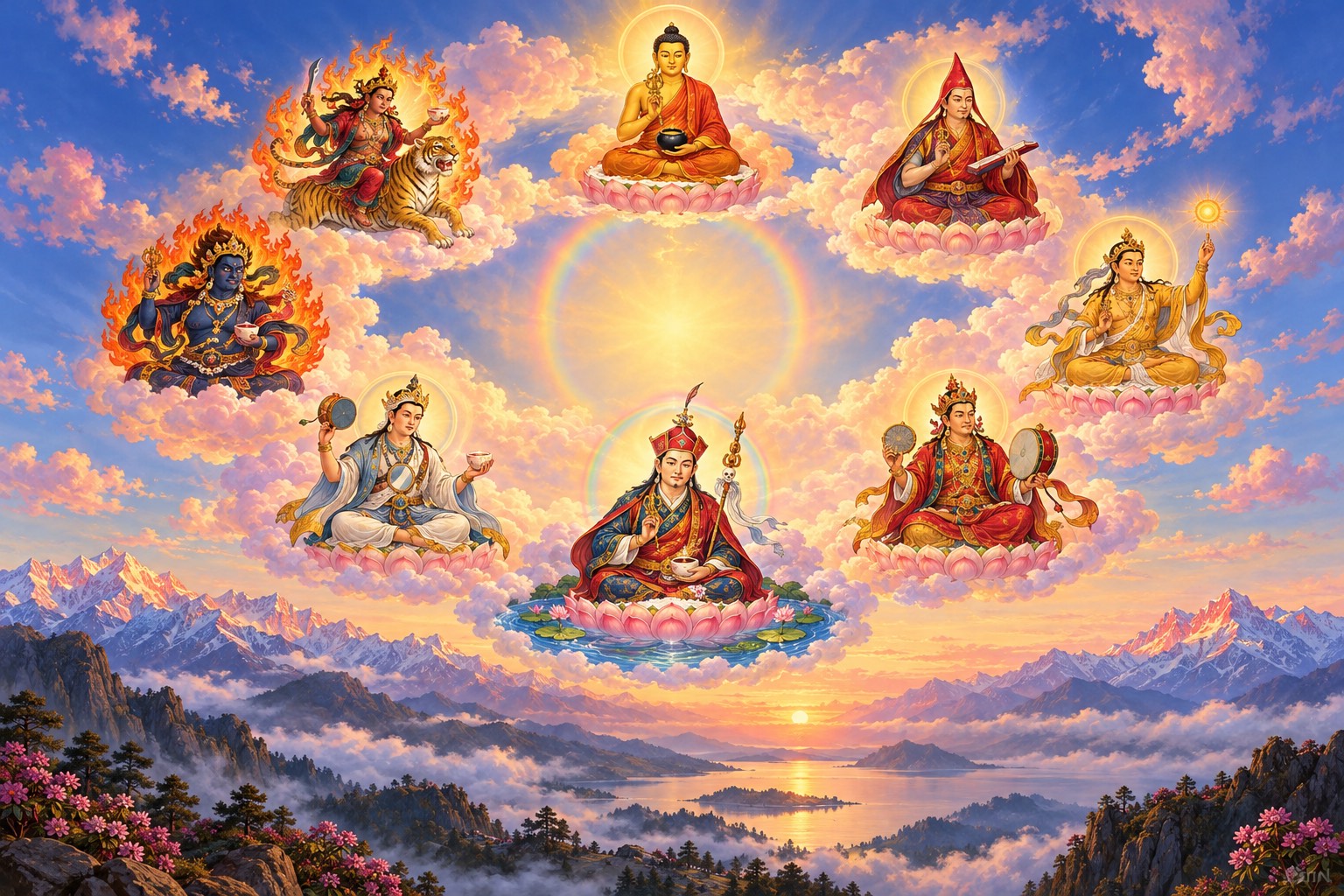
Illustration in preparationMeanwhile, the same account says, Guru Rinpoche appeared in his eight manifestations, the eight forms in which he is remembered, dancing in the field below. Every local spirit came to watch except Shelging Karpo.
Then, as the princess came back, the first ray of the sun struck her vessel. Light flashed onto the cliff, and the valley filled with rays and rainbows. Wikipedia's summary of the oral history tells it a little differently: the vessel is copper, and Guru Rinpoche himself turns its reflected sunlight toward the cave.
Curious at last, Shelging Karpo looked out of his hiding place in the form of a white snow lion. At that moment, the tellings say, Guru Rinpoche became a garuda, the great bird of Himalayan lore, and seized him. The garuda called out his own name: Guru Pema Jungne, the Lotus-Born.
Illustration in preparationThe written versions have no lion and no garuda. In them the spirits simply appear before the Guru, bow, give back the king's life force, and are bound by oath. Below the cave today, a figure of a snow lion with a garuda above it recalls the oral telling.
A life returned
Shelging Karpo yielded. He gave back what he had taken and promised to protect the teachings from then on. The later written version says the life force came back sealed in a small box. When it was brought to the king, it rose like a trembling rainbow and was absorbed at the crown of his head. The pilgrimage account adds that he drank the water from the spring.
The king recovered, the tradition says, and gave himself to the Dharma, the Buddha's teaching. This is the tradition's account of one healing, told to show what it understands Guru Rinpoche's compassion to be. It is not a promise about any illness of ours, and it is no substitute for care.
Illustration in preparationTo seal Shelging Karpo's promise, the story says, Guru Rinpoche planted his walking staff in the earth, and the great cypress behind the temples grew from it. The deity himself is still honoured at Kurjey, painted above a doorway as a pale rider on a white horse.
The oath stone
One thing remained: the war that had started it all. The later written version tells how Guru Rinpoche called both kings to the border, to a broad field of bare rock where no trees grew. There they made peace, laid their hands on a standing stone, and swore never to cross it in war.
The field became known as Nathang, the "place of oath," and the village there is now called Nabji, in the Mangde valley to the south. A temple there, said to have been built by Tashi Khyidren, keeps a stone pillar that pilgrims say bears the handprints of the Guru and both kings. Aris noted that oaths sworn over standing stones belong to the oldest layer of Himalayan custom.
Illustration in preparationThe temples at Kurjey
Bhutanese accounts say the healed king built the first temple against the cave. The oldest temple standing today, the Guru Lhakhang, was built or rebuilt in 1652 by Minjur Tenpa, governor of Trongsa. A second, Sampa Lhundrup, was added in 1900 by Ugyen Wangchuck, later Bhutan's first king.
A third was built for the Queen Grandmother, Ashi Kesang Choden Wangchuck, on the advice of the master Dilgo Khyentse Rinpoche; the same pilgrimage page dates it to both 1984 and 1990. The remains of Bhutan's first three kings rest at Kurjey.
Across the river stands Tamzhing, the temple Pema Lingpa founded in 1501. He knew this story well. Aris points to a vision in his writings of Shelging Karpo guarding a treasure hidden at Kurjey, the place where the Guru had won him over.
Behind the main image of the oldest temple, the cave is still there, with the shape the tradition says his body left in the stone.
Illustration in preparationA name to rest in
At dusk the valley goes quiet. A few people walk slowly along the long wall of small white chortens, and the cypress stands dark against the cliff.
Illustration in preparationFor anyone who recites the Seven-Line Prayer, Kurjey is a story about a name. In the oral telling, the taming comes when the Guru speaks his own name, Pema Jungne, the Lotus-Born. That is the name in the prayer's fourth line, the Tibetan form of Padmasambhava. A grieving king, an offended spirit and a whole valley came to rest in it.
About the art
Guru Rinpoche appears in his main, peaceful form: the lotus hat with a half-vajra, sun and moon and one vulture feather, layered robes in white, blue, red-orange and maroon, a five-pronged vajra at his heart, and the khatvanga, a slender staff crowned with a trident, resting against his left shoulder. A soft rainbow glow marks him as an awakened being.
In scene 9 he appears as a garuda, the great bird of Himalayan lore. In Tibetan art the garuda is the enemy of serpent spirits and stands for fearlessness; here it is painted as a golden bird with small horns and a tiny jewel, without the snake it often holds, so that it is not confused with the Garuda of Hindu imagery. Its talons hover over the snow lion and never wound it, because the tradition tells this as a spirit won over, not destroyed.
Shelging Karpo, the great local deity of Bumthang, is shown only as a white snow lion with a turquoise mane, the form the oral telling gives him. At Kurjey he is also painted as a pale rider on a white horse. The king, the princess and the fortress belong to legend; no portraits of them survive, so their dress is a respectful storybook choice, not a reconstruction.
The eighth-century scenes show the valley bare of temples, prayer flags and chortens. The present-day temples are drawn without prayer flags, which carry printed text, and the people near them are tiny and anonymous. The shape in the rock in scene 12 is shown only as a soft suggestion, as pilgrims describe it, not as a carved image.
Why this matters for practice
The Seven-Line Prayer's fourth line gives Guru Rinpoche's name, Pema Jungne, the Lotus-Born. In the Bhutanese telling of Kurjey, a grieving king and an offended spirit come to peace in the moment that name is spoken. Reciting the prayer is a simple way of saying that name ourselves, and of letting whatever is grieving or offended in us come to rest in it.
If something in this story stayed with you, the grieving king, the princess at the spring, or the shape left in the red rock, you might pause and recite the prayer once. Its fourth line holds the same name the garuda called out.
Sources and further reading
- Bhutan: The Early History of a Himalayan Kingdom, by Michael Aris (Aris & Phillips, 1979), Part One, Chapter 2, "The Legendary 'Sindhu Raja'", Internet Archive (full-text scan)
- Kurjey, a Cave where Guru Rinpoche left his Body Impression, Bhutan Pilgrimage (Internet Archive snapshot, 2024)
- Nabji Lhakhang, a Place where Guru Rinpoche erected a Stone Pillar of Oath, Bhutan Pilgrimage (Internet Archive snapshot, 2024)
- Kurjey Lhakhang, Wikipedia
- Nabji, Wikipedia
- Tashi Khyidren, Rigpa Wiki (Internet Archive snapshot, 2025)
- Garuda, Rigpa Wiki (Internet Archive snapshot, 2024)
- Snow lion, Rigpa Wiki (Internet Archive snapshot, 2024)
- Bhutan: Bumthang Chamkhar Tamzhing (A. Maki Archive), Himalayan Art Resources
This retelling is waiting to be read by a knowledgeable practitioner. Where the traditional accounts differ, the story says so; if you notice a mistake, please tell us through Share Your Story.