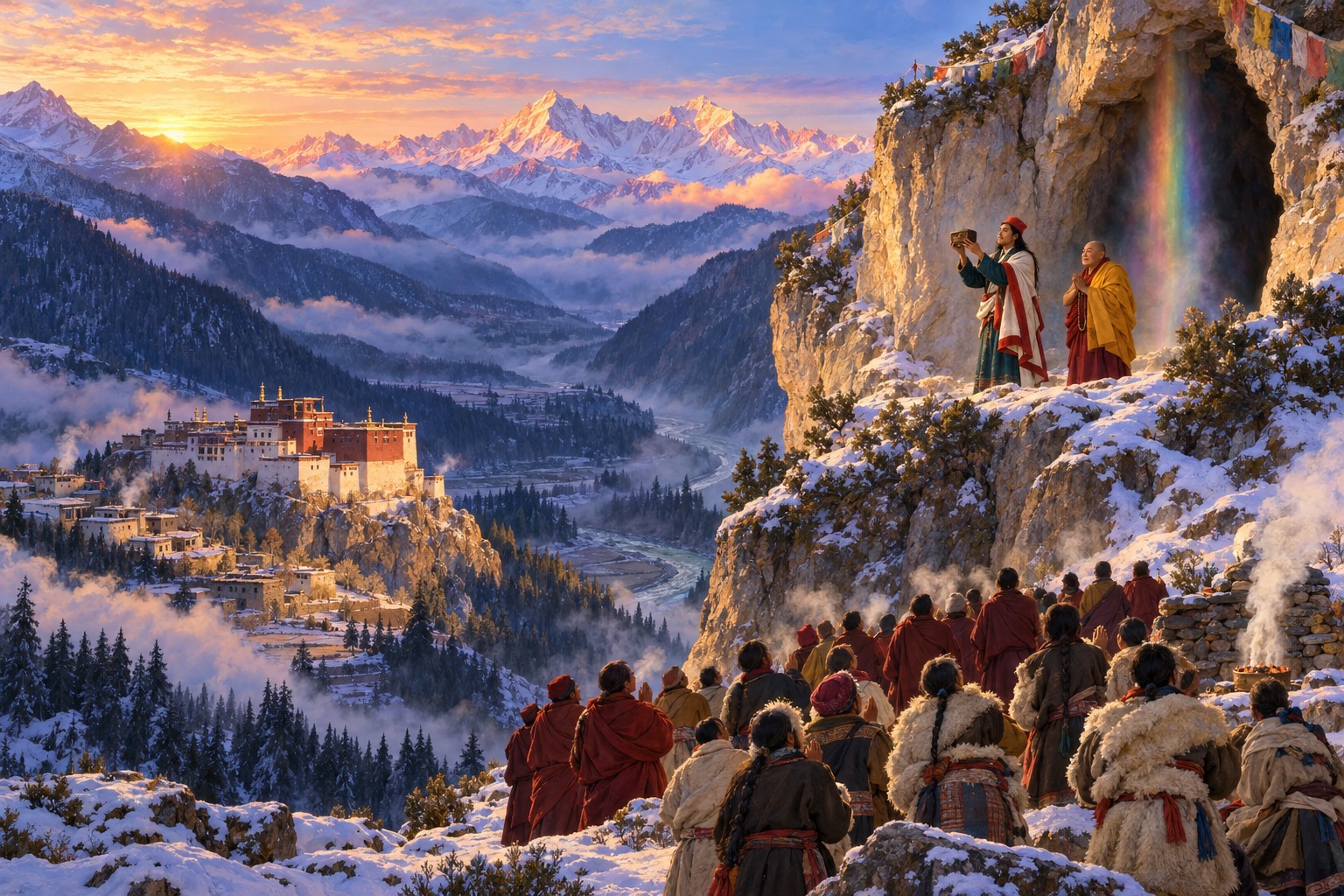
Far in the east of Tibet, in the region called Kham, a fast river cuts a long, deep valley through forested mountains. This is Nyarong. In the nineteenth century its farmers and herders were known as fierce fighters.
Here, in 1856, a boy was born into the Shyipa household, a well-off family that Treasury of Lives says was descended from a royal line. His father was Dargye and his mother Orgyen Drolma. He was named Sönam Gyalpo, "King of Merit," and the name was shortened to Sogyal.
He is remembered as Tertön Sogyal, and by his treasure name, Lerab Lingpa. A tertön is a treasure revealer. The tradition holds that Guru Rinpoche and Yeshe Tsogyal hid teachings and sacred objects long ago, to be found by destined people in later ages; how they were hidden is told in The Hiding of the Treasures.
A letter on a page
He learned to read and write quickly. His biography, as retold on Rigpa Wiki, says that while he was still very young he was taken to Nyala Pema Dündul, a great yogi of Nyarong. The master showed him a page written in Lantsa, an ornamental script used for Sanskrit, and the boy at once named the letter sa.
In Tibetan, sa also means "earth." Pema Dündul took it as a sign, the account says, that no one on earth would be greater than this child. The teachers who met him asked that he be sent to a monastery.
 Illustration in preparation
His father refused. Sogyal was his only son, and an only son belonged at home.
The hunter
So he grew up as the young men of Nyarong did. Treasury of Lives says he learned to hunt and to fight, and did both with skill.
Then something turned. Out hunting one day, the biography says, he looked along the sights of his rifle and saw the script of the dakinis, female embodiments of awakened wisdom. Soon afterwards he fell ill.
Illustration in preparationWhen he recovered, his father sent him hunting again. Then, the story goes, he dreamed that Ekajati, a fierce guardian of the secret teachings, pierced his heart with her single white fang. He fell sick once more. A divination said he must practise the Dharma, and at last his father let him go.
The sources tell this turning in different ways. Treasury of Lives says only that he fell ill at fourteen, went on pilgrimage on a lama's advice, and came home determined to practise. A prayer about his life by his fellow tertön Drimé Özer places his journey to Nyala Pema Dündul's camp after the dream. All of them agree that the young hunter put the rifle down.
Five years in retreat
He studied under Lama Sönam Thayé, one of Pema Dündul's two chief disciples. From about thirteen to eighteen he stayed in retreat. Even then, the biography says, he was deciphering a treasure written in the coded script of Yeshe Tsogyal.
Illustration in preparationNyala Pema Dündul passed away in 1872, when Sogyal was sixteen. At his request his disciples sewed his tent shut, and the tradition holds that after seven days only his hair, nails and clothes remained. Before he went, Rigpa Wiki records, he reminded them of an old saying: "For those with faith and devotion, Padmasambhava sleeps at their door."
Sogyal went on to study with many great masters of Kham, among them Patrul Rinpoche's disciple Nyoshul Lungtok, and Mipham. For long stretches, the biography says, he owned nothing but a yogi's white robes and practised alone in the forest.
The chest in the rock
Around 1880 came his first great earth treasure, an object drawn from the land itself. At a place called White Rock, the accounts say, he saw the outline of a door in the cliff but could not open it, and lay down to sleep. A crash like breaking stone woke him. The rock had split open, just wide enough for his hand.
Behind it lay a cave, and in the cave an iron chest. Treasury of Lives lists what was inside: a hat, a black cloak, a vajra and bell, a ritual dagger and a silk banner written in gold. The tradition says they had belonged to Nanam Dorje Dudjom.
Illustration in preparationThe minister of Samye
Nanam Dorje Dudjom was a minister of King Trisong Detsen in the eighth century, the envoy sent to invite Guru Rinpoche to Tibet, and one of the master's twenty-five close disciples. The tradition sees Sogyal as his rebirth, and Rigdzin Gödem, told in Rigdzin Gödem and the Hidden Valleys, as another.
Many of Sogyal's treasures are described as teachings Guru Rinpoche gave Dorje Dudjom at Samye, sealed away for this later life. Above all they centre on Vajrakilaya, a wrathful meditation deity whose practice the Nyingma school holds to clear away obstacles. Guru Rinpoche is said to have relied on it himself in the caves of Nepal, as told in The Caves of Yangleshö.
Illustration in preparationVajrakilaya became Sogyal's own heart practice. These practices are given by a qualified teacher, with empowerment, so this page only names them; the Find a Teacher page can help. The Seven-Line Prayer itself is open to anyone.
Before Khyentse
One Vajrakilaya treasure, Yang Sang Tröpa, he kept for five years, practising it as its prophetic guide directed. Then, in 1884, he brought it to Jamyang Khyentse Wangpo at Dzongsar, one of the three friends of The Treasure Friends of Kham.
Khyentse declared him an authentic tertön and gave him empowerments. When the two made a feast offering together, the biography adds, a treasure casket appeared in the middle of the mandala.
Illustration in preparationTeacher to the Dalai Lama
In 1888 requests came from Lhasa. The Thirteenth Dalai Lama, Thubten Gyatso, was then a boy of about twelve. Sogyal set out for the capital, revealing treasures on the road, the accounts say, and arrived in the autumn.
Illustration in preparationSogyal returned to Lhasa again and again, and gave the Dalai Lama the empowerments of his treasures. Treasury of Lives notes that the Dalai Lama reportedly helped to decipher some of them himself.
Illustration in preparationIn 1891 Sogyal brought to Lhasa a small statue of Guru Rinpoche he had revealed, called "Liberation upon Seeing." The biography describes clouds of incense, a gathered crowd, and rites of consecration in Lhasa's great temple, the Jokhang, in the Dalai Lama's presence.
Illustration in preparationThe Razor
In the autumn of 1895, back in Kham, Sogyal climbed with Jamgön Kongtrul, then about eighty-two, to a cave above Kongtrul's hermitage of Tsadra Rinchen Drak. When he saw the outline of the treasure door, the biography says, he grew excited and threw a stone at it. The mountain shook, the rock opened, and a sweet fragrance filled the air.
From the opening he drew a small statue and the casket of the Yang Nying Pudri, "Razor of the Innermost Essence," a Vajrakilaya cycle. Rigpa Wiki says it later became a regular practice of Namgyal, the Dalai Lama's own monastery.
Illustration in preparationOne telling says this treasure was first meant for Kongtrul and passed to Sogyal by necessity. Either way, the old scholar stood there that day, and later received its empowerments from his younger friend.
A hard year
Around 1900, Treasury of Lives relates, a plot against the Dalai Lama came to light, and boots Sogyal had given him were found to hide a harmful charm. Sogyal declared his innocence and said where the boots had come from. When the truth came out, he pleaded for mercy for those involved.
The lotus in the mud
Through all of it, Guru Rinpoche stays at the centre. On the tenth day of the seventh month of 1900, a day kept for Guru Rinpoche, the biography says the Guru appeared to him in a dream amid dakinis and gave him the teaching of Tendrel Nyesel, "Dispelling Flaws in Interdependence." When its casket came into his hands soon after, he said no revelation had ever made him happier.
He also wrote a short commentary on the Vajra Guru mantra, the mantra that follows the Seven-Line Prayer. On the word Padma, "lotus," he explains that Guru Rinpoche stays in the world for the sake of beings yet is never stained by it, "like a lotus that grows from mud" (trans. Samye Translations).
Illustration in preparationWhite scarves
In his last years he moved to Golok, in the north-east, to be near the Third Dodrupchen, Jigme Tenpe Nyima, a son of Dudjom Lingpa. In 1924 he entrusted the rest of his treasures to him. At their parting, Rigpa Wiki says, the two exchanged white scarves for the first time and promised to meet again in the pure land.
Illustration in preparationIn 1925 he sealed away again the treasures he had not finished, praying to meet them in a later life. He passed away in 1926, on the tenth day of the first month by most accounts; Treasury of Lives gives the second. His revelations fill about twenty volumes.
Teachers of the next century carried his lineage on. Jamyang Khyentse Chökyi Lodrö wrote a grieving lament for him, and later masters were recognized as his rebirths.
Illustration in preparationA rifle laid down, a stone thrown at a cliff, a lifetime opening doors Guru Rinpoche had closed for later ages.
About the art
Tertön Sogyal is drawn from the painted mural of him at Shechen Monastery (reproduced on Rigpa Wiki and Lotsawa House), not from the one photograph said to survive: a broad, beardless face, black hair drawn up in a topknot bound with red cord, large gold earrings, a rose-pink robe and a white shawl with a broad patterned border. He was a lay tantric master with a family, not a monk, and the white of the shawl is the colour of the yogi's robes the biography says he wore. In the mural his right hand holds a phurba, the three-sided ritual dagger of Vajrakilaya, his heart practice, and his left a small treasure casket. The images keep only the casket: a dagger drawn out of context is easily misread, and the practice behind it belongs with a teacher.
As a youth he wears the heavy wool robe of Kham with one arm out of its sleeve and a red tassel in his braided hair, and carries an old matchlock musket with a forked rest, shown lowered and never aimed. Nyala Pema Dündul is shown in the plain white of a lay yogi; no portrait of him was consulted, so the image is a respectful approximation. The Thirteenth Dalai Lama appears only once, small and from behind, in the tall yellow hat and maroon and gold robes of his portraits; his face is never shown.
Guru Rinpoche appears twice in his main form: the lotus hat with a half-vajra and a single vulture feather, a five-pronged vajra at his heart, a skull cup holding a long-life vase in his lap and the khatvanga staff against his left shoulder, seated on a lotus inside a rainbow sphere. Rainbow light is kept for him alone. The small gilt statue in the Lhasa temple shows the same form; such images, called kutsab, "representatives", are held to stand in for the Guru himself.
The minister Nanam Dorje Dudjom wears eighth-century Tibetan court dress and a plain turban. Caskets, scrolls, books and banners are always shown blank or turned away, because Tibetan script is never painted into the images. The two white scarves are khatak, offered in greeting, farewell and respect.
Why this matters for practice
Line four of the Seven-Line Prayer names Guru Rinpoche: Padmasambhava, the Lotus-Born. Tertön Sogyal spent his life drawing out teachings sealed in that name's keeping, and wrote that the lotus in it means a presence that stays in the world without being stained by it. His story suggests that even a restless young hunter can turn toward that presence. Saying the seven lines, even once, is a simple way to take a first step in the same direction.
If something in this story touched you, the boy who named a letter or the hunter who set down his rifle, you might pause tonight and recite the Seven-Line Prayer once, and call on the one who, the old saying goes, sleeps at the door of those who trust him.
Sources and further reading
- Tertön Sogyal, Rigpa Wiki (Internet Archive snapshot, November 2024)
- Tertön Sogyal Biography, Rigpa Wiki (Internet Archive snapshot, 2024)
- Lerab Lingpa, by Samten Chhosphel (September 2011), Treasury of Lives (Internet Archive snapshot, September 2014)
- The Seeds of Faith: A Prayer to the Vidyādhara and Great Tertön Lerab Lingpa, by Drimé Özer, Lotsawa House (Rigpa Translations, 1999)
- A Synopsis of the Vajra Guru Mantra, by Lerab Lingpa, Lotsawa House (Samye Translations, 2019)
- Tertön Sogyal Series and Inventory: The Perfectly Clear Mirror (Yang Nying Pudri), Lotsawa House
- Nyala Pema Dündul, Rigpa Wiki (Internet Archive snapshot, 2024)
- Dalai Lama Iconography, Himalayan Art Resources (Internet Archive snapshot, 2024)
- Potala Palace, Wikipedia
- Matteo Pistono, In the Shadow of the Buddha (Dutton, 2011)
This retelling is waiting to be read by a knowledgeable practitioner. Where the traditional accounts differ, the story says so; if you notice a mistake, please tell us through Share Your Story.