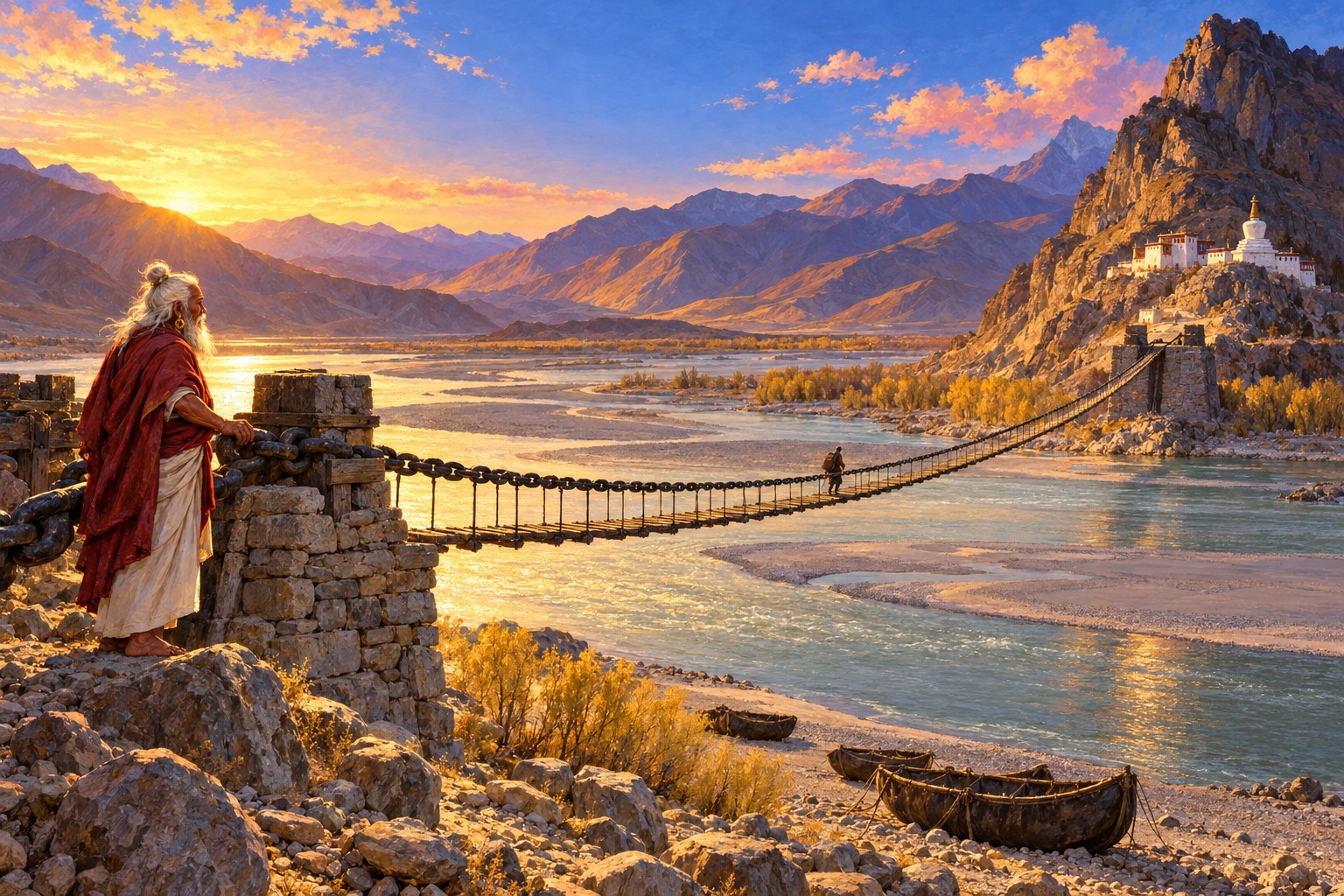
Where the Yarlung Tsangpo runs broad and cold beneath the mountain of Chuwori, travellers once crossed the river on a bridge of iron. Two heavy chains swung from bank to bank, and a walkway of short planks hung below them, wide enough for one person at a time.
People called the man who built it Chakzampa, "the Iron-Bridge Man." His best-known name is Thangtong Gyalpo, "King of the Empty Plain." Tibetans and Bhutanese still speak of him with a special fondness: a builder, a healer, a wandering yogi with a long white beard, and something of a holy eccentric.
A life too long to measure
Even his dates are a puzzle. Some accounts give 1361 to 1485, a life of about 124 years. Others prefer 1385 to 1464, and Rigpa Wiki gives 1385 to 1509.
The Treasury of Lives, an online encyclopedia of Himalayan lives, uses several of these in different articles. Tradition remembers him living to 125, and the scholars have not settled it.
He was born at Ölpa Lhartse in Tsang, in western Tibet. A legend recorded by early travellers, and passed on by the architect Manfred Gerner in his study of the bridges, says he waited sixty years in his mother's womb, meditating for the good of beings, and came into the world already grey-haired. Gerner suggests this is why his hair and beard are always painted white.
The King of the Empty Plain
He is said to have studied with more than five hundred teachers in Tibet, India and Nepal, and took the monk's name Tsöndrü Zangpo, "Excellent Diligence." But the name that stuck came from elsewhere.
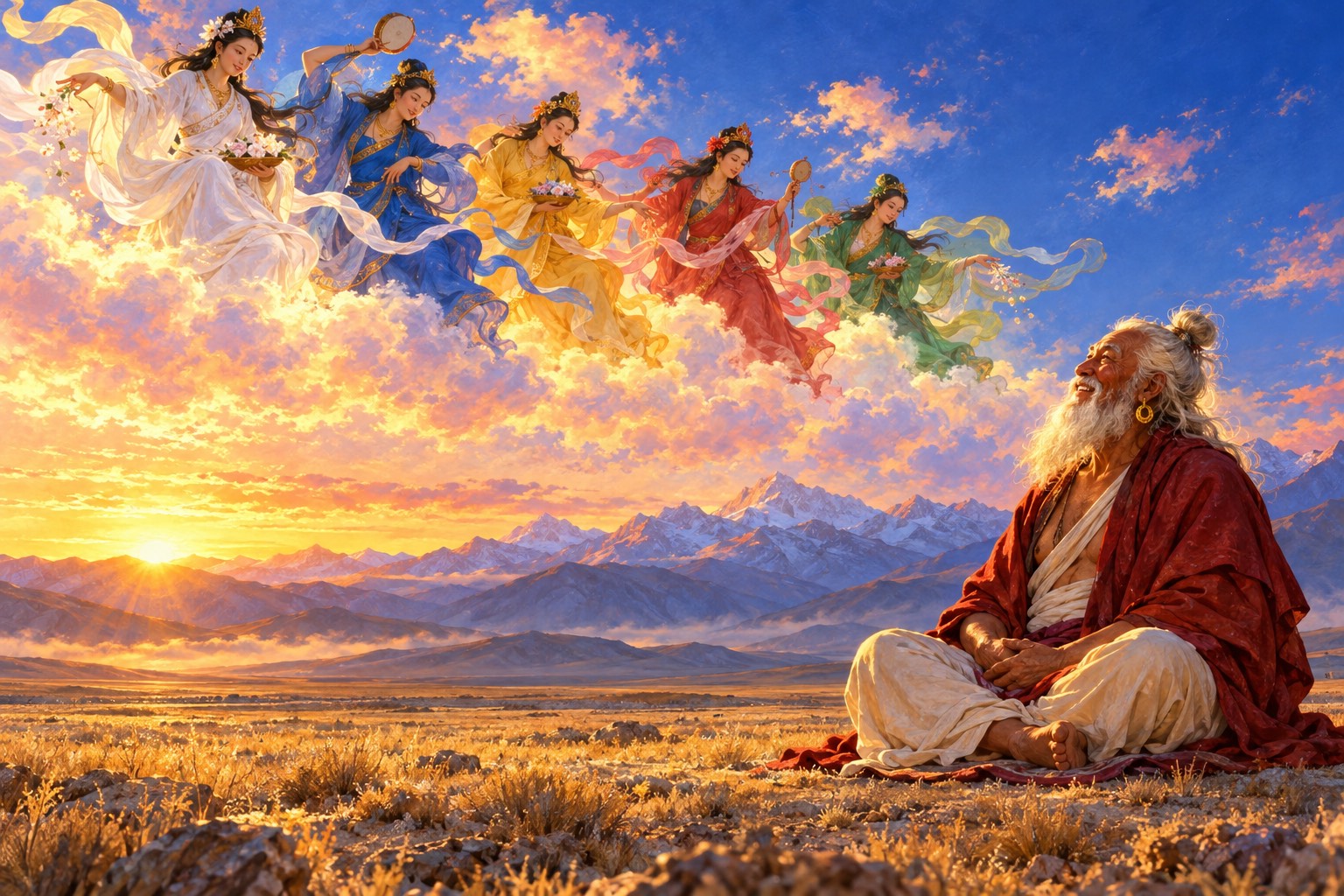
Rigpa Wiki tells how. While he sat in meditation on the Gyede plain in Tsang, five dakinis, the female wisdom beings of the tradition, came to him singing praises. They named him for what they saw: a yogi who had understood emptiness, sitting fearless as a king on a great open plain.
The dakinis gave him other names too. One, Cyrus Stearns notes in his study King of the Empty Plain, was "Madman of the Empty Valley": he belonged to Tibet's line of "mad adepts," whose startling ways were meant to shake people loose from habit.
Many streams, one source
He drew from many lineages at once. In visions, the traditional accounts say, the Indian yogini Niguma gave him her teachings directly, and he became the source of the "Iron Chain" line of the Shangpa Kagyu. From the Nyingma he received the Northern Treasures, a body of Guru Rinpoche's hidden teachings, and he was close to the Sakya school as well.
Guru Rinpoche is Padmasambhava, the eighth-century master the Seven-Line Prayer calls upon. Rigpa Wiki and Stearns both record the belief that Thangtong Gyalpo was an emanation of Guru Rinpoche's enlightened mind. He is also counted among the tertöns, the revealers of terma, the "treasures" Guru Rinpoche is said to have hidden for later times. A verse of homage on Lotsawa House praises him for bringing out many ancient treasures and hiding more for the future.
Why build a bridge?
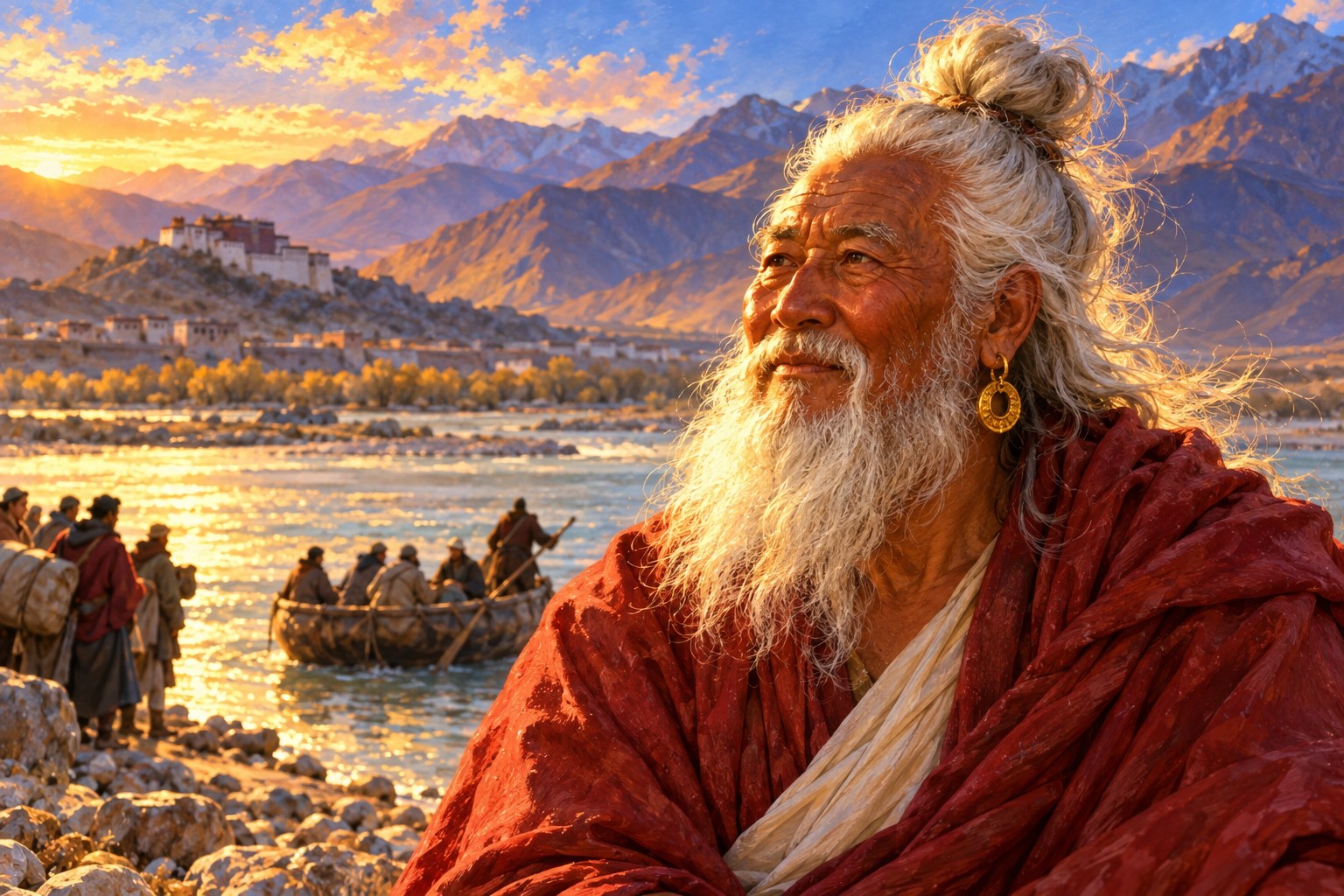
A popular story tells how it began. At a ferry crossing near Lhasa he saw poor travellers stranded on the bank because they could not pay the fare. He asked the ferryman to carry them for free and was beaten for his trouble, so he resolved to build bridges that anyone could cross.
The older accounts give a deeper reason. Gerner, following the scholar Janet Gyatso, says the bridges grew out of prophecies Thangtong received from Chenrezig, the bodhisattva of compassion, and were part of his vow to help all beings. A bridge, after all, is compassion you can walk on.
Iron from Bhutan
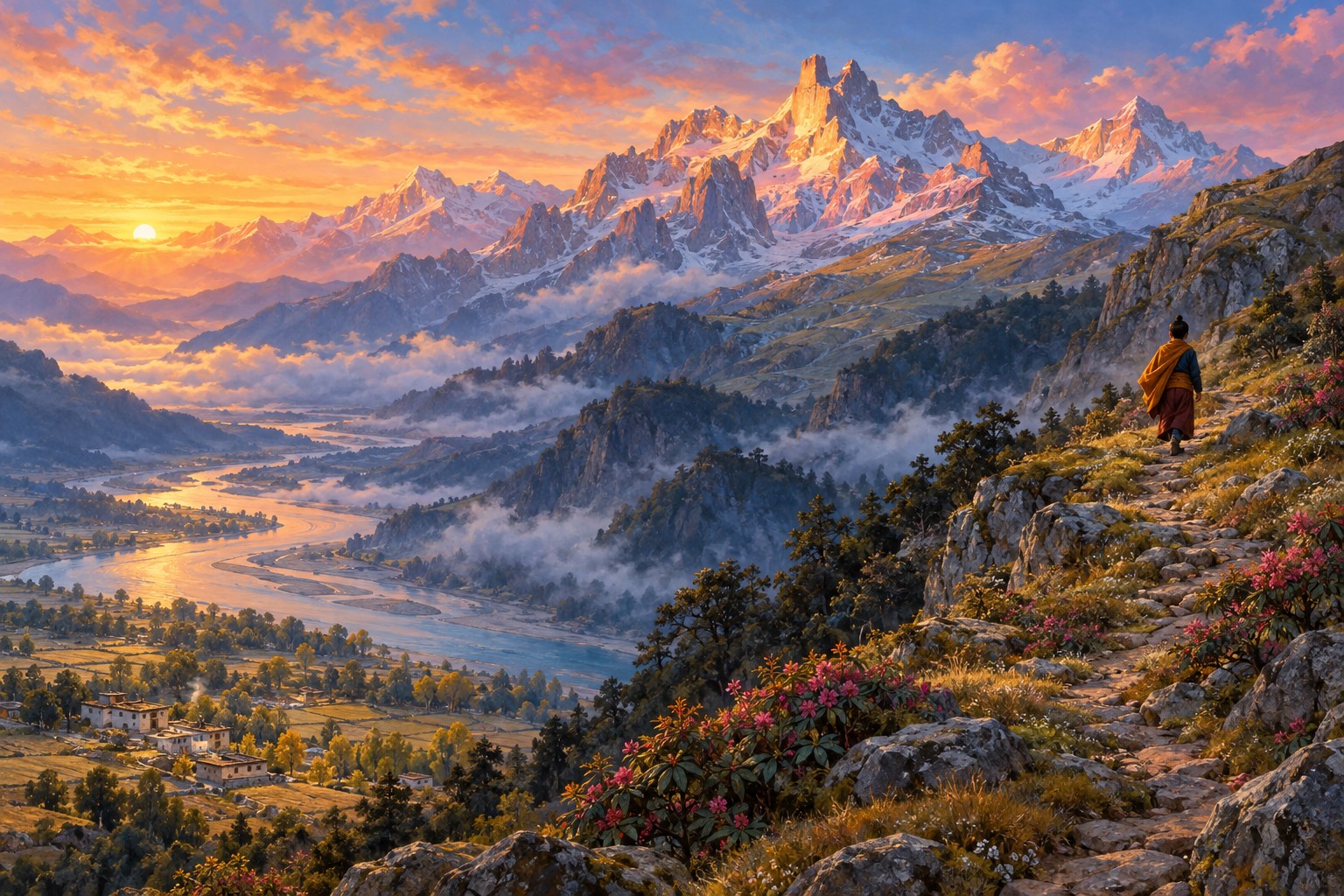
Bridges need iron, and in 1433, Gerner writes, he crossed the Himalaya by way of Phari into Bhutan, partly to spread the teachings and partly to find it.
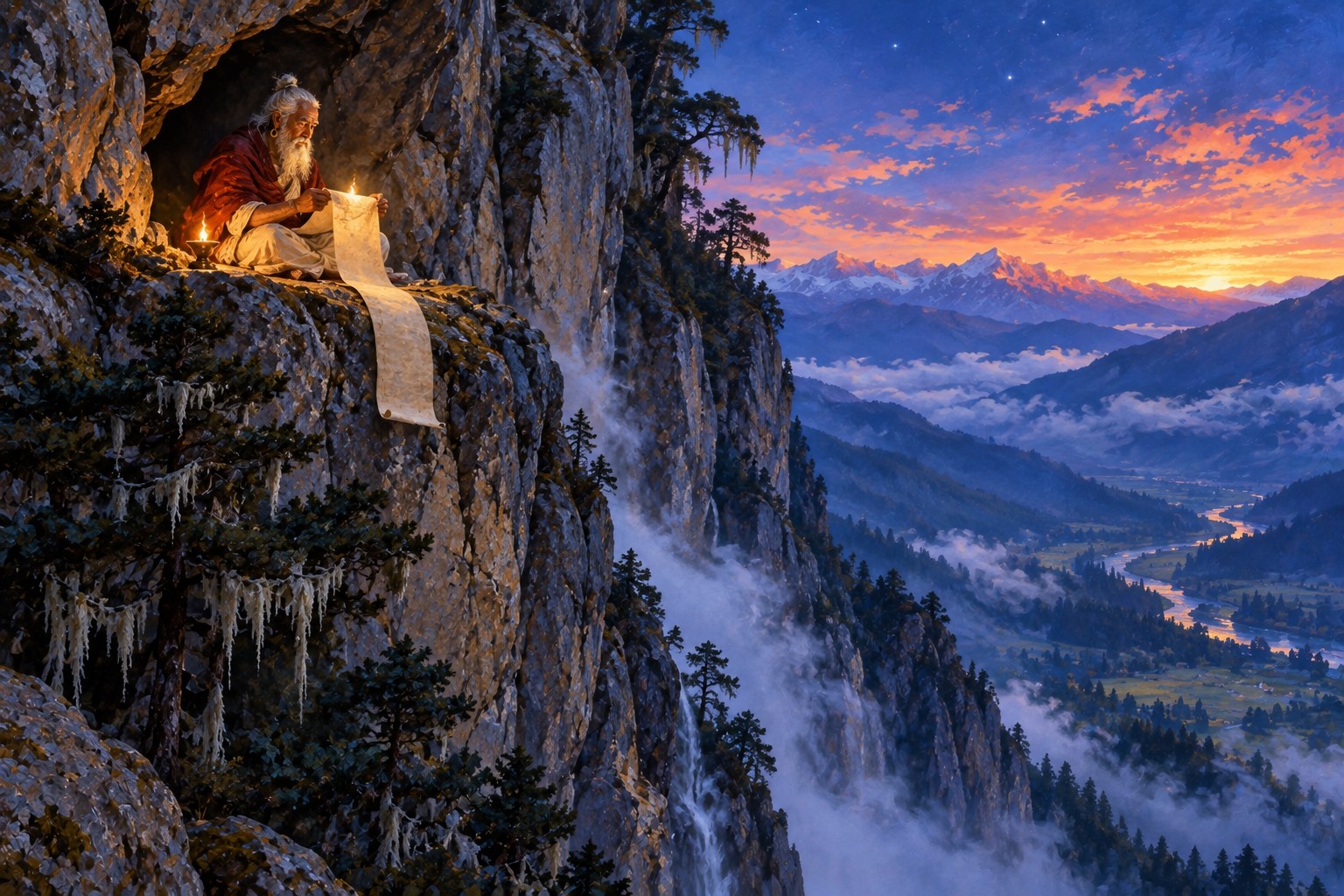
He began, as many masters had, at Taktsang, the cliff above the Paro valley where Guru Rinpoche is said to have meditated. One Bhutanese retelling of his biography says a guardian spirit of the place told him that Guru Rinpoche had hidden an inheritance there for him, and he drew a long scroll out of the rock.
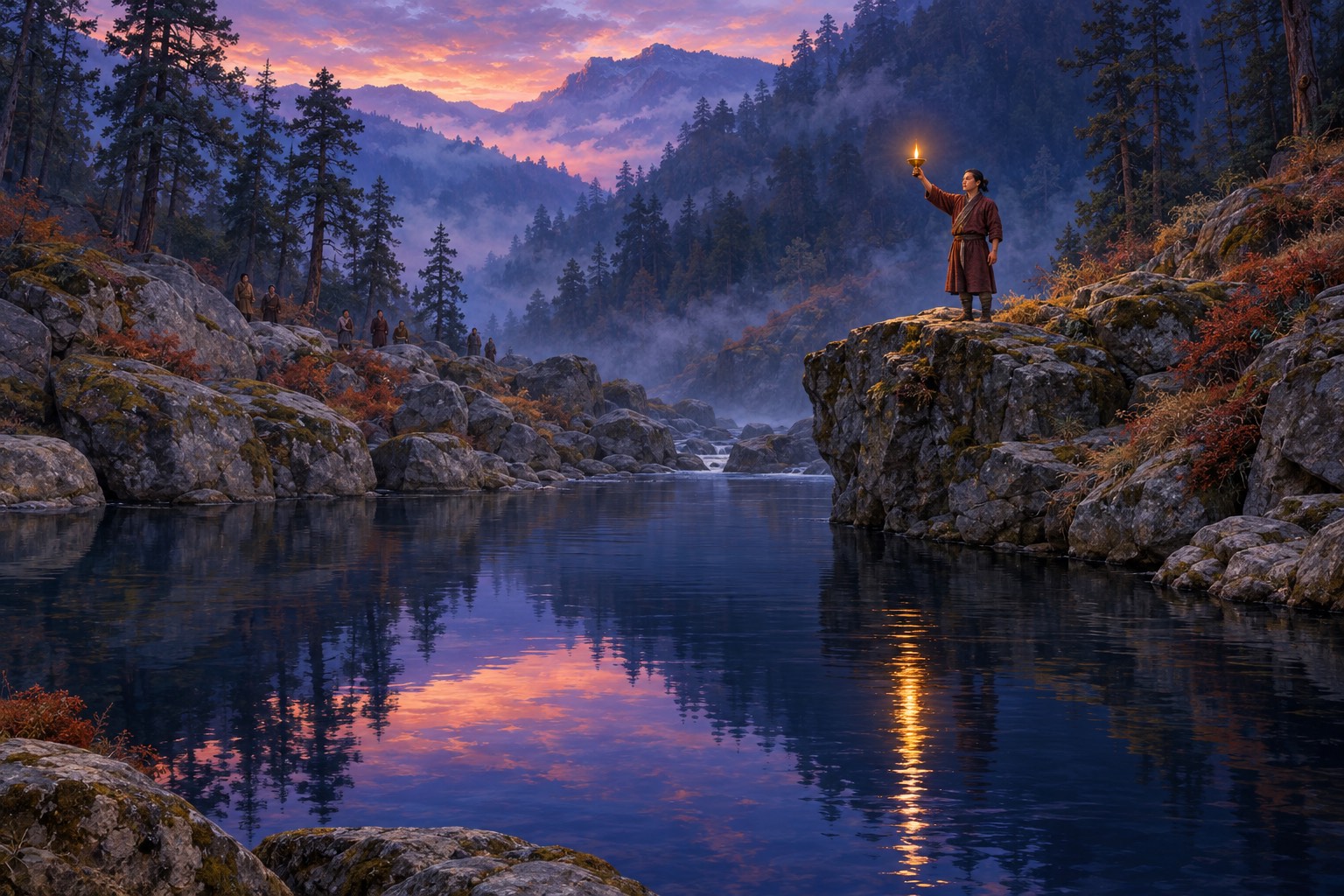
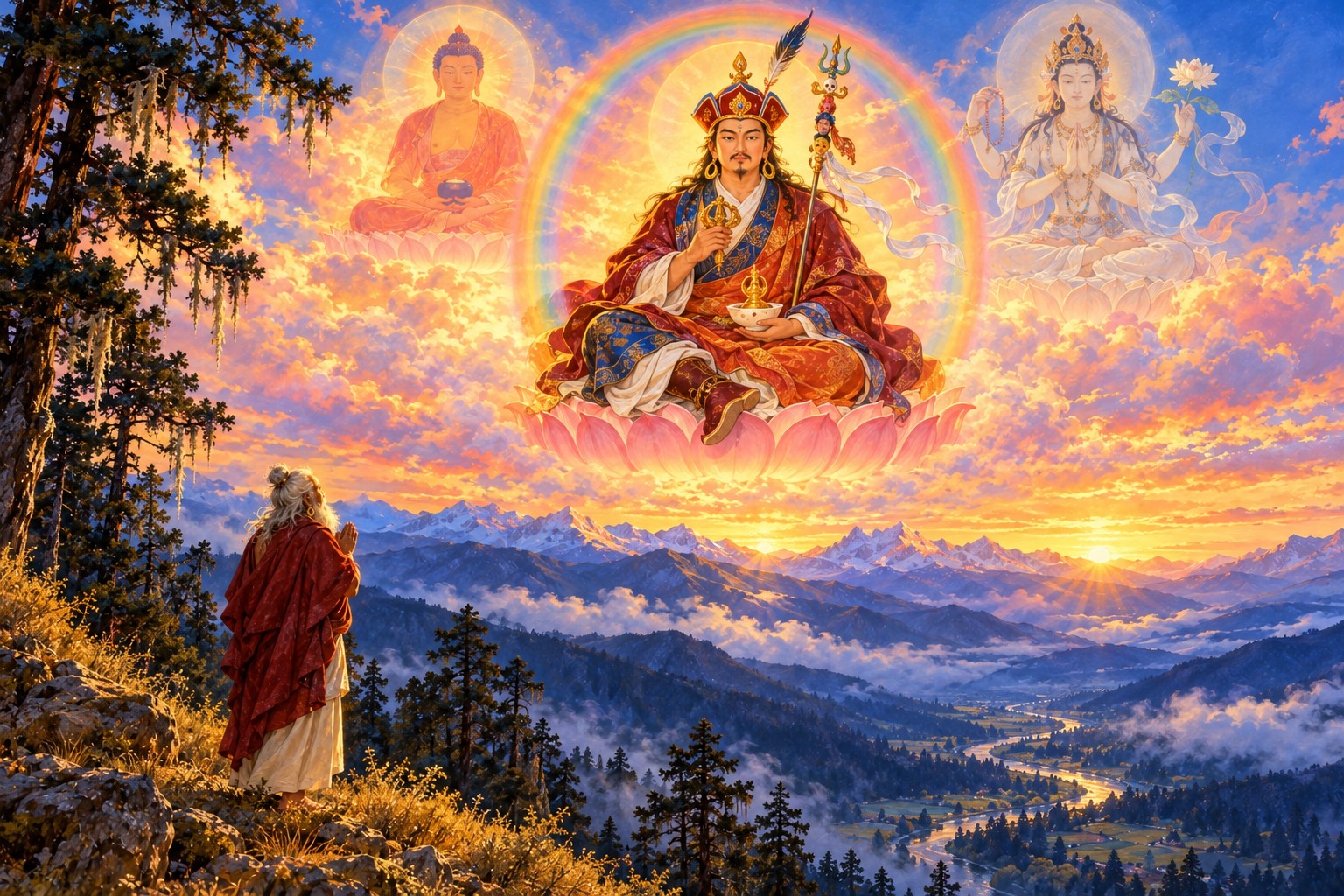
Further down the valley, the same retelling says, he came to a place called Phurdo and saw a five-coloured rainbow. Seated on it were the Buddha Amitabha, Chenrezig and Guru Rinpoche, and he declared the place as sacred as Chenrezig's own mountain paradise.
Below it, beside the Paro river, he founded the temple of Tamchog. Gerner notes that the rock there is still a rusty, iron-rich red. A local account gives the temple's name another origin, a vision of an excellent horse, and both stories are still told.
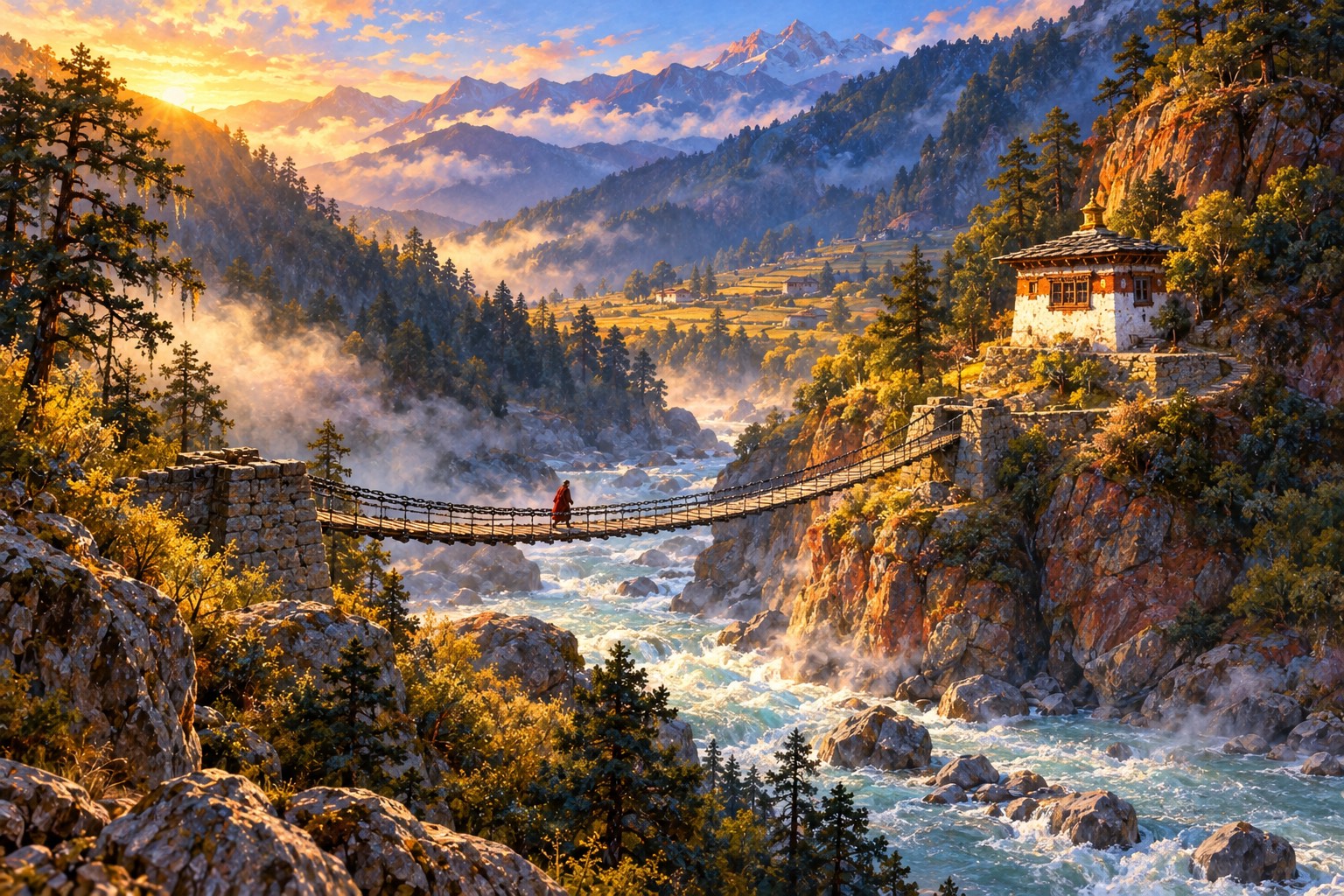
His descendants still look after Tamchog. Its iron-chain bridge over the river was swept away by a flood in 1968 and rebuilt in 2003, using old chains believed to be his.
Seven thousand links
In Paro he gathered offerings of iron, and the blacksmiths went to work. Gerner, citing the 1609 biography by Gyurme Dechen, records that the smiths of Paro forged seven thousand chain links, packed fifteen to a load.
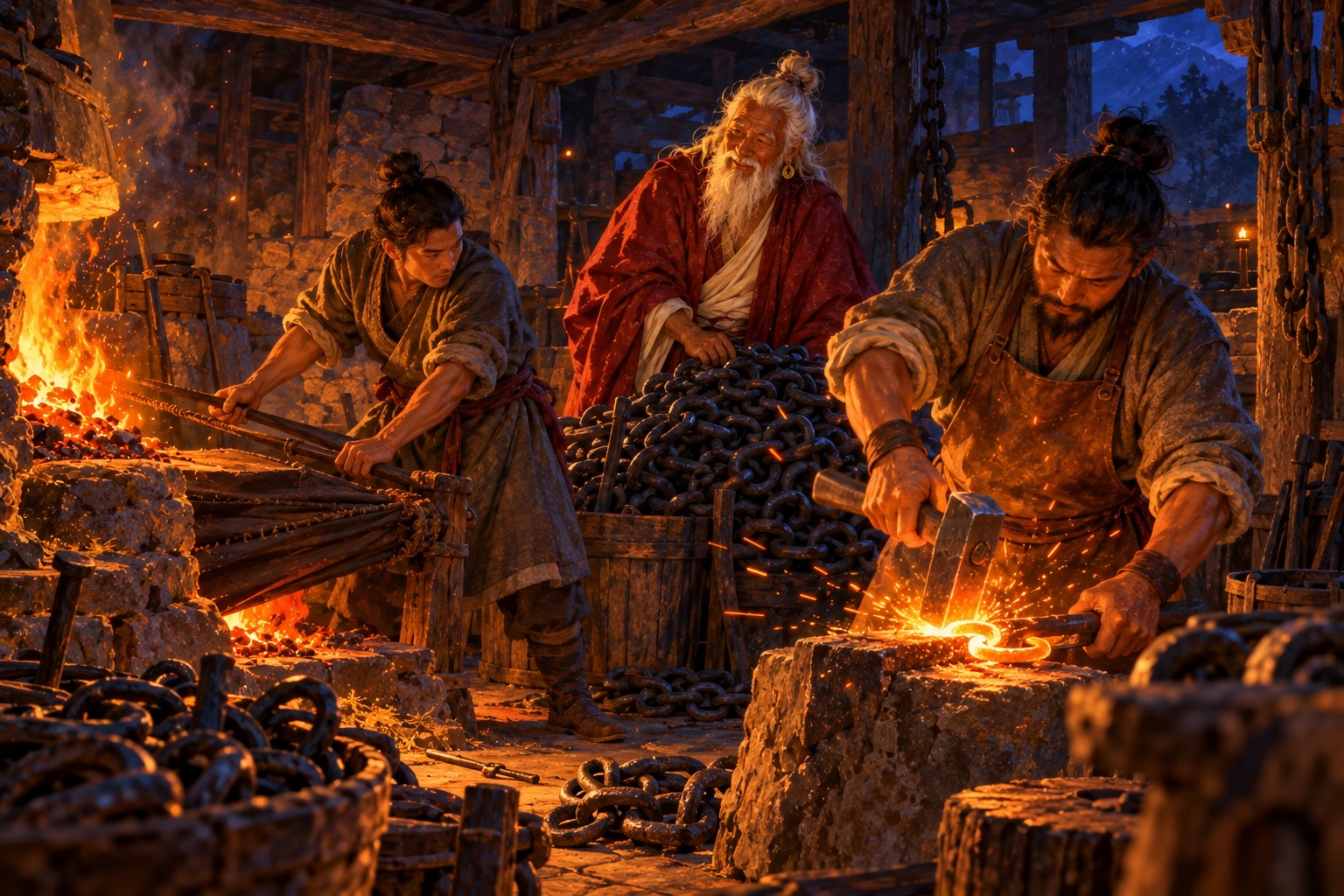
One retelling adds a wonderfully practical miracle: so that eighteen villages could work at once, he is said to have become eighteen people, one to stand beside each blacksmith.
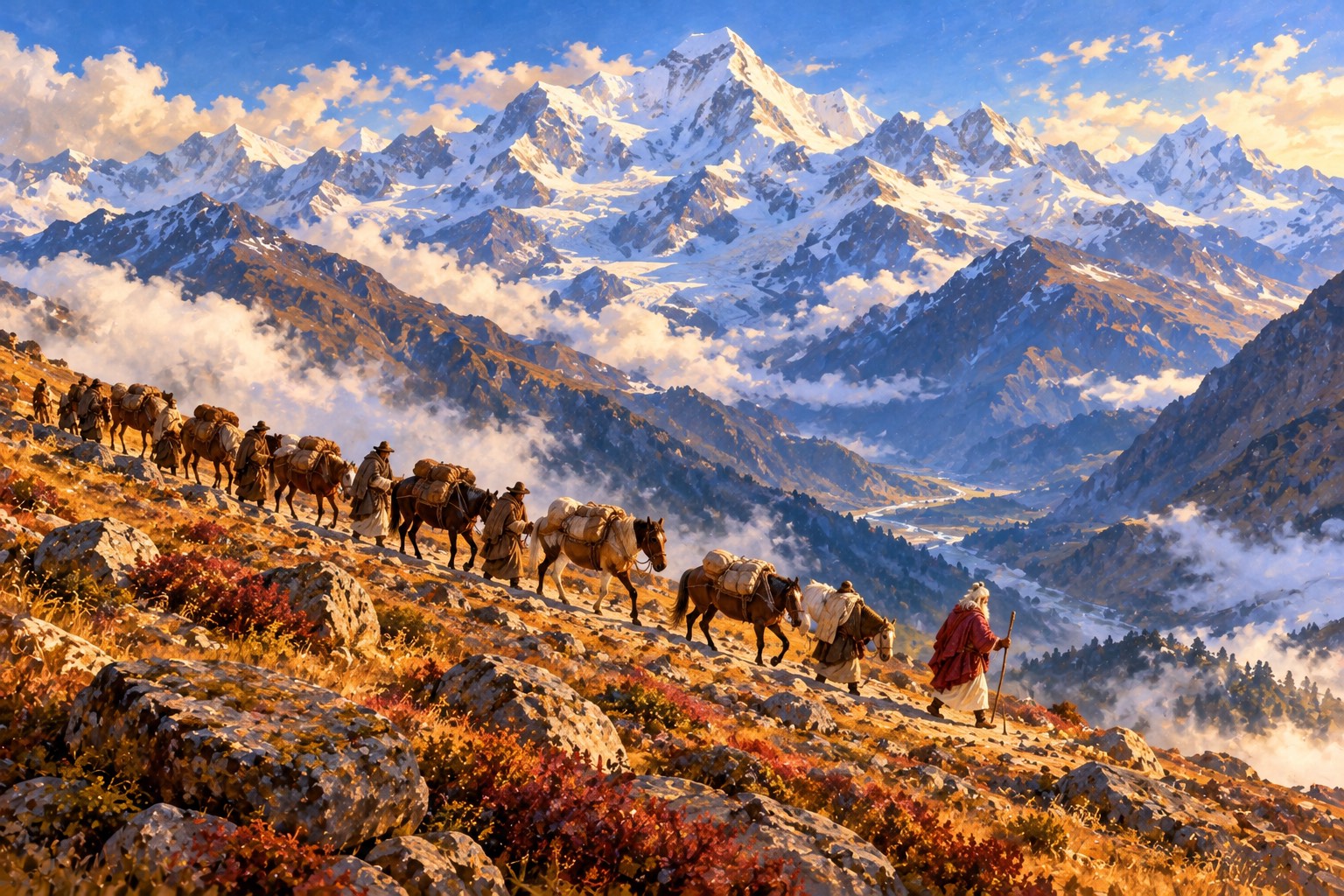
Then came the long haul home: some fourteen hundred horse-loads of iron, the accounts say, carried north over the passes to Phari and on into Tibet. Many of his Bhutanese bridges have gone, but Bhutan still credits him with eight of them, and with the art of the blacksmith itself.
The bridge at Chakzam
In 1444 he founded his main seat on Chuwori, the mountain at the southern end of his great bridge over the Yarlung Tsangpo. Gerner notes that Chuwori was one of Guru Rinpoche's places of meditation. The bridge toll is said to have supported about a hundred monks.
The summary of Stearns's book gives an astonishing tally: fifty-eight iron suspension bridges, sixty wooden bridges, 118 ferries and 111 stupas, besides temples from Derge in the east to Bhutan in the south. Travellers photographed the Chakzam bridge in the early twentieth century. Today it is gone.
Seven sisters and the first opera
Bridges also cost money. Tibetan oral tradition says that while the bridge at Chuwori was being built, he picked seven sisters from among his workers, taught them songs and dances, dressed them in fine costumes and sent them from village to village to raise funds. He beat the drum and cymbal himself.
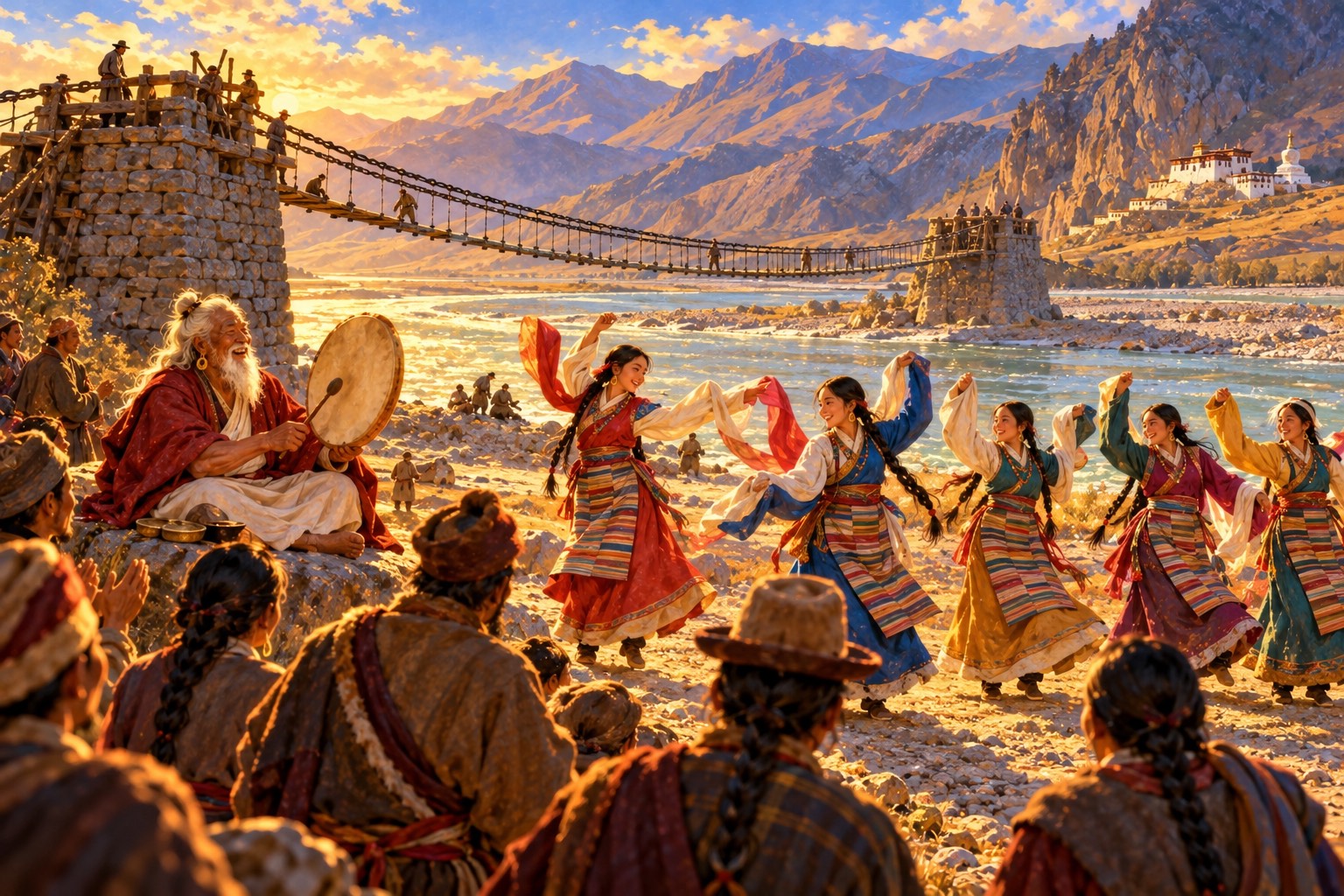
Audiences were so delighted, the story goes, that they called the sisters lhamo, goddesses. From them, Tibetans say, came Ache Lhamo, "the goddess sisters," Tibet's traditional open-air opera.
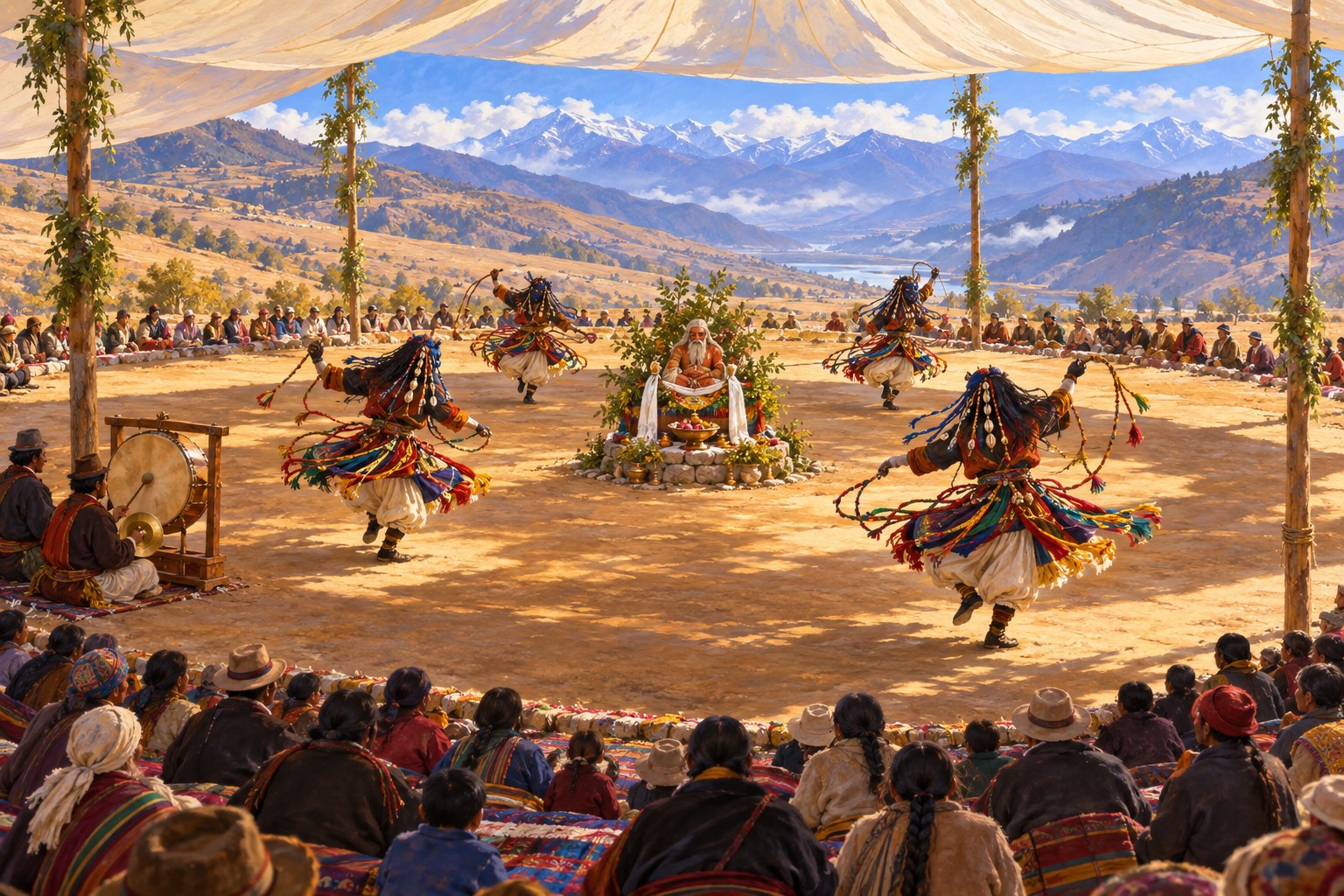
The masks and many of the stories came later, but the founder has not been forgotten. At the start of a performance, a troupe sets his small statue on an altar in the middle of the ground and pays him homage. Gerner adds that when Tibetans move house, his image is often the first thing carried in.
Prayers for hard times
He is also remembered for prayers spoken when people were suffering. Lotsawa House preserves the story behind one of them. When an epidemic was spreading through the great monastery of Sakya, and rituals, medicines and amulets had all failed, he told everyone to recite his refuge prayer, "All mother beings as infinite as space," to recite the mani mantra of Chenrezig many times, and then to say a short prayer he gave them.
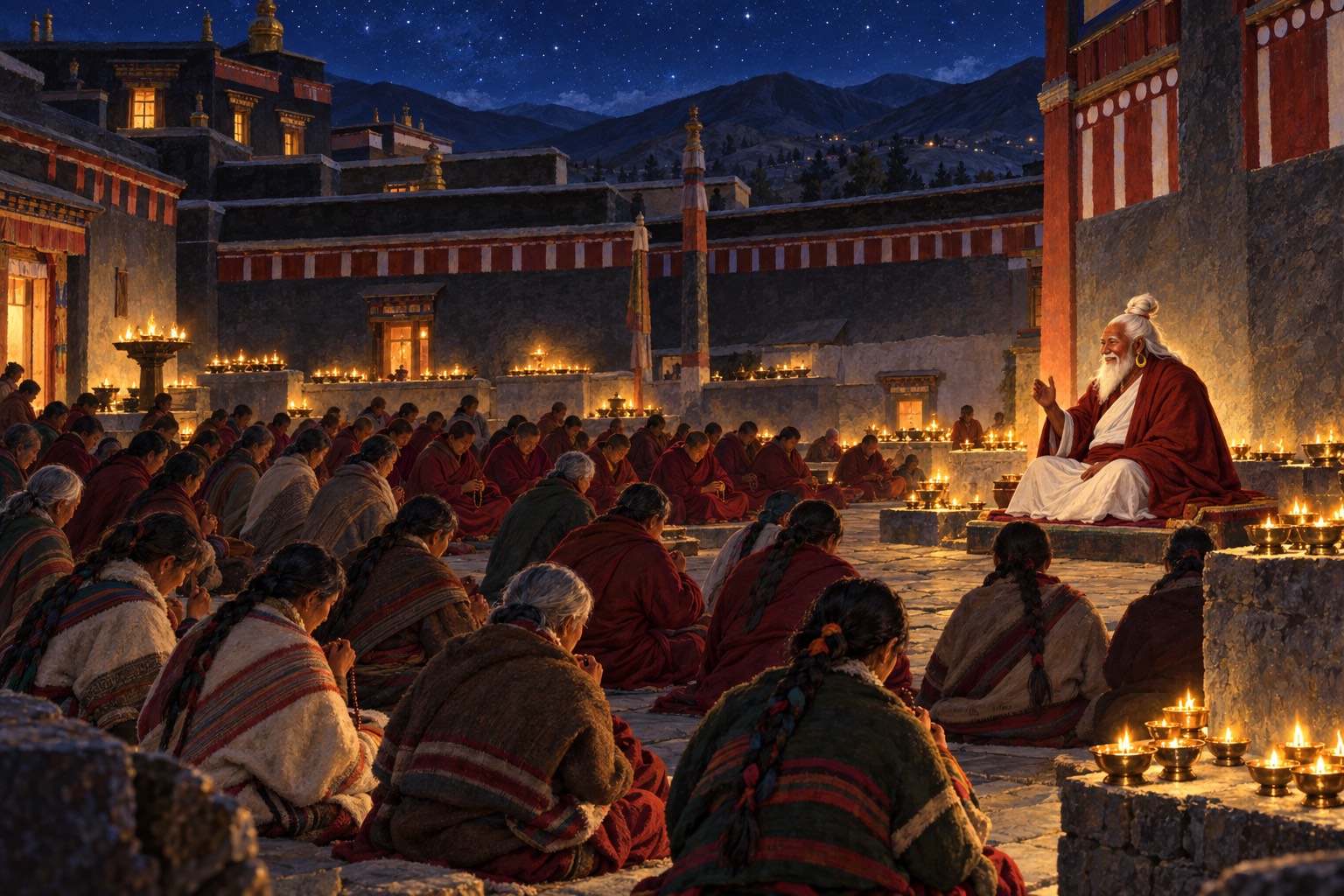
The epidemic stopped at once, the colophon says, and the prayer became known as Sakya Nedrolma, "The Verses That Saved Sakya from an Epidemic." Other prayers of his are linked with the end of a famine in 1437 and of a war in eastern Tibet. These are the tradition's own accounts. People still recite these prayers in hard times as an act of compassion, not as a guaranteed cure.
His Chenrezig practice, known in English as "Benefit of Beings, Extensive as the Sky," is one of the most widely practised in Tibet. That practice is something to receive from a qualified teacher; the Find a Teacher page can help. The Seven-Line Prayer itself is open to anyone.
The old man who would not stay put
In 1448 he founded the monastery of Derge Gonchen in the far east of Tibet, and the next year he began his masterpiece at Chung Riwoche, a great stupa of many chapels beside another of his bridges. Among his students was the yogini Chökyi Drönma, the first of the Samding Dorje Phagmo line of women teachers.
He is said to have left this world at Riwoche in his 125th year, departing bodily, as the sky-goers do. Stearns's book includes an early manuscript describing that miraculous death.
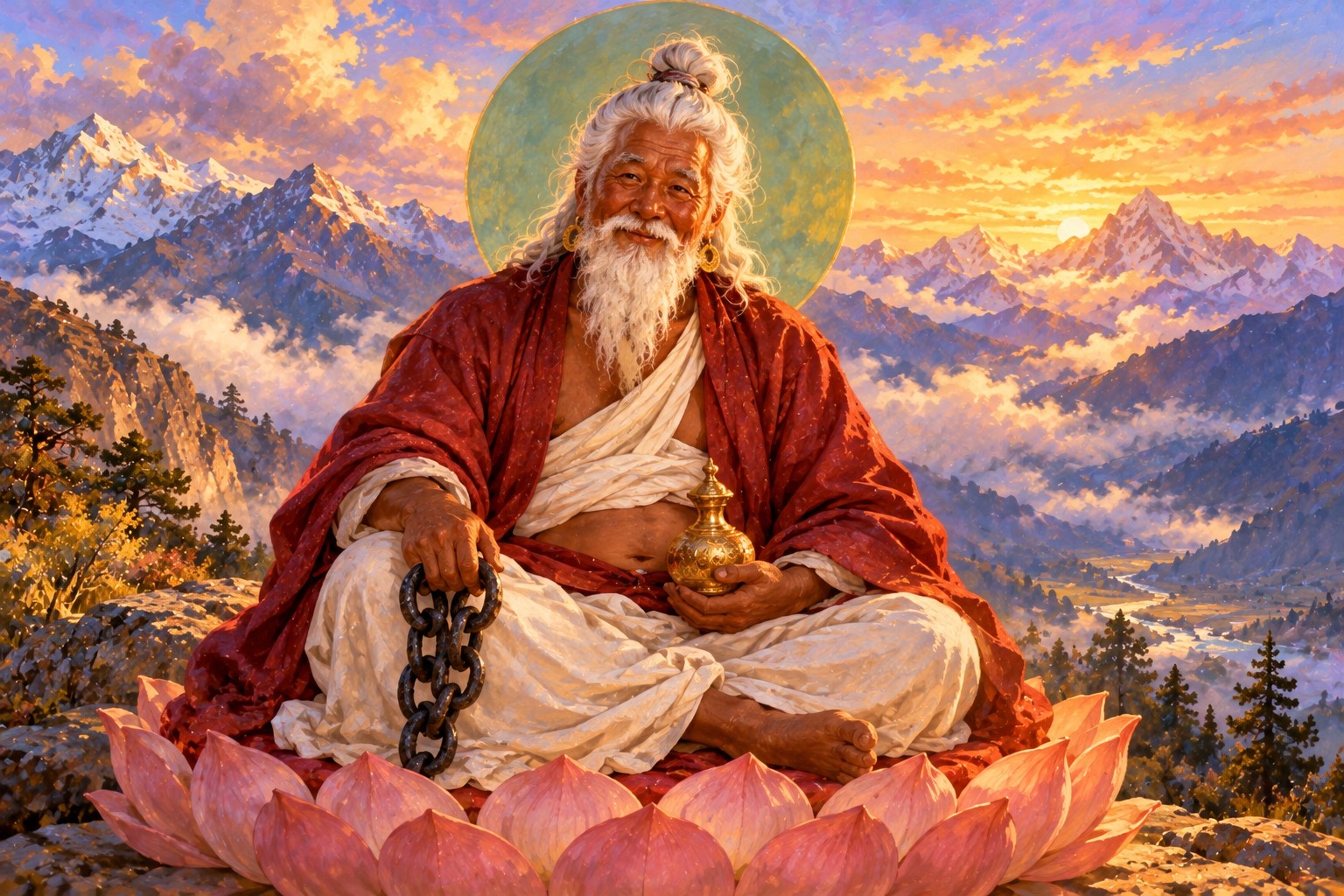
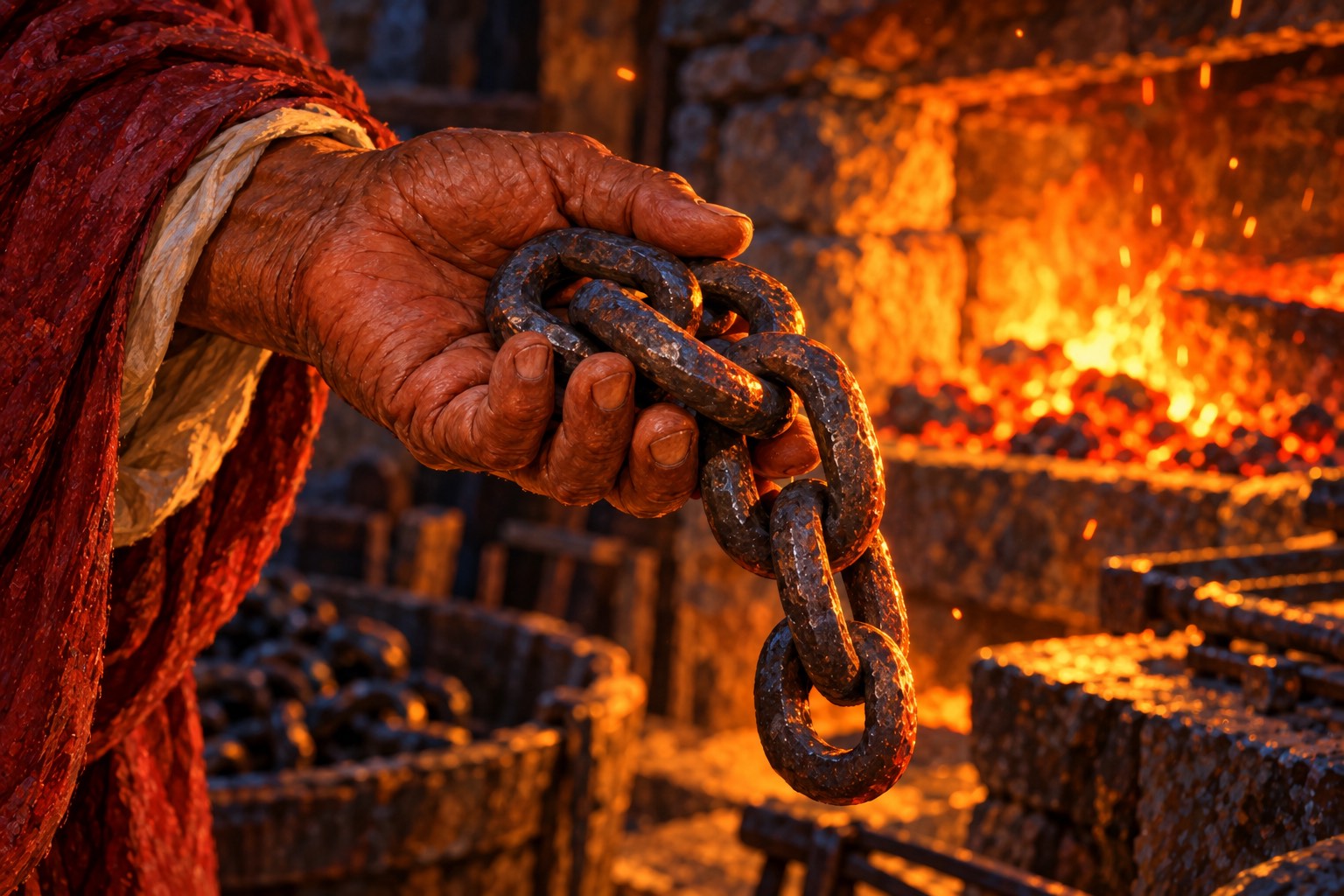
In paintings he sits at ease, deep red-brown, with white hair knotted on his head and a long white beard, often holding a few links of iron chain and a long-life vase. People still turn to him for long life: each year in Thimphu, Gerner reports, tens of thousands receive a long-life blessing in his lineage.
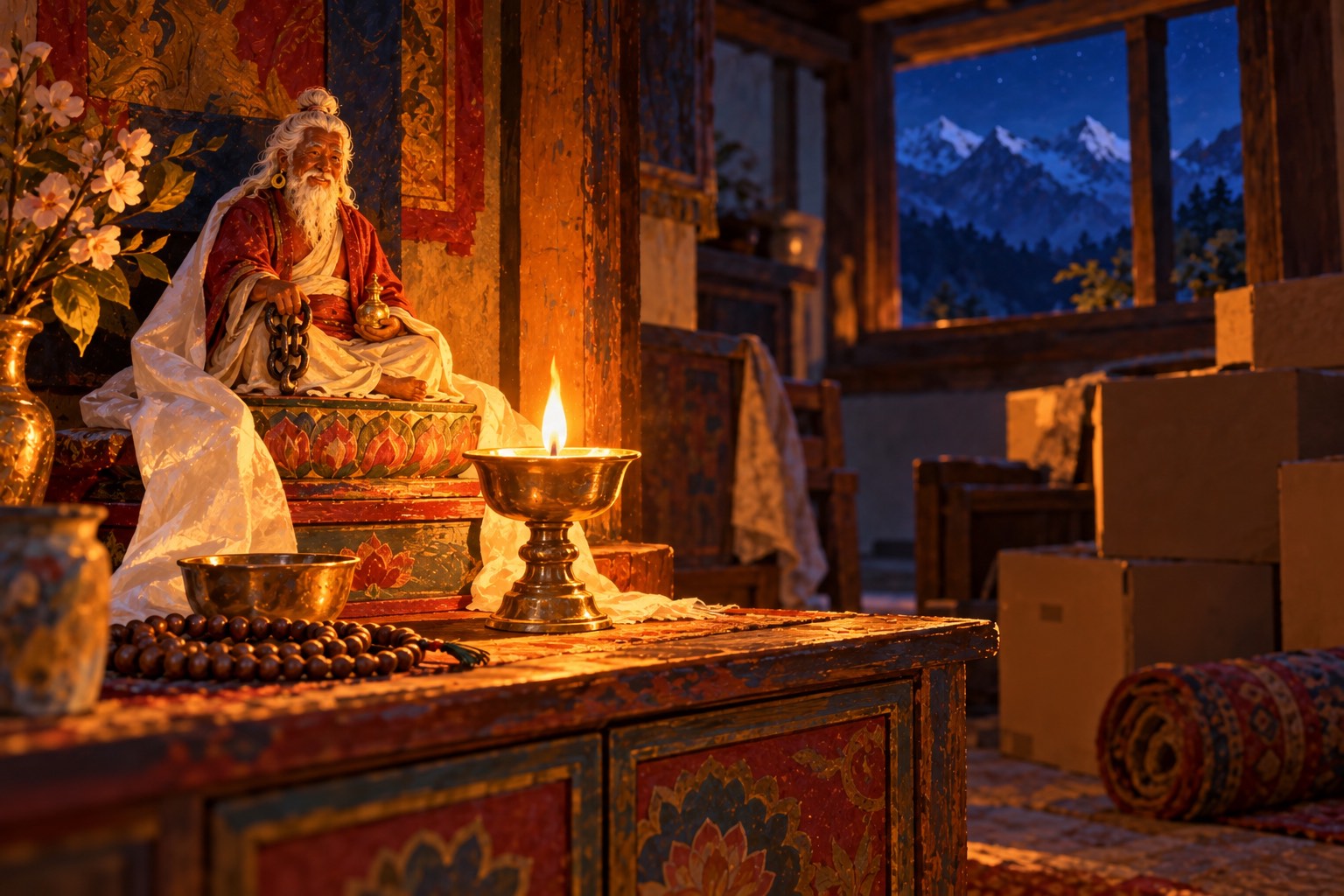
Most of his chains have rusted or been taken down. What he built still stands in another way: the idea that devotion and practical kindness belong together, and that a prayer can be a kind of bridge.
About the art
Thangtong Gyalpo is drawn as his traditional portraits show him: an old lay yogi, not a monk, with deep red-brown skin, long white hair knotted on top of his head, a long white beard and large gold earrings. Manfred Gerner explains that the red-brown colour links him with the red, horse-headed Hayagriva, and that his white hair recalls the legend that he was born already grey. In paintings he often holds a few links of iron chain, from his bridges, and a long-life vase, because he is especially prayed to for long life. Some paintings show him almost bare above the waist; these pictures keep his red cloak around him.
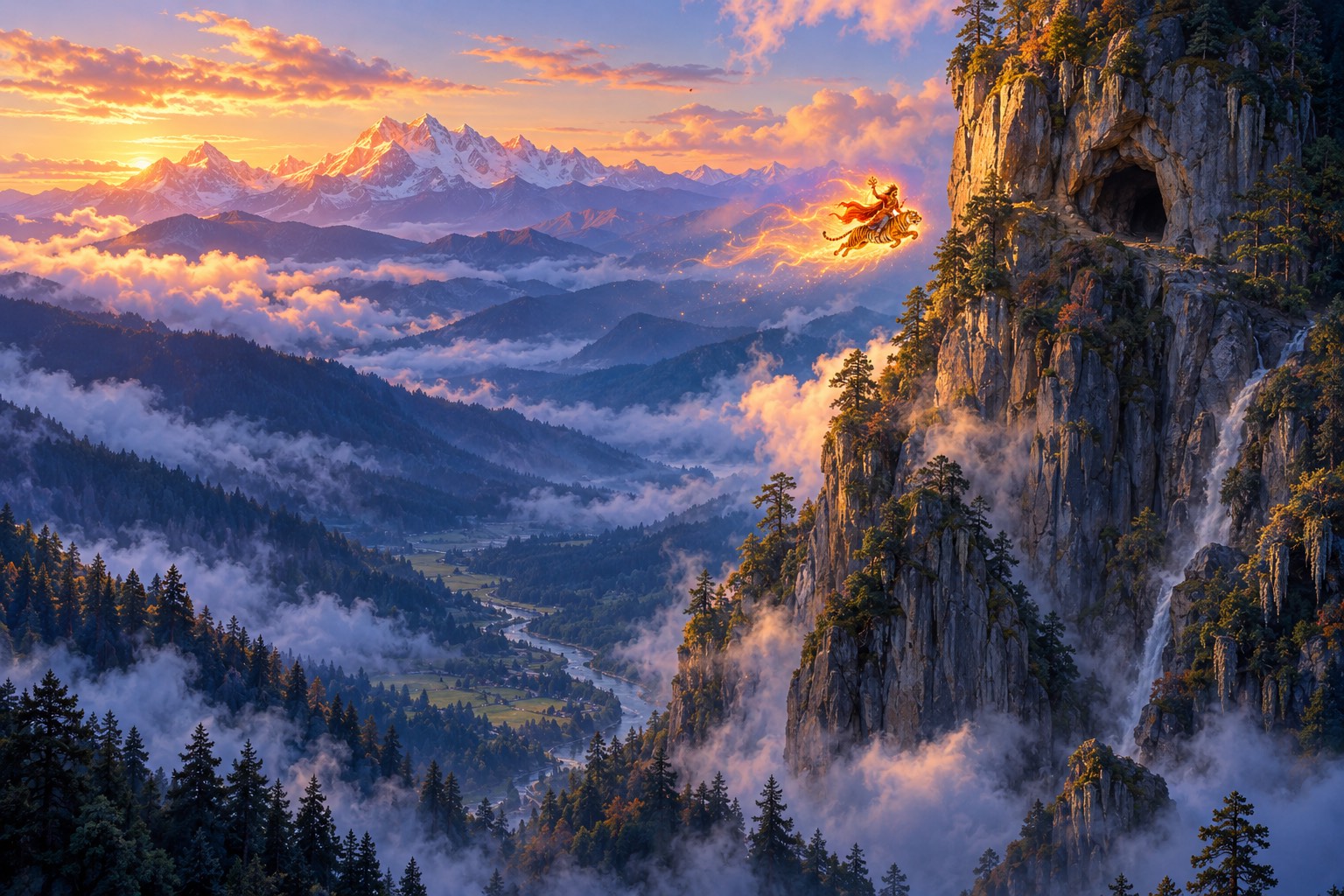
Guru Rinpoche appears once, in the vision at Phurdo, in his main form: the lotus hat with its single feather, a five-pronged vajra at his heart, a skull cup holding a long-life vase, and the slender khatvanga staff at his left shoulder, inside a sphere of rainbow light. Behind him are the red Buddha Amitabha, holding an alms bowl in meditation, and white four-armed Chenrezig, whose joined hands hold a jewel at his heart while his other hands hold a crystal mala and a white lotus. The five dakinis of the empty plain wear the five colours of the Buddha families.
The Chakzam bridge follows descriptions of the old bridge at Chushul: two great chains anchored in stone, with a narrow walkway of boards hanging below, wide enough for one person. Tamchog is shown as a small temple above the Paro river among rust-red rocks; today's building is a later rebuilding. The Ache Lhamo scene is set in the present day: the masks of the hunter dancers came centuries after Thangtong Gyalpo, which is why the seven sisters dance without them.
Why this matters for practice
The fourth line of the Seven-Line Prayer gives Guru Rinpoche his renowned name, the Lotus-Born. Thangtong Gyalpo's story is a story of names too, given by dakinis and by grateful travellers, and tradition holds that his mind was one with Guru Rinpoche's. His life shows the prayer's devotion turned outward into iron, song and help for anyone stranded at a river's edge.

If something in this story stayed with you, you might think of a river you would like to see someone cross safely, and recite the prayer once, to the master whose mind, it is said, the old bridge-builder shared.
Sources and further reading
- Thangtong Gyalpo Series, Lotsawa House (Internet Archive snapshot, 2025)
- The Verses That Saved Sakya from an Epidemic (Sakya Nedrolma), trans. Rigpa Translations (2020), Lotsawa House (Internet Archive snapshot, 2025)
- Far-Reaching Benefit of Beings, Extensive as the Sky, trans. Adam Pearcey (2020), Lotsawa House (Internet Archive snapshot, 2025)
- Thangtong Gyalpo, Rigpa Wiki (Internet Archive snapshot, 2024)
- Tangtong Gyelpo (person page and mentions in other biographies), Treasury of Lives (Internet Archive snapshot, 2024)
- Chakzampa Thangtong Gyalpo: Architect, Philosopher and Iron Chain Bridge Builder, by Manfred Gerner (Centre for Bhutan Studies, 2007), chapter 'Biographical notes', Centre for Bhutan Studies (PDF, Internet Archive snapshot, 2023)
- Tangtong Gyalpo: A Guide for Readers, with a biographical sketch from Cyrus Stearns, King of the Empty Plain, Shambhala Publications (Internet Archive snapshot, 2023)
- King of the Empty Plain: The Tibetan Iron-Bridge Builder Tangtong Gyalpo, by Cyrus Stearns (Snow Lion, 2007), Book, used only through summaries
- Teacher (Lama) – Tangtong Gyalpo, items 57383 and 940, Himalayan Art Resources (Internet Archive snapshots, 2024)
- Thang Tong Gyalpo, Wikipedia
- Lhamo, Wikipedia
- Flat face mask (HC.1999.1559), Horniman Museum
- Tamchog Goenpa, Paro Dzongkhag Administration (Internet Archive snapshot, 2024)
- Bridge built by Thangthong Gyalpo needs repair, Bhutan Broadcasting Service
- Thangtong Gyalpo is more than just a legendary iron bridge builder of Bhutan, Daily Bhutan
This retelling is waiting to be read by a knowledgeable practitioner. Where the traditional accounts differ, the story says so; if you notice a mistake, please tell us through Share Your Story.