
This is an original story, written for this site. It is fiction, not a teaching or a traditional account.
Every morning for forty-one years, Diki said her prayer at the kitchen window while the kettle came to the boil. Below the window the hillside fell away in rows of tea bushes, and most mornings the mist lay in them like milk in a saucer. She said the words into it, under her breath.
Mingma Sherpa, who taught mathematics at a boys' school in Darjeeling for thirty-four years, listened from the table behind his newspaper. He never said it with her. He was not sure what he believed, and she never asked him to be sure.
Diki died in February. It is October now. The kettle still boils.
Under the bed
On a Sunday he got down on his knees to look for a slipper and found a bead instead. Then another. He fetched the torch.
They were everywhere under the bed: in the dust along the wall, in the cracks between the floorboards, in the fluff around the iron feet. Her mala. The string had worn through and snapped, perhaps the last time she reached for it in the dark, and nobody had looked under there since.

A mala is a loop of prayer beads for keeping count of recitations. Diki's had 108 beads of dark wood. Where the two ends met sat a larger bead, the guru bead, which is never counted, with a small bead on top of it like a lid. From the loop hung two short strings of ten tiny silver rings, one ending in a little vajra and the other in a little bell, for keeping a tally of whole rounds.
She had told him, the summer before she fell ill, that the string was going. "It'll hold," she said. Kneeling on the floor, he remembered that, and told the empty room, "It didn't, you know."
A matter of counting
He did what he knew how to do. He put a saucer on the table by the window, put on his reading glasses, and counted in tens, the way he had once counted exam scripts.
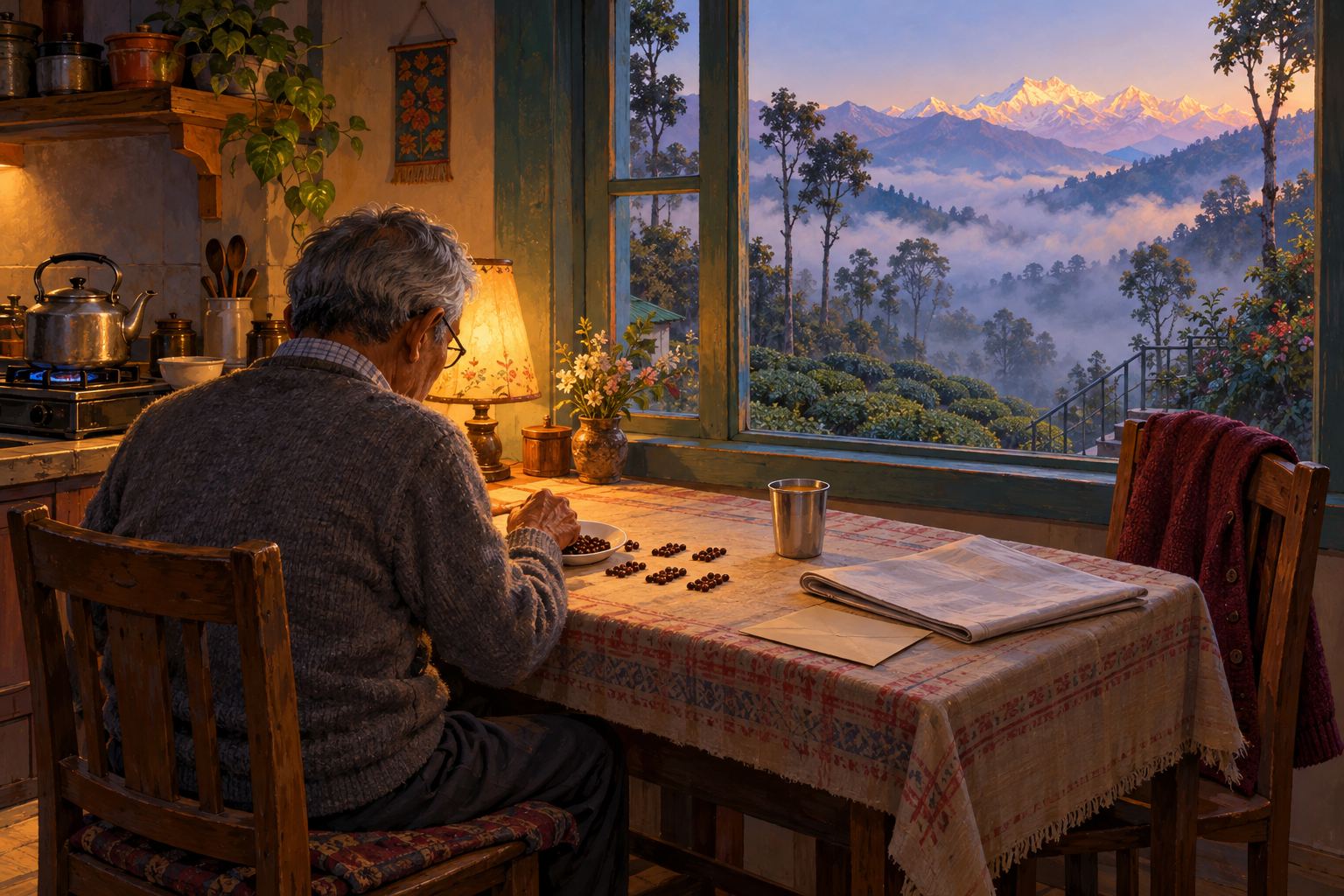
One hundred and four. The guru bead had rolled to the far corner. The two counter strings were whole, still knotted to their scrap of old string, their vajra and bell tangled in a ball of fluff.
On Monday he moved the bed, which he had not done in years, and found three more beads and one of her hairpins. A hundred and seven. He went over the floor twice more on his knees. A hundred and seven. He wrote it on the back of an envelope, as if that would make it argue less.
Thread
Restringing it, he thought, would take an evening. It took four, and got nowhere.
Diki's sewing tin had cotton thread, which went through the beads easily and snapped when he pulled it tight. Fishing line, from a drawer of things nobody had touched since their son moved to Bangalore, was springy and would not hold a knot. No needle he owned would go through a bead. Either the eye was too fat for the hole, or the thread would not go through the eye, because his hands shook now in a way they never had when he drew triangles on a blackboard.
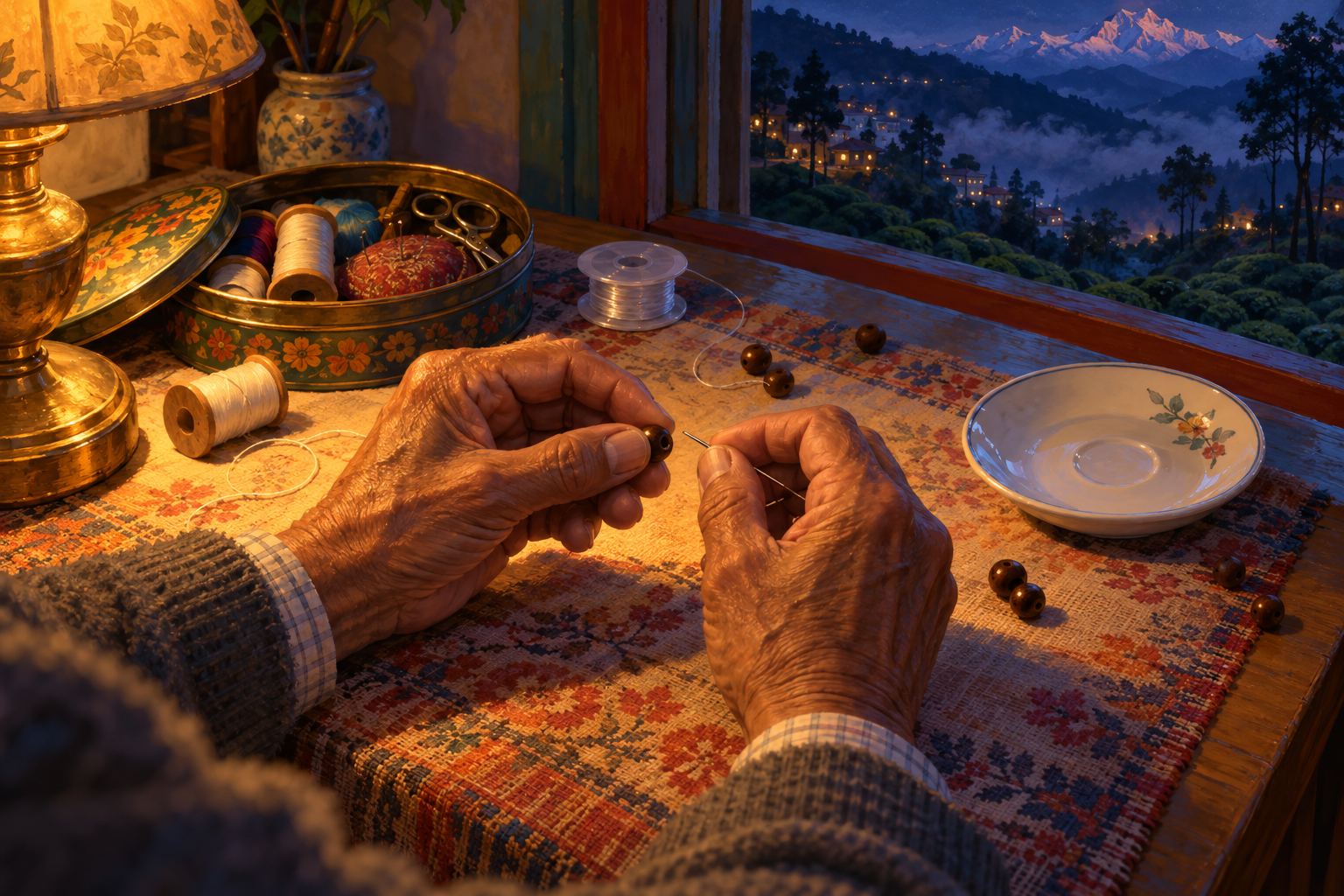
On the fourth evening the beads rolled off the table for the second time. He sat looking at the saucer for a long while. Then he tipped them into a little plastic box that had once held paper clips, and went to bed.
The bazaar
In the morning he walked down to Chowk Bazaar.
Darjeeling is built along a steep ridge, and the market lies below the main town in a tangle of lanes that are mostly steps and corners. The mist had come up from the valley again. Shutters were rattling open, the jeep drivers were calling for passengers to Siliguri, and somewhere a tall aluminium pot of momos was already steaming.

He found the stall in a lane of hardware and cloth shops: a narrow wooden counter hung with coils of coloured cord, jars of beads in every size, hairbands and phone covers. Behind it a young woman of about twenty was eating her breakfast out of a tiffin box and reading something on her phone.
Her name was Nima. It was her aunt's stall, she said; she minded it in the mornings before her college classes. He tipped the paper-clip box onto the counter and explained, more than he had meant to. She listened, nodding, and held one of the beads up to the light.
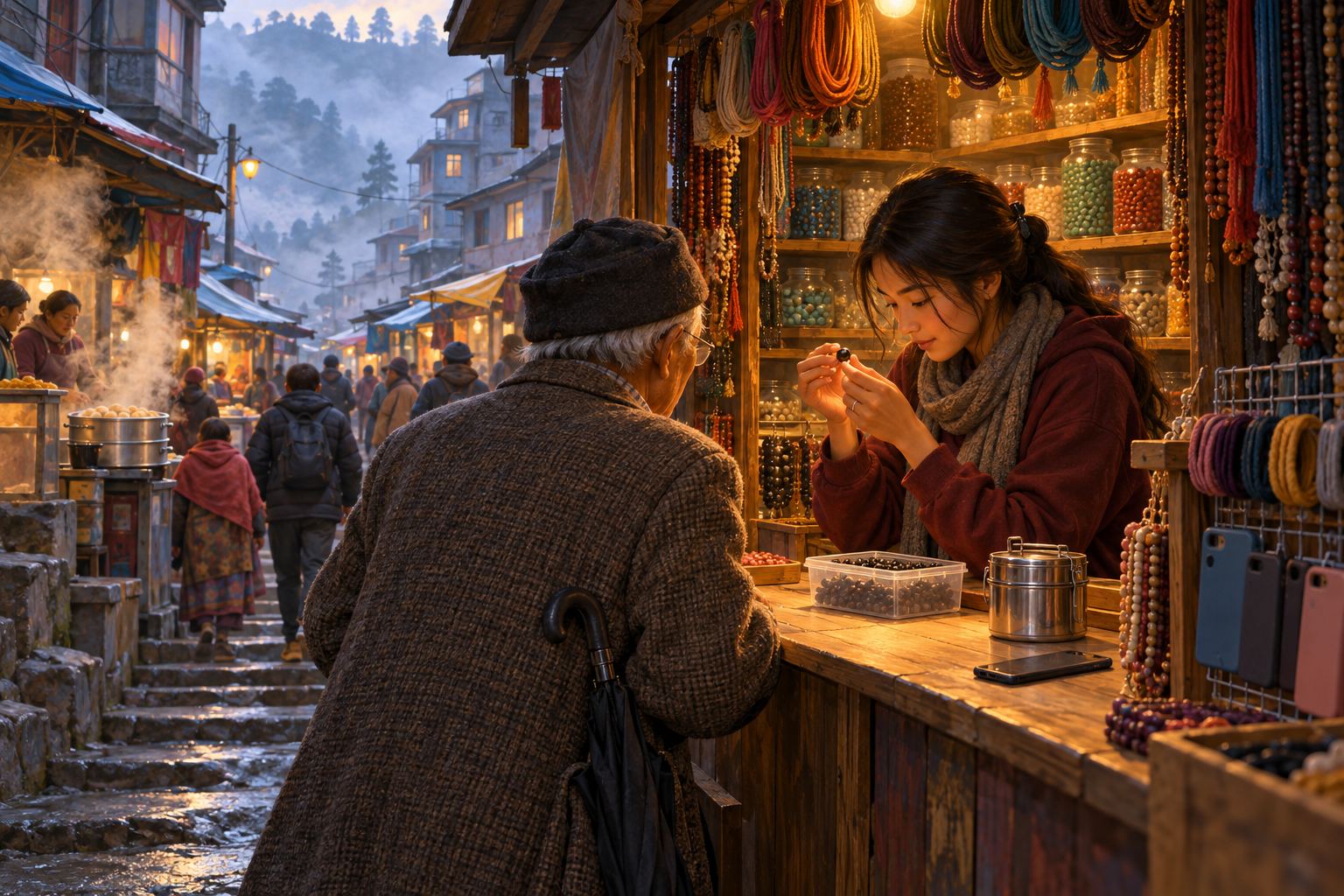
"Wrong string," she said, and pulled down a coil of thin, waxed nylon cord, dark brown. Then a beading needle that was nothing but a strip of fine twisted wire with a long, soft eye. It folded flat to pass through a bead and opened again on the other side.
With three beads and a scrap of cord she showed him the end: how both ends of the cord go up through the guru bead together, then through the little bead on top, and are knotted there, so the knot sits hidden.
"How many have you got?" she asked.
"A hundred and seven," he said. "I've looked."
She went through a biscuit tin under the counter, holding wooden beads against his one at a time, and found one nearly the right size, a shade paler. "It won't match," she said. "Not for a year or two. Hands make them darker." She put it in his palm, and would let him pay only for the cord and the needle.

The climb home
He climbed home slowly, stopping on the steps the way Diki used to make him stop, to look. Far below, women were out picking in the tea garden, moving along the rows with baskets on their backs, and the mist was coming off the hillside in rags.

Threading
That afternoon he sat down at the window and began. The needle went through. The cord held. One bead, then the next, slid down onto it, and to keep his place he counted under his breath in English, as he had in a classroom.
Somewhere in the twenties he noticed that he was no longer counting. His mouth was saying something else.
It was Diki's prayer, the Seven-Line Prayer: a short prayer to Guru Rinpoche, the eighth-century teacher remembered across the Himalaya for helping Buddhism take root in Tibet. It calls him by his birthplace and his name, and asks him to come and bless. Mingma had heard it every morning for forty-one years and had never, as far as he knew, learned it. It came out whole anyway, at her speed, with her small pause before the last line.
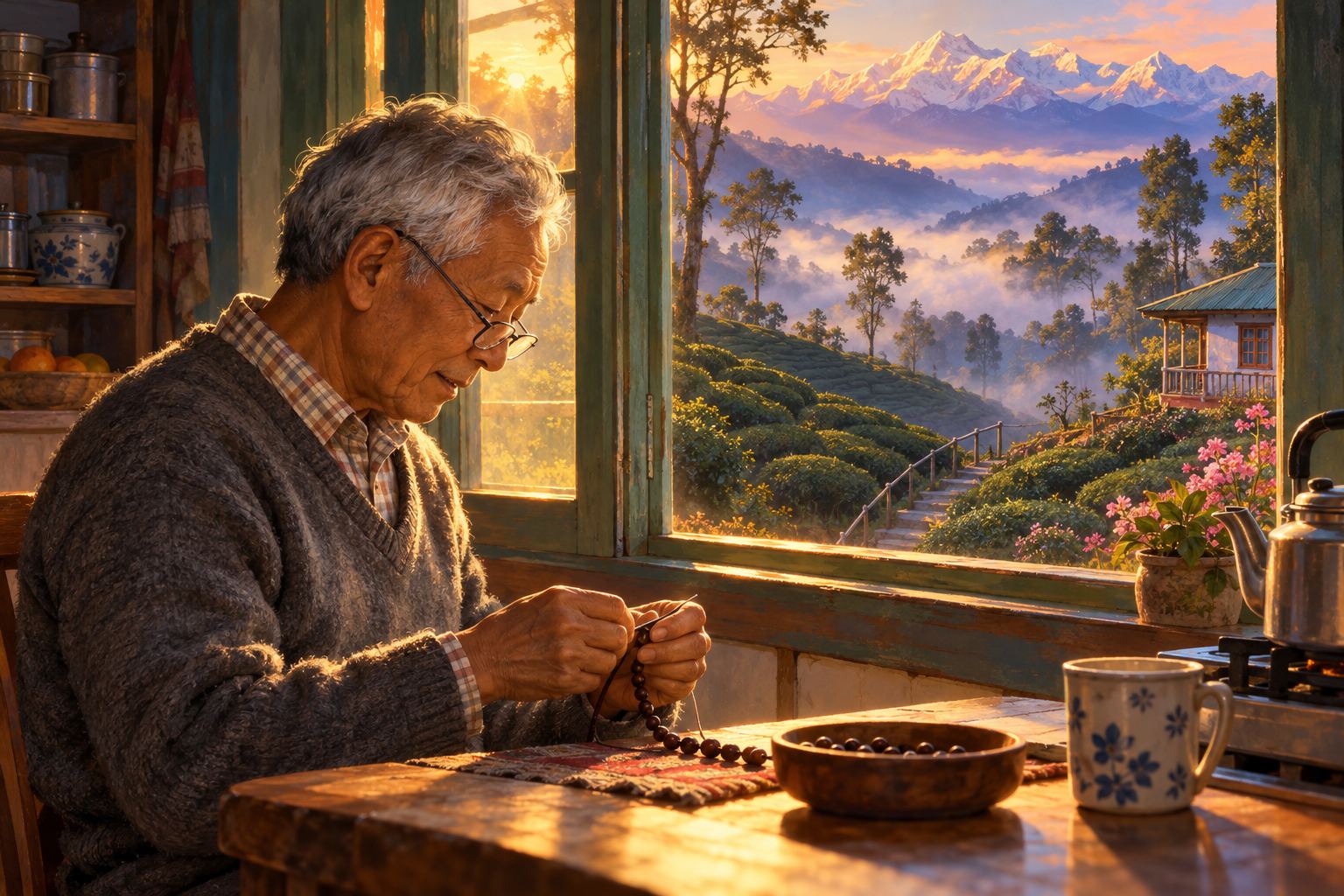
He did not stop to wonder about it. He let it come round once every few beads and went on threading. When he lost his place he counted the beads again from the guru bead, carefully, because the beads were the one thing that still needed counting. The prayers he did not count at all.
The light went. He switched on the lamp. Across the valley, from a monastery on the far ridge whose name he had never thought to ask, a bell rang for the evening, small and far off. He threaded three beads while it rang.

The knot
The new bead he put beside the guru bead, where the counting starts, so that it would be the first one his thumb came to. Then both ends of the cord up through the guru bead, the way Nima had shown him, and through the little bead on top; a knot, and another; and a dab of Diki's clear nail varnish on the knot, because he had once watched her do the same to a loose button.
He tied the counter strings back on and hung the mala on the nail by the window, where she had always kept it. It was nearly ten o'clock. He did not feel better, exactly. He felt like a man who had finished a job properly, and had someone he would have liked to tell.

In the morning
In the morning the mist was in the tea again. He filled the kettle, put it on, and took the mala down from its nail.
He had not decided anything. He stood at the window while the kettle worked itself up to the boil, his thumb on the pale bead, and said the prayer once. Then, because the kettle was not ready yet, once more.

In a year or two, Nima said, nobody will be able to tell which bead was the new one. He thinks he will always be able to tell. He finds that he does not mind.
About the art
This is an original story, written for this site; it is fiction, not a teaching or a traditional account, so its pictures show invented people. Following the site's rule for present-day figures, Mingma and Nima are gently stylised and seen mostly from behind, at a distance, as hands, or (once) in soft profile. Diki is never shown; only her cardigan is. Much of the story is told through beads, hands, a window, mist and the bazaar.
The mala is a Tibetan Buddhist one: a single closed loop of 108 beads, here of dark wood, with a larger guru bead where the ends meet that is not counted, a small cap bead and a tassel. The two short strings of ten small rings hanging from it are counters, one ending in a tiny vajra and one in a tiny bell, used to keep a tally of completed rounds. The replacement bead is shown a shade paler, because new wood darkens only slowly with handling.
Darjeeling is a hill town on a steep ridge in the Eastern Himalaya, surrounded by tea gardens that fall away below it, with the Kangchenjunga range visible to the north on clear days. The market lanes, the tea pickers' baskets and the hill house are drawn as they look today, so tin roofs, umbrellas and modern clothes appear. The monastery on the far ridge is generic and unnamed. Guru Rinpoche does not appear anywhere: nothing on this page is a vision.
Why this matters for practice
The Seven-Line Prayer's sixth line is a wish to follow in Guru Rinpoche's footsteps, and many people come to the prayer by following someone they loved, saying the words first in that person's voice. This story is fiction, but what happens in it is ordinary: a prayer heard every morning for years turns out to have been learned by ear. You do not have to know what you believe to say it once, and you do not have to count.

If something in this story stayed with you, you might pause at your own window, while your own kettle boils, and recite the prayer once.
Sources and further reading
- Seven-Line Prayer (topic page), Lotsawa House
- Japamala, Wikipedia
- Malas: How to Use Tibetan Prayer Beads, Yowangdu
- Darjeeling, Wikipedia
This retelling is waiting to be read by a knowledgeable practitioner. Where the traditional accounts differ, the story says so; if you notice a mistake, please tell us through Share Your Story.