Most prayers have an author who searched for the right words and wrote them down. The Seven-Line Prayer, the tradition says, is different.
Jamgön Mipham, the great nineteenth-century Tibetan scholar, described it as arising by itself, the "natural resonance of indestructible ultimate reality" (White Lotus, Padmakara Translation Group). No person composed it. The dakinis heard it first, and passed it on to the human world when it was needed.
Dakini is often translated "sky-goer." It means a female wisdom being, a messenger of awakening. This is the story, as the old accounts tell it, of the night a dakini gave these seven lines to people who badly needed them.
The seat of awakening
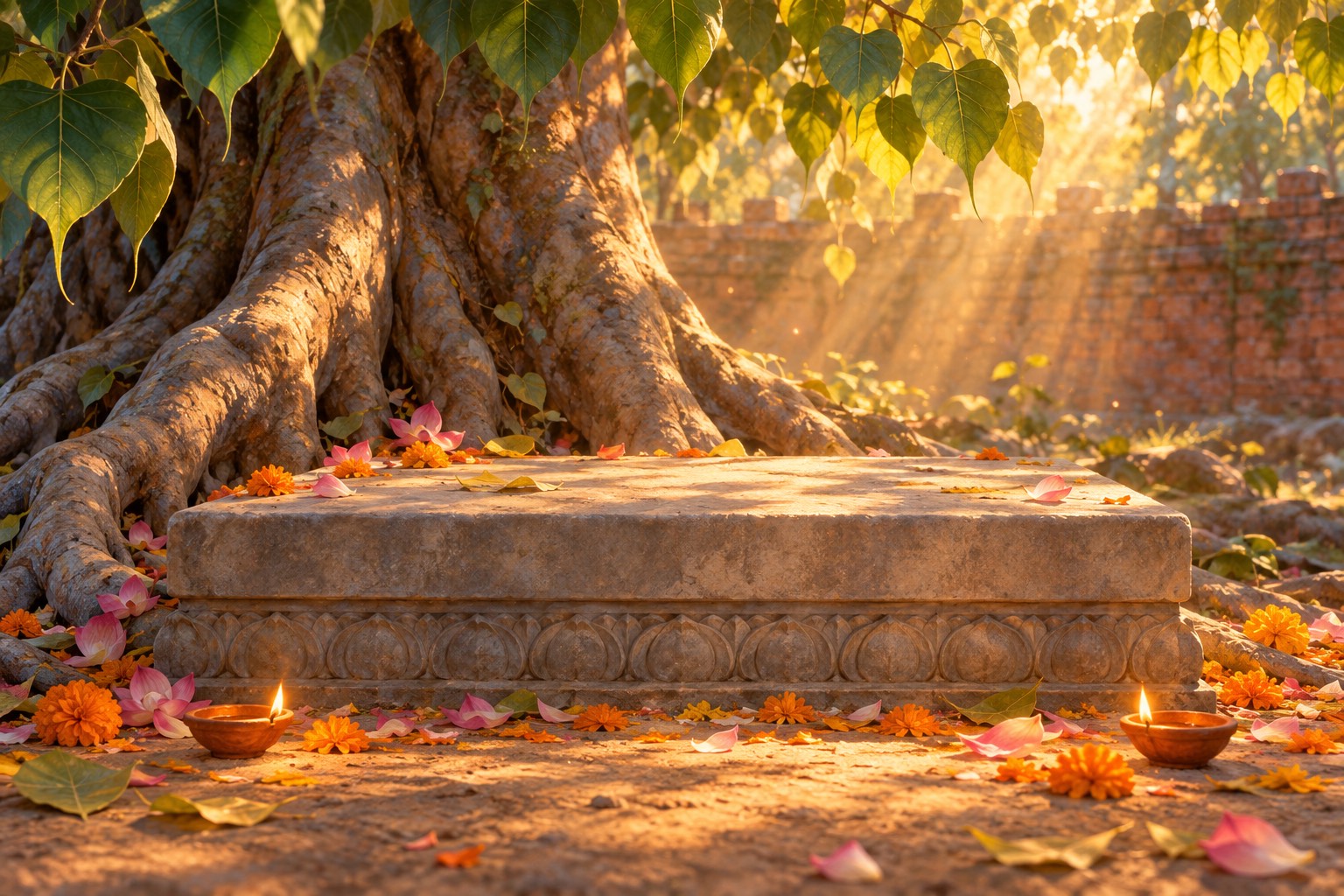
The version most often told today begins at Bodhgaya, in the ancient kingdom of Magadha in northern India. This is where the Buddha sat beneath a pipal tree and awoke. Buddhists call the spot the Vajrasana, the "Diamond Throne," because nothing could shake the one who sat there.
When the Chinese pilgrim Xuanzang came in the seventh century, he found the tree enclosed by a high wall. Beside it stood a great brick temple tower, plastered in lime, with golden figures in the niches of every storey. Under the Pala kings who followed, scholars came here from across Asia.
Five hundred visitors
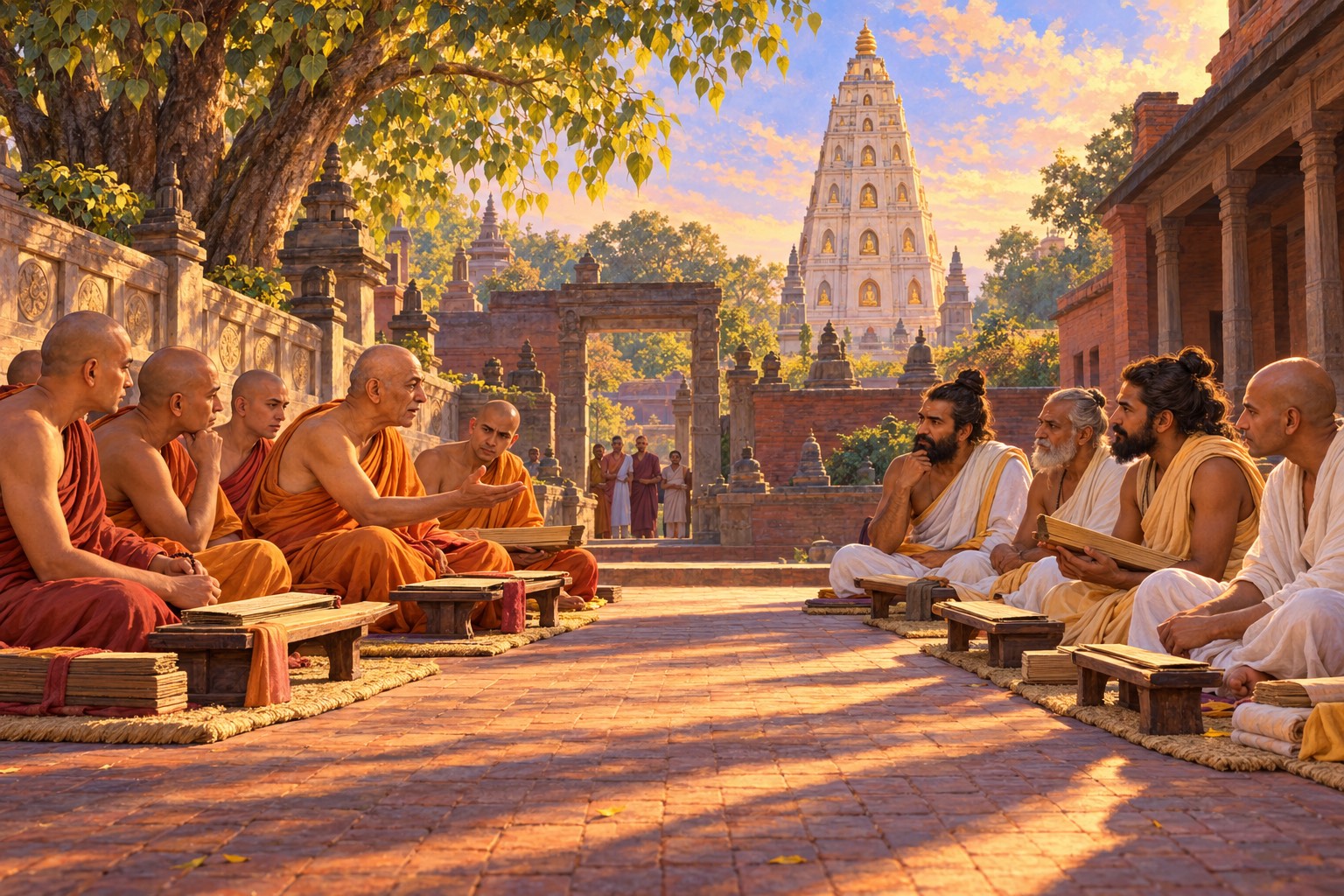
Ancient India loved debate. Teachers of different paths met in public to test their ideas with reasoning and scripture, and the side that lost was often expected to take up the views of the side that won.
The accounts say that five hundred non-Buddhist teachers came to such a debate. Tibetan texts call them tirthikas, from a Sanskrit word for a ford or crossing place: followers of other ways across the river of life. Mipham describes them as experts in grammar and logic. They were formidable scholars, sincere in their own traditions.
And they were winning. One after another, the Buddhist scholars, the panditas, found they could not answer them. In the tellings, the future of the Buddha's teaching in that place seemed to hang on the outcome.
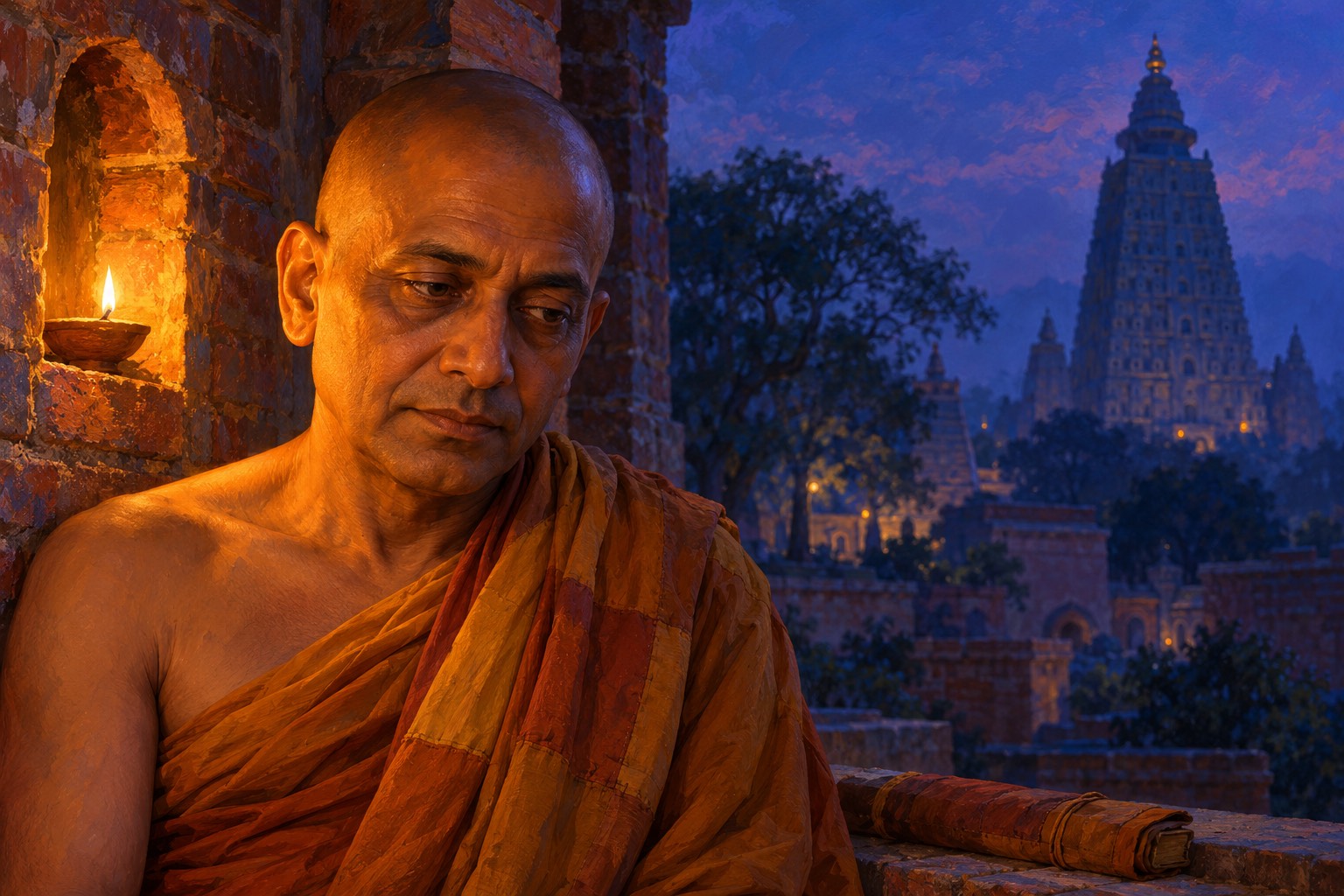
A dream in the night
Then, Mipham writes, a dakini appeared to most of the scholars in their dreams. Her name means Supreme Peace. Her message was plain: they could not win this alone. They must invite her brother, Dorje Tötreng Tsal, who was staying in a charnel ground, one of the wild places where the dead were cremated and yogis went to meditate.
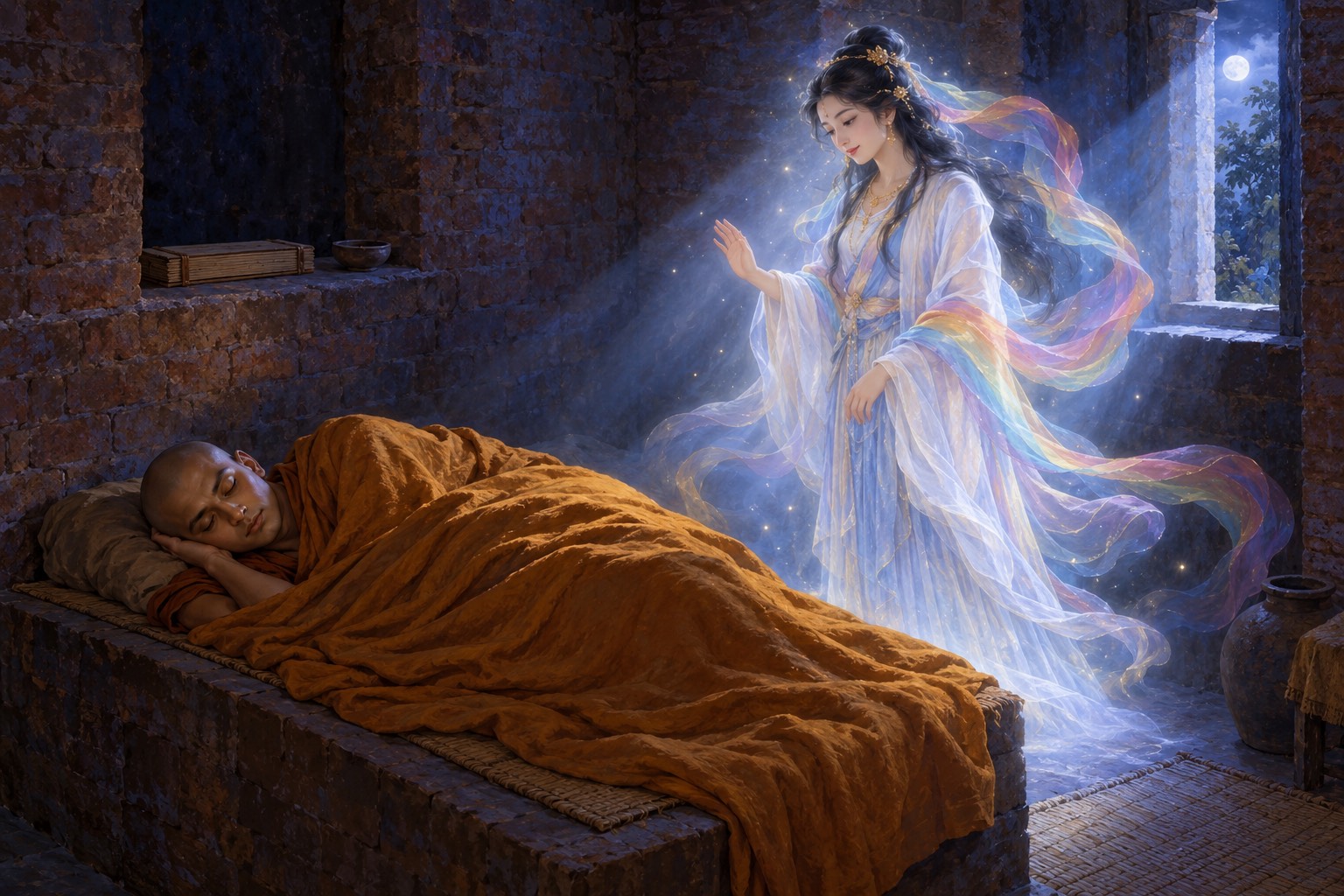
Dorje Tötreng Tsal, roughly "Vajra Power of the Skull Garland," is one of Guru Rinpoche's own names. The dakini was pointing them to Padmasambhava.
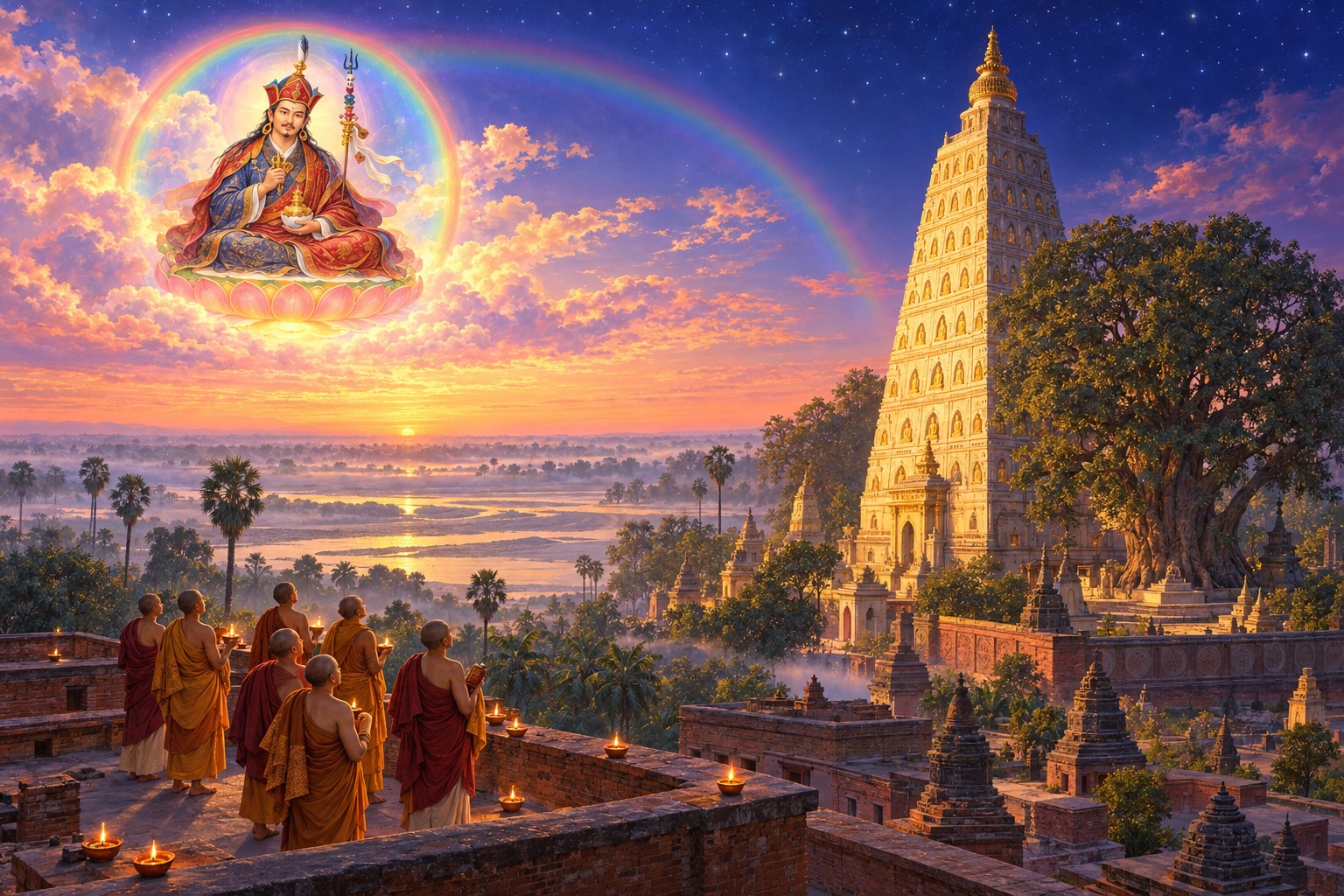
The way there was too hard, the scholars said; they could not go and fetch him. So she told them what to do. Go up onto the roof of the temple and prepare a great offering. Burn incense, play music, and pray together, with deep devotion, using the words she would teach them.
Seven lines on the roof
The words she taught them were the Seven-Line Prayer. In plain terms, it remembers where Guru Rinpoche came from, the northwest of the land of Oddiyana, and how he was born on the heart of a lotus. It honors his wondrous accomplishment, calls him by his name, the Lotus-Born, and sees him surrounded by dakinis. Then it promises to follow in his footsteps, and last of all it asks him to come and bless us.
The site's own translation is on the prayer page. Notice its shape: first it remembers, then it calls.
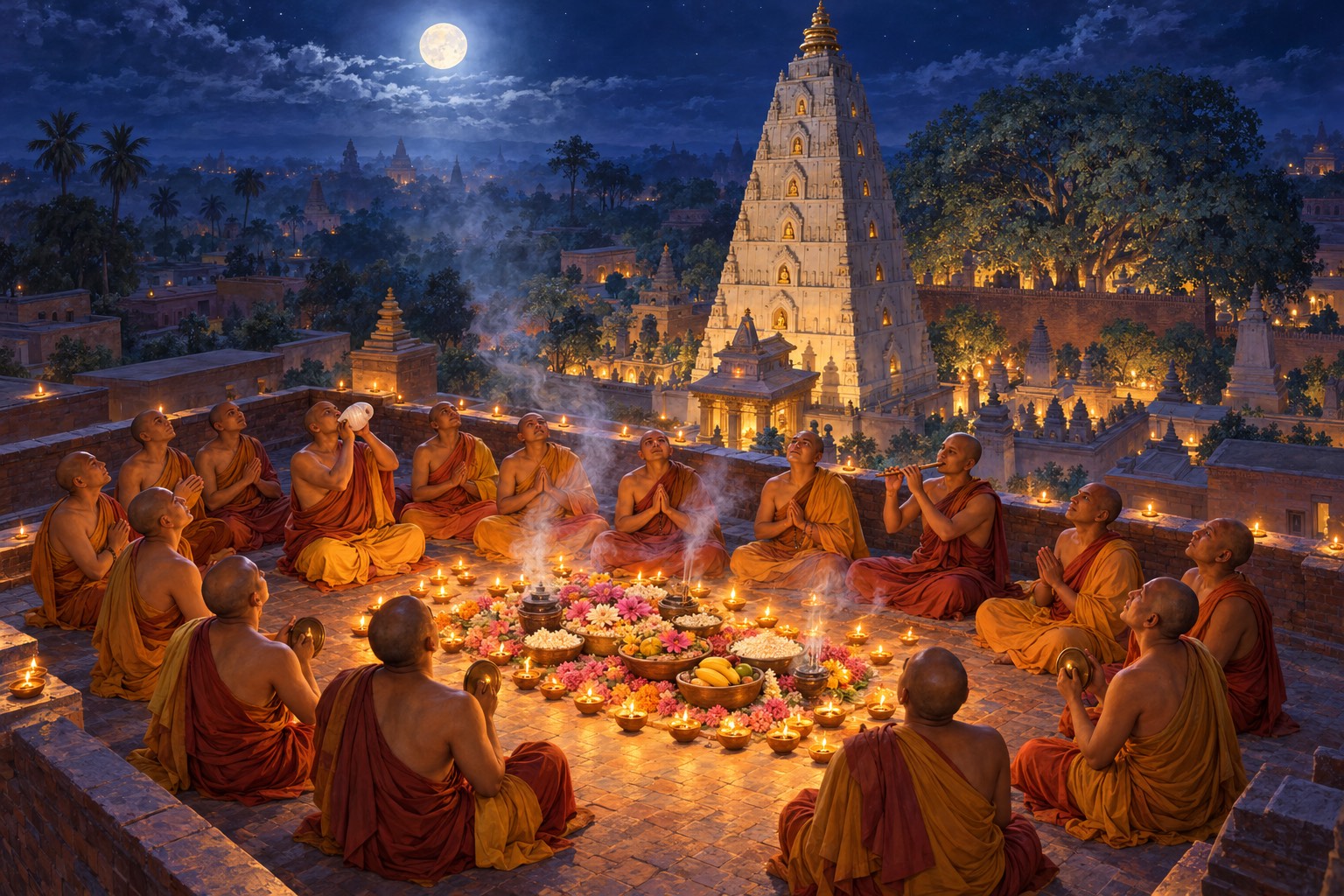
So on the flat roof, under the night sky, the scholars set out their lamps, incense and offerings, and joined their voices. Tired people who had run out of answers did the one thing left to them: they asked for help, together.
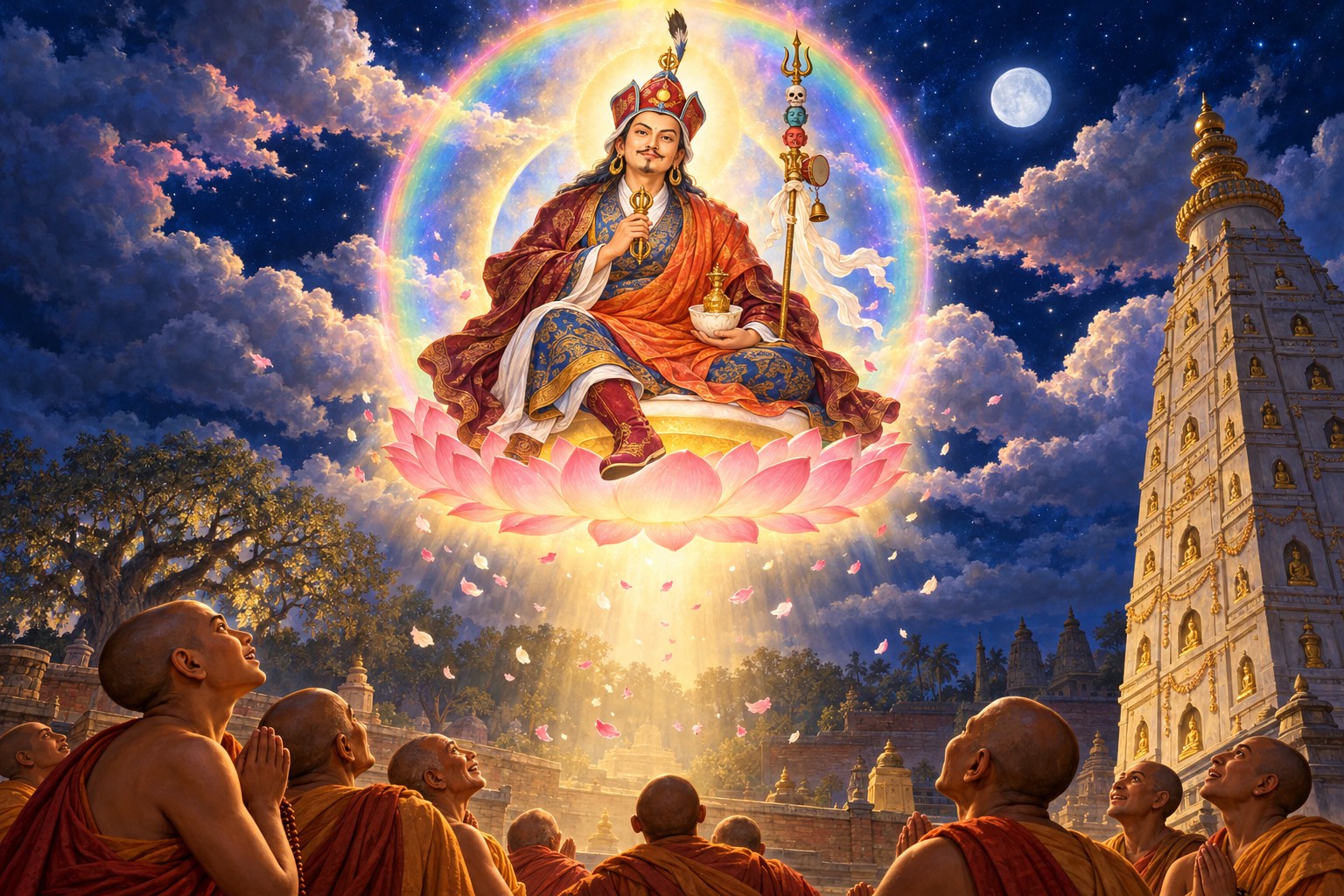
The accounts say that in that very instant Guru Rinpoche appeared in the sky before them. He had no need of the long road. He had been called, and he came.
The Lion's Roar
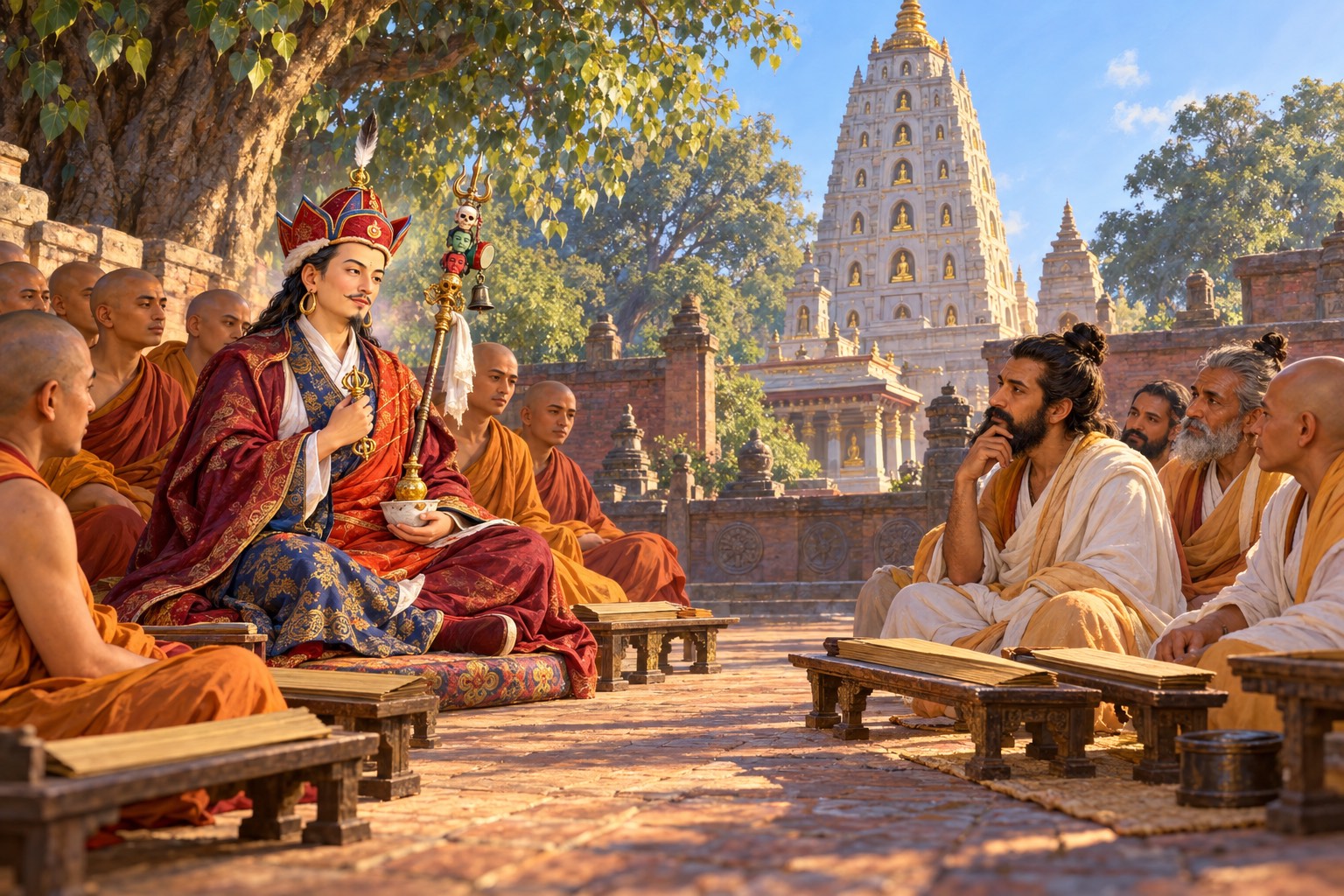
He took his seat at the head of the Buddhist scholars, and the debate began again. This time, Mipham says, the Buddhist side prevailed, through reasoning and through the authority of scripture.
The tellings then describe a second contest, of miraculous power, and a lion-faced dakini who came to Guru Rinpoche's aid. Jamgön Kongtrul's life of the Guru names her Marajita, "Tamer of Mara." The old texts tell this part in the dramatic language of wrathful power, with lightning in the sky. What they agree on is how it ended: the harm aimed at the Buddhist community was turned back, the contest was over, and many of the visiting teachers, the accounts say, took up the Buddha's path.
In Kongtrul's account, it was after this that he became known as Senge Dradok, "Lion's Roar." In Buddhist language, the lion's roar is truth spoken without fear, the way the Buddha himself taught. Senge Dradok is one of the Eight Manifestations, the eight forms in which tradition remembers Guru Rinpoche.
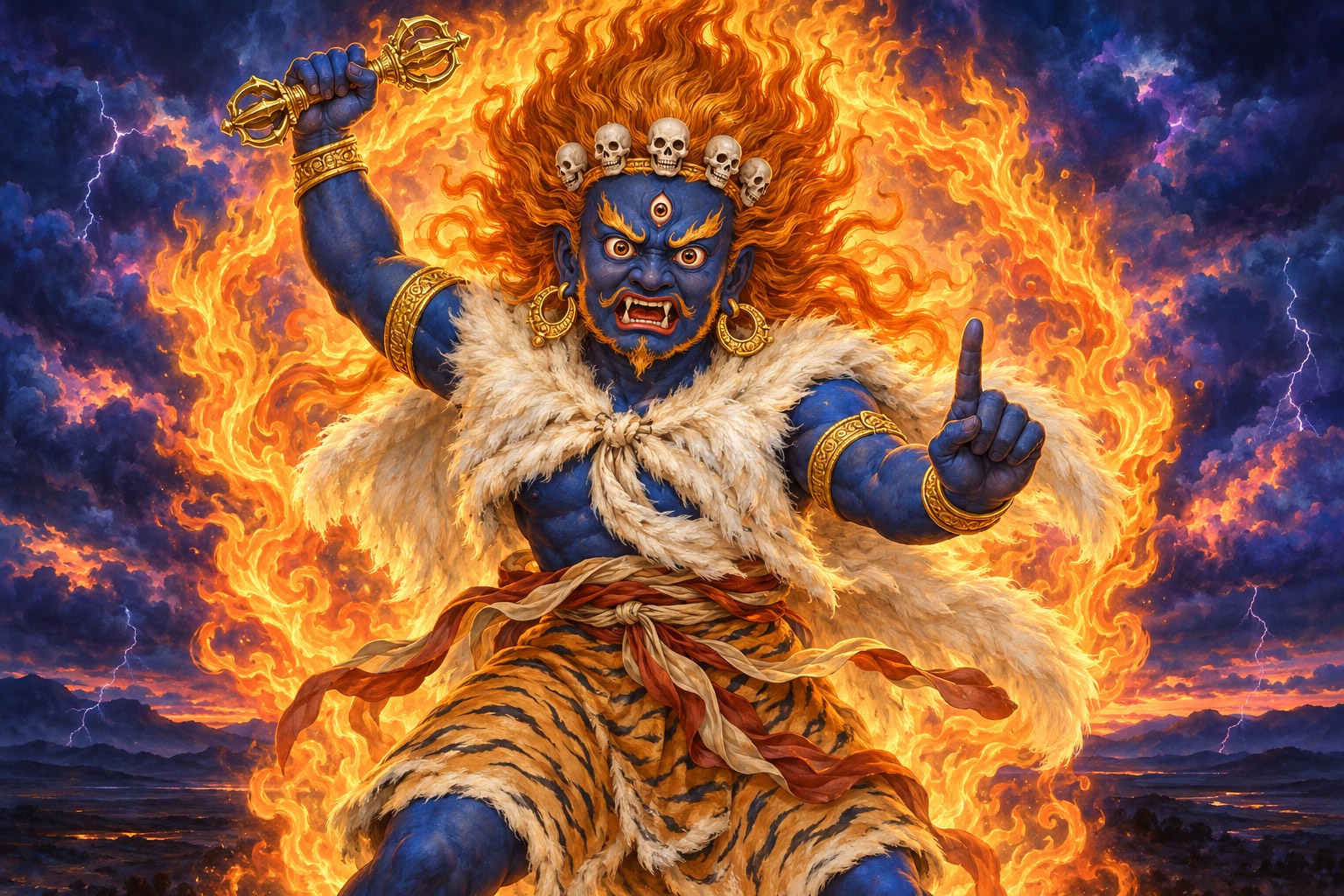
In paintings he is dark blue, wreathed in flames, his vajra held high. Wrathful forms are not pictures of anger; they show compassion at full strength, cutting through confusion.
Where it happened
It is worth saying gently that the versions differ. Mipham's own telling, in his commentary White Lotus, places the debate not at Bodhgaya but at Nalanda, the great monastic university less than a hundred kilometres away. The Nyingma scholar Tulku Thondup also tells it at Nalanda.
Kongtrul's life of the Guru, and Rigpa Wiki's summary, set the Lion's Roar debate at Bodhgaya's Diamond Throne, but say nothing of the seven lines. A seventeenth-century painting described by Himalayan Art Resources shows the debate at Bodhgaya, against four opponents. And one verse summary of the Pema Kathang, a classical life story, links the name Lion's Roar to a charnel ground in Nepal instead.
Retellings today often weave these threads into one; the pictures here follow the familiar Bodhgaya version.
Older than the debate
Mipham also writes that, long before any debate, the Seven-Line Prayer was famous as the song the dakinis used to invite Guru Rinpoche to their sacred gatherings.
Some treasure texts go back further still, to his birth. In a revelation of Jamgön Kongtrul that Mipham quotes, Guru Rinpoche remembers countless wisdom dakinis calling to him with one voice, in a song of seven lines, asking him to come into this world. Rigpa Wiki calls it the invocation by which Guru Rinpoche came into the world, and Khenpo Sodargye, a teacher of our time, says it was never composed at all.

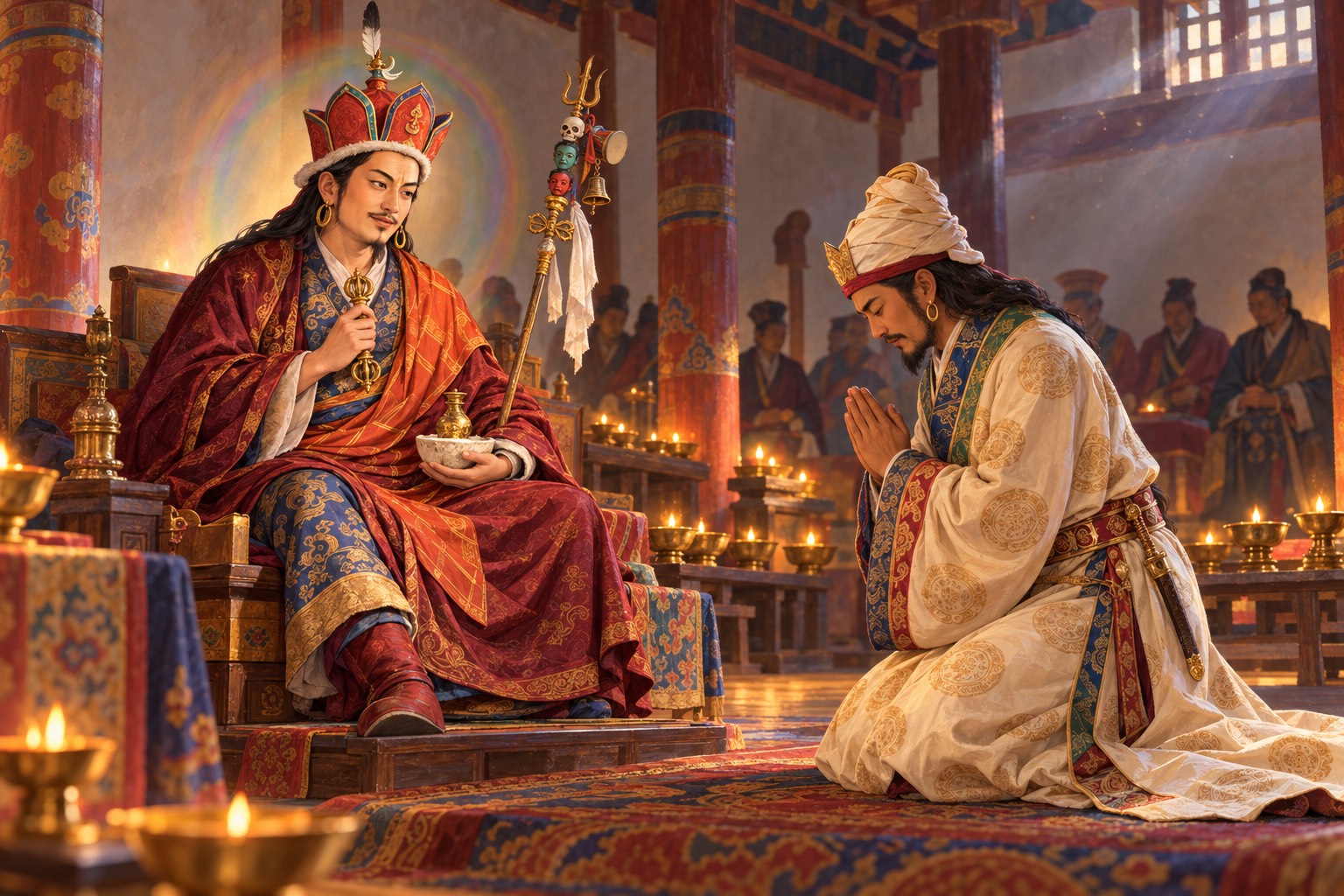
And there is a third thread, in which Guru Rinpoche passes the prayer on himself. Mipham writes that when he came to Tibet, he gave it to King Trisong Detsen and his subjects.
Hidden for the future
He was also thinking, the accounts say, of people not yet born. Tibetans call the teachings he concealed terma, "treasures," hidden in rocks, lakes and even in the minds of disciples, to be found centuries later by masters called tertöns. Mipham says there is no treasure text in which the Seven-Line Prayer does not appear.
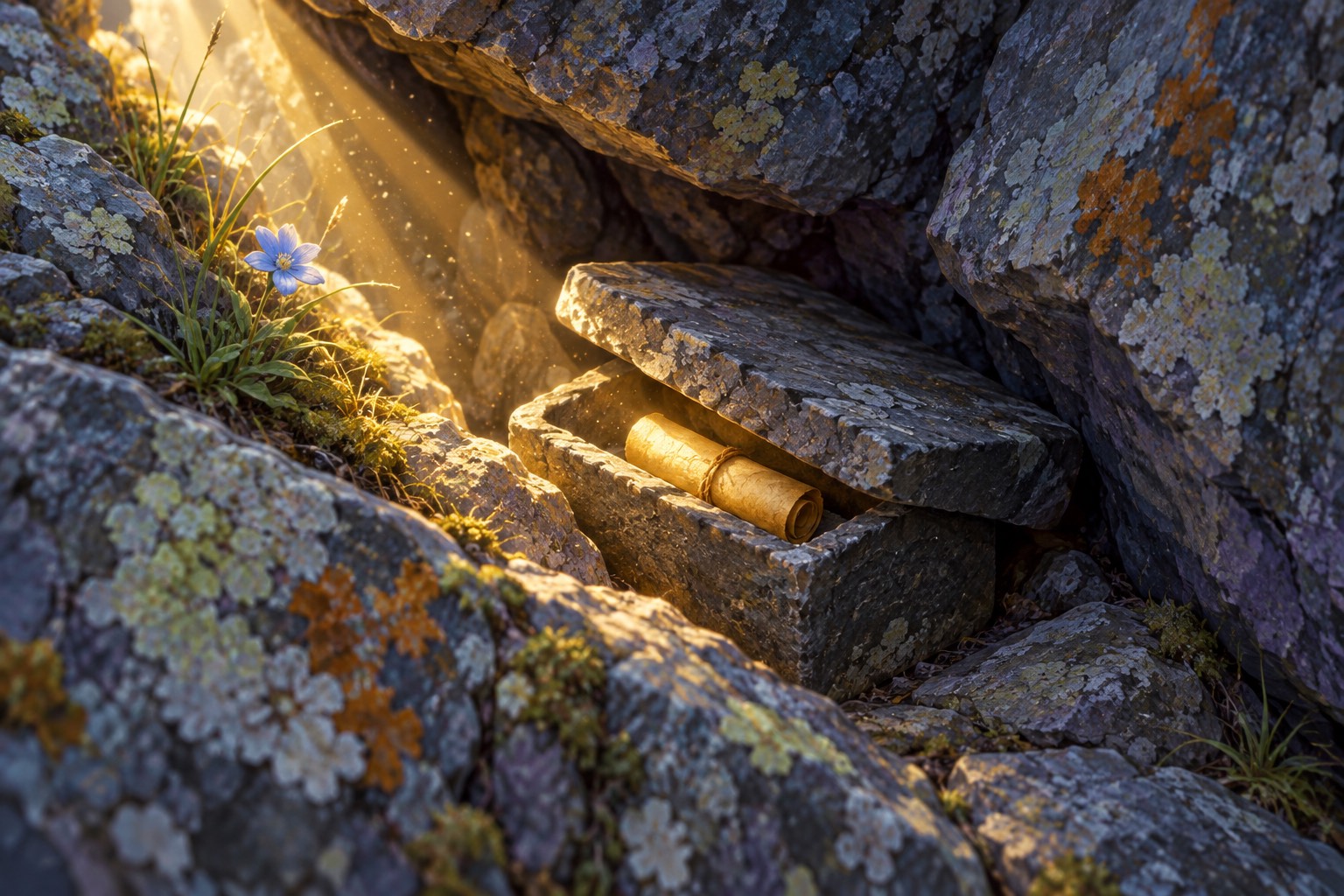
Lotsawa House notes that the prayer was first revealed in the thirteenth century by Guru Chöwang (1212–1270), one of the great treasure revealers, in his Lama Sangdü cycle. In that text Guru Rinpoche gives a simple instruction. Go somewhere quiet. Let the impermanence of life touch you. Trust him completely. No elaborate offerings are needed: just pray with these seven lines, with longing, again and again.
The Treasury of Lives adds that this cycle is also the heart of a yearly sacred dance of Guru Rinpoche's eight forms at most Nyingma monasteries. Guru Chöwang has his own story on this site.
Mipham's White Lotus
Six centuries after Guru Chöwang, Mipham wrote White Lotus, the best-known explanation of the prayer, and he opens it with the story you have just read. His translators note that the language of his closing verses suggests the commentary arose in his mind all at once, as a mind treasure (gongter).
Mipham explains the seven lines on more than one level. There is the outer meaning, which follows Guru Rinpoche's life. And there are hidden meanings, often spoken of as inner and secret, which his translators say hold the whole Vajrayana path in a few words. Those deeper meanings are given by qualified teachers, in person; the site's Find a Teacher page is a place to start.

A dakini appears in Mipham's story too. Dilgo Khyentse Rinpoche writes that at Karmo Taktsang, a sacred retreat in Kham, a dakini appeared to Mipham and sang him the Seven-Line Prayer in a beautiful melody. From that meeting came A Shower of Blessings, the much-loved practice built around the prayer.
A prayer for everyone
Today, according to Mipham's translators, no Nyingma practice session begins without three recitations of the prayer. The Nalanda Translation Committee, drawing on Tulku Thondup, notes that Kagyu and Sakya practitioners use it very often too. Some recite it hundreds of thousands of times; others say it once before sleep.
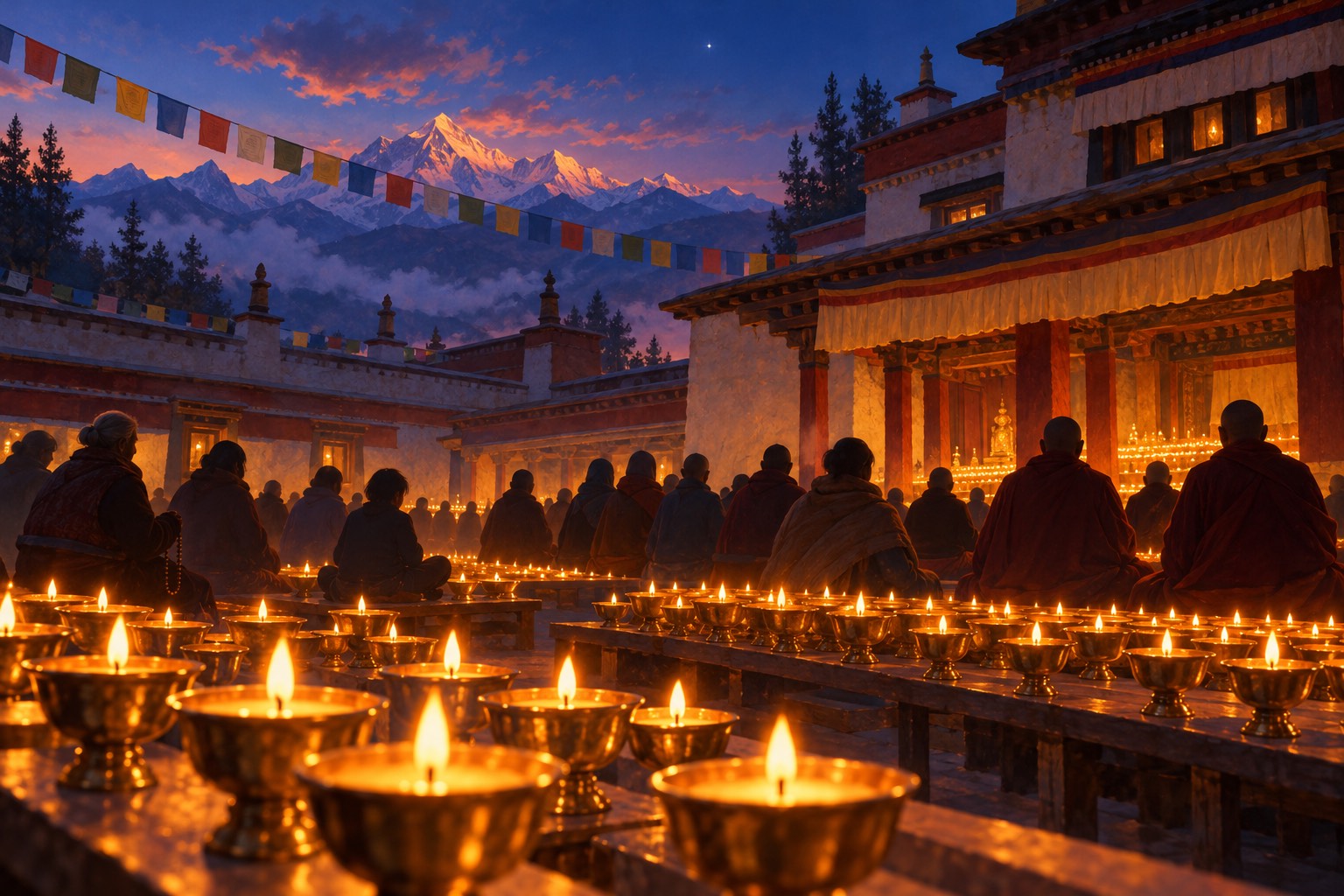
Think back to the scholars on the roof. They had only a need, the words a dakini gave them, and each other. The last line of the prayer still does what they did. It asks him to come.
About the art
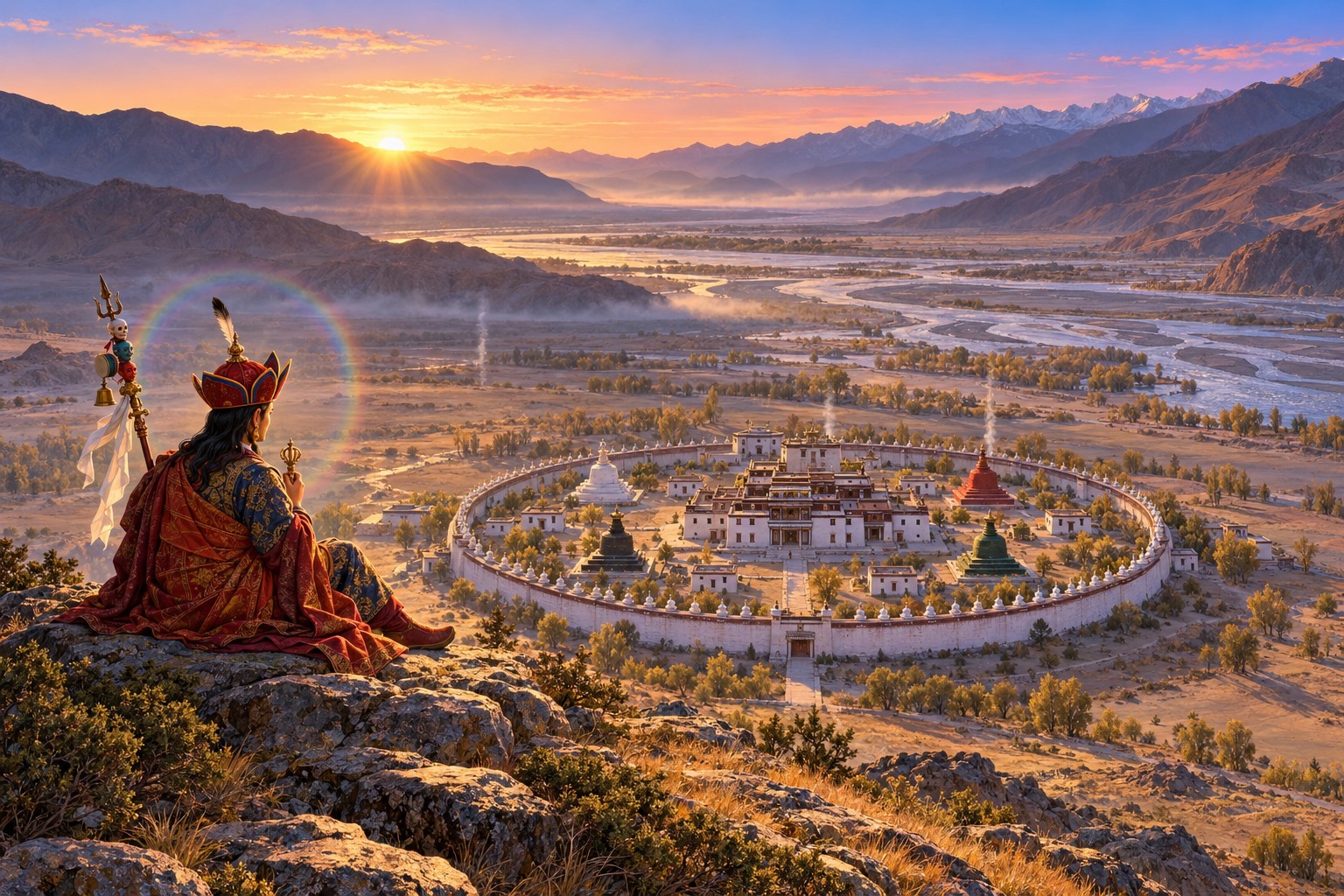
Guru Rinpoche appears on the roof and in the debate in his main form: the lotus hat with its vulture feather, layered robes, a five-pronged vajra at his heart, a skull cup holding a long-life vase, and the khatvanga staff resting against his left shoulder. A seventeenth-century life-story painting described by Himalayan Art Resources likewise shows him debating in his usual form, and only afterwards in his fierce one.
Senge Dradok, the Lion's Roar, follows the paintings described by Himalayan Art Resources and Robert Beer: dark blue, one face with three eyes, flaming upswept hair, a crown of skulls, a tiger-skin skirt and a snow-lion skin at the neck, a golden vajra raised in his right hand and the left hand in the threatening gesture, standing amid wisdom flames. Traditional paintings show figures beneath his feet and a garland of heads; this page crops the image at the knees and leaves the garland out. In Tibetan art, a wrathful form shows the fierce energy of compassion, not anger.
Bodhgaya is drawn as the Chinese pilgrim Xuanzang described it in the seventh century: a tall brick tower plastered in lime, with figures in its niches and a gilded copper finial, and the bodhi tree enclosed by a high wall. The four corner turrets seen today were added in the nineteenth-century restoration, so they are left out. The Indian Buddhist scholars are shown bareheaded in ochre robes. The pointed red pandita hat of Tibetan painting is reserved on this site for named masters such as Shantarakshita.
The dakinis are shown in their peaceful aspect, in silks of the five colours. As everywhere on this site, the seven lines are never written into the pictures, and the treasure scroll is left blank: Tibetan script and mantras are set only as real text, on the prayer page.
Why this matters for practice
The tradition remembers the Seven-Line Prayer first being given to people who had run out of answers of their own, and its last line is simply a request: come. Knowing this story can turn that line from a formula into a real calling-out, made with the same trust the scholars had on the temple roof. You do not need to be a scholar to say it. It is enough to mean it.

If something in this story moved you, you might pause and recite the prayer once, the way the scholars did on the roof, simply asking him to come.
Sources and further reading
- Seven-Line Prayer (topic page), Lotsawa House
- Accomplishing the Lama Through the Seven-Line Prayer: A Special Teaching from the Lama Sangdü, the terma of Guru Chöwang (Rigpa Translations, 2004), Lotsawa House
- Lama Sangdü (topic page), Lotsawa House
- Dedicatory Colophon Verses for White Lotus, by Jamyang Khyentse Chökyi Lodrö (trans. Adam Pearcey, 2020), Lotsawa House
- The Quintessence of the Profound Path: A Concise Guide to A Shower of Blessings, by Dilgo Khyentse Rinpoche (trans. Sean Price, 2021), Lotsawa House
- The Life and Liberation of Padmākara, by Jamgön Kongtrul, Lotsawa House
- A Beautiful and Wondrous Uḍumbara Garland (verse summary of the Pema Kathang), by Jamyang Khyentse Wangpo, Lotsawa House
- Seven Line Prayer, Rigpa Wiki (Internet Archive snapshot)
- Guru Sengé Dradrok, Rigpa Wiki (Internet Archive snapshot)
- Padmasambhava, Rigpa Wiki (Internet Archive snapshot)
- Eight Manifestations of Guru Rinpoche, Rigpa Wiki (Internet Archive snapshot)
- Guru Chökyi Wangchuk, Rigpa Wiki (Internet Archive snapshot)
- Guru Chowang, by Jakob Leschly (2007), The Treasury of Lives (Internet Archive snapshot, 2014)
- Padmasambhava – 8 Forms: Senge Dradog (Rubin Museum of Art, F1997.30.8), item 633, Himalayan Art Resources
- Padmasambhava life-story painting, Bodhgaya debate, item 36510, Himalayan Art Resources
- Seven-Line Supplication to Padmakara, Nalanda Translation Committee
- Seven-Line Prayer to Guru Rinpoche (teachings), Khenpo Sodargye
- White Lotus: An Explanation of the Seven-Line Prayer to Guru Padmasambhava, by Jamgön Mipham (Padmakara Translation Group, Shambhala, 2007), Book
- Si-yu-ki: Buddhist Records of the Western World, vol. 2, Xuanzang, trans. Samuel Beal (1884), Internet Archive
- Mahabodhi Temple at Bodh Gaya, India, Asian Art Museum, Education
- Mahabodhi Temple, Wikipedia
This retelling is waiting to be read by a knowledgeable practitioner. Where the traditional accounts differ, the story says so; if you notice a mistake, please tell us through Share Your Story.