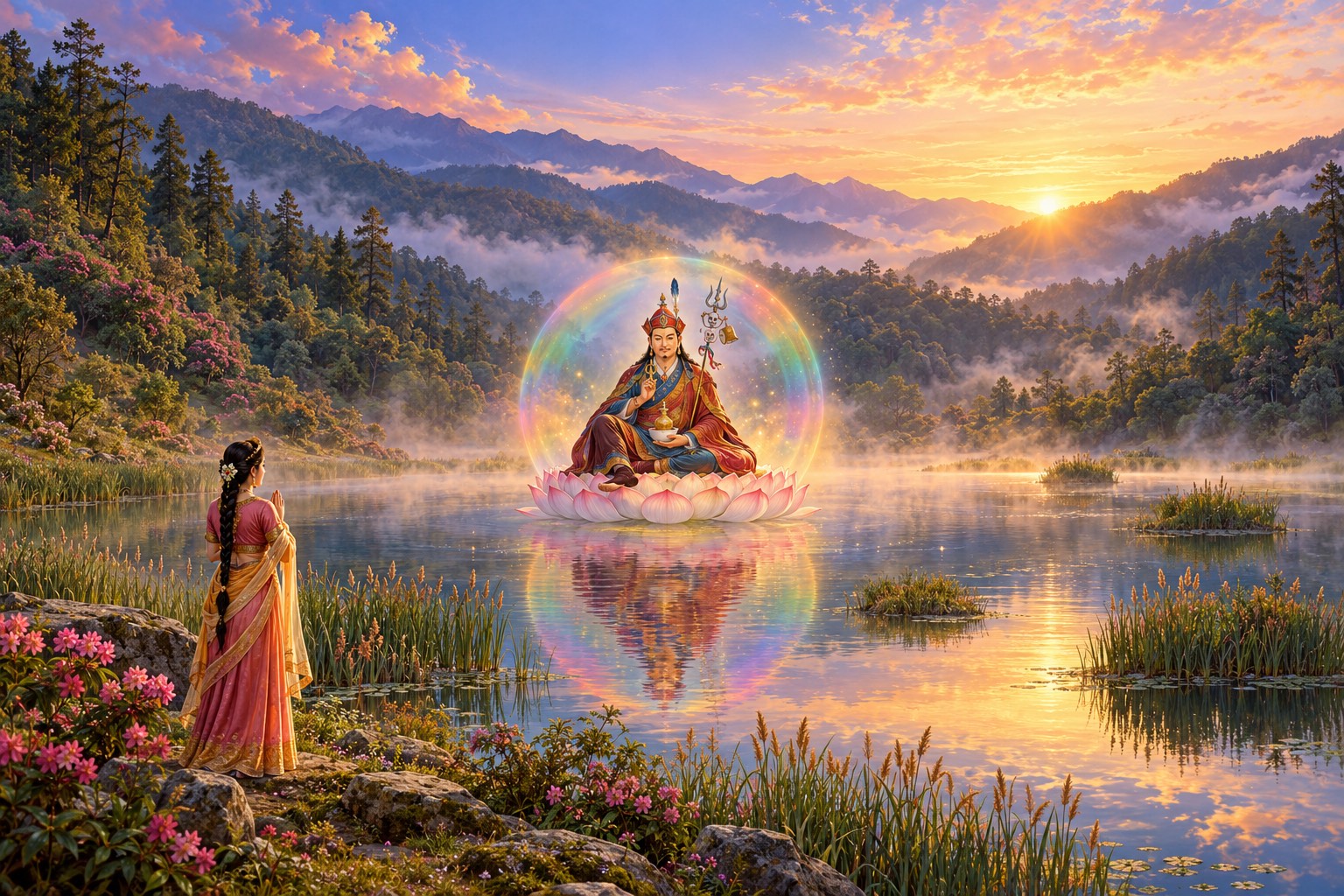
A small lake in the hills
High in the green hills of Himachal Pradesh, in northern India, lies a small lake that Tibetans call Tso Pema, the “Lotus Lake.” On maps it is Rewalsar, after the little town that has grown up around its shore.
Another story in this library, “Mandarava and the Lotus Lake,” tells how, in the traditional accounts, a king’s pyre became this water, and Guru Rinpoche, the “Precious Guru” Padmasambhava, was found seated on a lotus at its heart. This page begins where that story ends. It asks how one small lake became a place of pilgrimage for century after century.
The title comes from a prayer. A lament that arose at Tso Pema, spoken by the twentieth-century master Khenpo Jigme Phuntsok, is addressed to the Great Lama of Oddiyana. Lama is the Tibetan word for guru, a spiritual teacher. To the pilgrims of this lake he is the great lama who, they say, never quite left it.
Where was Zahor?
The old life-stories place the burning in Zahor, a kingdom of ancient India. Where Zahor lay is an honest puzzle. Scriptures, and Mandarava’s own life-story, point east, toward Bengal. Rigpa Wiki notes that Tibetan pilgrims have at times also linked the miracle with the pool before the Golden Temple at Amritsar.
According to Nekhor, a guide to Guru Rinpoche’s sacred places, it was Tibetan masters of the late eighteenth and early nineteenth centuries who came to see Rewalsar as the true Tso Pema. Rigpa Wiki offers a gentle way to hold this: in the Buddhist way of seeing, holy places are less fixed points on a map than a living, shifting landscape. Today, when pilgrims say Tso Pema, this is the lake they mean.
Even the wonder itself is told in more than one way. Some tellings place Guru Rinpoche alone on the pyre, others Mandarava with him. One local version, recorded on Wikipedia, says he rose from the lotus as a youth of sixteen, holding Mandarava in his arms.
The caves above the water
On the steep slopes above the lake are caves. The tradition of the place says that Guru Rinpoche and Mandarava stayed and practised in them. Nekhor calls them the caves where the two first “raised the victory banner of practice,” an old way of saying that the Dharma, the Buddha’s teaching, took root there.
 Illustration in preparation
Photographs on Rigpa Wiki show a cave of Guru Rinpoche with his image inside, a mark in the rock honoured as his footprint, and next to it a cave of Mandarava with her image. From the mouth of his cave the whole lake lies open below.
The classical life-stories speak more of another cave: Maratika, in the hills of eastern Nepal, where the two are said to have done their long-life practice. The caves of Tso Pema belong to the memory of pilgrims and of the place itself. One local legend, again on Wikipedia, even says Guru Rinpoche flew to Tibet from here; the classical accounts take him by way of Nepal. Both kinds of memory are honoured.
Islands that drift
Illustration in preparationOn the lake float small islands of reeds, mats of stems and roots that rise and fall with the water. The Gazetteer of the Mandi State, a British record of 1920, describes them clinging to the banks on calm days, then setting off across the water when a breeze springs up.
Buddhists and Hindus alike, it says, took this movement as “a miracle of the presiding saint.” Tibetans held that Guru Rinpoche’s presence dwelt on the islands, and Wikipedia records the same belief today. Hindu tradition, the Gazetteer adds, spoke of seven islands made by the god Shiva for a sage who had devoted himself to him.
The same record mentions an older belief still: that beneath the water lie the palaces of the nagas, serpent-spirits of lakes and springs, whom Tibetans call lu.
Winter roads
For generations the pilgrims came in winter, when the work of the fields was done. The Gazetteer names Tibetans who came down from Tibet each year, and hill people from Lahaul and Kinnaur. Their great gathering fell in Phagan, the late-winter month that begins around February.
Illustration in preparationSome, the Gazetteer says, covered the last stretch on hands and knees. Tibetans know this as prostration, bowing down to the earth again and again, an old way of approaching a holy place with the whole body.
Illustration in preparationThe rocks above the lake bore many Tibetan inscriptions, and a carved figure of Padmasambhava with his usual emblems: the vajra, a ritual sceptre standing for unshakeable awareness; the skull cup; and the staff crowned with heads. The record also notes a small Buddhist shrine on the shore, fairly new in 1920, with his image inside.
Illustration in preparationIt passes on one more memory, from an Indian scholar: that the special hat the Guru wears in paintings was still called the hat of Zahor. As the Mandarava story tells, painters remember the lotus hat as a gift from Zahor’s king.
Pilgrim families sometimes stayed for a while. A girl born at Tso Pema to such a family in the mid-nineteenth century grew up to be Shuksep Jetsün Lochen Rinpoche, a great yogini, or woman devoted to meditation, whose story is also told in this library.
One lake, three faiths
The lake is not only Buddhist. Hindu tradition, drawing on the Skanda Purana, an old collection of sacred lore, remembers Rewalsar as the place where the sage Lomas meditated and was blessed by Shiva and Parvati. Temples to Krishna, Shiva and Lomas stand near the water, and a great fair is held in the spring month of Baisakh.
Sikhs remember that Guru Gobind Singh, the tenth Sikh Guru, stayed here for a month to meet the kings of the hill states. In 1930 the Raja of Mandi built a gurdwara, a Sikh house of worship, to honour his visit.
Illustration in preparationThe Gazetteer notes, in the blunt words of its day, that some Hindus honoured the image in the Buddhist shrine as their sage Lomas. Read kindly, it is a picture of neighbours sharing one holy place, each seeing it through their own story.
After 1959
In 1959 many thousands of Tibetans fled their homeland and became refugees in India and Nepal. Many of Guru Rinpoche’s great places in Tibet now lay beyond a closed border. Tso Pema, like the holy caves of Nepal, was still within reach.
Nekhor records that a Tibetan yogi settled at the lake in 1959, and calls him Tso Pema’s first resident yogi. Rigpa Wiki says he meditated in the caves for some thirty years, and that over time more than fifty yogis and yoginis, men and women given to meditation, came to live in the caves around him.
Illustration in preparationRigpa Wiki and Nekhor say that the master Dudjom Rinpoche (1904–1987) founded a retreat monastery on the shore, with that yogi’s help. It belongs to the Nyingma, the oldest of Tibet’s schools and the one most devoted to Guru Rinpoche. Rigpa Wiki calls it the oldest monastery at the lake, though the Gazetteer had already seen a small shrine there in 1920. A monastery of the Drikung Kagyu, another Tibetan school, stands there too, among others.
The pilgrims kept coming. Jamyang Khyentse Chökyi Lodrö, whose life is told in this library, wrote a praise of the lake on its shore in 1957. In Adam Pearcey’s translation he marvels that Padmakara, another name of Guru Rinpoche, “turned heat into moisture.” Later the lament that gives this page its title arose there too.
Illustration in preparationTibetan families in exile came as well, as Tibetans had come down the winter roads for generations, to walk around the water and offer what they could.
The lake today
Today a path runs right around the shore. Pilgrims walk it clockwise, the practice called kora, circling a holy place with it always on their right. They pass Nyingma and Kagyu monasteries, a temple shaped as the Copper-Coloured Mountain, the realm where Guru Rinpoche is said to dwell, the Hindu temples and the gurdwara, and rows of butter lamps.
Illustration in preparationOn the hill above stands a great statue of Guru Rinpoche, consecrated in 2012. Wikipedia notes that it was made almost entirely by hand, by craftspeople of the Rewalsar area and artists from Nepal and Bhutan. In the caves, retreatants still practise, and lamps still burn before the images of Guru Rinpoche and Mandarava.
Illustration in preparationFor those who recite the Seven-Line Prayer, Tso Pema is a picture of its second line, which says that Guru Rinpoche was born on the heart of a lotus. The tradition remembers that here too, when fire should have ended him, he was found seated on a lotus, cool and unharmed. A whole lake took its name from that flower.
Illustration in preparationAbout the art
Guru Rinpoche appears in his main form, as painters most often show him and as he is remembered after Zahor: the lotus hat with a half-vajra and a single vulture feather, a five-pronged vajra held at his heart for unshakeable awareness, a skull cup in his lap holding a small vase of long-life nectar, and a khatvanga, a trident staff, resting against his left shoulder. In the cave he sits on a simple grass mat rather than on a throne; in the closing image he sits on a lotus with sun and moon discs inside a rainbow sphere. The weathered rock carving shows the same emblems the 1920 Gazetteer lists for the carving above the lake, drawn from the site's own sheet, not from the real stone.
Mandarava is shown in her dakini form: a small flower diadem, silks in rose, white and gold, a long-life arrow hung with a mirror and silk streamers, and a vase of long life, the emblems of her bond with long-life practice. In devotional images she sits at Guru Rinpoche's right, on the viewer's left. Her image in the cave shrine is painted from this same sheet; the real statue at Tso Pema may look different.
The pilgrims of every period are drawn small, from behind or in silhouette, because they stand for many people, not for any one. The yogis and teachers of the exile years are not drawn at all; a single lamp in a cave stands for them. The great modern statue on the hill is left out of the pictures on purpose, since its form differs from the main form shown here. Prayer flags are plain and unprinted, and as everywhere on this site the images contain no Tibetan script or mantras.
Why this matters for practice
Tso Pema is a living picture of the prayer's second line: the tradition remembers that here, as at his birth, Guru Rinpoche was found on the heart of a lotus. For centuries people of many backgrounds have walked around this small lake and simply called on him. Reciting the Seven-Line Prayer is a way of joining that long, quiet line of pilgrims from wherever you are.
If something in this story moved you, the drifting islands, the winter roads, or a lamp burning in a cave above the water, you might pause and recite the prayer once. You do not need to travel to any lake. Wherever you are tonight is enough.
Sources and further reading
- Gazetteer of the Mandi State 1920 (Punjab States Gazetteers), Internet Archive (full text)
- Zahor (Tso Pema), Nekhor
- Tso Pema, Rigpa Wiki (archived snapshot)
- Tso Pema Orgyen Heruka Nyingmapa Gompa, Rigpa Wiki (archived snapshot)
- Zahor, Rigpa Wiki (archived snapshot)
- In Praise of the Supreme Vajra Place, Tso Pema (Lotus Lake), by Jamyang Khyentse Chökyi Lodrö, tr. Adam Pearcey (2018), Lotsawa House
- Lament Recalling the Great Guru of Oḍḍiyāna, by Khenpo Jigme Phuntsok, tr. Adam Pearcey (2019), Lotsawa House
- Rewalsar Lake, Wikipedia
- Rewalsar, India, Wikipedia
- Mandarava and the Lotus Lake, 7LinePrayer.com (this library)
This retelling is waiting to be read by a knowledgeable practitioner. Where the traditional accounts differ, the story says so; if you notice a mistake, please tell us through Share Your Story.