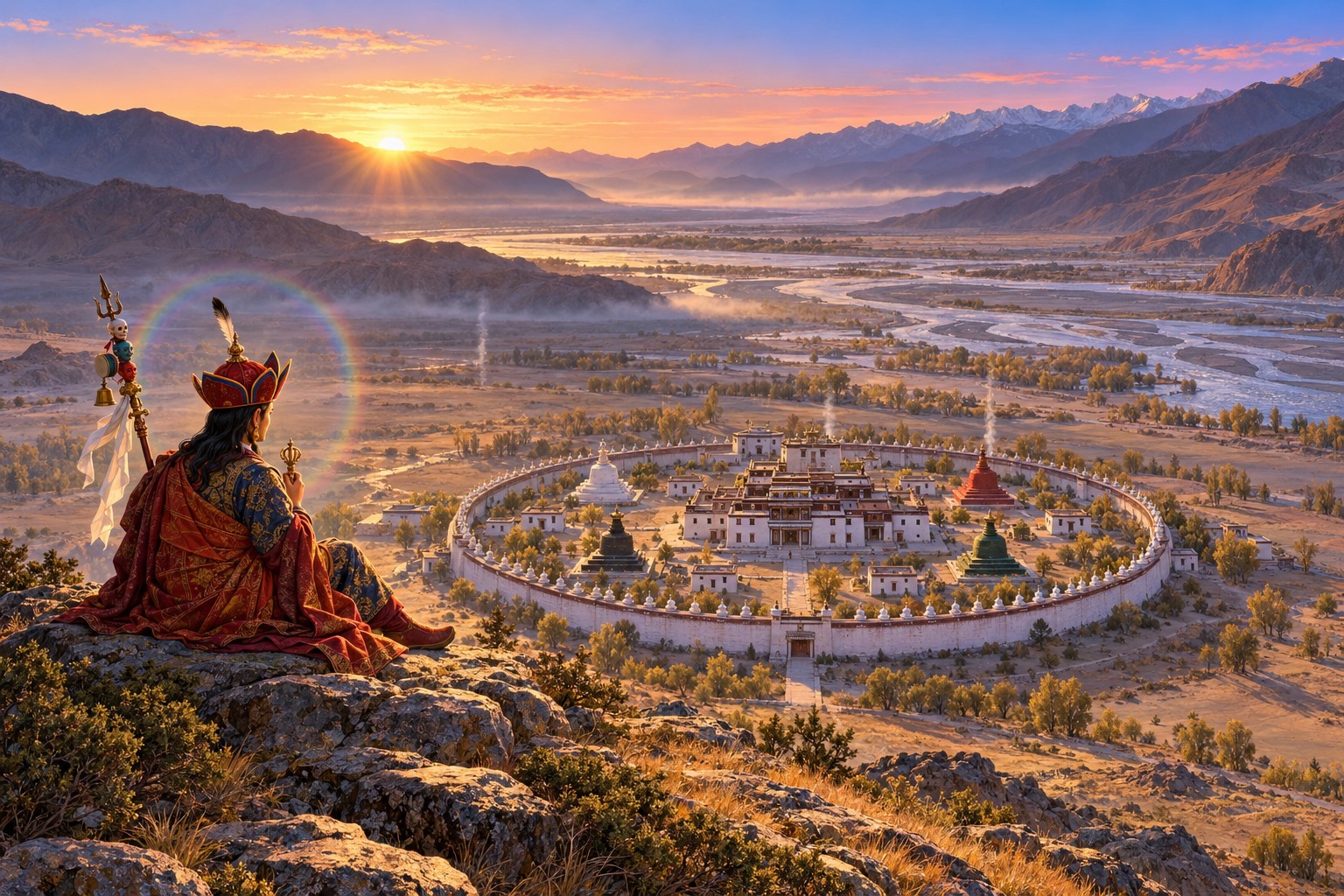
Near the end of his years in Tibet, the traditional accounts say, Guru Rinpoche began to think less about the people in front of him and more about people who had not yet been born. He had taught kings, translators and yogis. What about the ones who would come a hundred years later, or a thousand?
The answer the tradition gives is one of the most beautiful ideas in Tibetan Buddhism. He and his closest disciple, Yeshe Tsogyal, are said to have hidden teachings away, like seeds stored for a spring that was still far off. These hidden teachings are called terma, which means "treasure."
Teachings for a later time
Why hide a teaching at all? The scholar and lama Tulku Thondup, as Rigpa Wiki summarizes him, gives the tradition's reasons: so that the deepest teachings would not be mixed, diluted or lost, and so that their blessing would reach later followers fresh, as if newly given.
Yeshe Tsogyal was the keeper. Rigpa Wiki remembers her for an unfailing memory: she is said to have gathered every teaching Guru Rinpoche gave in Tibet. Night after night, in the life stories, the two of them sat in mountain caves, and what he taught, she held.
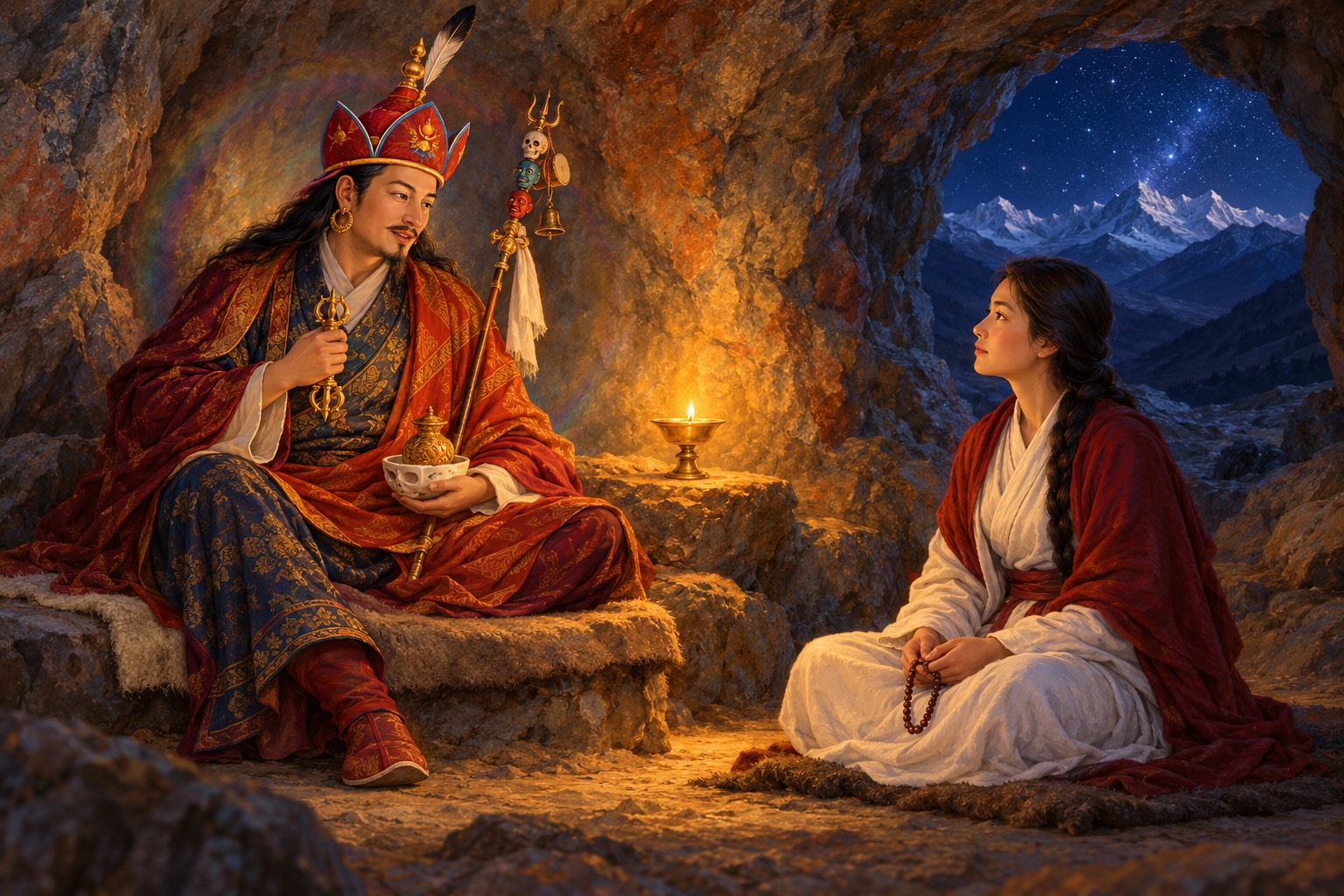
The Wish-Fulfilling Tree, a treasure biography revealed by Chokgyur Lingpa in the nineteenth century, tells it in Guru Rinpoche's own voice. He wrote the teachings down, it says, in five kinds of writing on scrolls of five kinds of material, and placed them in wondrous caskets.
Yellow scrolls
In paintings and stories these are often called the yellow scrolls, because most are yellowish or golden paper, though Tulku Thondup notes that they can be of any colour or size. They usually rest inside a small sealed casket of stone, wood or precious metal.
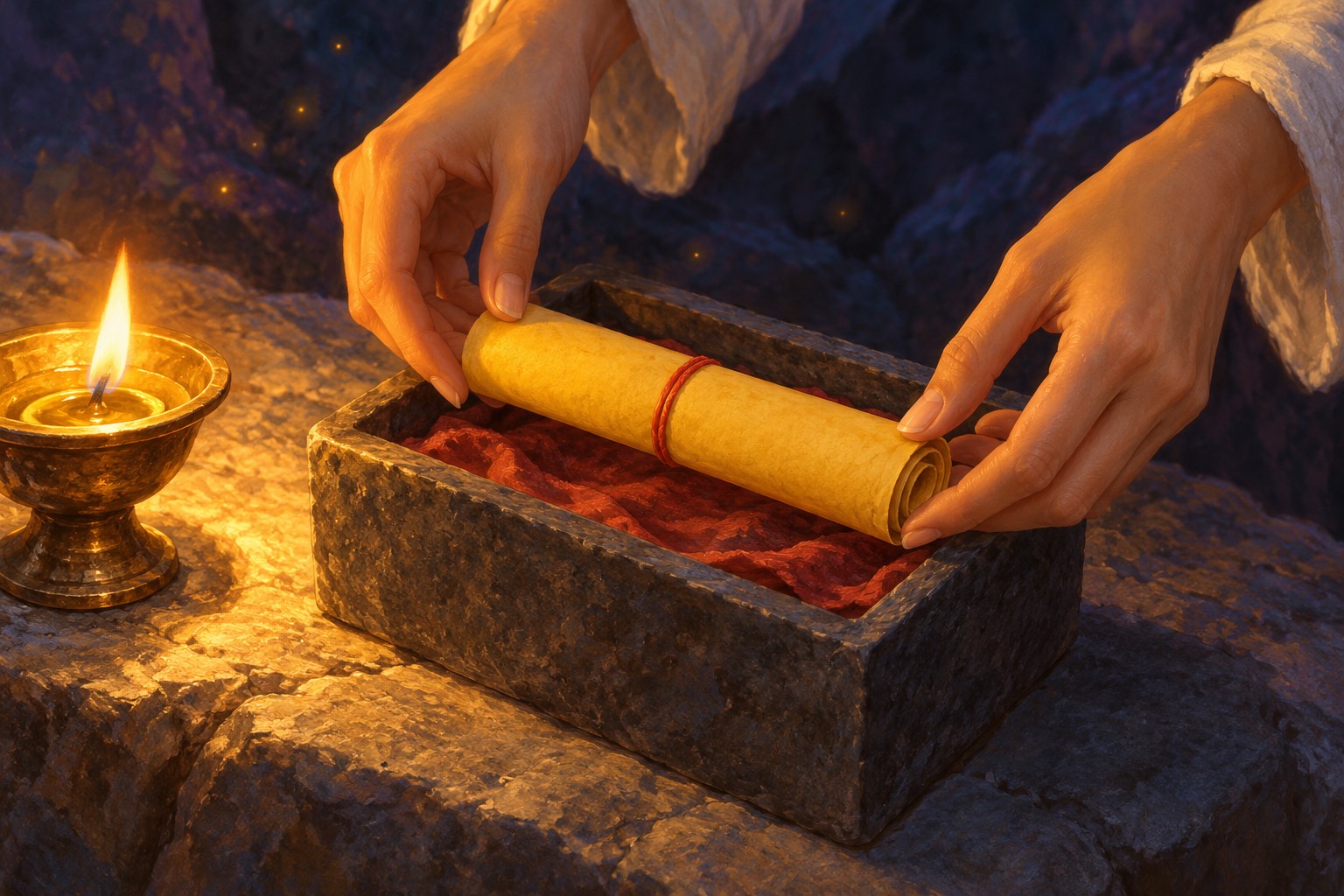
What is written on them is not ordinary writing. The tradition calls it dakini script, a symbolic code. A dakini is a female embodiment of awakened wisdom, often pictured as a sky-dancer. Sometimes a scroll is said to hold a single syllable, sometimes a phrase, sometimes a whole text.
And here is the surprising part. Tulku Thondup stresses that the script is only a key. The scroll does not contain the teaching the way a book does. It wakes the teaching up, out of the mind of the one destined to find it.
Rock, lake, temple and heart
Where were the treasures hidden? Everywhere, the accounts say. The Wish-Fulfilling Tree lists temples such as Lhasa and Samye, caves such as Sheldrak in the Yarlung valley and Yerpa, snowy ranges such as Lapchi, and twenty-five sacred places in the east of Tibet. Other accounts speak of mountains, lakes and caves as well.

Treasures hidden in the physical world are called earth treasures, sa ter. They may be scrolls, statues or sacred objects, tucked into a cleft in a cliff, sunk in a lake, or sealed inside a temple wall.
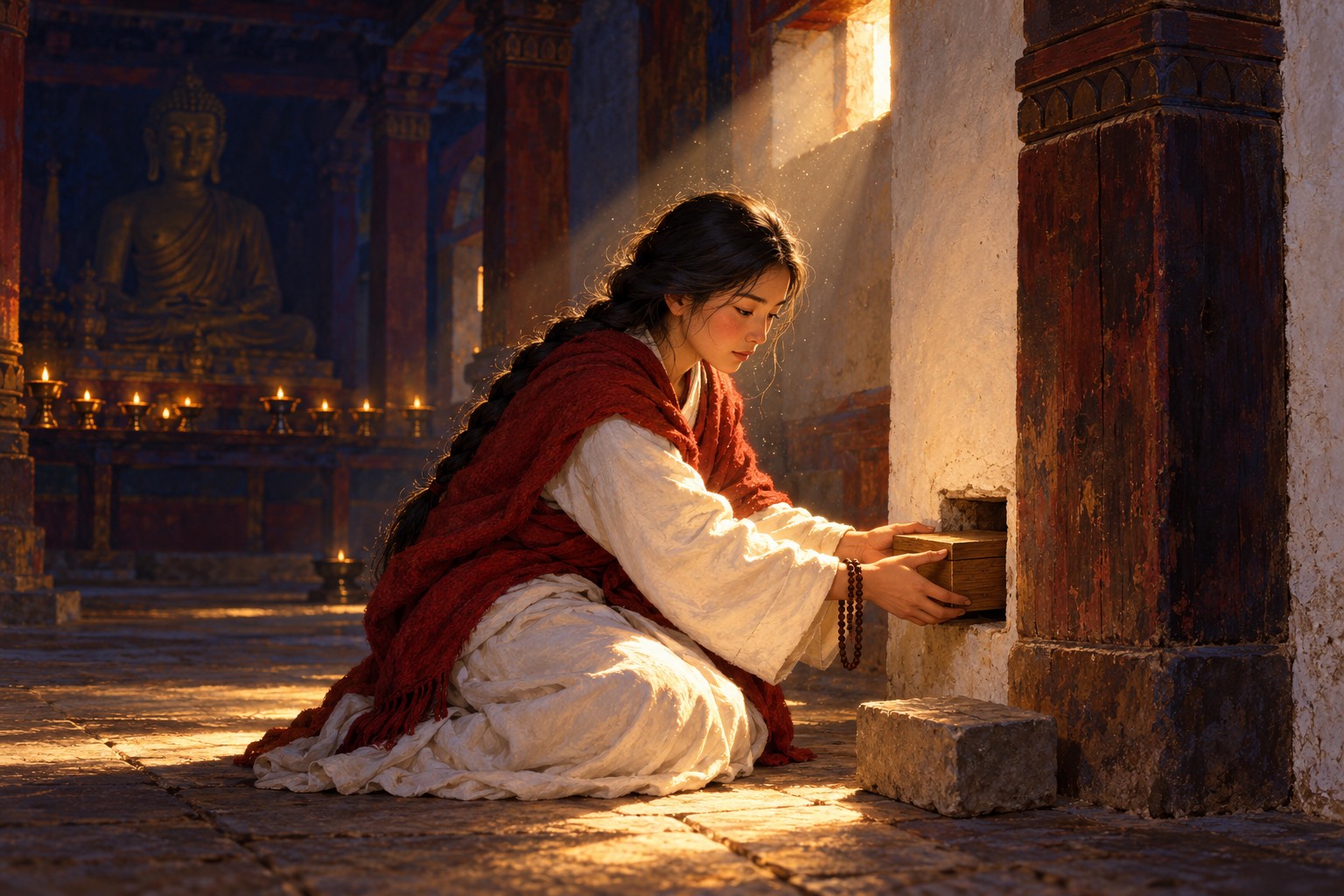
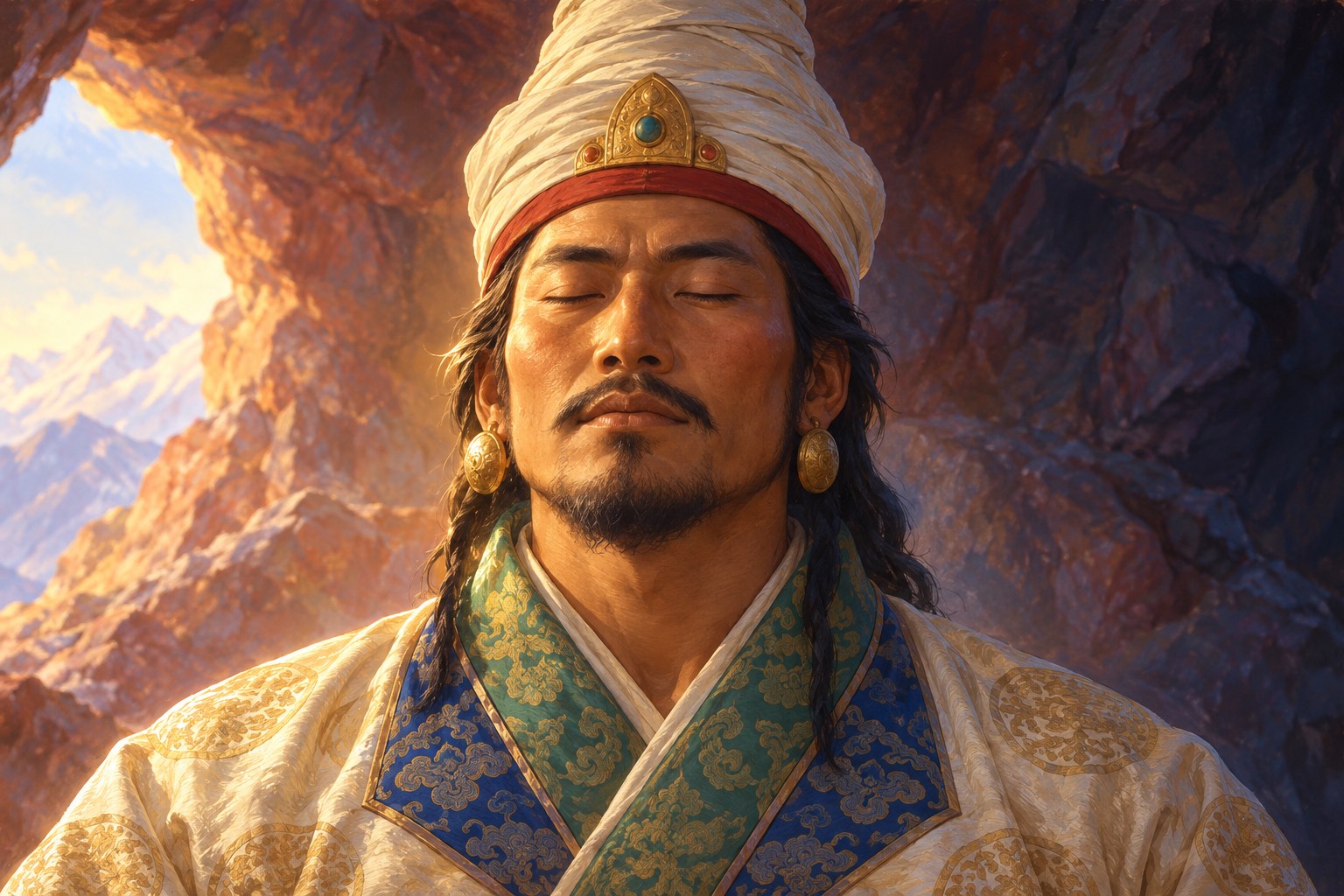
But the tradition speaks of a quieter hiding place too. Some teachings, it says, were concealed in the minds of the disciples themselves. These are mind treasures, gong ter. No scroll is needed to find them. Centuries later, a sight or a sound in a vision is enough, and the teaching rises from within.
Rigpa Wiki describes this as a joining of master and disciple: the teaching was sealed in the very nature of the disciple's awareness, and Guru Rinpoche made aspirations that it would be found when the time was right.
Sealed with aspiration
That word, aspiration, matters. In the tradition's own account, a treasure is not simply buried. It is passed on through three special kinds of transmission, which Tulku Thondup describes.
First is the aspiration-empowerment, the sealing of the teaching in the disciple's mind together with a heartfelt prayer. Second is prophetic authorization: a prophecy that this disciple, in some later life, will be the one to reveal it. Third is entrustment to the dakinis, who, with the protectors of the teachings, keep watch over the treasure until its time.
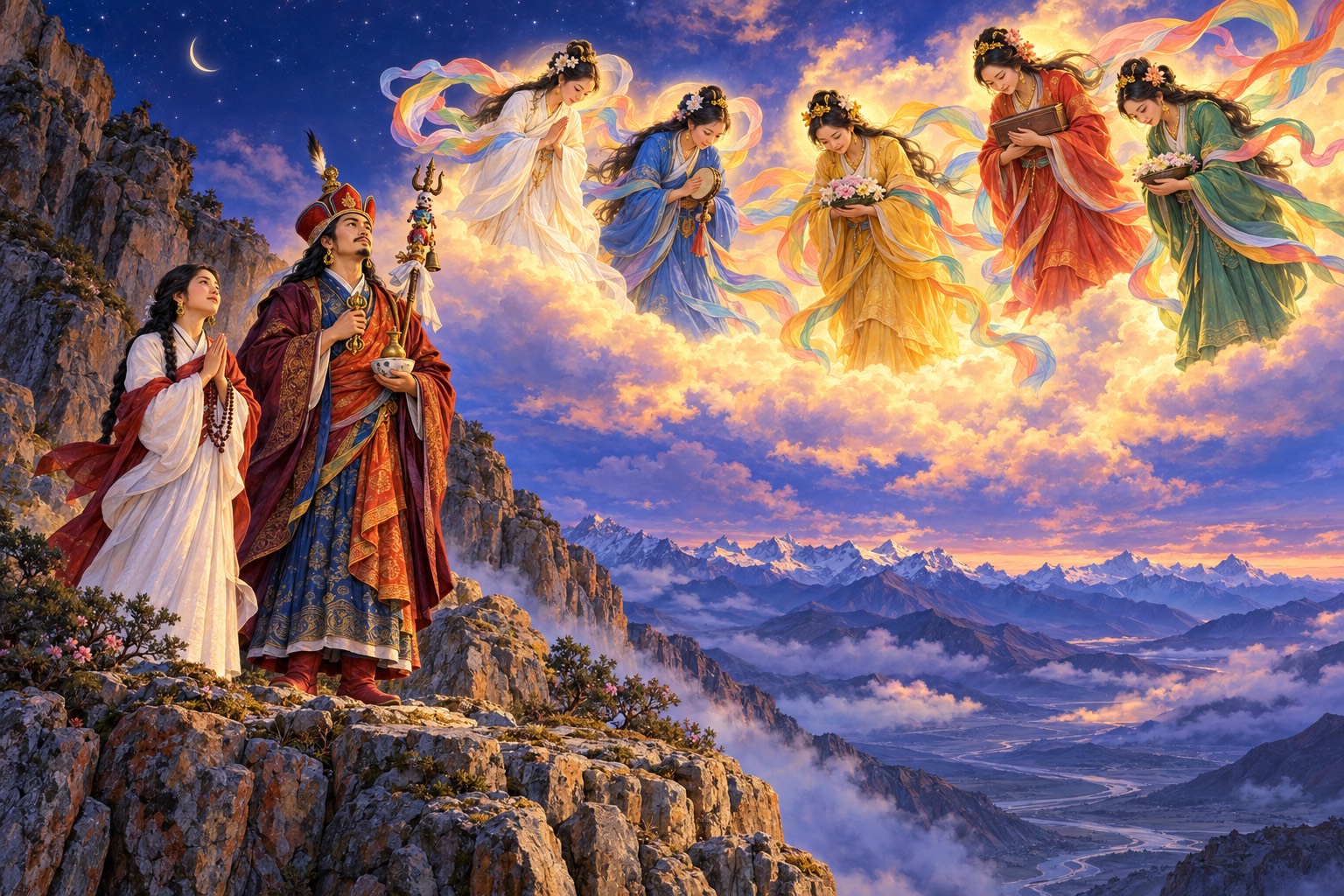
So each treasure, the tradition says, carries a time, a place and a person. Rigpa Wiki notes that for each one Guru Rinpoche foretold when it would appear, who would reveal it, and who would hold its teachings.
The prophecy
In The Wish-Fulfilling Tree, Guru Rinpoche looks down the centuries. Hard times will come, he says, and the teachings will be torn down. But the king and the disciples now present will return, because of their aspirations, as treasure revealers: a hundred great ones and a thousand lesser ones, until every district has its own.
These revealers are called tertöns. Rigpa Wiki counts the first as Sangye Lama, born around the year 1000, and names five as especially great, from Nyangral Nyima Özer in the twelfth century to Jamyang Khyentse Wangpo in the nineteenth. The line, it says, has continued to the present day.

The pass of Gungthang
Then it was time to go. The life stories say Guru Rinpoche told the Tibetans that his work among them in that body was done, and that he must travel to the southwest, to tame the rakshasas, fierce beings who, the accounts say, threatened the human world.
The young prince wept and begged him to stay. In The Wish-Fulfilling Tree the prince is comforted only when Guru Rinpoche explains what he is leaving behind: likenesses for his body, treasures for his speech, and his heart's realization entrusted to destined heirs.
A great company walked with him to the Gungthang pass in Mangyul, on the border with Nepal, where he had first entered Tibet. There, the accounts say, he gave his last advice.

How he left depends on who is telling it, and the tradition keeps every version. Rigpa Wiki relates that in the Zanglingma, the earliest of the great life stories, he rode away on a beam of sunlight. Others saw a divine horse, or a lion. The Wish-Fulfilling Tree has him mount a fine horse held aloft by four dakinis.
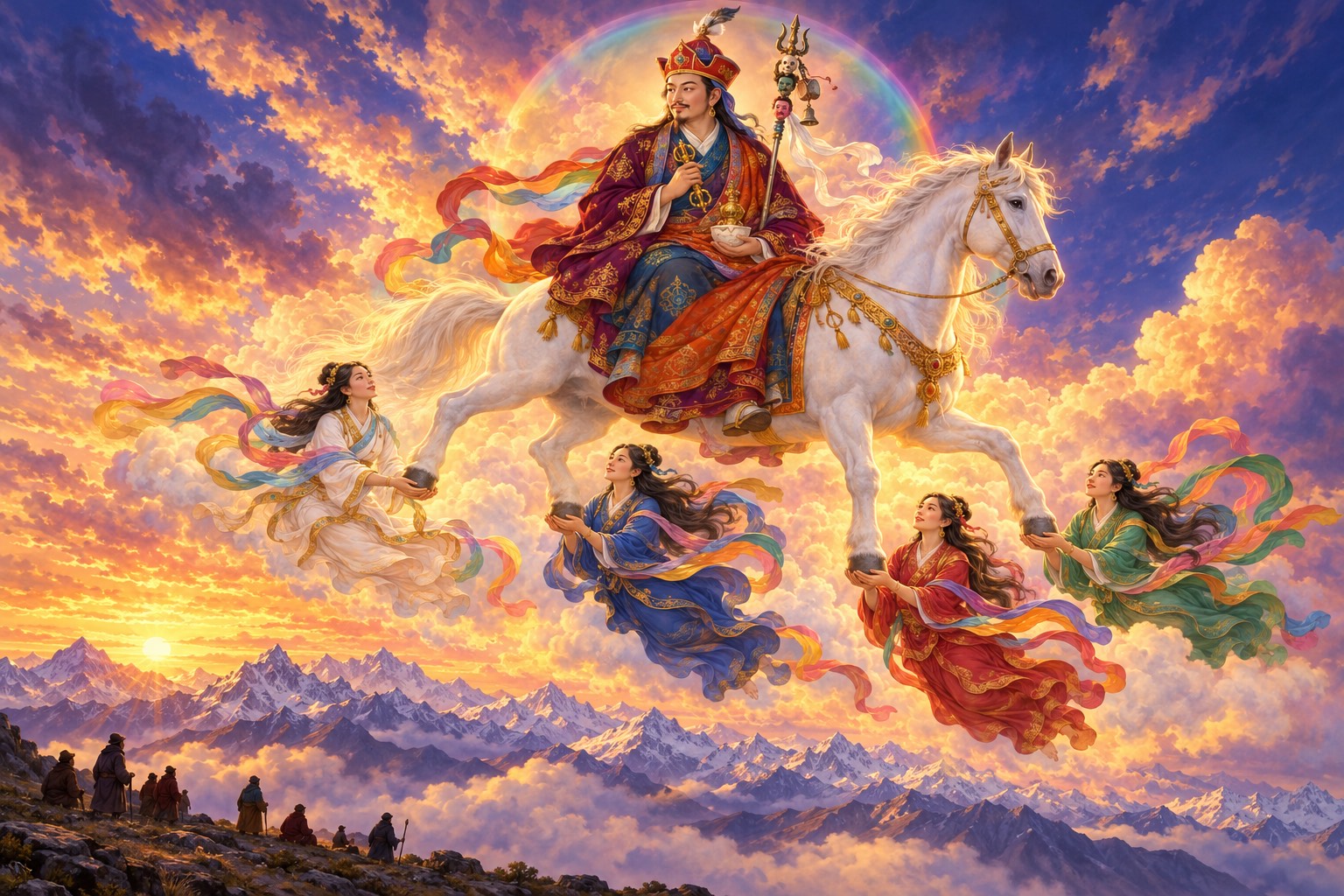
In one telling the disciples, sitting in meditation, watched him grow smaller and smaller in the sky until he was a speck. Rigpa Wiki recounts that he looked back from the southwest and sent his disciples a ray of loving kindness.
The tradition says he went on to the Copper-Coloured Mountain, Zangdok Palri, and that he dwells there still, in a palace of lotus light.

A promise
Before he rode away, the tradition holds, he left one more gift: a promise. In The Wish-Fulfilling Tree he tells the Tibetans that he will return each month for their sake, especially on the tenth day of the monkey month. His last words there are simple: "Call upon me, don't forget!"
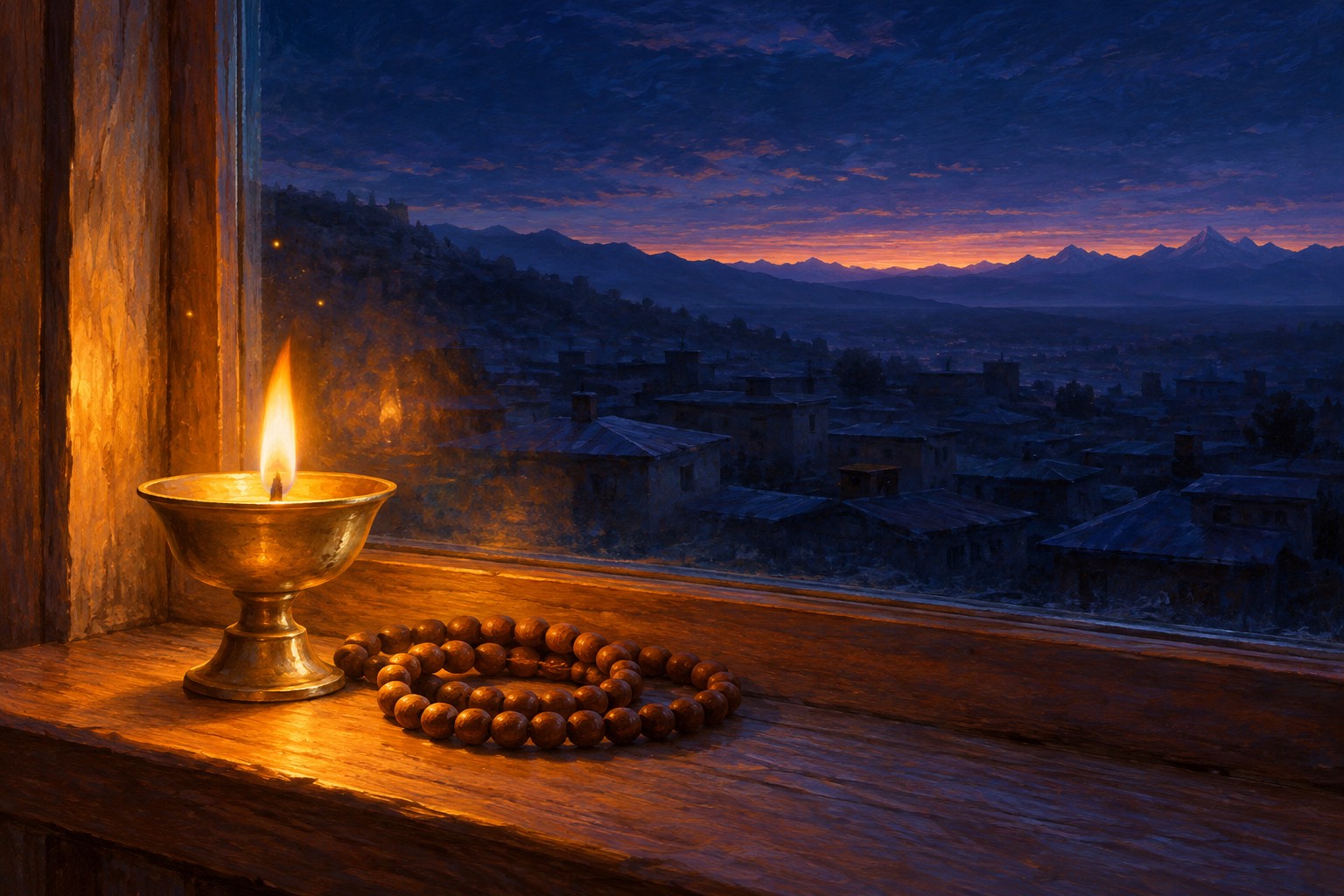
Other treasure texts, which Dudjom Rinpoche gathered in a short work on the tenth-day festival, give the promise in other words: that he will come on the tenth days, and that whoever remembers him will never be apart from him. The tradition holds, in short, that he said he would come to anyone who calls on him. Many practitioners treasure these words. They are a promise of presence, of companionship, rather than of any particular result.
Two ways of looking
Scholars study the treasure tradition with great care, alongside the tradition's own account. Janet Gyatso has written about it as a Buddhist theory of how scripture is passed on, in which a sign such as a scroll awakens memory. Andreas Doctor has surveyed the revelations of one tertön, Chokgyur Lingpa, and the tests Mipham proposed for telling true treasures from false.
Jacob Dalton has traced how the stories of Guru Rinpoche grew, using tenth-century manuscripts from the Dunhuang caves. Their work shows a tradition that developed over many generations, and it sits beside, not against, the devotion of those who read the treasures as his living voice.
Either way, something remarkable is true. For roughly a thousand years, people in the Himalayas have felt that this teacher did not leave them alone. The seventh line of the Seven-Line Prayer asks him to come and grant his blessing, and the tradition answers that he said he would.
About the art
Guru Rinpoche appears in his main form: the lotus hat with a half-vajra, a sun and moon and a single vulture feather; layered robes; a five-pronged vajra at his heart in his right hand; and a khatvanga, a slender staff crowned with a trident, resting against his left shoulder. On this page he is mostly shown standing on a ledge, by a lake or riding through the sky, because the story finds him travelling. In the farewell he rides a white horse borne up by dakinis, as in a seventeenth-century painting of his departure from the Gungthang pass on Himalayan Art Resources and in The Wish-Fulfilling Tree.
Yeshe Tsogyal is shown as a yogini in simple white robes and a red shawl, the form the tradition remembers for her years of practice and for gathering and concealing the treasures. The dakinis wear silks in the five colours (white, blue, yellow, red and green) that stand for the five kinds of awakened wisdom; teachers explain their meaning more fully. King Trisong Detsen wears eighth-century Tibetan imperial dress. The treasure revealer of scene 8 is a generic lay yogi, not a portrait of any particular tertön.
The yellow scrolls are always painted plain, with no writing. In the tradition they carry dakini script, a symbolic code that is said to work as a key rather than a text, and no painting could render it truly. The caskets are plain and small. The Copper-Coloured Mountain is shown only from far away, glowing copper-red with a palace of light on its summit, as in Himalayan paintings of Guru Rinpoche's pure land, without the many figures and inscriptions those paintings contain.
Why this matters for practice
The seventh line of the Seven-Line Prayer asks Guru Rinpoche to come and grant his blessing. The treasure tradition is, in a sense, the story behind that request: a teacher who prepared for people he would never meet in that life, and who, the tradition holds, promised to come when called. For many practitioners, reciting the prayer is simply taking up that invitation.

If something in this story stirred you, you might take the old promise at its word tonight, and recite the Seven-Line Prayer once, as a way of calling on him. Anything beyond recitation is best explored with a teacher.
Sources and further reading
- Terma, Rigpa Wiki (archived snapshot)
- Tertön, Rigpa Wiki (archived snapshot)
- Guru Rinpoche, Rigpa Wiki (archived snapshot)
- Zangdokpalri, Rigpa Wiki (archived snapshot)
- Yeshe Tsogyal, Rigpa Wiki (archived snapshot)
- Padma's Wish-Fulfilling Tree (Chokgyur Lingpa, trans. Erik Pema Kunsang and Samye Translations), Lotsawa House
- Concise Benefits of the Festival of the Tenth Day (Dudjom Rinpoche, trans. Rigpa Translations), Lotsawa House
- Guru Padmasambhava: an introduction (Stefan Mang), Lotsawa House
- gTer (Tulku Thondup on the terma tradition), Tibetan Buddhist Encyclopedia
- Hidden Teachings of Tibet (Tulku Thondup, Wisdom Publications, 1986), Book
- Padmasambhava (Jacob Dalton), The Treasury of Lives (archived snapshot)
- Padmasambhava I: the early sources (Sam van Schaik), early Tibet
- The Early Development of the Padmasambhava Legend in Tibet (Jacob Dalton, Journal of the American Oriental Society 124.4, 2004), Journal article
- Signs, Memory and History: A Tantric Buddhist Theory of Scriptural Transmission (Janet Gyatso, JIABS 9.2, 1986), Journal article
- Tibetan Treasure Literature (Andreas Doctor, Snow Lion, 2005), Book
- Gungthang Pass, Nekhor
- Samye Chimpu, Nekhor
- Padmasambhava leaving Tibet from the Gungtang Pass (item 36517), Himalayan Art Resources
- Padmasambhava: Pure Land, Copper-Coloured Mountain (item 90908), Himalayan Art Resources
- Mangyül Gungthang, Wikipedia
This retelling is waiting to be read by a knowledgeable practitioner. Where the traditional accounts differ, the story says so; if you notice a mistake, please tell us through Share Your Story.