The road back
Some stories in the life of Guru Rinpoche, the “Precious Guru” Padmasambhava, are about setting out. This one is about coming home. It is a short episode in the old life-stories, told there in only a few lines, and it reaches us mostly through later summaries of them.
We last saw him in Zahor, a kingdom of India, where the tradition says a king's pyre became a lake and the princess Mandarava became his companion in practice. That story is told in “Mandarava and the Lotus Lake.” From there, the accounts say, the two turned toward Oddiyana, the kingdom where he had grown up as a prince.
He had not left it gladly. As “From Prince to Yogi” tells, a minister's son died at the palace, and the young prince was sent into exile. Now, writes the nineteenth-century scholar Jamgön Kongtrul, he went back to bring that land, too, to the Dharma, the Buddha's teaching.
The land at the start of the prayer
Oddiyana has a special place for anyone who recites the Seven-Line Prayer. Its very first line names the northwest of Oddiyana as the place the Guru came from. Tibetans often call it Orgyen, and Rigpa Wiki notes that it was known as the land of the dakinis, women of awakened wisdom.
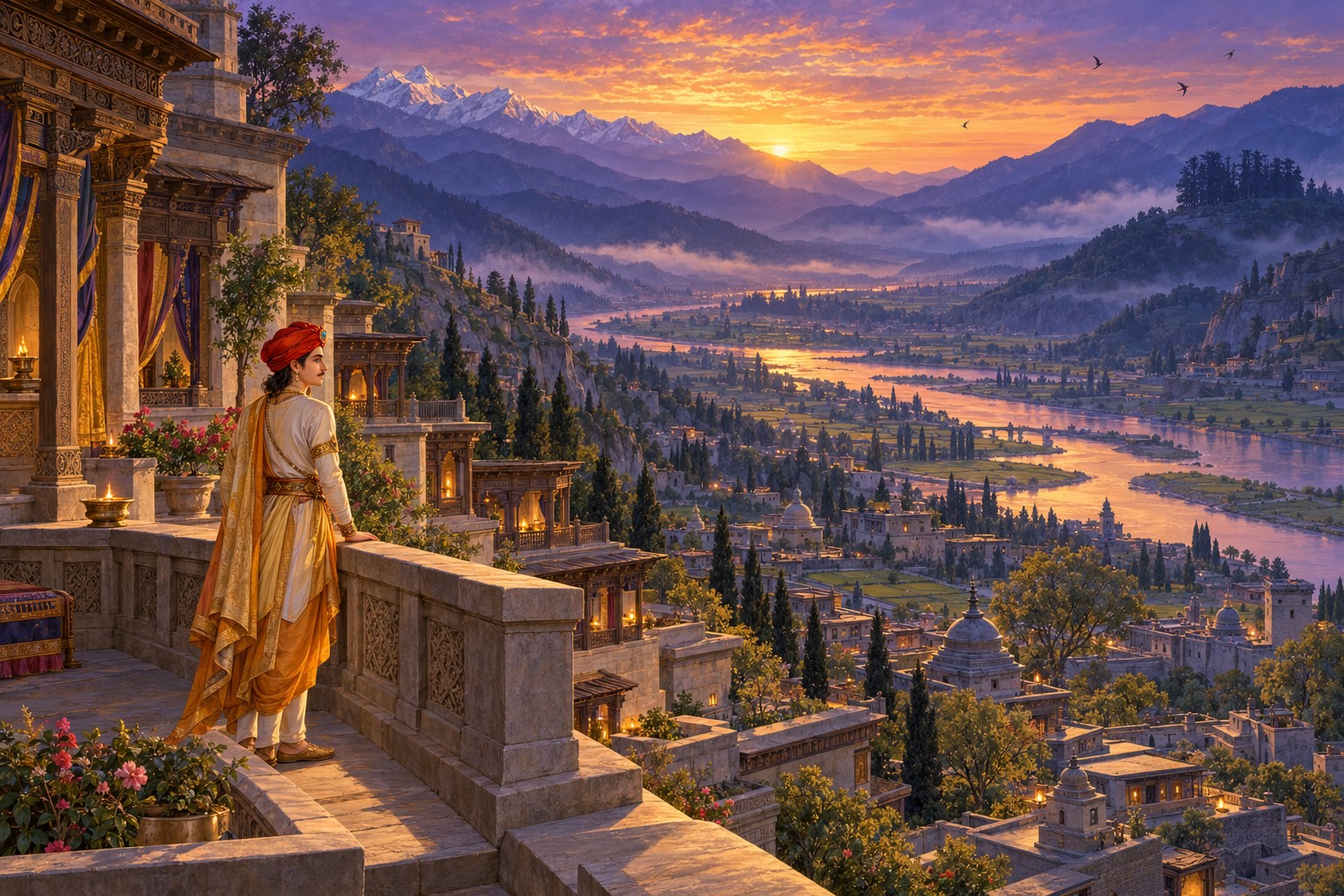
Where was it? Following Chinese pilgrims of the fifth to seventh centuries, most scholars place it in the green Swat valley of northern Pakistan. In Rigpa Wiki's summary, the pilgrim Xuanzang found there a fertile land of fruit, flowers and forests, with gentle people, though many of its monasteries already stood empty.
 Illustration in preparation
Historians add a gentle caution. The Treasury of Lives notes that very little is known of the Guru as a historical person, and that he may or may not have come from Oddiyana at all. The homecoming told here belongs to the tradition's life-stories, which grew fuller from about the twelfth century on.
Beggars at the gate
The accounts say he and Mandarava did not arrive as royalty. They came as they had been living, as wandering practitioners asking for alms, the simple food that householders give to those who have left home.
Kongtrul says the two had already completed their retreat at Maratika, the cave of long life, and had gained what he calls bodies beyond birth and death. On the streets of Oddiyana, though, they looked like two travellers with a begging bowl.
Illustration in preparationAnd there, Kongtrul says, the Guru was recognised. Someone knew the face of the prince who had been sent away.
Here the tellings begin to differ. Kongtrul's summary says it was the very minister whose son had died, years before, who moved against him, together with his men. The verse summary of the Pema Kathang, a fourteenth-century life-story revealed as treasure, speaks more generally of ministers plotting to burn him. Rigpa Wiki says only that he was recognised.
Illustration in preparationA second fire
What followed will sound familiar to anyone who has read the Zahor story. The accounts say the two were seized and placed on a pyre, and Kongtrul and Rigpa Wiki both say it was built of sandalwood, a precious and fragrant wood.
The old tellings do not linger over the fire, and neither will we. Kongtrul and Rigpa Wiki say only that some time passed before anyone saw what had become of them.
Illustration in preparationA lake where the fire had been
What was found then, the traditional accounts say, was water. Where the pyre had stood lay a lake, and in its middle, on an open lotus, sat the Guru and Mandarava, unharmed.
The sources picture the lake differently. Rigpa Wiki calls it a lake of sesame oil; Kongtrul and the Pema Kathang summary speak simply of a lake. That verse summary does not mention Mandarava in this episode at all, while the other two place her on the lotus beside him.
Illustration in preparationTwo of the accounts add a detail that can startle at first: the pair were wearing garlands of skulls. Both explain it at once as a symbol. In Rigpa Wiki's words, it stood for “liberating all beings from samsara”, the endless round of suffering, through compassion. For this, they say, he was now called Pema Thötreng Tsal, the Mighty Lotus with a Garland of Skulls.
What was different this time
So the tradition tells of fire turning to water twice. It is worth noticing how the second time is not the same as the first.
In Zahor he was a stranger, and the anger he met was that of a king who thought his daughter had chosen a beggar. In Oddiyana he was a son of the land coming back, and what met him, in Kongtrul's telling, was the oldest sorrow in his own story. The fire was lit by people who remembered him.
And this time the wonder was not seen by a foreign court. It was seen by his own people, in the country where the accounts say he had first appeared, as a child, on a lotus in a lake.
The king of his homeland
The Pema Kathang summary says the king was filled with tremendous faith. Kongtrul and Rigpa Wiki both speak of the king and the queen, and say that they and many others went on to deep realisation.
Illustration in preparationWho was this king? The accounts used here do not name him. Readers of “From Prince to Yogi” may remember old King Indrabhuti, who raised the lotus-born child, wept at their last meal, and heard his son promise that they would meet again. Whether this was that meeting, these sources do not say, so we leave it as a quiet question.
What they agree on is that the homecoming became a welcome. Kongtrul says the Guru and Mandarava stayed for thirteen years as teachers appointed by the king, until the whole kingdom had come to the Dharma.
Thirteen years
Kongtrul and the Pema Kathang summary both say that he taught there a great cycle of tantric teaching known as the Gathering of Transmitted Precepts. Teachings of that kind are given by a qualified teacher in person; if they call to you, the Find a Teacher page is a place to begin.
Illustration in preparationRigpa Wiki goes further. It says the king, the queen and many others attained the rainbow body, which the tradition describes as a body that dissolves into light at death, a sign of complete realisation. Here, as throughout, we are listening to the tradition's own voice.
In these years, Rigpa Wiki and Kongtrul say, he became known as Pema Gyalpo, the Lotus King, a name later counted among his Eight Manifestations. Himalayan Art Resources ties the same name instead to his earlier years, when he ruled for a time as a young king after his adoption. Both tellings are honoured.
Illustration in preparationMandarava, too, is remembered in Oddiyana as a teacher, not as a figure at the edge of the story. Kongtrul names them together: it was the Guru and Mandarava who remained, and the two of them who taught.
Illustration in preparationWhere the stories differ
Not every life-story tells this episode. In The Wish-Fulfilling Tree, a nineteenth-century treasure text in which the Guru tells his own life, the road runs from the fire at Zahor straight to Maratika, and the return to Oddiyana does not appear. Orgyen Lingpa's short account of the Guru's deeds remembers the fire at Zahor but not a second one.
The Pema Kathang summary, for its part, places the return much later, after many travels through India, rather than straight after Zahor. The order is not settled, and the tradition has never needed it to be.
Illustration in preparationComing home
There is something tender in the shape of it. The one who had been sent away came back with nothing in his hands, met the hardest welcome his homeland could give, and, as the tradition tells it, answered with a lake, then stayed thirteen years to teach the land whose ministers had lit the fire.
Many of us have a place, or a person, that we left on hard terms. The story does not promise that going back will be easy. It simply remembers one return that ended in welcome.
Illustration in preparationAbout the art
Guru Rinpoche appears here in his main form, as painters most often show him. The lotus hat, with its half-vajra and single vulture feather, is the one tradition says the king of Zahor offered him, so it is right for him to wear it now, after Zahor. He holds a five-pronged vajra, a small scepter standing for what cannot be broken, at his heart; a white skull cup in his left hand, a reminder of impermanence; and the khatvanga, a slender trident staff, rests against his left shoulder. When he walks the streets as a wanderer, we have left out his lotus seat and rainbow sphere.
Mandarava is shown as a shaven-headed nun in the ochre robes of early Indian Buddhist women while she travels and teaches, and in her dakini form only at the moment of wonder on the lake. There, as in traditional paintings, she sits at Guru Rinpoche's right, lower than him, holding a long-life arrow hung with a mirror and silk streamers, and a vase of long life.
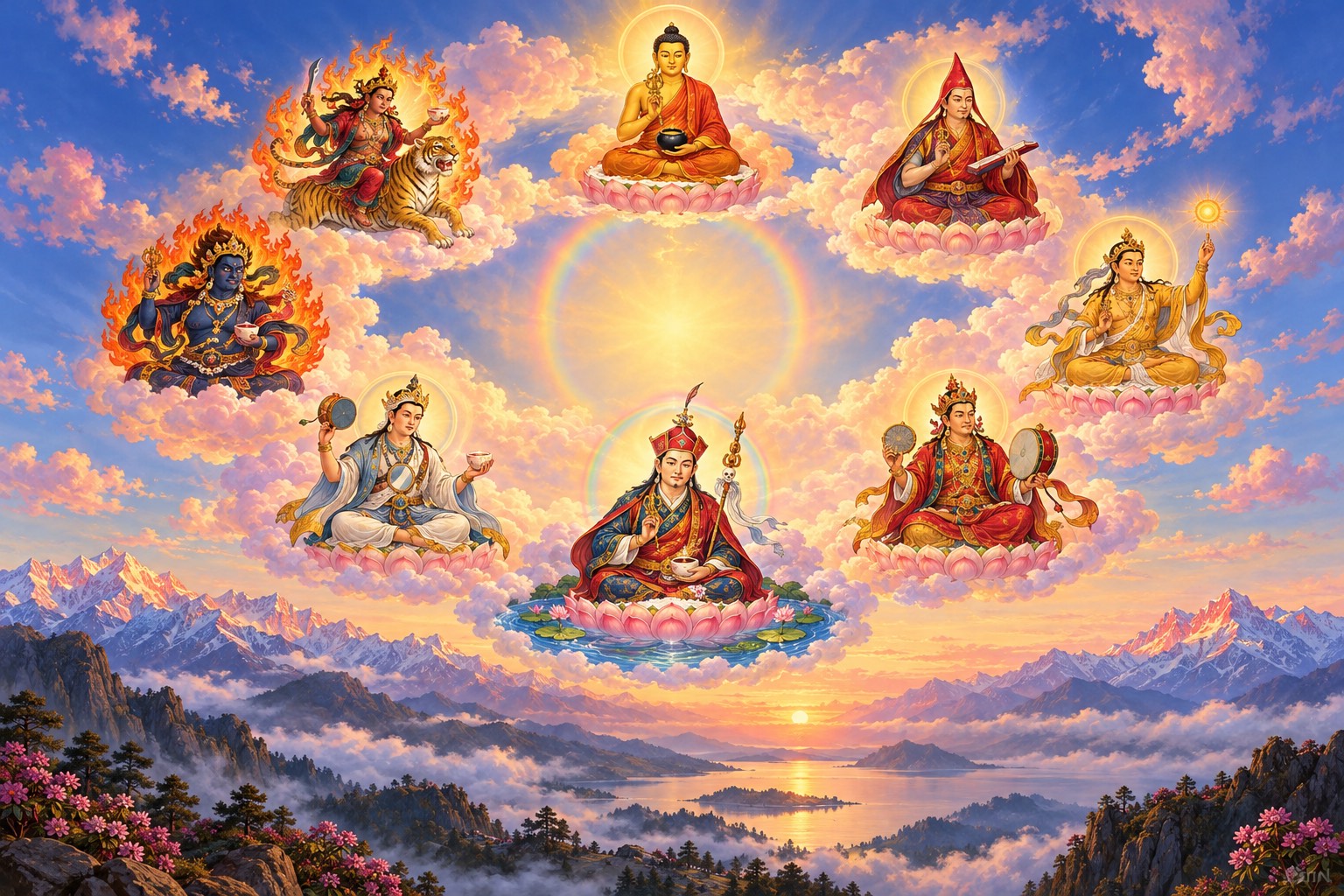
One portrait shows him as Pema Gyalpo, the Lotus King, one of the Eight Manifestations: a king's crown over a turban, royal robes, a small hand drum raised in his right hand and a round golden mirror at his heart. The mirror is what tells him apart from his scholar-prince form. The accounts say the Guru and Mandarava wore garlands of skulls when they were found on the lake, as a symbol of freeing beings from suffering; we have not painted them, so that the page stays gentle, and the fire itself is never shown.
Oddiyana is painted as the Swat valley of about the eighth century: stupas of grey-green stone on square bases, flat-roofed houses, apricot orchards, plane trees and blue pines. The lamps are small brass oil lamps of the region, not Tibetan butter-lamp chalices. The king and queen of Oddiyana are not named in the sources used, so they are drawn in the region's royal dress without any portrait-like features. As everywhere on this site, the images contain no Tibetan script or mantras.
Why this matters for practice
The Seven-Line Prayer begins in the northwest of Oddiyana, and this is the tradition's account of the Guru coming back to that very place, not in triumph but as a wanderer, to meet an old sorrow and turn it, the stories say, into a lake. When we start the prayer with its first line, we can remember that the place of origin it names is also a place of return. Recitation can be a kind of going home, however long we have been away.
If something in this story stayed with you, you might pause and recite the Seven-Line Prayer once, and let its first words carry you, for a moment, to the northwest of Oddiyana: the place he came from, and the place he came back to.
Sources and further reading
- The Life and Liberation of Padmākara, by Jamgön Kongtrul (tr. Peter Woods and Stefan Mang, Samye Translations, 2018), Lotsawa House
- A Beautiful and Wondrous Uḍumbara Garland (verse summary of the Pema Kathang), by Jamyang Khyentse Wangpo (tr. Kaleb Yaniger and Stefan Mang, Samye Translations, 2016), Lotsawa House
- Padmasambhava, Rigpa Wiki (archived snapshot)
- Oddiyana, Rigpa Wiki (archived snapshot)
- Padmasambhava (biography by Alexander Gardner, 2012), The Treasury of Lives (archived snapshot)
- The Wish-Fulfilling Tree, by Chokgyur Dechen Lingpa (tr. Erik Pema Kunsang and Samye Translations, 2020), Lotsawa House
- Orgyen Padma's Enlightened Deeds, by Orgyen Lingpa, Lotsawa House
- Padma Raja (Pema Gyalpo), item 260, Himalayan Art Resources
This retelling is waiting to be read by a knowledgeable practitioner. Where the traditional accounts differ, the story says so; if you notice a mistake, please tell us through Share Your Story.