
This is an original story, written for this site. It is fiction, not a teaching or a traditional account.
The summer Yangzom finished Class Ten, she had one plan, and it was Thimphu.
Her cousin was already there, sharing a room above a shop in the capital, and at night she sent pictures: lit-up streets, a café with music, girls Yangzom's age in jeans with somewhere to be. Yangzom looked at them on the bed she had slept in all her life, in a farmhouse halfway up a valley in central Bhutan, and counted the days until her exam results.
Her father had a different plan for the waiting. "Meme Phub needs hands," he said. Meme means grandfather, and it is what everyone called the old man at the top of the village. "His sons are in Thimphu too."
Under the eaves
Meme Phub carved mani stones: flat slabs of grey slate cut with lines of prayer, painted, and laid along the low wall beside the village chorten. A chorten is a whitewashed shrine of the kind other Buddhist countries call a stupa, and people walk around it clockwise as they pass.
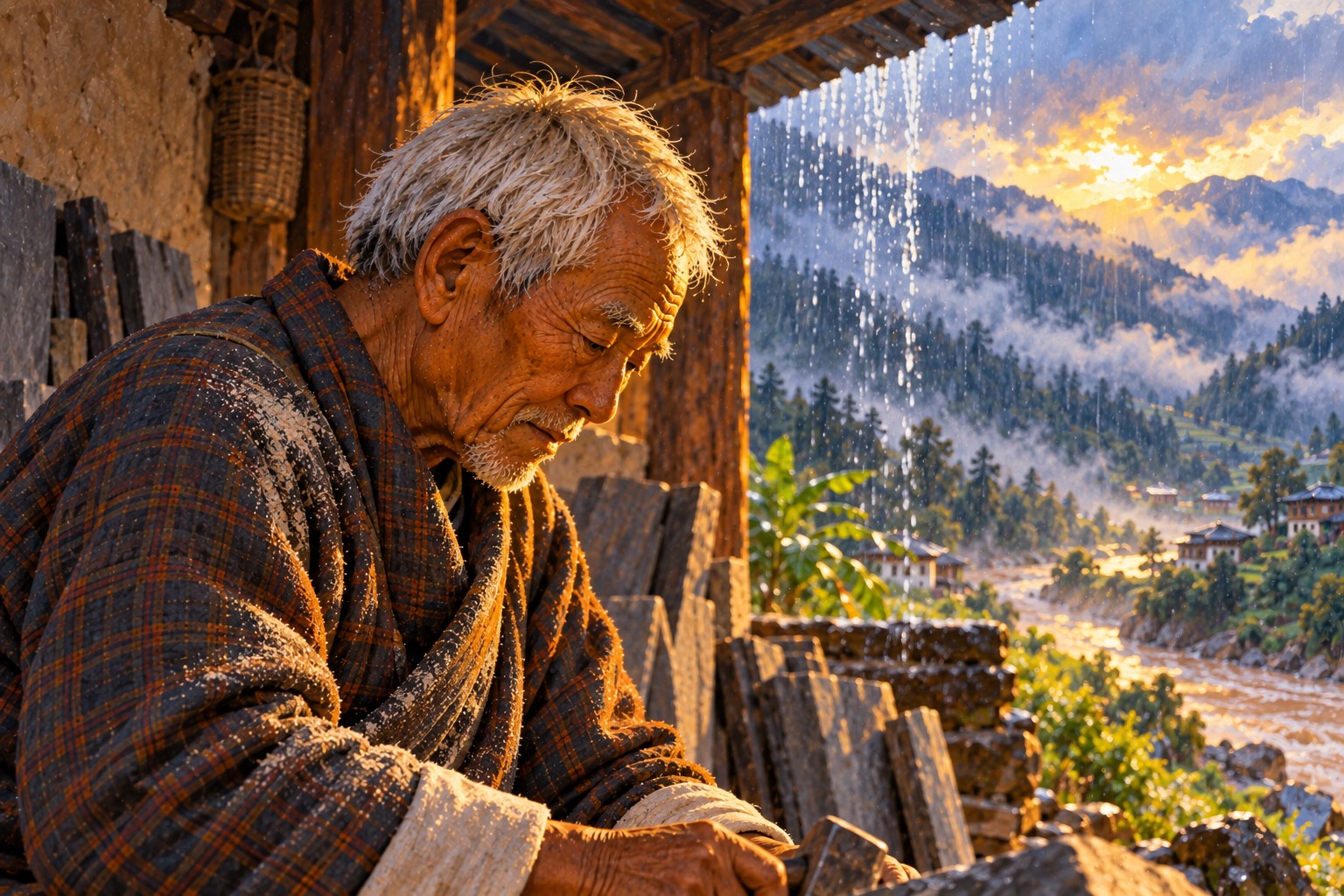
He worked under the deep eaves of his house, an old farmhouse of rammed earth with a timber upper floor, carved wooden windows, and a tin roof held down against the wind with stones. On the first morning the rain came off that roof in a curtain, and he did not look up when she arrived.
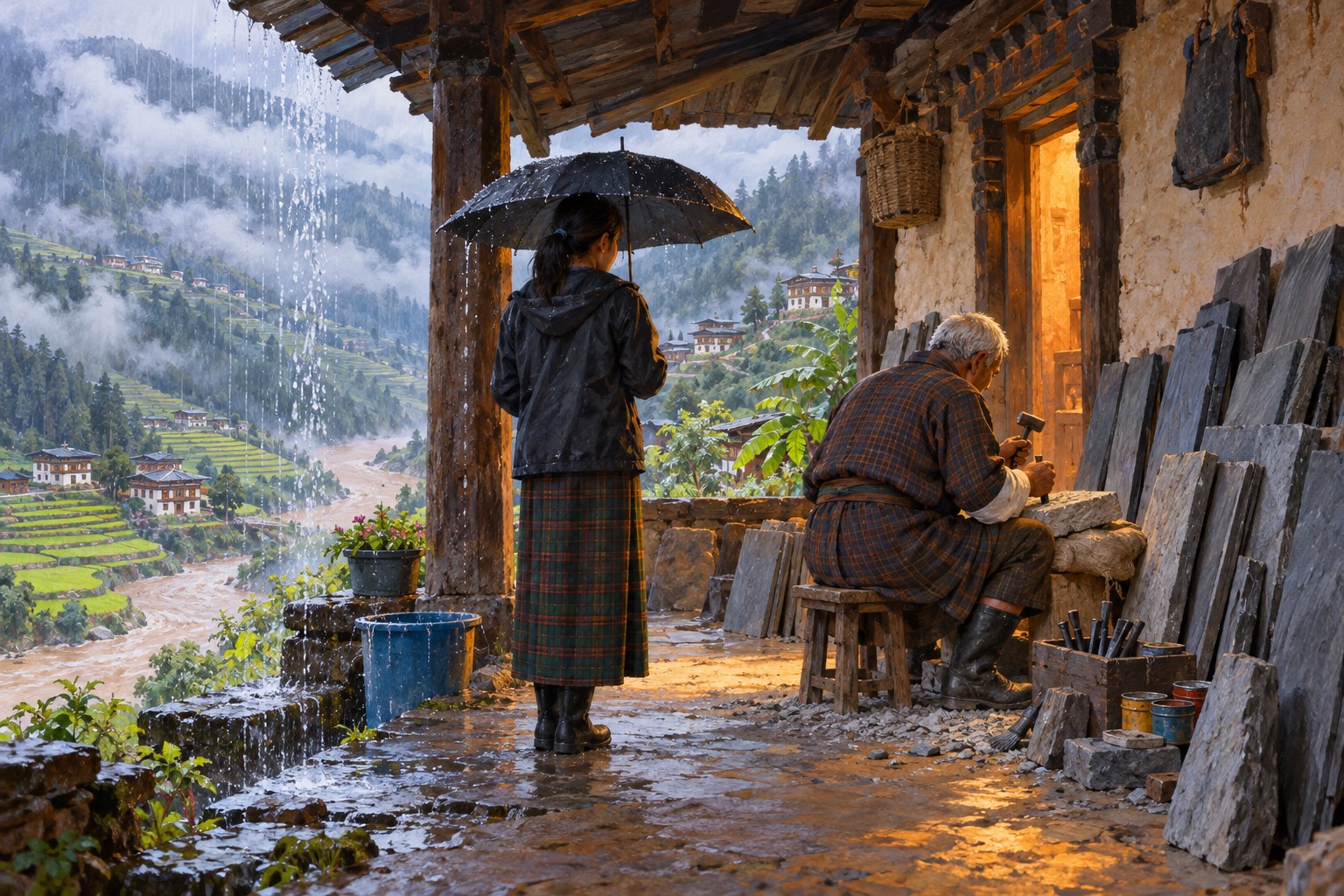
He handed her a bucket and a stiff brush, and nodded at a stack of slabs leaning against the wall, their faces turned inward. "Wash those," he said. "Both sides."
That was the first week. Washing stones, carrying stones, rubbing their faces smooth with a wet whetstone until her arms ached. She did not touch a chisel. She did not see why it should take a week to learn to wash a rock.
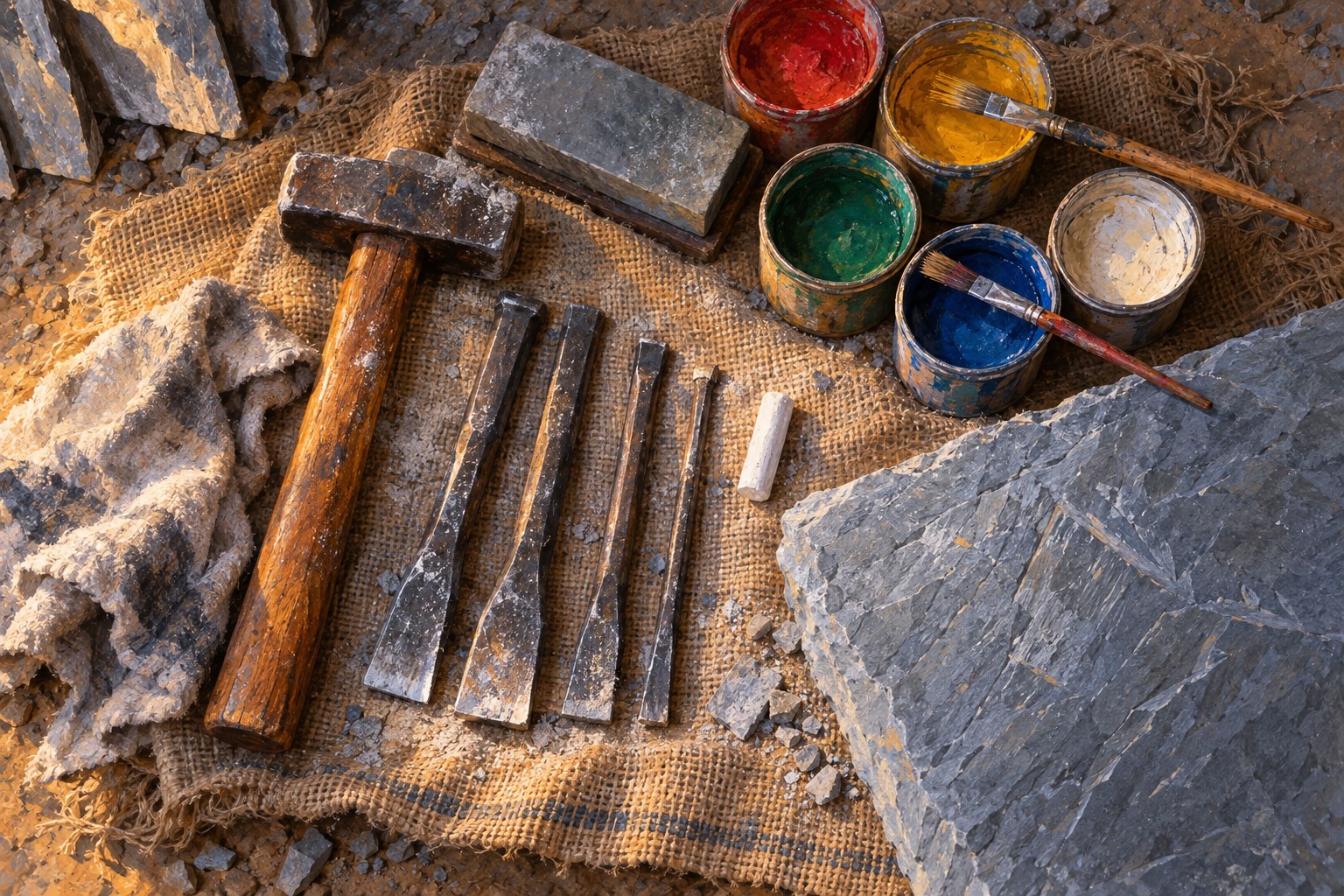
While he worked, Meme Phub murmured. It took her a few days to place the sound. It was the Seven-Line Prayer, a short prayer to Guru Rinpoche, the eighth-century teacher whom people in Bhutan remember for bringing Buddhism to these valleys. Her grandmother had said it when Yangzom was small. She had heard it all her life without listening, the way you stop hearing the river.
She asked him why he said it while he carved.
He shrugged. "Once through for each letter. Then I know I haven't rushed." He tapped the chisel. "My hands are old. They like to hurry and finish."
Rain on a tin roof
At home her mother cooked red rice and ema datshi, chillies stewed with cheese, on the gas ring, and the rain drummed on the roof so loudly they had to raise their voices over dinner. The power went off twice a week and came back when it liked.
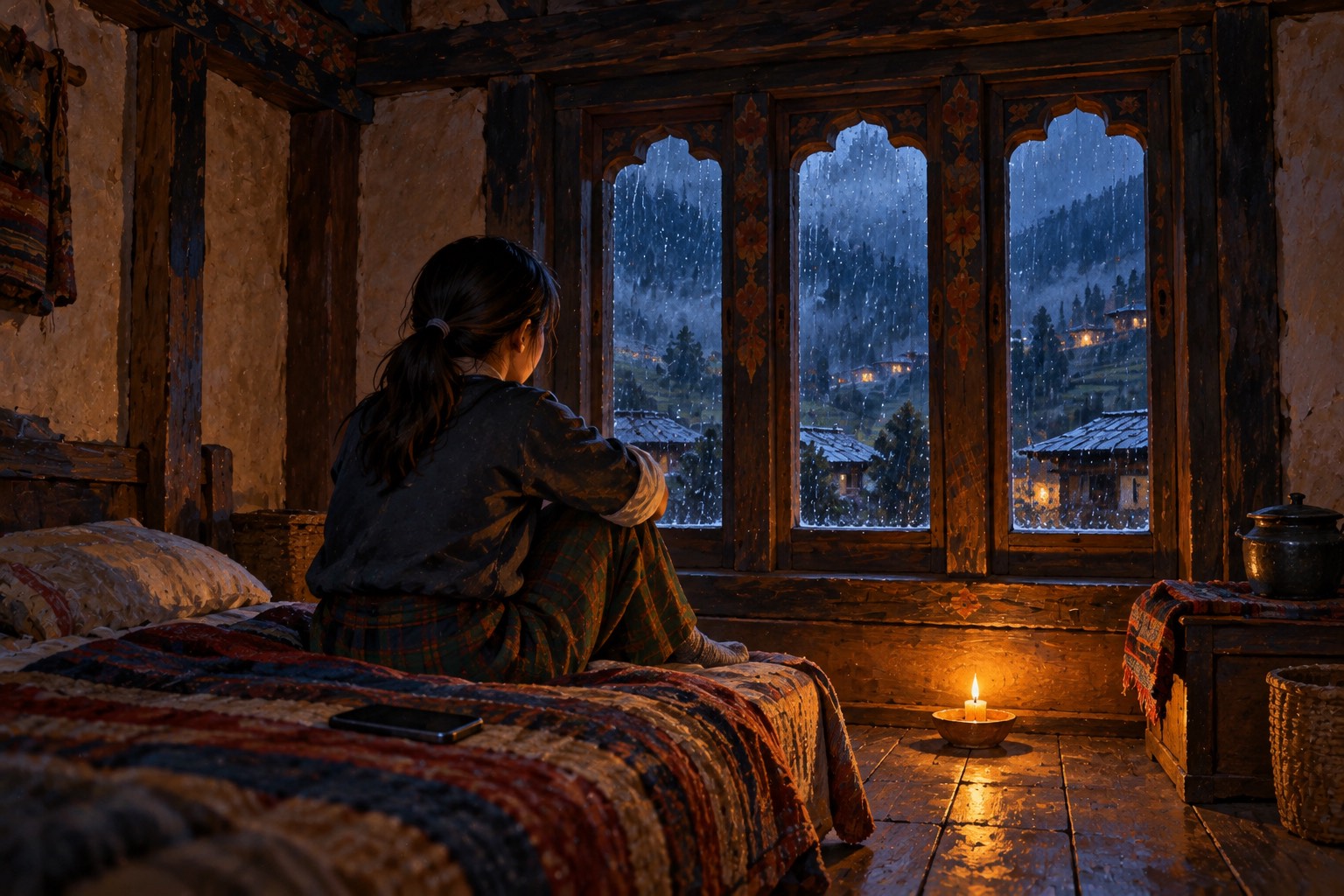
There was no phone signal in the house. To read her cousin's messages Yangzom had to climb to the chorten on the ridge above the village, where the signal came and went like the clouds. She went most evenings, with an umbrella and a torch, and came back with leeches on her ankles.
Stones that ring
In the second week the rain broke for an afternoon, and Meme Phub took her down to the river to choose new slate. The water was high and brown. He walked the bank slowly, picking up flat stones, turning them, tapping each with a small hammer and holding it to his ear.
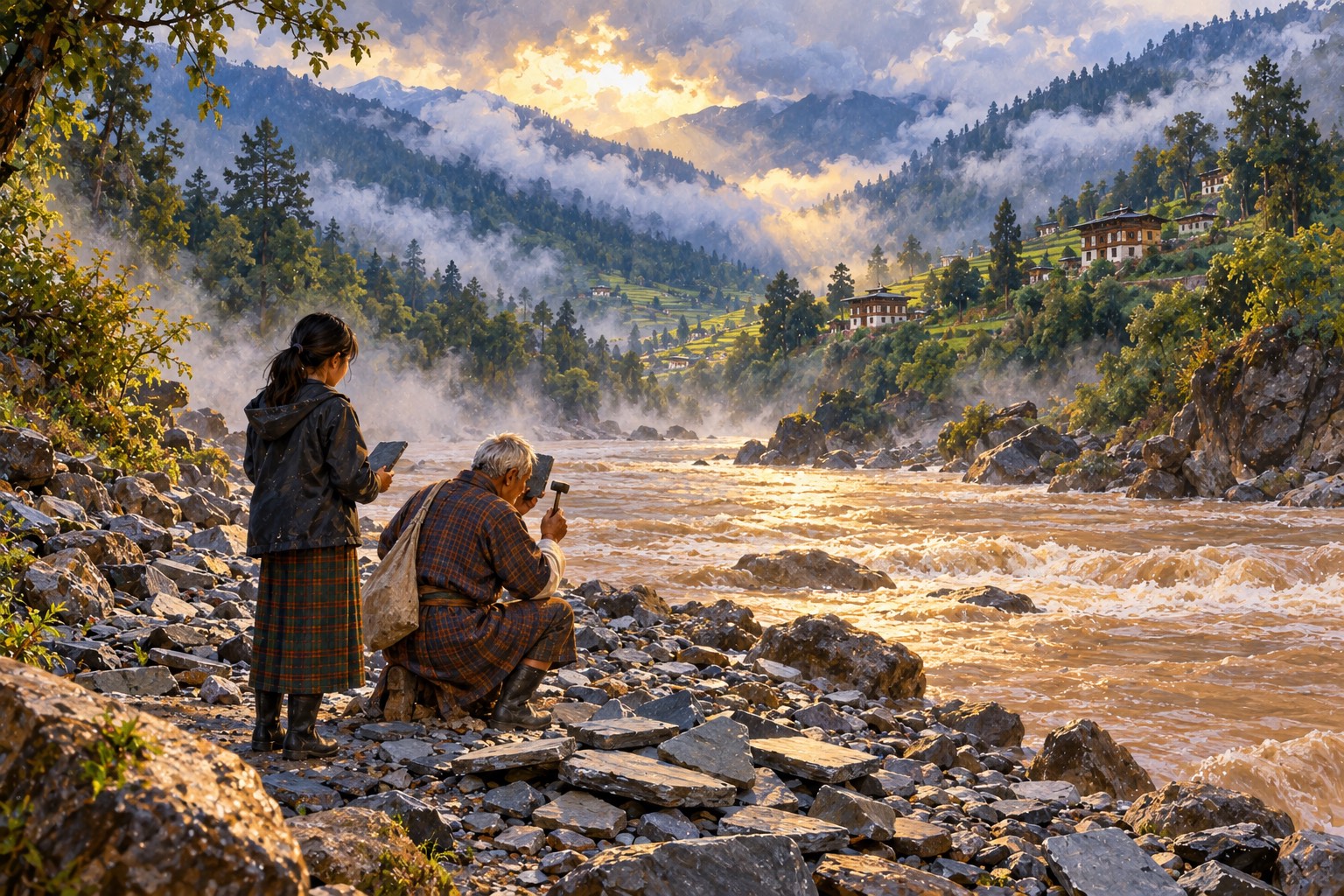
Most he put back. "That one's cracked inside," he said of a stone she thought was perfect. "Listen." It gave a dull sound, like a knock on a wet door. The next one rang. They carried home four slabs out of forty.
Some evenings she sat with him while he drew the letters on a fresh stone in white chalk, and then cut along them, a few taps at a time. He never looked at a book. His lips moved, and the chisel moved, and the rain fell beside them off the roof.
Paint that won't dry
In July he let her paint. Each carved letter had its own colour, in an order he kept in his head, and the background another. The paint came in small tins from the shop in town. In the wet it would not dry, and the stones stood in rows under the eaves for days, faces to the wall, like children sent to think.
She painted too fast. The red ran into the yellow. Meme Phub looked at it, wiped it all off with a rag dipped in kerosene, and handed the brush back. "Again," he said. Not unkindly. Just again.
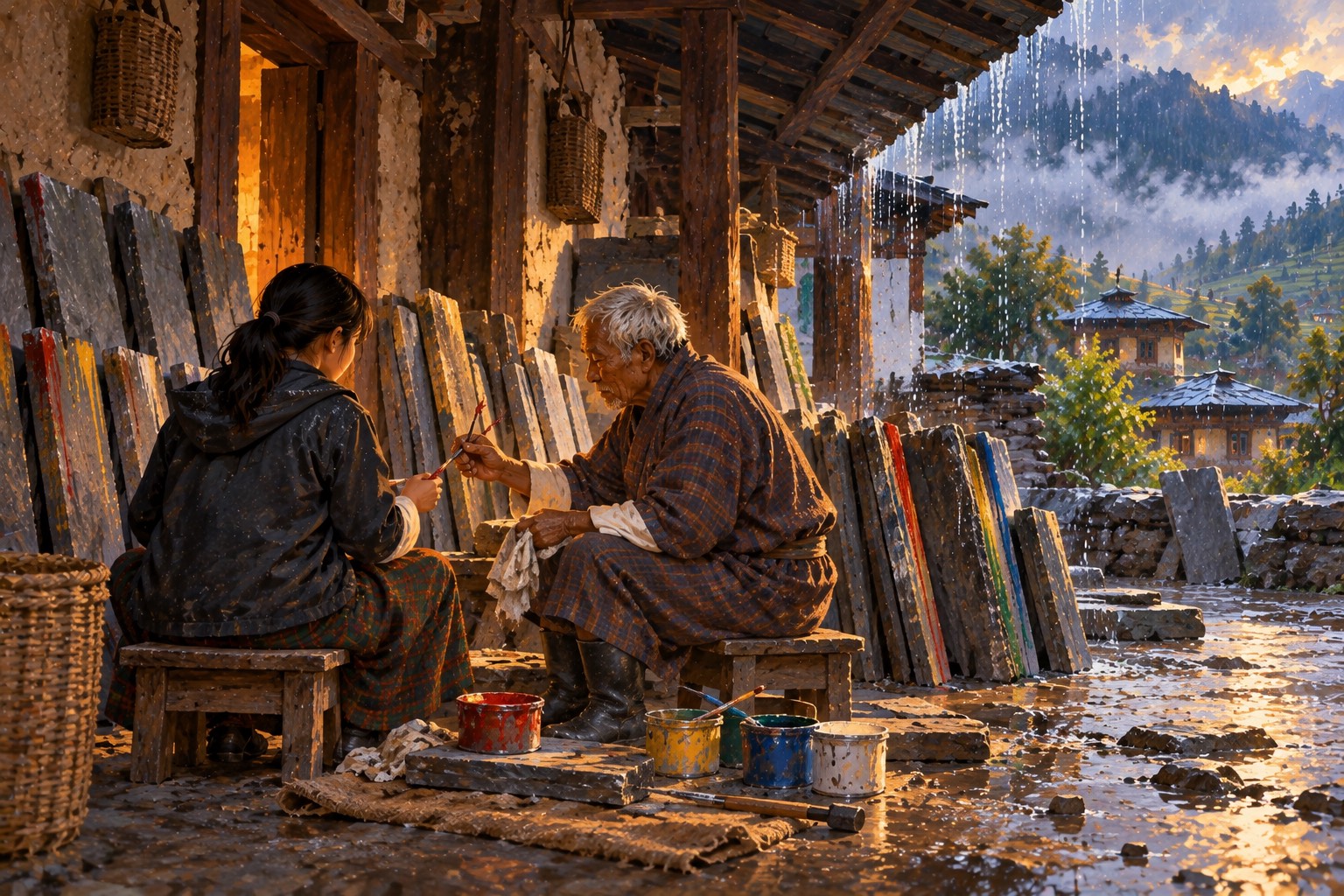
Under each line of letters he carved a small lotus, a few petals around a round heart. She asked about that too.
"The prayer says he was born in a lotus," he said. "The second line. So we give him one to sit on." Then he laughed at himself a little. "That's only how I think of it. Ask a lama, you'll hear better."
The road
Her older sister Pem lived in Thimphu with her husband, and her first baby was due in August. Yangzom had planned to be there. Then, at the end of July, a landslide carried away a stretch of the road below the village, and for eleven days nothing went up or down it but people on foot.
On the ninth evening she was at the chorten, holding her phone up into the drizzle, when it buzzed. A girl. Both well. A photograph came through one line at a time: a small red face in a hospital blanket.

Yangzom sat down on the wet step of the chorten and cried, because she was glad and because she was not there, and because the road was gone. Below her the village lights came on one by one. After a while she walked once around the chorten, clockwise, the way everyone did, and went home.
Her own stone
The next morning Meme Phub had set a small slab apart on her stool. It was a good one; she had heard it ring at the river.
"Not letters," he said. "Letters later. Make a lotus."
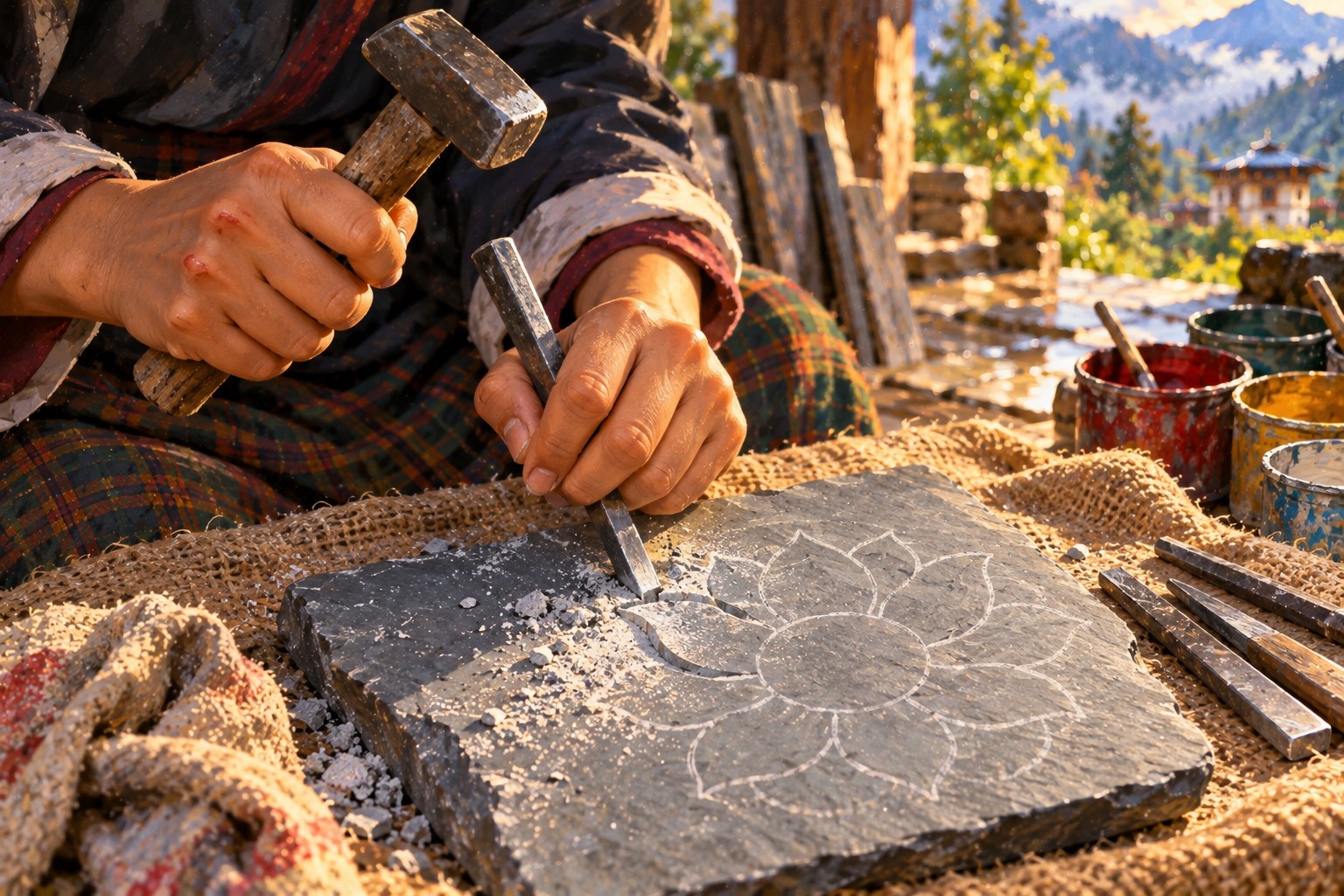
It took her the rest of the month. She drew it in chalk and rubbed it out a dozen times. She cut the first petal too deep and had to make all the others match it. Her hands blistered, then hardened. Some days she made four careful taps in an hour and stopped, because she could feel herself wanting to hurry.
Walking home, she passed the little hut over the stream where the water turned a prayer wheel, a painted drum filled with printed prayers. Each time it came round, a peg struck a small bell. She began to stop there and listen. The bell rang every few seconds, in rain or sun, and never once rang faster.

Somewhere in those weeks she noticed she was murmuring under her breath while she worked. It was his prayer. She did not remember learning it. It had come in with the rain and the tapping, a line at a time, and now it was simply there, keeping her hands slow.
September
When the lotus was done, Meme Phub carved the letters above it himself, and they painted the stone together: his colours for the letters, hers for the petals, pink with a gold heart.
The road opened in September. Pem came home with the baby tied to her back in a woven cloth, and on a bright morning after rain the four of them climbed to the chorten. Yangzom set her stone on the mani wall among the old ones, whose paint had faded to the colour of dust.

Nobody made a speech. Pem walked around the chorten with the baby asleep against her, and Meme Phub turned the prayer wheel by the gate, and Yangzom stood looking at her lotus in the sun, the paint still a little too bright.
The bus
Her results came at the end of the month, good enough for a place at a higher secondary school in Thimphu. She told Meme Phub, half expecting him to be sorry.
"Go," he said. "The stones will wait. They're good at it."

She left on the bus in October, when the rice terraces had gone gold. From the window she watched for the chorten on its ridge until the road turned and the hill hid it. Then she put her headphones in, and did not play anything, and found that she was saying the seven lines, slowly, once for each bend.
About the art
This is an original story, so its pictures show invented people. Following the site's rule for present-day figures, they are gently stylised and seen mostly from behind or at a distance. Yangzom's face is never shown close up; the one close portrait is of the old carver, in soft profile. Much of the story is told through hands, rain, stone and paint.
Mani stones are flat slabs, in Bhutan most often slate, carved with prayers and mantras and placed beside temples or on long walls and monuments. Real mani stones are covered in carved letters, but this site never puts script in its pictures, so every stone here is shown blank, turned away, or with only rough chisel marks, colour and a lotus. Yangzom's lotus is the only carving you see.
The farmhouses are the kind seen across rural Bhutan: rammed-earth lower walls, a timber upper storey with carved windows, and tin roofs held down with stones. The chorten is a small whitewashed stupa, walked around clockwise. The little hut over the stream holds a water-driven prayer wheel: a drum filled with printed prayers, turned by the current, with a peg that rings a bell on each turn. As everywhere on this site, the prayer flags and wheels in the pictures carry no writing, and Guru Rinpoche does not appear: nothing on this page is a vision.
Why this matters for practice
The Seven-Line Prayer's second line remembers that Guru Rinpoche was born in the heart of a lotus, and this story is about a lotus too: the one an old carver puts under every line of prayer, and the one a girl learns to carve the week her niece is born. It is fiction, but the habit in it is real and within anyone's reach: saying the prayer slowly, while the hands do something else, until the words are simply there. Nobody has to stay in the village to keep it.

If something in this story moved you, you might take a few unhurried minutes today, wherever you are, and recite the prayer once.
Sources and further reading
- Seven-Line Prayer (topic page), Lotsawa House
- Stone Carving (Bhutan Cultural Library), NOD Subjects, University of Toronto
- Account of Water-driven Prayer Wheel, NOD Subjects, University of Toronto
- Last remaining stone sculptors in Lauri breathe life into fading tradition of stone carving, Bhutan Broadcasting Service
- Chorten (Stupa), Wikipedia
This retelling is waiting to be read by a knowledgeable practitioner. Where the traditional accounts differ, the story says so; if you notice a mistake, please tell us through Share Your Story.