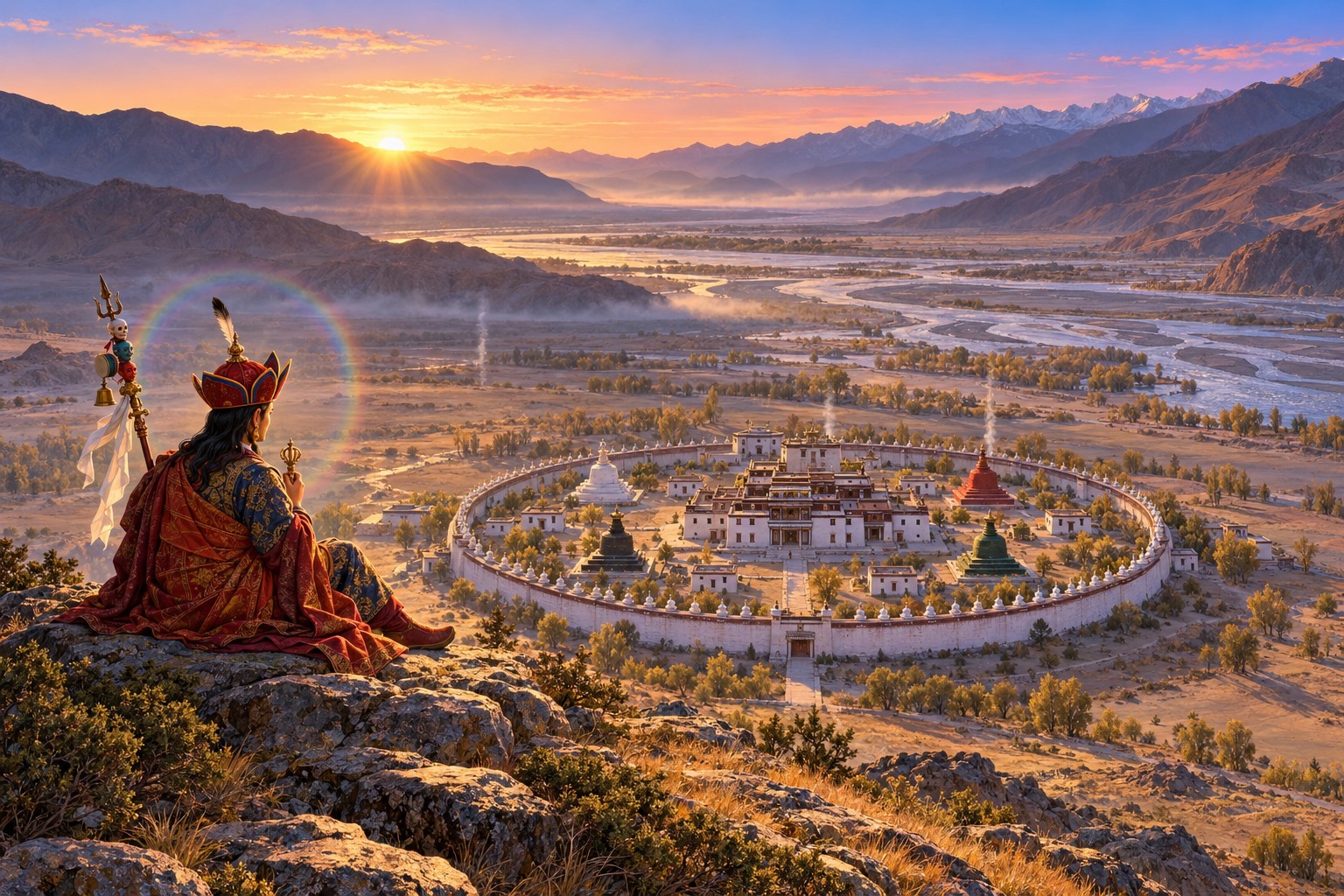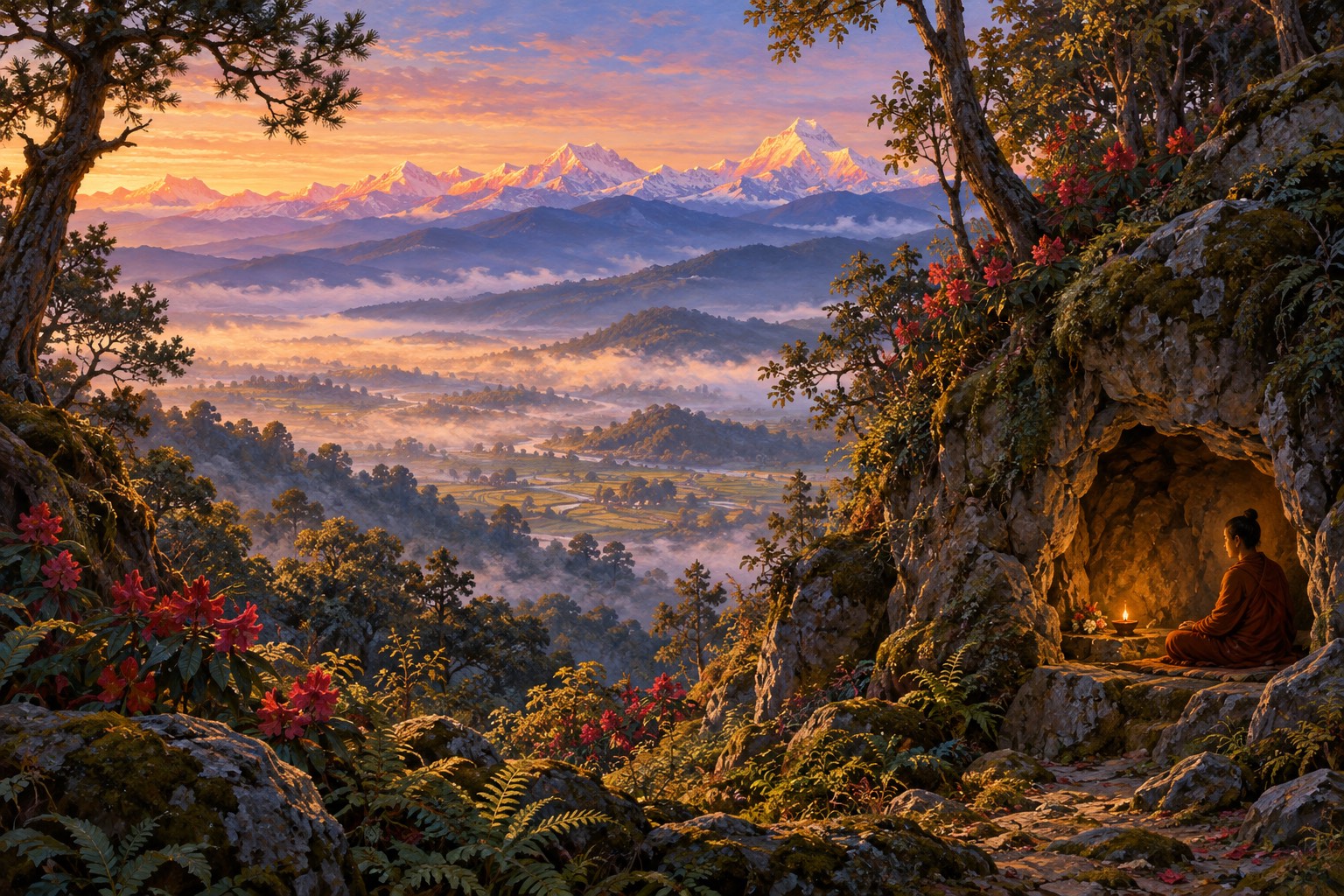
Long ago, the tradition says, Tibet's high places were never empty. Every snow peak, every turquoise lake and every windy pass had its own guardian, a presence that belonged to that place the way a family belongs to its house.
This is the story of how Guru Rinpoche, the Precious Master, also called Padmasambhava, is said to have met those guardians on his road into Tibet in the eighth century. Above all it is the story of twelve sisters of the snows, the tenma, and of one proud goddess of a glacier who did not want to let him pass.
It belongs just before another story on this site, the building of Samye, Tibet's first monastery. There, King Trisong Detsen invites the Guru because the work keeps failing, and the taming at Hepori and Samye is told in full. This page stays out on the road, among the mountains, before he ever reached the king.
A stranger at the border
The life stories say the Guru set out from Nepal toward Tibet, and that the land itself grew uneasy as he came. In The Wish-Fulfilling Tree, a life story revealed by Chokgyur Lingpa in the nineteenth century, the Guru says that Tibet's gods and spirits were all troubled by his approach.
It helps to know who these spirits were. Tibetans speak of yul lha, the gods of a whole region, and zhidak, the owners of a piece of ground: mountain lords, lake ladies, spirits of rock and meadow. The scholar Thupten K. Rikey calls them nature-deities.
 Illustration in preparation
To them, a famous master from India was a stranger at the border. The fullest telling of what happened next is a chapter of the Padma Kathang, a life of the Guru revealed in the fourteenth century by the treasure revealer Orgyen Lingpa. Rikey has studied and translated it, and this page follows his reading, told gently.
In that chapter, the guardians test the Guru one by one, at one pass after another. They use what they have: wind and storm, lightning and rock. Each time he answers with calm and power, and each time the test ends not in destruction but in a promise.
The pass that tried to close
The first test, as Rikey's translation tells it, came at the Tön pass in Mangyul, on the border between Nepal and Tibet. A guardian called Zhangzhung Dralha Dzamun tried to trap the Guru between two hills.
The accounts say he simply rose into the open sky above them, and the hills closed on nothing. The guardian accepted defeat, received a new name, and was given a treasure place to guard.
Illustration in preparationThe Lady of the White Glacier
The best-loved of these stories is the one about Gangkar Shamé. The translators' notes at Lotsawa House describe her as the goddess of a white snow mountain called Lhabu Gangkar, in the region of Shang. Her name is usually given in English as the Fleshless Lady of the White Glacier.
Illustration in preparationLike the other guardians in this chapter, she wanted to keep the stranger out of Tibet. As the Padma Kathang tells it, when the Guru reached a high pass called Namthang Karnak, she sent lightning down to stop him.
The accounts say he caught the lightning on the tip of one finger and turned it aside into a lake. Frightened now, the goddess dived into the water to hide.
Illustration in preparationThe old text describes the lake boiling around her and her being overcome there. It is told in strong, fierce images, and this page leaves those images in the old text. What matters for our story is what came after.
The Guru drew her up to the surface. There, the tradition says, she asked his pardon. She promised to put no more obstacles in his way, and to follow his words as his disciple.
Illustration in preparationHe bound her under oath and gave her a secret name: Shamé Dorje Yudrönma. Dorje means vajra, the indestructible thunderbolt-diamond of awakening, and Yudrönma means Turquoise Lamp. He also made her the guardian of a great treasure place. A glacier that had sent lightning became a lamp.
The sources do not quite agree on the name. One painting described by Himalayan Art Resources gives her the secret name Dorje Yubunma, which Rikey's translation gives to the Mangyul guardian instead. Small differences like this are common in stories told for so many centuries.
Twelve sisters on the heights
Then came the twelve. The tenma chunyi, the Twelve Tenma, are female guardians of Tibet. A note at Lotsawa House describes them as "twelve goddesses connected to twelve different mountains and lakes." Translators render their name in several ways, among them the Established Goddesses and the Immovable Goddesses.
Rigpa Wiki explains that they fall into three groups of four, each a different class of goddess. Their names in the lists are long and beautiful, full of snow, turquoise, lakes and passes.
Illustration in preparationIn the Padma Kathang, as Rikey translates it, the twelve met the Guru together at a pass in Oyuk, in the region of Tsang. They sent twelve great flashes of lightning and tried to trap him between the hills, as their neighbour had.
None of it touched him. The accounts say it was the sisters' own power that faded and grew weak. Then they came before him and offered him their lives, which in this story means offering complete loyalty. He bound them under oath and gave each of them a treasure place to guard.
Illustration in preparationNot every account sets this meeting in the same place. The Wish-Fulfilling Tree says the Guru bound the Tenma Sisters on the heights of the Khala Pass. Rigpa Wiki, following a commentary by Tulku Tenpo, places their oath at the Asura Cave above Pharping in Nepal, where the Guru stayed with his disciple Langchen Palgyi Sengé.
Illustration in preparationIn that telling the twelve promised to protect Tibet, and the Guru placed a vajra in their hands as a sign of what they had promised. Rigpa Wiki's page on the twelve, drawing on a later treasure text, says their special task was to guard Tibet's borders in all four directions.
Illustration in preparationMothers and elder sisters
Over the centuries, the tradition came to think of the twelve with real affection. Rigpa Wiki says they are called the mother and sister tenmas because they look after beings the way a mother or an elder sister would.
Wikipedia's short summary adds that the tellings differ on why the goddesses resisted at all. In some they opposed the new teaching; in others they only wished to go on protecting Tibet in their own way.
Their lists differ too. Rigpa Wiki gives two of them, from different treasure cycles, with different names and orders. Himalayan Art Resources notes that most surviving paintings of the twelve are fairly late, and that they often appear in the retinue of other protector goddesses.
Practices connected with the protectors belong with a qualified teacher, so this page only tells their story; the Find a Teacher page can help anyone drawn to learn more. Anyone, though, may recite the Seven-Line Prayer.
Illustration in preparationHow to hold this story
Taming, in these stories, never means destroying. The proud goddess is not cast out of her mountain; she is given a new name and a new work. The power that once guarded a single glacier now guards the teaching.
Scholars read the story in their own way too. Rikey sees in it the meeting of Indian tantric Buddhism with Tibet's much older worship of mountain and lake gods, and a slow weaving of the two together. A historian and a devotee may both find something true here.
And perhaps there is something closer to home in it. Most of us have our own high passes, places in the heart that throw lightning at anything new. The story suggests that even those can become lamps.
Illustration in preparationAbout the art
Guru Rinpoche appears in his main, peaceful form: the lotus hat with a half-vajra and one vulture feather, layered robes of white, blue, red-orange and maroon, a five-pronged golden vajra at his heart, and the khatvanga, a slender staff crowned with a trident, resting against his left shoulder. A soft rainbow glow marks him as an awakened being; on this page it belongs to him and the dakinis alone.
The tenma sisters and the Lady of the White Glacier are worldly goddesses, the old guardians of Tibet's own land, so they are painted differently from the dakinis of India. Himalayan Art Resources describes the twelve as peaceful in appearance, each riding an animal; here they wear long Tibetan-style robes with turquoise and coral, and only the gentlest mounts are shown, a white horse, a wild ass and a deer. Their dress is a respectful storybook choice, not a reconstruction, and their edges are softened like mist because the tradition ties each one to a mountain or a lake.
In traditional paintings the twelve often hold objects such as a skull cup or a lasso, and appear in the retinue of other protector goddesses. Those details belong to protector practice and are left out here. The vajra in scene 10 has five prongs at each end, curving inward to meet at the tips: the indestructible diamond-thunderbolt of awakening, given here as a sign of a promise.
The mountains are drawn without prayer flags, cairns or chortens, which came later and often carry writing. The passes, the glacier and its lake are composite landscapes; the sources name them, but this page does not claim to show the real places.
Why this matters for practice
The fifth line of the Seven-Line Prayer pictures Guru Rinpoche surrounded by a great gathering, and the tradition counts the oath-bound guardians of the land among those who gather around him. In this story even a goddess who threw lightning at him ends up in that circle, given a new name and a new work. Reciting the prayer is a simple way to join that gathering, bringing whatever in us is proud or unwilling along too.
If something in this story moved you, you might pause and recite the prayer once, slowly, the way a traveller greets the guardians of a high pass before crossing.
Sources and further reading
- The Nature-Deities of Tibet: A discussion on the tale "The Subduing and Putting under Oath of Tibet's Malignant lha 'dre" in Padma bka' thang, by Thupten K. Rikey (Studia Orientalia 109, 2011, pp. 119–140), The Open Buddhist University (catalogue page with link to the article PDF)
- The Wish-Fulfilling Tree: The Life Story of the Master of Uḍḍiyāna (Chokgyur Lingpa, trans. Samye Translations), Lotsawa House
- Twelve Tenma Sisters, Rigpa Wiki (Internet Archive snapshot, 2024)
- Asura Cave, Rigpa Wiki (Internet Archive snapshot, 2024)
- Padmasambhava, Rigpa Wiki (Internet Archive snapshot, 2024)
- Buddhist Worldly Protector: Tanma Chunyi (Jeff Watt), Himalayan Art Resources
- Tanma Chunyi, the Twelve Goddesses, black-ground painting (item 58537), Himalayan Art Resources
- Serchen Khading Dorje Lumo Gyal (item 34071) and the sculpture set of the Twelve Goddesses, Himalayan Art Resources
- Tenma goddesses, Wikipedia
This retelling is waiting to be read by a knowledgeable practitioner. Where the traditional accounts differ, the story says so; if you notice a mistake, please tell us through Share Your Story.