
This is a source-based Nyingma lineage story. Recorded events are distinguished from the reflections offered here. The illustrations are atmospheric reconstructions, not historical portraits or records of particular rooms.
A scroll kept for later
At Dzongsar Monastery, the young Third Dodrupchen received a scroll from Mipham Rinpoche. He was to read it later. The translator Adam Pearcey places the meeting probably around 1886, while noting that the date is uncertain. The scroll contained advice: personal, sometimes difficult to interpret, and concerned with the future of its recipient.
It is a small beginning for the story of a major Nyingma master. A teacher gives a student something that is not to be exhausted on the day it is received. We should not imagine a particular farewell, a smile, or a speech that the sources do not record. The scroll itself is enough to hold our attention.

The child and the lineage
Jigme Tenpé Nyima was born in 1865 and recognized as the Third Dodrupchen. Treasury of Lives identifies him with the Nyingma tradition and records teachers including Patrul Rinpoche, Mipham, and Khenpo Pema Vajra. His life belonged to a network of teaching relationships, not to one isolated schoolroom.
The Dodrupchen name is closely associated with the Longchen Nyingtik, the Heart Essence lineage revealed by Jigme Lingpa. This is a story about the third holder of that incarnation name, not the first Dodrupchen already featured elsewhere in this library. Keeping those people distinct matters when the same title appears again across generations.
Learning beyond one doorway
The introductions to his writings describe an education that included study with teachers trained in the Geluk system. That background helped give his work its precision. It also belongs to the historical setting of Mipham’s concern that he become firmly grounded in the Ancient Translation tradition, the Nyingma.
There is no need to turn this into a contest between worthy and unworthy teachers. The sources preserve both broad learning and strong commitments to a particular lineage. Readers can recognize that tension without pretending that all the differences between Tibetan Buddhist traditions disappear, or that learning from another tradition is in itself a failure.

The unopened thing
The sealed scroll remains the narrative’s centre. Its advice was not simply a certificate announcing that the student had learned enough. The text challenges the weight given to intellectual positions and reputation. Its historical introduction describes a later renewal of Dodrupchen’s engagement with Nyingma sources.
This page leaves the personal prophecy and the more specialized instructions with their source. It does not extract them as directions for readers. The accessible part of the story is the relationship: Mipham’s confidence in his student came with a challenge that the student would have to understand through his own subsequent life.

A scholar who could laugh at scholars
Dodrupchen later wrote a short work published in English as On the Ignorance of the Learned. Its translator explains that this English title is editorial; the Tibetan work has no title of its own. That modest bibliographical detail helps us meet the text without treating a modern label as something the author wrote.
The work matters here because a highly learned Nyingma master is examining the dangers of learning. He is not describing a convenient enemy outside his own world. In the concluding words he presents his comments as arising from experience. The translator leaves open how directly each fault should be read as autobiography.

The restless argument
His portrait is of a scholar whose knowledge feeds contempt and whose mind keeps rehearsing disputes. The criticism concerns what learning is doing to the person who possesses it. A quick answer and an impressive memory are not, on their own, evidence that the teachings have transformed a life.
Yet the essay begins by affirming the value of studying Buddhist scriptures. Its warning is not an excuse to dismiss books or the work of understanding them. Study is to serve practice and the ability to help others. The difference becomes visible in the use made of knowledge, rather than in how little or how much a person can quote.

Another kind of question
In Transforming Suffering and Happiness, Dodrupchen approaches a different problem: the changing conditions of a practitioner’s life. The work addresses both adversity and good fortune. It belongs to mind training, often called lojong, which concerns bringing experience into the Buddhist path.
This page does not turn that work into a prescription for someone who is ill or distressed. Its presence in his writings tells us something about his range. Beside intricate scholarship stands a concern with how people live through what happens to them. The difficult book and the difficult day both belong within the world he addressed.

A place for the Seven Lines
Among his works, Lotsawa House also lists a commentary connected directly with the Seven-Line Prayer to Guru Rinpoche. We mention its existence as evidence of his connection with the prayer. Its visualization instructions are not reproduced here; this site’s invitation remains at the level of recitation.
That connection keeps the scroll story within this library’s purpose. Dodrupchen is not included merely because he was a famous Tibetan scholar. He was a Nyingma lineage holder whose writings include work on the very prayer around which these pages gather. More advanced study belongs with a qualified teacher, whom readers can begin seeking through Find a Teacher.

What was passed onward
Treasury of Lives records Jamyang Khyentse Chökyi Lodrö among his students and gives Dodrupchen’s death as 1926. The relationships surrounding him extend in both directions: back toward the teachers who shaped his education, and onward toward those who would teach after him. The scroll is one episode inside that larger transmission.
The story does not require us to invent a final conversation between Mipham and his student. The surviving works offer a more reliable ending. We can still read a learned man warning against pride, see the range of questions he addressed, and recognize that his intellectual gifts were placed in the service of a living tradition.

Returning to the scroll
In the opening scene, a student receives advice that he is to read later. At the end, we can return to that simple action without pretending to know all it meant to him. The source preserves a teacher’s challenge. Our reflection is that advice may remain something to grow into, even after its words have been understood.
The Seven-Line Prayer includes the wish to follow Guru Rinpoche. For this story, following suggests the willingness to continue learning and to question pride in what one already knows. That is a thematic connection made by this retelling. It is not a claim that one recitation produces wisdom, or that the full meaning of a lineage can be learned from a story page.
About the art
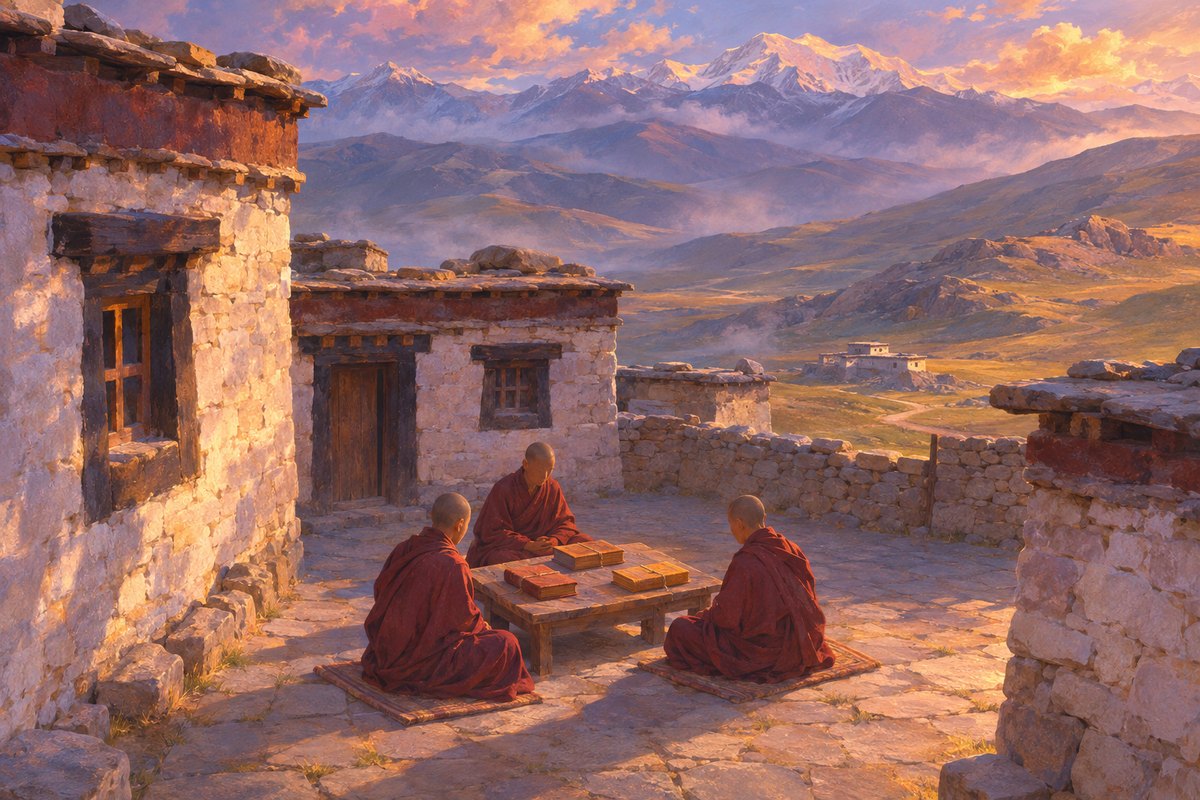
These AI-generated storybook paintings show nineteenth-century eastern Tibetan landscapes, wrapped books, and small anonymous monastic silhouettes. They do not claim to reproduce a named teacher’s face, exact monastery architecture, or a recorded gathering.
Maroon robes and modest stone-and-timber settings suggest the period. No sacred figures, ritual implements, halos, Tibetan script, or mantras appear. Scenic light is atmospheric rather than a sign of realization.
Why this matters for practice
The sixth line of the Seven-Line Prayer expresses a wish to follow Guru Rinpoche. This lineage story invites reflection on learning, devotion, and the care with which teachings pass between people. The connection is thematic; no particular recitation or promised result has been invented.

If something in this story moved you, you might pause and recite the Seven-Line Prayer once.
Sources and further reading
- Advice to Jigme Tenpe Nyima, Lotsawa House
- The Third Dodrubchen, Jigme Tenpai Nyima, Treasury of Lives
- On the Ignorance of the Learned, Lotsawa House
- Transforming Suffering and Happiness, Lotsawa House
- Dodrupchen Jigme Tenpe Nyima Series, Lotsawa House
- Seven-Line Prayer, Lotsawa House
This retelling is waiting to be read by a knowledgeable practitioner. Where the traditional accounts differ, the story says so; if you notice a mistake, please tell us through Share Your Story.