Long before dawn on a festival morning in Bhutan, the paths into the valley fill with people. Grandparents walk with sticks, children are carried half asleep, and families bring food for a long day.
They are walking toward the white walls of the dzong, the fortress-monastery that keeps watch over the valley. They are going to the Tshechu (also spelled Tsechu).
The word means "tenth day." It names the day of the lunar month that the tradition keeps for Guru Rinpoche, Padmasambhava, the master called on in the Seven-Line Prayer. Why the day is his is told in "Why the Tenth Day Belongs to Guru Rinpoche." This page is about what Bhutan made of it.
It is also the hundred and eighth story in this library. A mala, a string of prayer beads, has 108 beads, so it seemed right to give this one to a festival where a whole valley prays together.
A festival in every valley
Almost every district of Bhutan holds a Tshechu, usually in the courtyard of its dzong or at an important temple, and usually over several days. The month depends on the place. Paro's ends on the fifteenth day of the second lunar month, in spring. Thimphu's comes in autumn, and Trongsa's around midwinter.
The anthropologist Françoise Pommaret, writing for the Rubin Museum, calls such dances the high point of the year across the Buddhist Himalaya. People come for blessing, and also to see relatives, eat together and laugh.
 Illustration in preparation
For the rest of the year the masks wait. Pommaret notes that the heavy brocade costumes are kept with them in a special room of the monastery. The dancers, mostly monks, train under a dance master who works from a written guide to steps and music.
Where the dances came from
Bhutanese tradition traces the dances to Guru Rinpoche himself. One telling says he danced in the Bumthang valley to restore a dying king, the story of "The Shape in the Red Rock."
Many dances are counted as treasure, or terma: teachings the tradition says he hid for later times. Pommaret writes that the dance of his eight manifestations goes back to Guru Chöwang, the thirteenth-century master who also revealed the Seven-Line Prayer, and who is said to have watched it danced in Guru Rinpoche's own paradise.
In Bhutan the great name is Pema Lingpa, the fifteenth-century blacksmith who became a treasure revealer ("Pema Lingpa and the Burning Lake"). The Treasury of Lives says dakinis, female wisdom beings, came to him in dreams to teach him the steps of sacred dances. The art historian Ariana Maki writes that his temple at Tamzhing still hosts dances he received in visions, and that in the late seventeenth century his dances and rituals entered Bhutan's state monastic curriculum. One of them, the dance of three kinds of ging, is still performed at Trongsa.
Illustration in preparationA monk sent north
The festivals of western Bhutan, as they are kept today, owe most to Tenzin Rabgye (1638–1696), the fourth Desi, or civil ruler, of the country that Zhabdrung Ngawang Namgyal had unified. The historian John Ardussi notes that the Zhabdrung himself, with his Nyingma teacher Rigdzin Nyingpo, had performed rites linked with the Tshechu at Taktsang during a war with Tibet in the 1640s.
Tenzin Rabgye went further. He sent one of his Nyingma assistants to Tibet to study how the Tshechu was kept at monasteries such as Gongkar, Neudong and Lhodrak. When the monk came home, a book was written on the dances, the music and the costumes.
Illustration in preparationIn 1690, Ardussi writes, the first full three-day Tshechu of dances was held at Tashichhodzong in Thimphu. Maki credits Tenzin Rabgye with bringing in the dance of the Sixteen Dakinis there and at Punakha, and with making the unrolling of a great appliqué banner the climax of the festival.
The sources differ a little. Ardussi dates the monk's journey to 1687, Maki to 1688. Maki has the first great banner unveiled at Thimphu in 1690; Ardussi's reading of the biography puts it at Punakha in 1692. Ardussi adds that central and eastern Bhutan may have had their own Tshechu traditions earlier, and that beneath everything new lay a far older service to Guru Rinpoche.
A Tshechu on the cliff
Illustration in preparationIn 1692 Tenzin Rabgye kept the Tshechu at Taktsang, the cave on the cliff above Paro, and ordered the temple built there that is told of in "The Tiger's Nest." His biography, which Ardussi translated, describes the morning. With drum, bell and chant he recited a long prayer to Guru Rinpoche in seven chapters, a different prayer from the Seven-Line Prayer, while horns sounded from the mouth of the cave.
The biography says that a triple rainbow arched across the clear sky, and that flowers fell slowly like snow along the rays of light, dissolving before they touched the ground. These are its words, passed on here as the tradition remembers them.
What the dances are for
Pommaret lists the aims the many kinds of cham, sacred masked dance, have in common: to celebrate the Buddha's teaching or a great saint, to subdue harmful forces, to teach, to free those who watch from the weight of past harmful actions, and to bless. The dancers, she writes, must become the beings they portray.
Karen Greenspan, writing in Tricycle, adds that each dance is understood as a mandala, a sacred world, set in motion. What the dancers hold in mind belongs to their training and their teachers. What is offered to everyone else is simply to watch.
Illustration in preparationThe Black Hat dancers take the ground first in many programmes. The Bhutan Cultural Atlas describes them as tantric adepts who purify the dance ground with their footsteps, beating drums to proclaim victory over harmful spirits.
Some dances teach in plain sight. In the Dance of the Judgement of the Dead, the Lord of Death, whom the Atlas calls a wrathful form of Avalokiteshvara, the deity of compassion, weighs a person's deeds as white pebbles and black. A white god pleads for the good, a black demon recites the bad, and the soul is led away along a road of black cloth or of white.
Illustration in preparationOthers are close to theatre. In the Dance of the Stag and the Hounds, the yogi Milarepa calms a frightened stag and the dogs chasing it, then turns the angry hunter to the Dharma, the Buddha's teaching. Masked jesters called atsara clown through the first half before it turns quiet and dignified.
Guru Rinpoche's retinue
Many of the dances show the company around Guru Rinpoche. The Atlas says the ging belong to his retinue. In one dance they drive off fierce beings and take the ground, then tap people on the head with their drumsticks to knock out impurities, while the crowd whistles to keep demons away.
Illustration in preparationAt Drametse in eastern Bhutan, a drum dance was composed in the sixteenth century, the Atlas says, by a saint who had seen a vision of Guru Rinpoche's heaven. Its dancers, in animal masks, are his entourage. UNESCO, which lists it as world heritage, says it is believed to have first been danced by the heroes and heroines of the celestial world. The two even count the dancers differently, sixteen and twelve.
On the last day comes the dance of the eight manifestations. Pommaret describes Guru Rinpoche entering in procession, shaded by a parasol and attended by monks, his face a gilded mask beneath his hat. The other forms dance before him and then sit at his side, some with small retinues of their own.
Illustration in preparationGreenspan describes the sixteen dakinis, danced by young monks in long brocade, offering flowers, lamps and incense with slow, flowing hands. While they dance, the crowd lines up unhurriedly to receive a blessing and a protection cord. For Pommaret, at this moment the ground becomes his paradise, and the faithful receive the blessing, as they see it, from Guru Rinpoche himself.
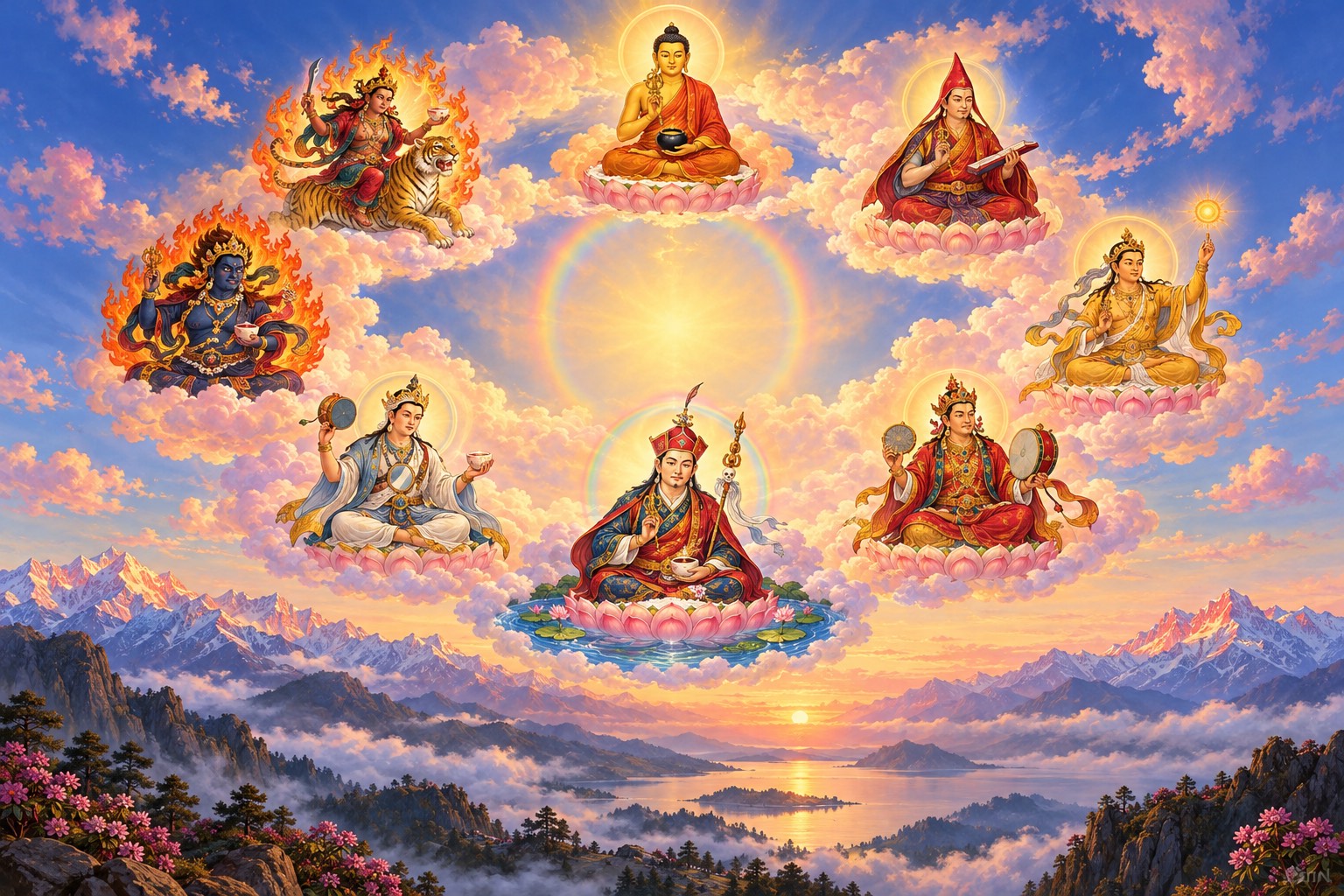
Illustration in preparationThe fifth line of the Seven-Line Prayer pictures him surrounded by a retinue of dakas and dakinis, male and female wisdom beings. For one afternoon, a whole valley stands inside that line.
Liberation on seeing
Greenspan writes that the dances themselves are counted as thongdrol, "liberation through seeing," the name the great banners carry too. Pommaret adds a gentle condition: it is a great blessing to watch, but with an attentive mind and the wish to be born in Guru Rinpoche's paradise. Today, she notes, elderly people watch the Tshechu on television while praying.
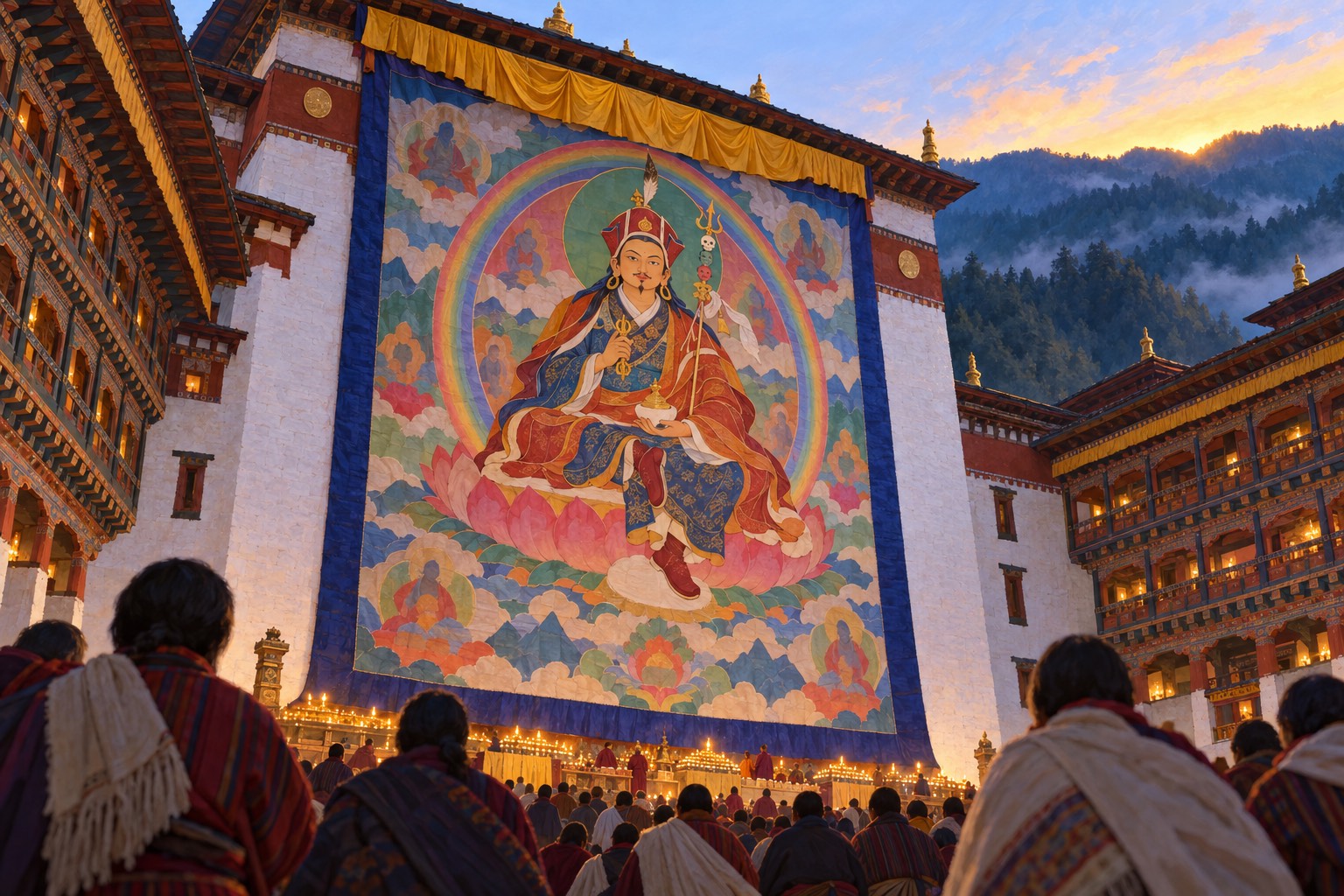
At Paro, before dawn on the fifteenth, the dzong's great appliqué banner of the eight manifestations, about twenty metres wide, is hung for the gathered crowd. The dzong's history records that when fire swept through it, in the years before Bhutan's first king was enthroned, most of its relics and statues were lost, but this banner survived. Before the sun can reach it, it is rolled away for another year.
Illustration in preparationThe tradition says that seeing it cleanses the viewer of negative karma, the results of past harmful actions. Tenzin Rabgye's biography even tells of three blind women whose sight returned when the first great banner was unrolled. This page passes these on as the tradition's words and promises nothing. What the festival asks of anyone who comes is simple: to look, and to remember him.
Illustration in preparationAbout the art
Every dancer on this page is a real present-day performer, so faces are never shown: the masked dancers keep their carved wooden masks on, the Black Hat dancers are seen with their faces lost in the shadow of their broad hats, and the dancers of the Sixteen Dakinis, who dance unmasked, are seen only from behind. Spectators are small, wrapped in shawls, or seen from behind. No royal figures appear.
The Black Hat dancers carry round, flat drums on curved handles, the drum version of the dance named in Bhutanese programmes. The Drametse dancers wear yellow skirts and animal masks, real and mythical, and beat hand drums. The dakini dancers wear long brocade gowns, lace-like aprons of carved bone (drawn here as fine ivory openwork) and small crowns of five golden lobes, as Tricycle describes them. The scale with white and black pebbles comes from the Dance of the Judgement of the Dead.
The dancer who represents Guru Rinpoche wears a gilded mask and his lotus hat and sits under a parasol, a sign of honour. In the closing image he appears in his main form: the lotus hat with a half-vajra and one feather, a five-pronged vajra at his heart, a skull cup with a long-life vase in his lap and the staff (khatvanga) in the crook of his left arm, inside a rainbow sphere, with the dakas and dakinis of the prayer's fifth line drawn as small figures of light. The great banner is shown only as soft patches of stitched silk while it is rolled away, so nothing on it can be mistaken for writing.
The two historical scenes keep to what the sources describe. The dzong of 1690 has shingle roofs weighted with stones rather than today's metal roofs. The 1692 Taktsang scene has no temple yet, and its rainbow and falling flowers illustrate the biography's own account.
Why this matters for practice
The fifth line of the Seven-Line Prayer pictures Guru Rinpoche surrounded by a retinue of dakas and dakinis, and a Tshechu sets that line on the ground: his entourage danced, his paradise made for a day in a courtyard, a whole community gathered around him. The festival also shows how simple the heart of practice can be for most people: to come, to look with an open mind, to remember him and to call. Reciting the prayer is that same calling, and it can be done on any day, anywhere.
If something in this story stayed with you, you need not wait for a festival. You might recite the Seven-Line Prayer once, and at its fifth line picture the dancers turning around him in the morning light.
Sources and further reading
- Ritual Dance Mask of Guru Dorje Drolo: Reenacting Foundational Stories as Communal Performance, by Françoise Pommaret (2023), Rubin Museum, Project Himalayan Art
- Gyalse Tenzin Rabgye and the Founding of Taktsang Lhakhang, by John A. Ardussi, Journal of Bhutan Studies 1.1 (1999), Journal of Bhutan Studies (PDF, Internet Archive snapshot)
- The Fourth Druk Desi, Tendzin Rabgye, by Ariana Maki (2010), Treasury of Lives (Internet Archive snapshot)
- The Moving Mandala: Inside Bhutan's Sacred Dance Festivals, by Karen Greenspan (2018), Tricycle
- A Bhutanese Buddhist Master's Treasure House: Tamshing Temple, by Ariana Maki (2023), Rubin Museum, Project Himalayan Art
- Pema Lingpa, by Ariana Maki (2011), Treasury of Lives (Internet Archive snapshot)
- Bhutan Cultural Atlas: Trongsa Tshechu; The Dance of the Black Hats (Shanag); The Dance of the Drummers from Drametse; The Dance of the Ging and the Tsholing; The Dance of the Judgement of the Dead (Raksha Marcham); The Dance of the Masters of the Cremation Grounds (Durdag); The Dance of the Stag and the Hunting Dogs (Shawa Shachhi); The Dance of the Eight Manifestations (Guru Tshen Gye), Bhutan Cultural Atlas (Internet Archive snapshots, 2020)
- Mask dance of the drums from Drametse, UNESCO Intangible Cultural Heritage
- Tshechu, Wikipedia
- Rinpung Dzong, Wikipedia
- Thongdrel, Wikipedia
- Cham dance; Dzong architecture; Tashichho Dzong; Drametse Ngacham, Wikipedia
This retelling is waiting to be read by a knowledgeable practitioner. Where the traditional accounts differ, the story says so; if you notice a mistake, please tell us through Share Your Story.