In a side valley of western Tibet called Gyang Yönpo Lung, the old notes say, a small temple kept a secret for some five hundred years. The man who drew it out is remembered as Tulku Zangpo Drakpa. Almost nothing else about him is remembered.
What he found is another matter. It is the Le'u Dünma, the “Prayer in Seven Chapters” to Guru Rinpoche, the “Precious Teacher” Padmasambhava. Its last chapter, often said on its own, is the Sampa Lhundrupma, which Lotsawa House renders as the prayer for the “Spontaneous Fulfilment of Wishes.” In Nyingma homes and temples it is among the best-loved prayers there are.
Because so little is known of his life, this page tells a slightly wider story: how, in the tradition's own telling, the Prayer in Seven Chapters was hidden, found and handed on.
Hidden twice
Two words will help. A terma, or treasure, is a teaching the tradition says Guru Rinpoche and his disciples hid long ago, to be found at the right time. A tertön is the destined person who finds it. A short note at the end of a treasure text, its colophon, often tells where it was hidden and who brought it out.
The Le'u Dünma tells its own beginning. Five close disciples asked Guru Rinpoche for a short prayer that ordinary people could say, and each chapter answers one of them. The last chapter is his farewell to the young prince Mutri Tsenpo on the heights of Gungthang, as he left Tibet. That tender scene is told on this site in “The Rakshasa Land,” so here we pick up the story just after he has gone.
 Illustration in preparation
According to the chapter's closing lines, the prince did not keep what he had been given out in the open. He hid it twice.
First, the text says, he placed the Guru's parting advice, with a set of instructions likened to wish-fulfilling jewels, inside a rock in Mangyul that looked like a heap of jewels. He gave them into the care of four goddess sisters. Treasures are said to be watched in this way, by guardians who keep them safe until the finder comes.
Illustration in preparationThe prayer itself he hid in a temple at Rulak Gyang, in the western part of the province of Tsang. Its guardian is named as Lhamo Dreu Zhönma, a goddess whose name seems to mean “she who rides a mule.”
Then he made a wish. When hard times came to his family line, he said, may a person with the right karmic connection come to the eastern foot of Mount Trazang and find it. Earlier in the same chapter, the text has Guru Rinpoche himself speak of a hidden yogi who would one day appear there.
Illustration in preparationCenturies passed. The old Tibetan empire broke apart, and the prince's descendants came to rule a small kingdom in Gungthang, near the border with Nepal. In the tradition's telling, the temple at Rulak Gyang simply waited.
Illustration in preparationThe hermit
Then, in the fourteenth century, comes Zangpo Drakpa. Tulku means an emanation, someone recognized as the rebirth of an earlier master. The Treasury of Lives gives him other names too, among them Manglam Ritröpa Zangpo Drakpa. A ritröpa is a mountain hermit, someone who lives in retreat far from towns.
The same encyclopedia places his birth early in the century and his death late in it. It links him with the hermitages of Tsibri, and with both the Kagyu and Nyingma traditions. Beyond that, the records are almost silent.
Illustration in preparationThe historian Jay Valentine, writing on the early Northern Treasures, calls him “the original treasure revealer of the tradition” (Journal of Global Buddhism, 2015). He also calls him little known. The stories remember him mostly for what he passed on.
Out of the temple
The colophon of the seventh chapter gives a date: the Male Water Dragon year, 1352. In that year, it says, Tulku Zangpo Drakpa took the treasure out of the temple of Rulak Gyang.
Another of his treasures, a short protective text called The Blazing Wheel, names the place a little differently. Its closing note, in the Samye Translations version, says he drew it from Gyang Yönpo. Lung means valley, so Gyang Yönpo Lung seems to be the same district seen closer up. The sources do not say exactly how the temple and the valley fit together.
Illustration in preparationTreasures were often found as rolls of yellow paper, written in the symbolic script of the dakinis, the female wisdom beings said to guard them. Only the destined revealer could read it. The colophon says this one was later deciphered from its yellow scroll by Rigdzin Gödem.
The dates do not quite agree. Martin Boord's biography of Gödem, reproduced by Himalayan Art Resources, says that in 1364 Zangpo Drakpa “apparently revealed” texts foretelling that another man would reveal great treasures. Whether these were one discovery or several, twelve years apart, the sources do not say.
A treasure meant for someone else
Here the story takes a turn that is easy to miss. The prophecies in Zangpo Drakpa's hands did not point to him. They spoke of someone else, near Mount Trazang.
Illustration in preparationSo, the accounts say, he did not keep them. In 1365 he gave the scrolls and a sealed letter of good wishes to a monk, the Vinaya master Tönpa Sönam Wangchuk, and two companions. He told them to look east of Mount Zangzang for a yogi with a sacred image or a rosary in his hand, who would start talking about the king of Gungthang.
Illustration in preparationHow they met the young Gödem beside a stream, just as he had said, is told in “Rigdzin Gödem and the Hidden Valleys.” Valentine adds a quieter, human thread. Gödem's uncle, Sangyé Tenpa, had a teacher who was a close friend of Zangpo Drakpa, and the uncle was there when the treasures were drawn out.
To a historian, then, the treasure traveled along a web of friends and family as well as signs. The two ways of seeing can sit side by side. Either way, the finder of one of Tibet's most loved prayers handed it to a younger man and stepped quietly out of the story.
Hand to hand
The first chapter of the Le'u Dünma ends with a prayer to its own lineage, the chain of teachers who passed it on. After Guru Rinpoche and the five disciples comes Zangpo Drakpa, then Gödem under his own name, Ngödrup Gyaltsen. Further down come the bridge-builder Thangtong Gyalpo and, in the seventeenth century, Terdak Lingpa.
Illustration in preparationThe prayer kept traveling. In the nineteenth century Jamyang Khyentse Wangpo placed the Sampa Lhundrupma in his great Compendium of Sadhanas, a collection of practice texts. The Le'u Dünma, with its history, entered the Rinchen Terdzö, the vast anthology of treasures. Rigpa Wiki lists commentaries by Karma Chakmé and Jamgön Kongtrul.
There is a surprise, too. The nineteenth-century tertön Chokgyur Lingpa revealed a treasure cycle called The Guru's Heart Practice: The Wish-Fulfilling Jewel. Lotsawa House prints the Sampa Lhundrupma as its outer part, in almost the same words. The tradition treasures both versions, and does not ask one to cancel the other.
A prayer for midday
What is the prayer like? It is long and plain-spoken. Verse by verse it names a trouble, such as sickness, war, a hard journey or the hour of death, and calls on Guru Rinpoche in a particular form to meet it. Rigpa Wiki counts thirteen of these forms.
Each verse ends by calling him by name, the Lotus-born Guru of Orgyen, and asking that wishes be fulfilled without effort. It is the same name the Seven-Line Prayer gives in its fourth line: Padmasambhava, “Lotus-Born.”
Illustration in preparationIn the chapter's own telling, the prince asked his people to say this prayer at midday, in the pause from work, and to say any of the chapters whenever suffering pressed close. That is the tradition's advice, passed on here as such, not a promise of what reciting will bring. For anything beyond recitation, a qualified teacher is the right guide.
Illustration in preparationAbout the art
No traditional portrait of Tulku Zangpo Drakpa could be found for this page, so he is never shown close up. He appears only at a distance or as a pair of hands, using the site's generic figure of a later treasure revealer: a lay yogi in a white robe and a white shawl with dark red borders. That is a choice, not a record of how he dressed. His title Ritröpa, “mountain hermit,” is why he is shown at a cave hermitage.
The prince Mutri Tsenpo wears eighth-century Tibetan court dress, as in the paintings of the Dunhuang caves: a tall wrapped turban and a long silk robe with wide triangular lapels. The treasure itself is drawn as a small roll of yellow paper, the form treasures are often said to take, and it is left blank on purpose. The symbolic script of the dakinis is never painted, because no image on this site carries writing. The guardian goddesses are only hinted at as a faint shimmer, since the text names them but does not describe them.
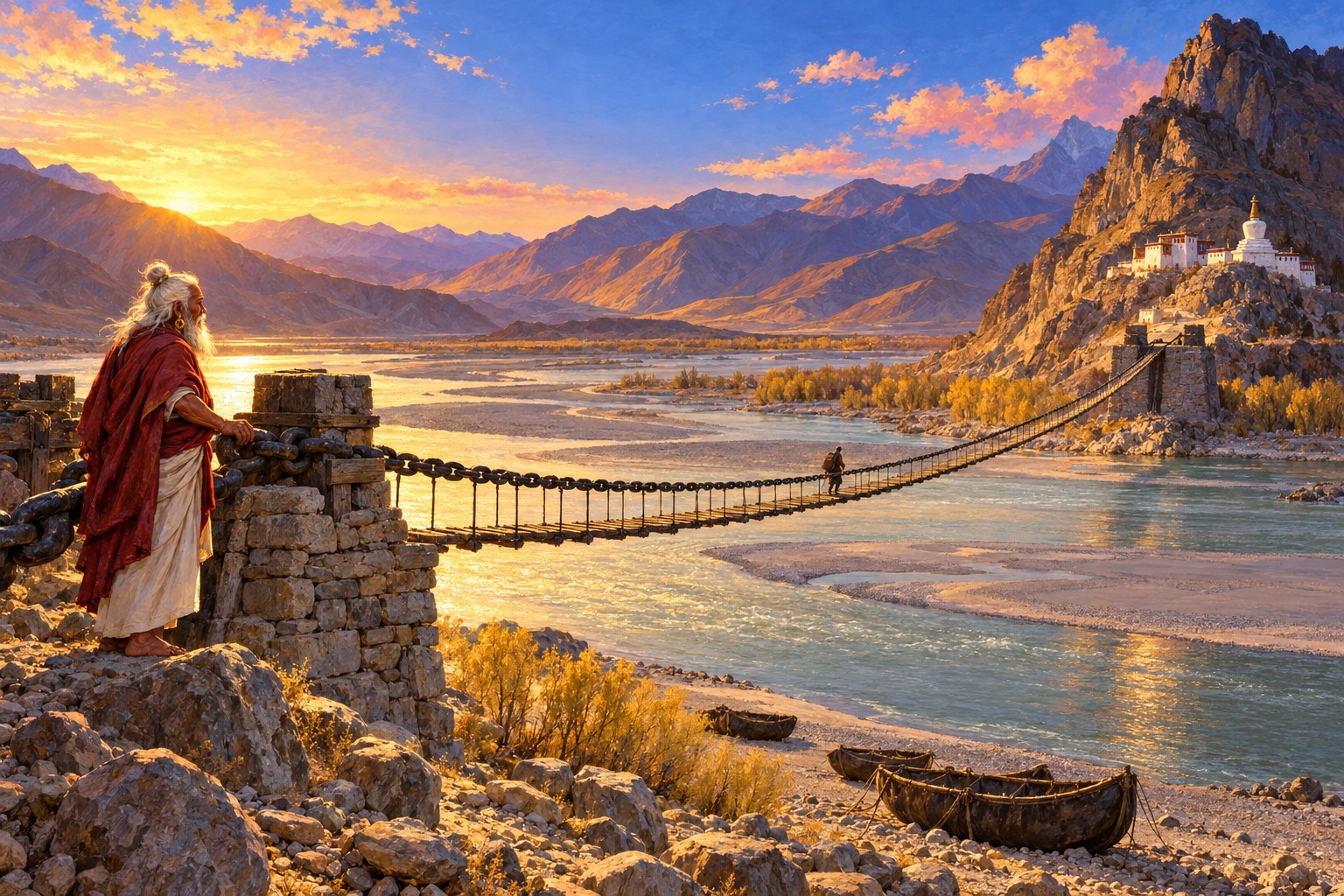
Guru Rinpoche appears once, in his main form: the lotus hat with a half-vajra and a vulture feather, a five-pronged vajra in his right hand, a skull cup with a vase of long life in his left, and the khatvanga staff in the crook of his left arm, inside a sphere of rainbow light. He is painted in bright midday light because the Sampa Lhundrupma is the chapter given for midday. Thangtong Gyalpo, named in the prayer's lineage, is shown as his own portraits show him: a white-bearded lay yogi in a dark red cloak, crossing his iron bridge.
Why this matters for practice
The Seven-Line Prayer gives Guru Rinpoche his name in its fourth line, and every verse of the Sampa Lhundrupma calls on him by that same name, the Lotus-born of Orgyen. Zangpo Drakpa's part in the story is small and quiet: he found a prayer and passed it to the person it was meant for. Reciting the seven lines, even once, joins the long line of people who have said his name with trust.
If something in this story stayed with you, you might think of the hermit who found a prayer and gave it away, and recite the prayer once. Every name in that long lineage once said it for the first time.
Sources and further reading
- Le'u Dünma, Chapter 7: The Prayer to Guru Rinpoche that Spontaneously Fulfils All Wishes (Sampa Lhundrupma), revealed by Tulku Zangpo Drakpa (trans. Rigpa Translations), Lotsawa House
- Le'u Dünma, Chapter 1: The Prayer to the Three-Kāya Guru (trans. Rigpa Translations), Lotsawa House
- Tulku Zangpo Drakpa Series (author page), Lotsawa House
- The Means for Accomplishment called ‘Blazing Wheel’, revealed by Tulku Zangpo Drakpa (trans. Stefan Mang and Peter Woods, Samye Translations, 2017), Lotsawa House
- Sampa Lhundrupma (Compendium of Sādhanas version), revealed by Tulku Zangpo Drakpa (trans. Rigpa Translations), Lotsawa House
- Sampa Lhundrupma (Chokling version), from The Guru's Heart Practice: The Wish-Fulfilling Jewel, revealed by Chokgyur Dechen Lingpa (trans. Rigpa Translations), Lotsawa House
- Zangpo Drakpa, by Jay Valentine (2016), header and bibliography, Treasury of Lives (Internet Archive snapshot)
- The Family and Legacy of the Early Northern Treasure Tradition, by Jay Valentine, Journal of Global Buddhism 16 (2015), Journal of Global Buddhism (Internet Archive copy of the PDF)
- Teacher: Godemchen, Rigdzin (set), with the biography by Martin Boord, Himalayan Art Resources (Internet Archive snapshot)
- Tulku Zangpo Drakpa; Le'u Dünma; Sampa Lhundrupma; Northern Treasures, Rigpa Wiki (Internet Archive snapshots, 2024)
- Person record P6943, bzang po grags pa, Buddhist Digital Resource Center
This retelling is waiting to be read by a knowledgeable practitioner. Where the traditional accounts differ, the story says so; if you notice a mistake, please tell us through Share Your Story.