
Understanding teachings
Reading a Prayer on Your Phone: Text Care and Group Use
Prepare the version, placement and device arrangements with your teacher or host.
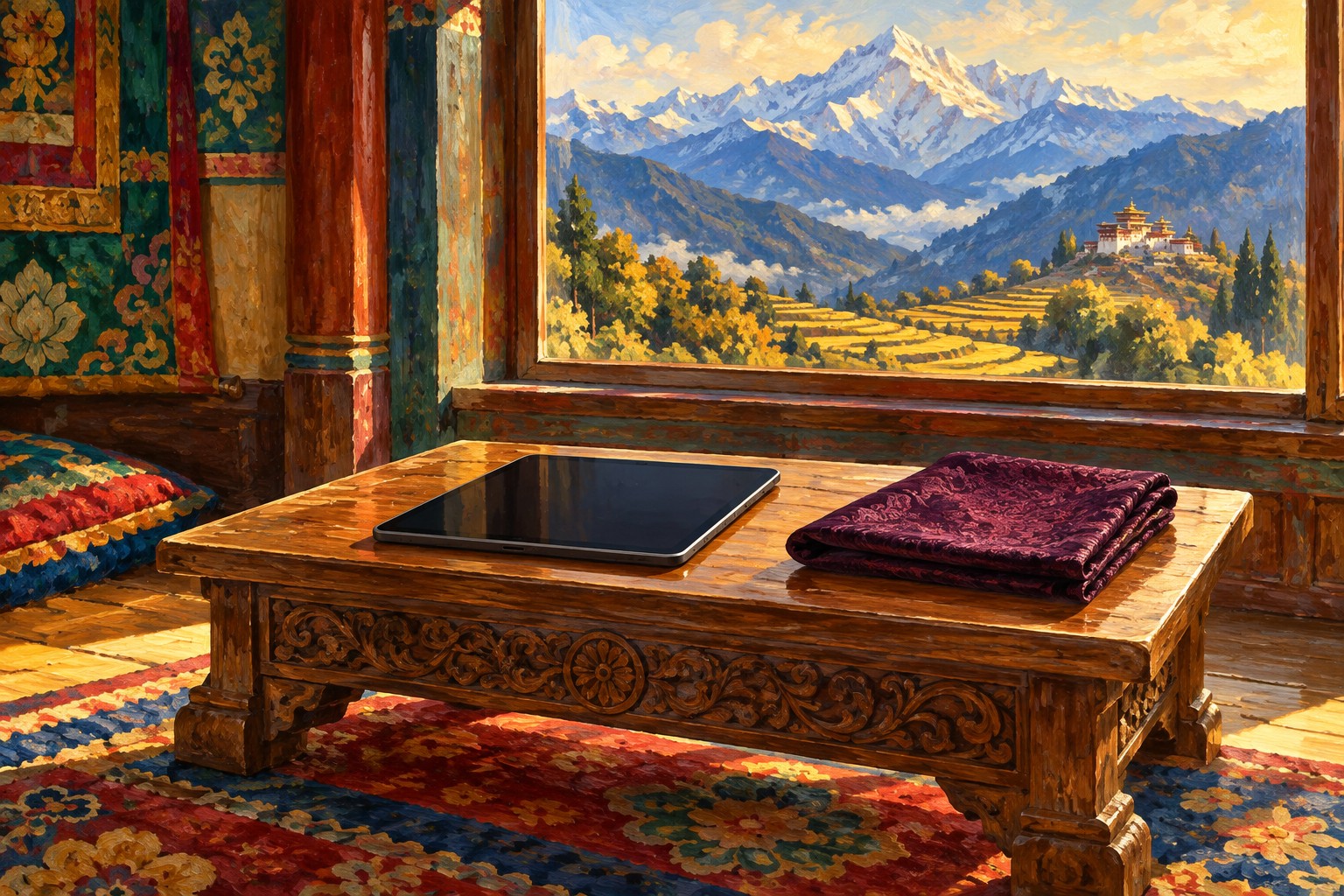
You have the prayer on your phone, but the group is using printed booklets. Before the session, ask whether reading from a device is welcome, which version the group uses and where the device should rest. A short conversation can settle several practical questions before the chanting begins.
A digital text can still call for respectful handling
In a teaching given at the Light of the Path retreat on August 26, 2017, Lama Zopa Rinpoche described his iPad, containing the Kangyur, Tengyur and other teachings, as equivalent to a Dharma text for purposes of respect. He advised keeping it higher rather than on a bed or down low. The Lama Yeshe Wisdom Archive provides the transcript. [1]
In the same teaching, he explained respect through the teachings' role in showing the path to liberation and enlightenment. He also advised against placing reading glasses or a mala on top of Dharma texts. This is a particular teacher's instruction, not an assumption that every Buddhist community gives identical guidance about devices. [1]
If you practice with a teacher or center, ask how its instructions apply to your phone, tablet or reader. Describe your arrangement, including whether you use a stand or need a larger display. Ask for an arrangement that lets you read comfortably and handle the text as requested.
Ask where the text belongs during a group session
Drogmi Buddhist Institute's shrine-room guidance says Dharma books and puja texts belong on a table or cushion, rather than the floor, and should not be stepped over, stepped on or sat on. In a crowded room, it asks people to pick up and hold their text to let others pass. These are that institute's published instructions for texts. [2]
For a device, ask the host what support and placement it prefers. Do this before arranging a charging cable through someone else's seating area. Keep the route clear and ask before using a nearby outlet.
A useful question is: “I read from this tablet because I need larger type. Where would you like me to put the stand, and is there a printed version I should keep available?” The request identifies both the reading need and the practical arrangement.
Prepare the file you intend to use
The following are practical suggestions from this site, not ritual instructions:
- Confirm the edition. Ask the host for the exact title, translation and source. Check the opening words and page or section reference against the group's copy.
- Check access before arriving. Open the file and confirm that you can reach the needed section. If you plan to read without an internet connection, check that arrangement beforehand.
- Set up the display. Choose readable type and a brightness that works without distracting your neighbors. Ask about the host's device policy.
- Prevent interruptions. Review notification sounds and any audio playback before the session. Charge the device in advance and ask what to do if it stops working.
Ask before recording, photographing or sharing a teaching or practice text. Possessing a file does not tell you the host's recording policy, the publisher's sharing terms or the prerequisites for a practice. Check those matters with the responsible teacher, organizer or publisher.
Finish with the same care
Lama Zopa Rinpoche recalled Kyabje Ling Rinpoche carefully covering and tying his text after prayer. The teaching treats covering a text as an expression of respect. [1]
Ask your teacher how to handle and protect the device after use. Keep accessories in their own place instead of automatically resting them on the text or screen. If you are unsure how advice about printed materials applies to a digital file, ask that question directly rather than inventing a ceremony.
For the wider visit, read your first visit to a Tibetan Buddhist center. For learning the words, see Tibetan prayer pronunciation and follow the version your teacher or group uses.
Sources and further reading
- Proper Respect for Dharma Texts. Lama Zopa Rinpoche; Light of the Path, August 26, 2017, Black Mountain, North Carolina; transcript, Lama Yeshe Wisdom Archive.
- Shrine room etiquette. Drogmi Buddhist Institute; Dharma texts and teachings section; checked October 30, 2026.
Sources checked October 30, 2026. Written with AI assistance and checked against the linked texts. The examples and brief review are supplied by this site; they do not replace instruction from a qualified teacher.