In the life story of Yeshe Tsogyal there is a short chapter that is easy to pass over. It happens far from Tibet, in the warm green valley of Nepal, and it turns on a young man nobody there would have looked at twice.
His name was Atsara Salé. The tradition remembers him as the servant she set free, and as the companion who walked beside her on the path for the rest of her life.
Yeshe Tsogyal was Guru Rinpoche's closest Tibetan disciple, a dakini or "sky-goer," the tradition's word for an awakened woman. Her own story has its own page. This one follows the young man who came into her life in Nepal. It is told as the traditional accounts tell it, and honestly about where they differ.
Sent to Nepal
By this point in her story, the traditional accounts say, Tsogyal had spent long years in retreat with Guru Rinpoche, among other places at Tidro, a gorge of cliffs and hot springs far to the northeast of Samye. Jamgön Kongtrul, the nineteenth-century master who summed up her life in a prayer, says she went to Nepal because her teacher told her to.
Modern summaries of the life story add what he is said to have told her. In the valley of Nepal, he said, there was a young man of about sixteen, with a small mark on his chest, who had wandered there from a land called Serling in India. She was to find him, and he would be her companion on the path.
 Illustration in preparation
The life story also says the youth was more than he seemed. It calls him an emanation of Hayagriva, a protector with a horse's head. It is one of the tradition's ways of saying that something precious can live in a person the world overlooks.
So she set out. The way south from Tibet crossed the main range of the Himalaya on foot, over passes of snow and scree, and then fell away through forest into the valleys below. The texts spend few words on the road. Anyone who has walked such paths can picture the rest.
Illustration in preparationA servant in the valley
The young man she was looking for was not free. Wikipedia's summary of the life story says he was born into a poor family, sold into slavery, and brought to Bhaktapur, a town in the Kathmandu valley, where he was sold again into the service of a powerful household.
The sources do not agree on where he came from. The summary of Keith Dowman's translation gives Serling in India; the same article calls him a man of south India; the Dharma Fellowship's retelling says he was from the Kathmandu valley itself. One modern history, by Alexander Gardner of the Treasury of Lives, even sets the whole meeting in India. All agree on the heart of it: he was young, far from any family, and he belonged to someone else.
Illustration in preparationHis name comes down in several spellings: Atsara Salé, Acharya Salé, Arya Salé. Rigpa Wiki gives Acharya, the Sanskrit word for a teacher or master. It was a large title for a boy carrying other people's water. In time, the tradition says, it fitted.
The price of a life
To free him she needed his price, and she had come with nothing. Here Kongtrul's prayer tells a wonder in a single line. While she was in Nepal, it says, she brought a dead man back to life, and was rewarded with gold.
That is the tradition's account, told as a sign of her realization, and it is passed on here in the tradition's words, not as a fact anyone can check. Other summaries say only that she raised enough to buy his freedom from his owners.
Illustration in preparationWith the gold, the accounts say, she paid the ransom, and Salé was released. Rigpa Wiki puts it plainly: in Nepal she paid a ransom for him.
It is worth pausing here. Years before, Tsogyal's own family had given her away to settle a quarrel she had no part in. Now, in a story full of visions and powers, one of the deeds remembered of her is very simple: she paid so that someone else could be free.
Illustration in preparationThe older texts give Salé a title that belongs to the tantric teachings. What it means is kept between teachers and their students, and it is left with them here. In the story itself he is what he plainly was: her companion, and a fellow practitioner. Kongtrul's Tibetan verse calls him a pawo, a "hero," which is also the Tibetan word for a daka, the male counterpart of a dakini.
Illustration in preparationFriends along the way
They did not hurry back. Kongtrul's prayer says that in Nepal Tsogyal exchanged teachings with Nepali practitioners, among them Vasudhara, a scholar of the Kathmandu valley, and Shakyadevi, the Nepali princess who had practised with Guru Rinpoche.
Wikipedia's summary adds that the two of them visited the caves on the valley's southern rim where Guru Rinpoche had meditated, the Asura cave and Yangleshö, and practised there with Shakyadevi. The story of those caves is told on another page.
Illustration in preparationWinter in the mountains
Then they crossed back into Tibet, and Kongtrul's prayer brings Tsogyal home to Tidro. For a young man from the warm valleys, the high caves were a hard home. The Dharma Fellowship's retelling notes that he had never known the biting cold of a Tibetan winter.
Illustration in preparationThe accounts are honest about what happened next. During a long winter retreat, Salé left her. The summaries give different reasons: the cold was more than he could bear, or the practice she was entering was beyond him, or, in some versions, he went to serve Guru Rinpoche as an attendant, thinking she had food enough to go on alone.
She did go on alone, the story says, until she was close to starving, and Guru Rinpoche himself came to bring her out of retreat. She recovered. And Salé came back, and the two were reconciled. Wikipedia's summary sets this at Tidro; the Dharma Fellowship places it at the wintry cave of Nering Senge Dzong.
Illustration in preparationIt is a very human moment in a sacred story. He is not remembered as someone who never faltered. He is remembered as someone who faltered, and returned.
A practitioner in his own right
Salé was not only Tsogyal's companion. Wikipedia calls him a student of both Tsogyal and Guru Rinpoche, and says he stayed with her for the rest of his life, in retreats across Tibet and as far as Senge Dzong, in what is now Bhutan.
The mountains still remember him. High above Samye, at Chimphu, the pilgrimage guide Nekhor describes three upper caves where Guru Rinpoche, Yeshe Tsogyal and Acharya Salé each practised. The freed servant's cave sits beside his teachers'.
Illustration in preparationThe one who kept her story
The best-known life of Yeshe Tsogyal is credited to two of Guru Rinpoche's disciples, Namkhai Nyingpo and Gyalwa Changchub. The Treasury of Lives notes that, near the end of that same book, Tsogyal names Gyalwa Changchub as Salé reborn. How that fits the dates is not explained, since Gyalwa Changchub is also remembered as one of the first Tibetan monks.
The book itself was found as a terma, a teaching hidden for later times, by the treasure revealer Taksham Nüden Dorje, born in 1655. Rigpa Wiki and the notes to Kongtrul's prayer both say that Taksham, too, was the rebirth of Acharya Salé. Another prophecy in the life story, as Wikipedia reports it, says he would return as Topabhadra, companion of the eleventh-century yogini Machik Labdrön, whom the tradition counts as Tsogyal returning.
Read together, these accounts make a quiet circle. The young man she set free is remembered as the one who helped set her story down, and then, some nine centuries later, as the one who brought it back to light. Historians cannot follow these threads; the Treasury of Lives notes that no evidence has been found that Yeshe Tsogyal herself lived. The tradition holds them with love all the same.
Illustration in preparationThe fifth line of the Seven-Line Prayer pictures Guru Rinpoche surrounded by a retinue of dakas and dakinis. Salé's story is a reminder of who that circle can hold: not only queens and ministers, but a servant bought out of bondage, who lost heart once, came back, and stayed.
The practices these stories only name belong with a qualified teacher, and the site's Find a Teacher page lists places to begin. Anyone, though, may recite the prayer.
About the art
No traditional portrait of Atsara Salé has been found, so his appearance here is a careful reconstruction, not a likeness. As a youth he wears the plain, much-mended cotton of a servant, oatmeal and faded indigo; as a mature practitioner he keeps the same colours in a long robe and a warm Tibetan wool shawl, with a simple wooden mala. He carries no ritual objects and has no halo. The life story calls him an emanation of Hayagriva, the horse-headed protector; that is told in words only and not drawn. The word atsara also names the comic masked figures of Tibetan ritual dance, and he is deliberately shown nothing like them.
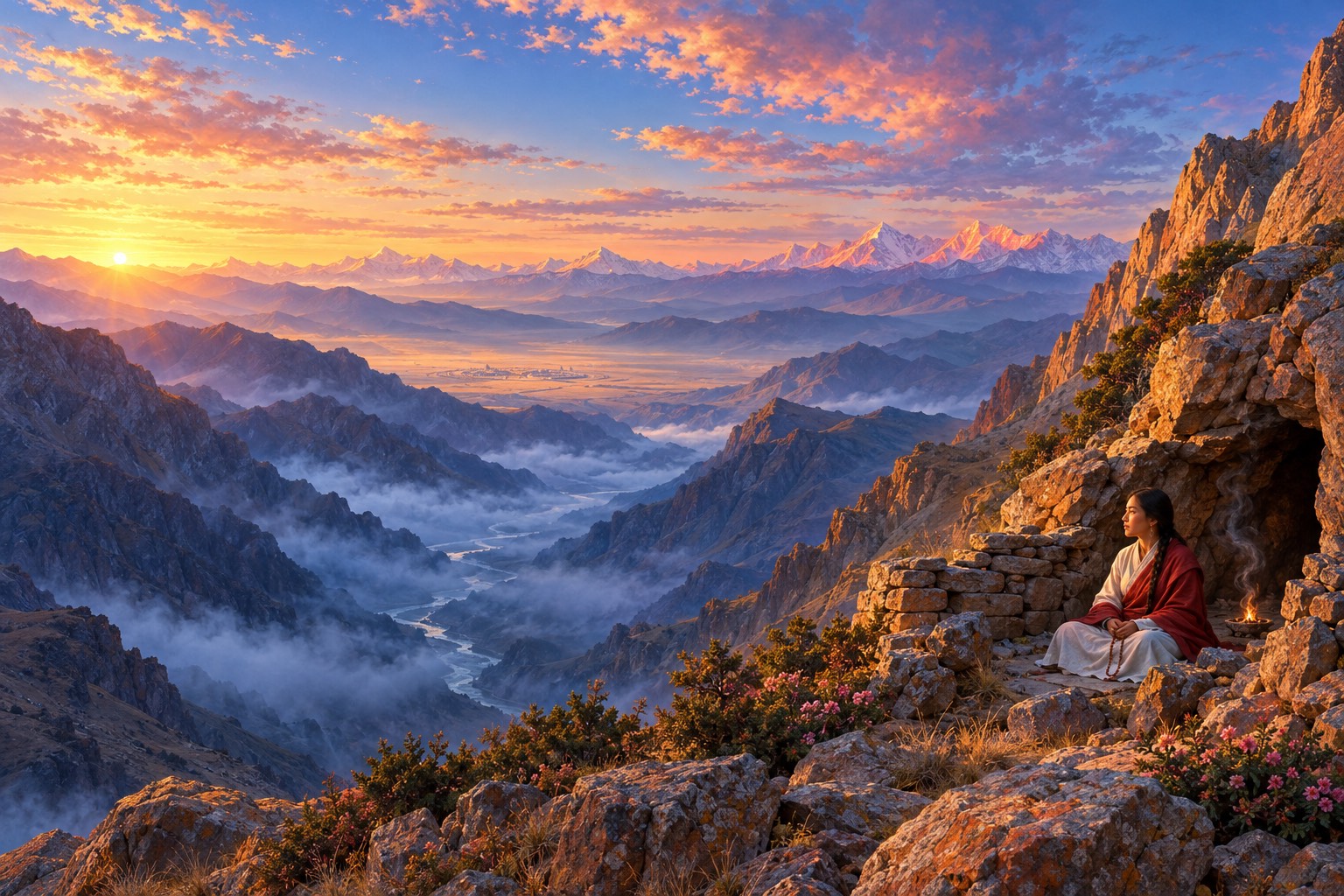
Yeshe Tsogyal appears as a yogini in plain white cotton robes and a dark red woollen shawl, with a mala of 108 beads, as on her own page. Shakyadevi, the Nepali princess, wears a cream wrap with a madder-red border and a forest-green shawl, a reconstruction of Licchavi-period dress, the dynasty that ruled the Kathmandu valley at the time. The town is drawn in plain brick and timber, without the tiered temples and carved windows of much later Bhaktapur, and the scene of the wonder in the house of mourning shows only the family and the lamps.
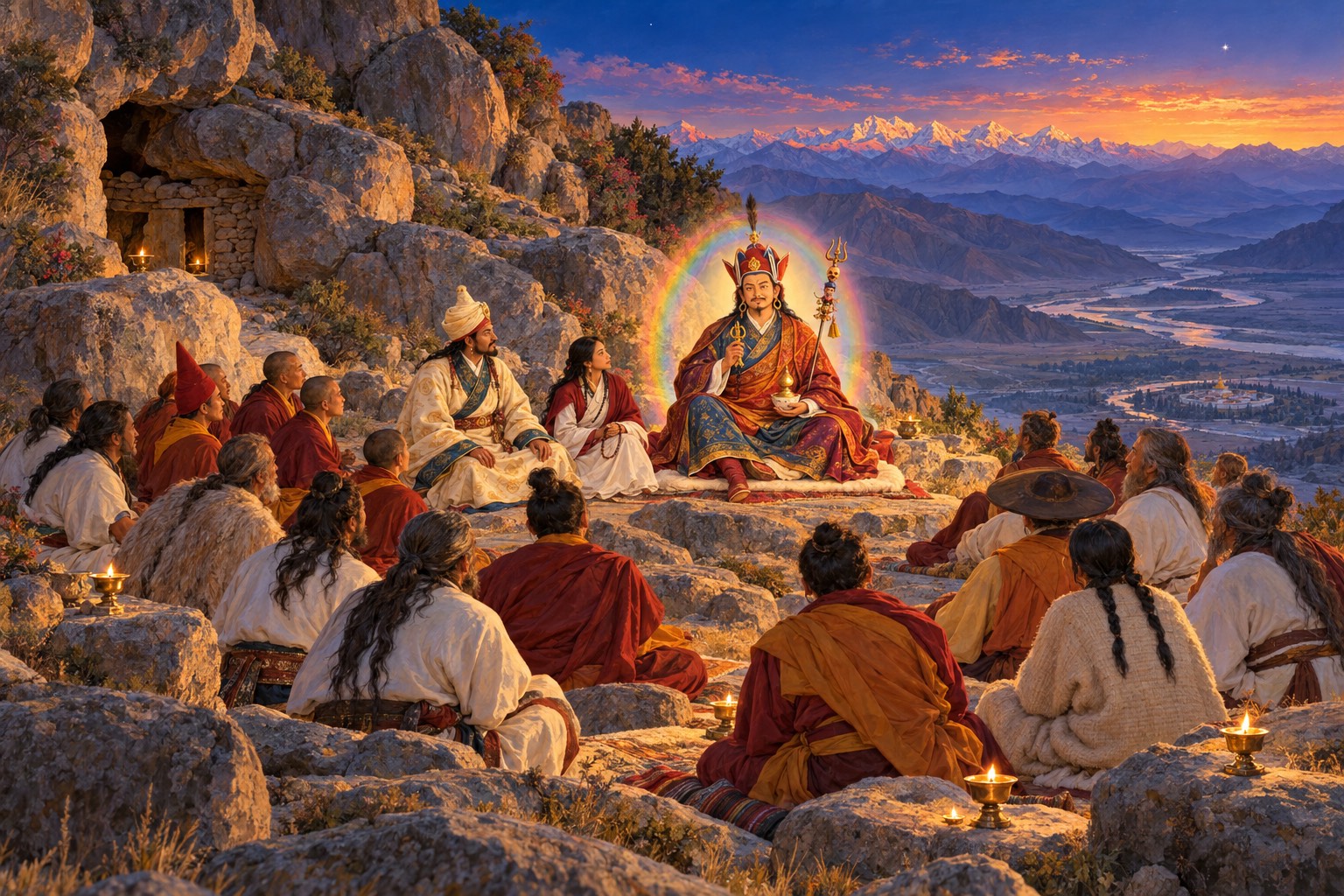
Guru Rinpoche is shown in his main form: the lotus hat with its vulture feather, a five-pronged vajra at his heart, a skull cup in his lap holding a small vase of long-life nectar, and a khatvanga, a slender trident staff, resting against his left shoulder. In the narrative scene at Tidro he has no throne or rainbow sphere; in the closing image he sits within the rainbow light among dakinis, the retinue of the prayer's fifth line. As everywhere on this site, the images contain no Tibetan script or mantras.
Why this matters for practice
The fifth line of the Seven-Line Prayer pictures Guru Rinpoche amid a retinue of dakas and dakinis. Atsara Salé's story shows how wide that circle is in the tradition's eyes: a servant bought out of bondage, who faltered once and came back, is remembered as a hero of the path and as the keeper of his teacher's story. When we recite the prayer, we are not asking to be perfect first; we are asking to be included.
If something in this story moved you, a price paid for someone else's freedom, or a friend who stumbled and came back, you might pause and recite the prayer once, and remember that the circle around Guru Rinpoche has room for everyone.
Sources and further reading
- Acharya Salé (redirected from Atsara Salé), Rigpa Wiki (archived snapshot)
- Yeshe Tsogyal, Rigpa Wiki (archived snapshot)
- Taksham Nüden Dorje, Rigpa Wiki (archived snapshot)
- The Tambura's Yearning Song of Devotion: A Prayer Summarizing Khandro Yeshé Tsogyal's Life and Liberation, by Jamgön Kongtrul Lodrö Tayé (tr. Stefan Mang, Samye Translations, 2017), Lotsawa House
- Atsara Sale, Wikipedia
- Yeshe Tsogyal, Wikipedia
- Machig Labdrön, Wikipedia
- Lasum Gyelwa Jangchub, by Gyurme Dorje (2008), The Treasury of Lives (archived snapshot)
- Teacher: Yeshe Tsogyal (Biography), by Alexander Gardner (Treasury of Lives, 2018), Himalayan Art Resources (archived snapshot)
- Yeshe Tsogyal, Princess of Karchen, Dharma Fellowship (archived snapshot)
- Samye Chimpu, Nekhor
- Lady of the Lotus-Born: The Life and Enlightenment of Yeshe Tsogyal, attributed to Gyalwa Changchub and Namkhai Nyingpo, revealed by Taksham Nüden Dorje, tr. Padmakara Translation Group (Shambhala, 1999), Book (consulted only through the summaries above)
- Sky Dancer: The Secret Life and Songs of the Lady Yeshe Tsogyel, tr. Keith Dowman (Routledge and Kegan Paul, 1984; Snow Lion, 1996), Book (consulted only through the summaries above)
This retelling is waiting to be read by a knowledgeable practitioner. Where the traditional accounts differ, the story says so; if you notice a mistake, please tell us through Share Your Story.