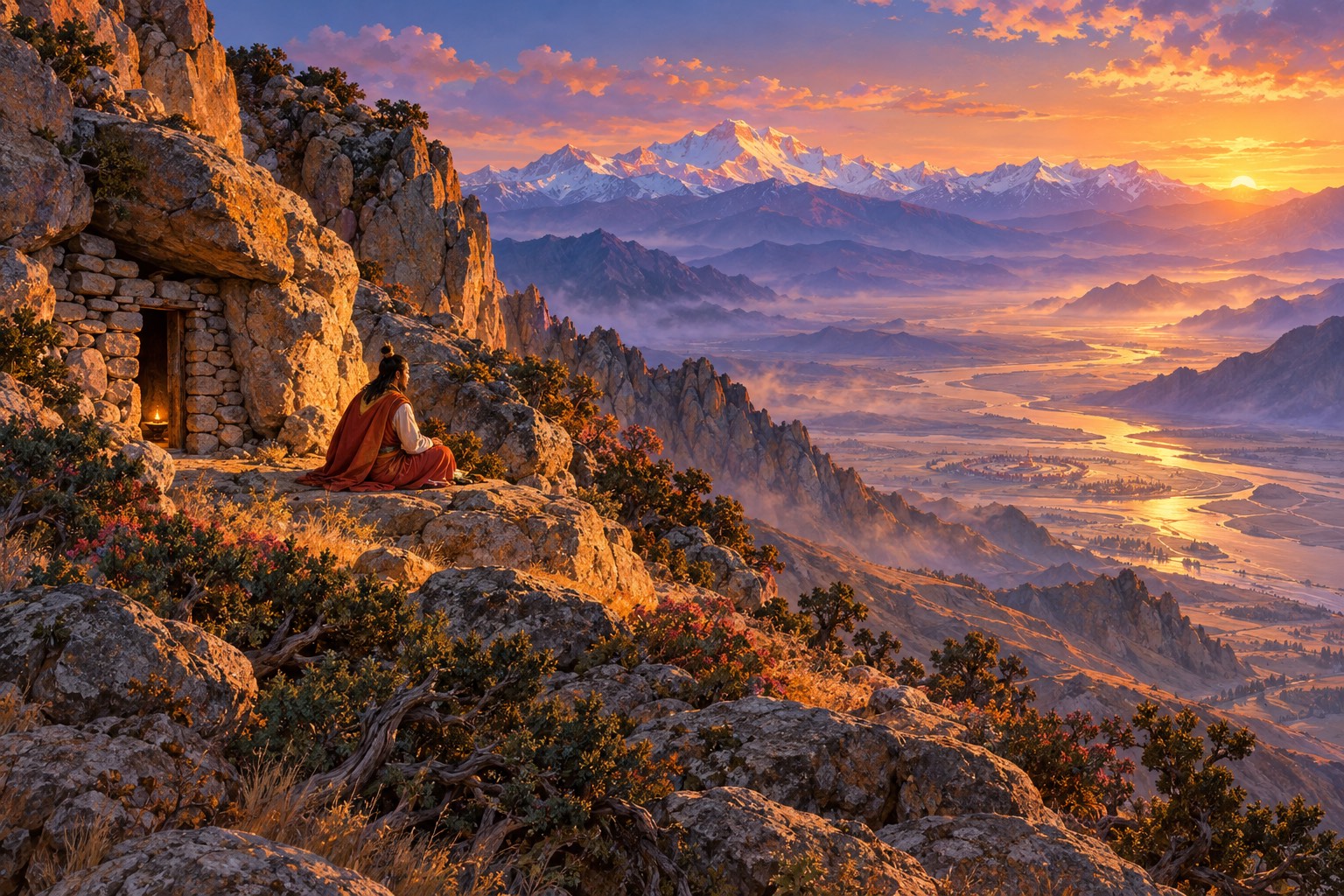
Some teachers are remembered for their gentleness. Do Khyentse Yeshe Dorje (1800–1866) is remembered for something harder to explain: a wildness that, his students came to believe, was itself a kind of kindness.
He was a nomad's son from Golok, a revealer of hidden teachings, a wandering yogi who dressed like a hunter, and the teacher who once threw Patrul Rinpoche into the dust. This is his story as the tradition tells it.
A child of two worlds
He was born in 1800 in Golok, the high grassland of north-eastern Tibet. His mother, Tsewang Men, came from the Dawa clan; the man who raised him, Chokor Sönam Pel, belonged to the Akyong clan of Golok.
His own biography, as later teachers retell it, adds something stranger. While his parents were on pilgrimage in Lhasa, his mother had a vision of being led into a palace of light. The child she carried was afterwards spoken of as a son of Nyenchen Tanglha, the great mountain protector of central Tibet, and her husband raised the boy as his own.
The accounts say that the newborn recited the Sanskrit alphabet and then vanished from his bed for three days. Later he said he had been taken to a crystal palace, where lamas and dakinis washed and blessed him. Dakinis, in this tradition, are feminine embodiments of awakened wisdom.

Recognized
When he was about a year old he met the First Dodrupchen, Jigme Trinle Özer, a leading disciple of the great master Jigme Lingpa, who had died in 1798. Dodrupchen recognized the little boy as Jigme Lingpa's rebirth, and the family moved into his encampment. From then on Dodrupchen was his root teacher, the teacher closest to his heart.
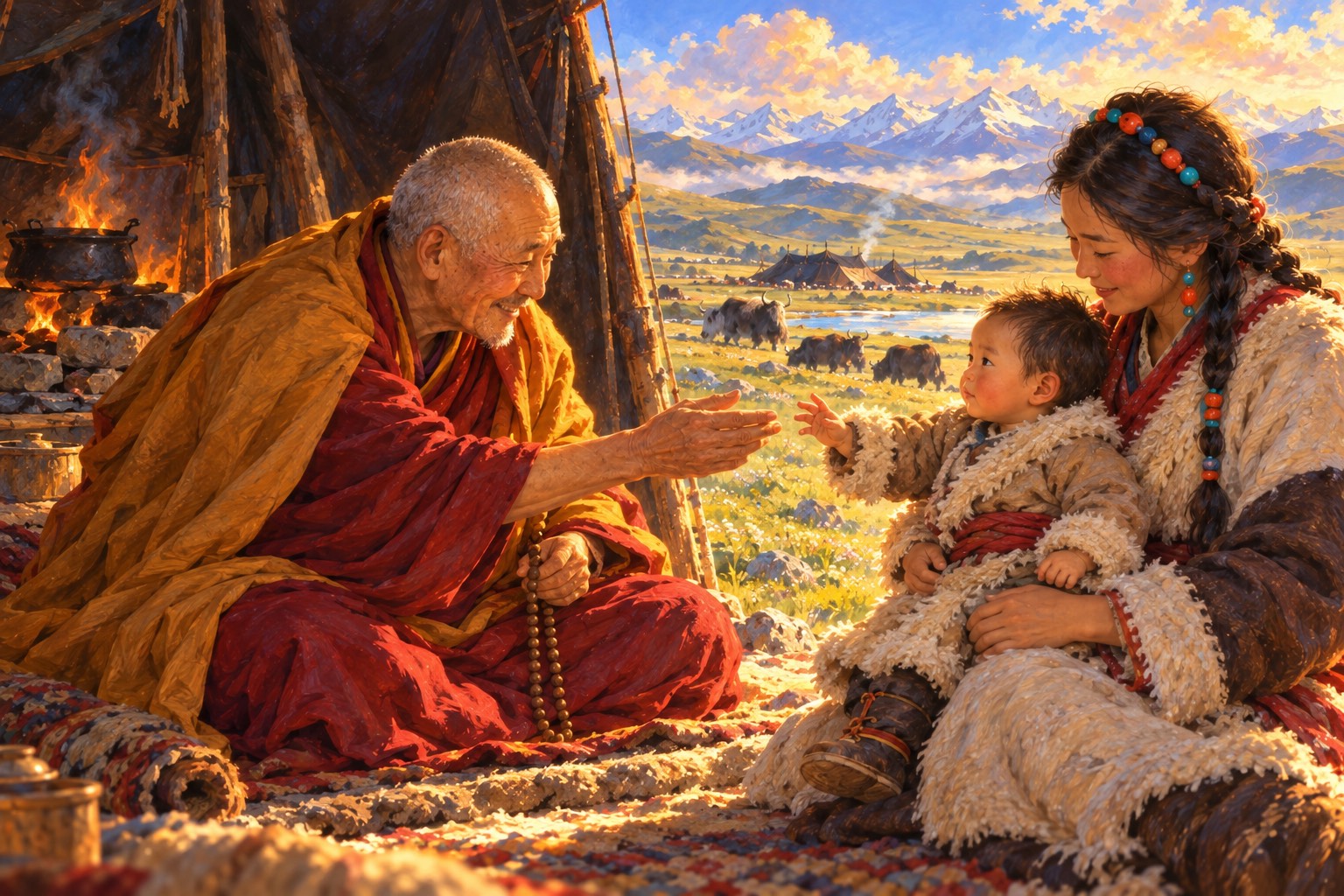
Tradition speaks of three emanations of Jigme Lingpa, of body, speech and mind: Jamyang Khyentse Wangpo, Patrul Rinpoche and Do Khyentse. The sources do not agree on which role is whose. Lotsawa House and Rigpa Wiki call Do Khyentse the mind emanation; Himalayan Art Resources and the essay on Treasury of Lives say body. Rigpa Wiki traces the difference to a slip in one English book.
The Copper-Coloured Mountain
In a verse account of his own life, written only because a king insisted, Do Khyentse says that at the age of two he saw Guru Rinpoche in Zangdok Palri, the Copper-Coloured Mountain, Guru Rinpoche's pure land, and received his blessing.
Such journeys came again and again. One, retold by Phakchok Rinpoche, lasted more than two weeks while his body lay as if lifeless. He found Guru Rinpoche in the Palace of Lotus Light, surrounded by buddhas, awareness-holders, dakas and dakinis: the very retinue the fifth line of the Seven-Line Prayer describes. Yeshe Tsogyal, the account says, took him by the hand, and Guru Rinpoche entrusted him with treasure caskets before he returned.

A boy among teachers
As a child he was taken to central Tibet, enthroned at Jigme Lingpa's hermitage, Tsering Jong, and given the vows of a novice monk. He studied with many masters there and in Kham. In his verses he says that at fourteen he received his first list of treasures.
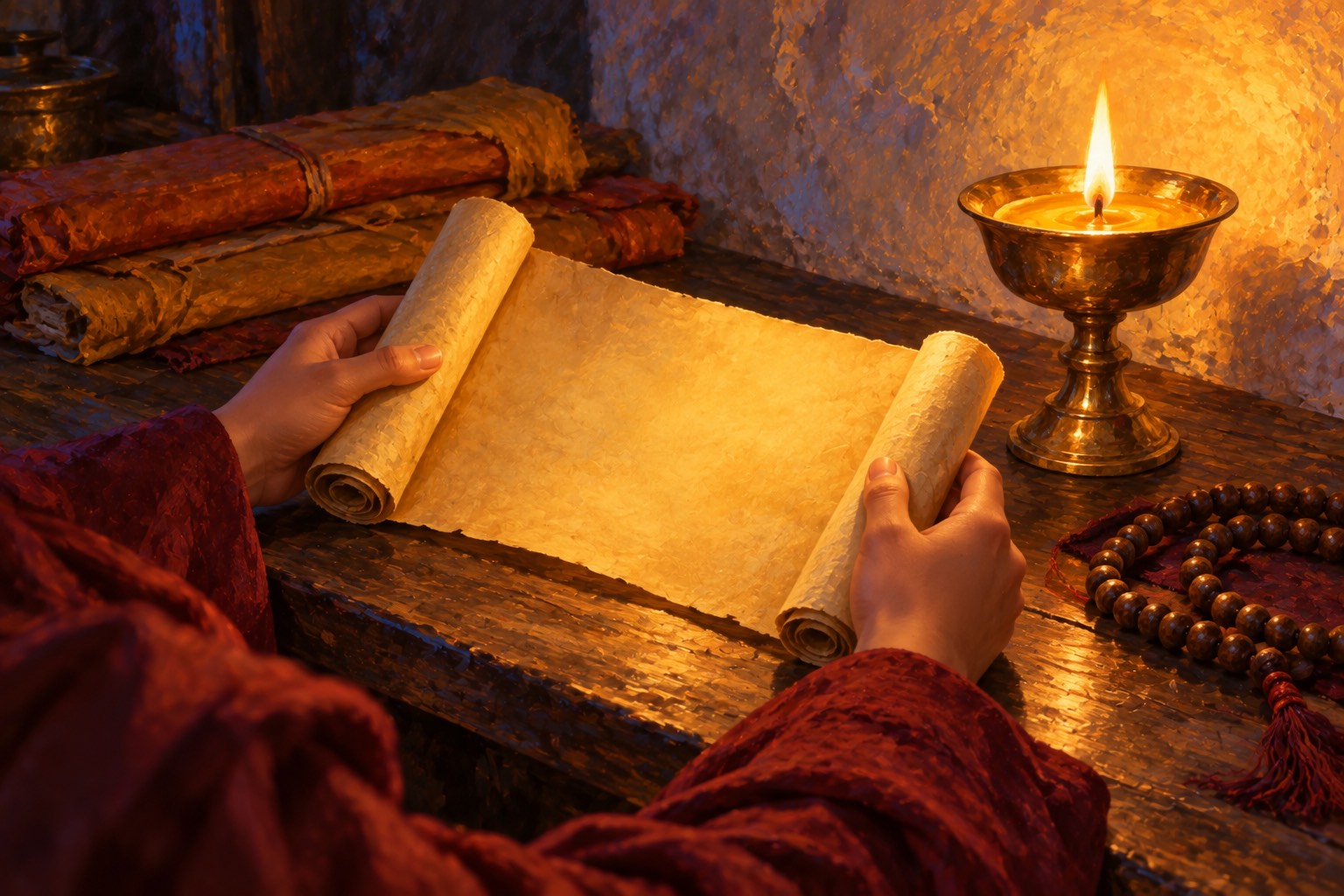
A terma, or treasure, is a teaching the tradition says Guru Rinpoche concealed long ago, to be found again when the time is right. Some are drawn from earth or rock; others, called mind treasures, arise in the revealer's own mind. Treasury of Lives says he revealed several of his as mind treasures.
Robes laid down
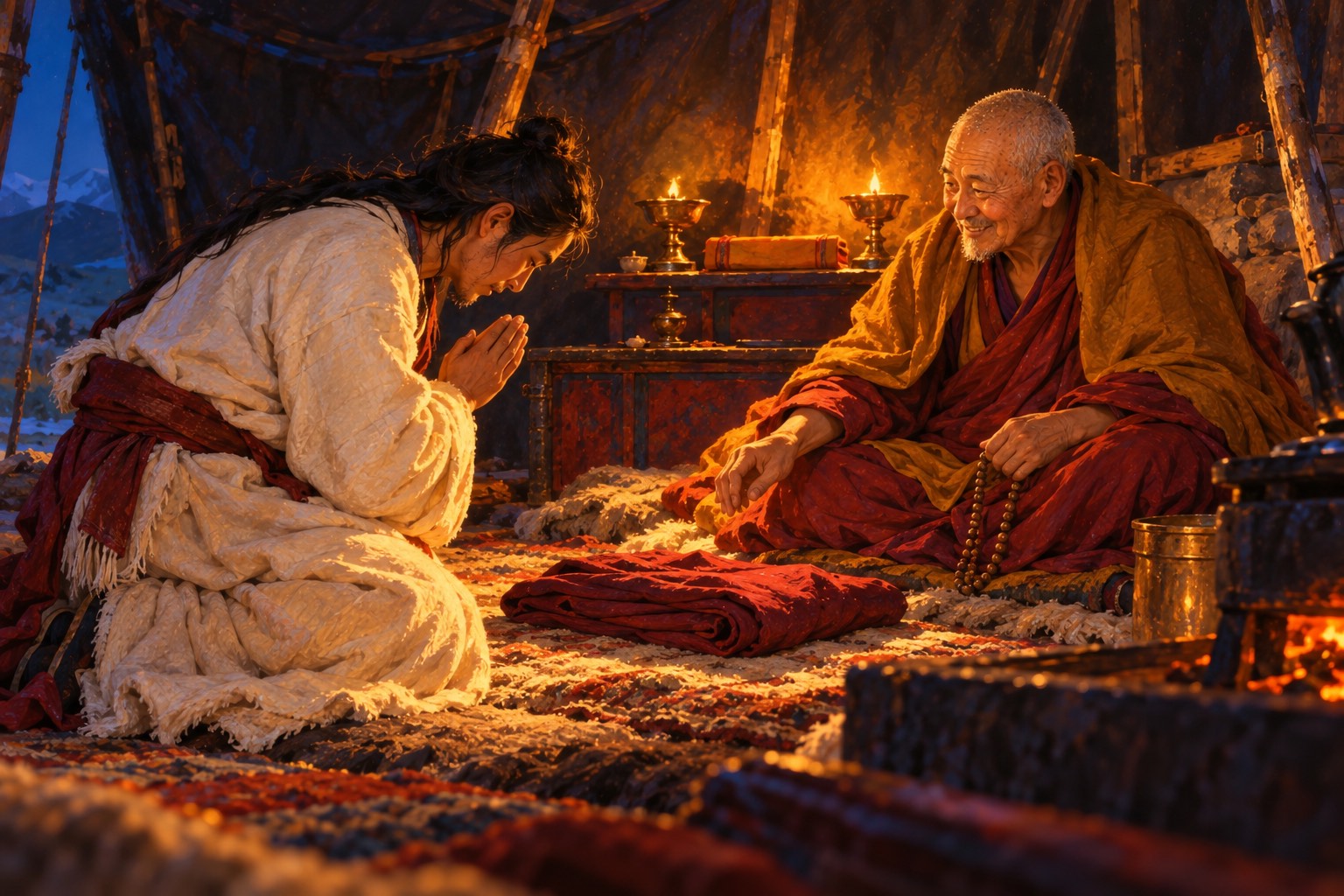
Many lamas and officials hoped he would stay a monk. But Dodrupchen saw that his path was that of a lay tantrika, a yogi who practises without monastic vows. At about nineteen, Drupon Rinpoche's summary of his life says, he offered everything he owned to his teacher, set aside his monk's robes and let his hair grow long.
Dodrupchen was glad, and counselled him to practise without concern for wealth, comfort or status. Teacher and student parted knowing they would not meet again in this life.
The hunter of Golok
Then he wandered. Treasury of Lives says he roamed the region "in the guise of a deer hunter." Here the stories become hard for a newcomer to hear, and they deserve a careful word.
In this tradition a few rare masters, like some of the great adepts (mahasiddhas) of ancient India, are said to have acted in ways that look wrong from the outside. Their behaviour is understood as a teacher's skilful means, a way of cutting through students' fixed ideas. The stories are told to deepen trust in what such masters had realized, never as a model to copy.

In one story, after a wild blue sheep had been killed and roasted, he asked his companions to keep every bone and the skin. One disciple quietly doubted him. At the end of the meal Do Khyentse had the remains laid before him, sat in meditation and snapped his fingers. The sheep, the account says, stood up, shook itself and walked away, limping a little, because someone had mislaid a small bone from its leg.
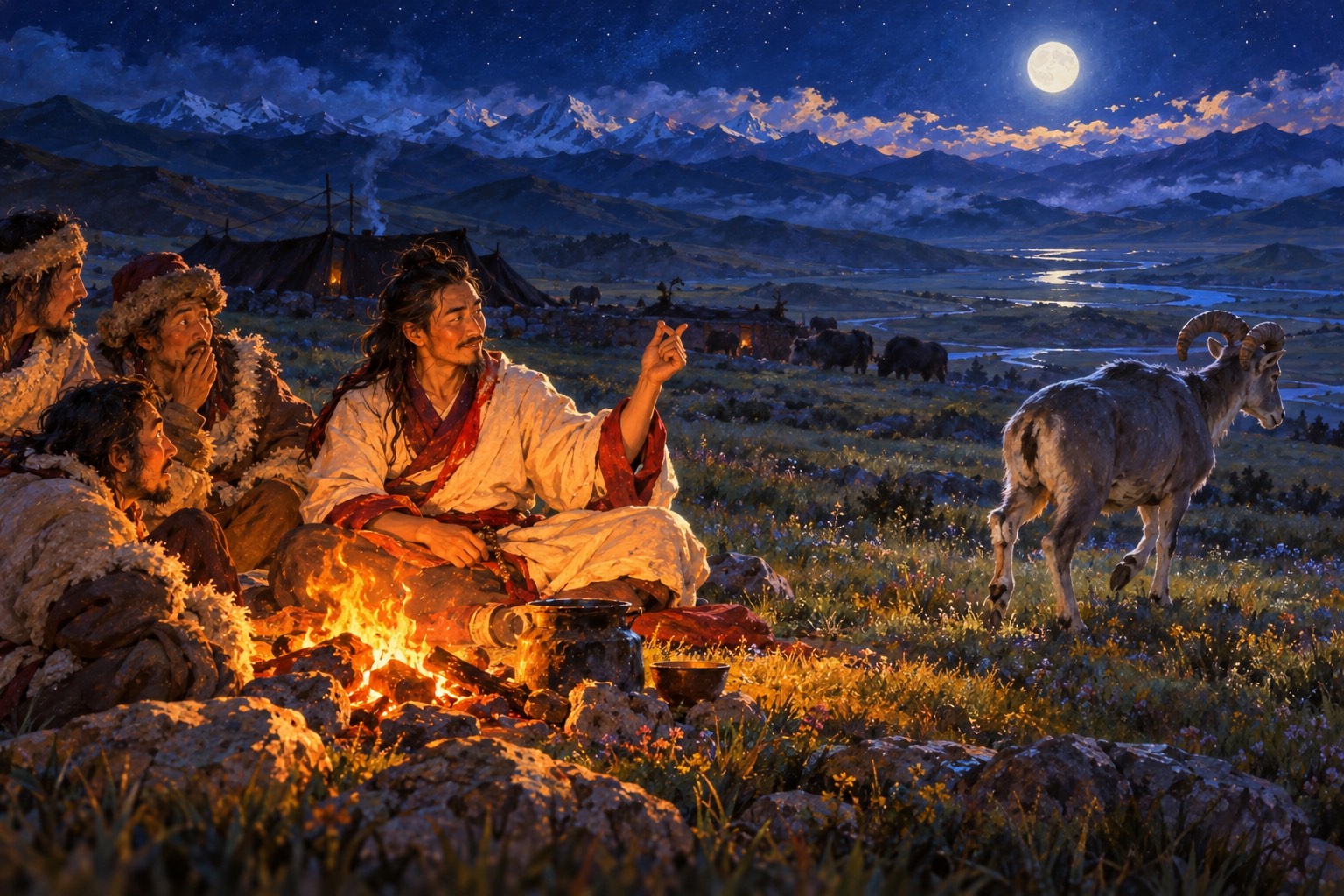
The accounts credit him with other wonders as well: flight, passing through rock, bringing the dead back to life. His students said he could see what was in their minds. Patrul Rinpoche was about to find out.
"Old Dog"
Patrul Rinpoche (1808–1887), later one of the best-loved teachers in Tibet, felt deep devotion to Do Khyentse. In the telling gathered by Matthieu Ricard, Do Khyentse once came to Dzogchen, a great monastery in Kham, and Patrul hurried down from his hermitage to find him sitting in the village.
Do Khyentse called out a challenge. As Patrul came close he smelled barley beer on his teacher's breath, and a doubting thought arose: can even a great master behave like this? At that moment, the story goes, Do Khyentse seized him, threw him down and dragged him by the hair, then let him go, spat, called him an old dog, made a sign of contempt and walked away.
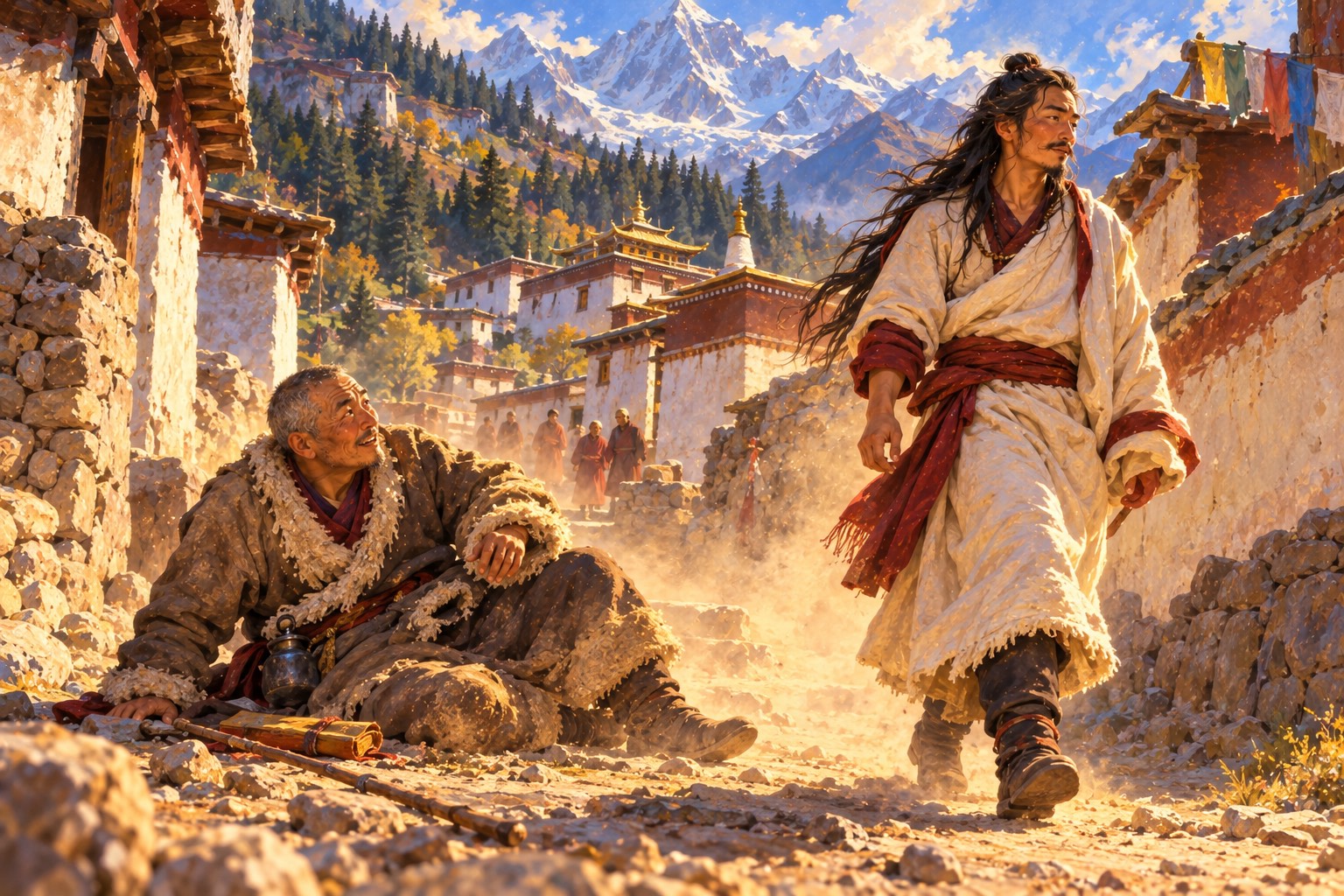
Patrul sat in the dust, shaken. Then, as the tradition tells it, he saw that the judging, doubting mind was exactly what his teacher had cut through. He sat up straight and rested in the open, clear nature of his own mind. For the rest of his life he called "Old Dog" the secret name his teacher had kindly given him, and he signed some of his writings with it.
The versions differ in their details. Some place the meeting at a tent or a cave, and some add that Do Khyentse threw stones as he left. All agree on what it meant to Patrul, whose own story is told in its own page.
Teacher of kings
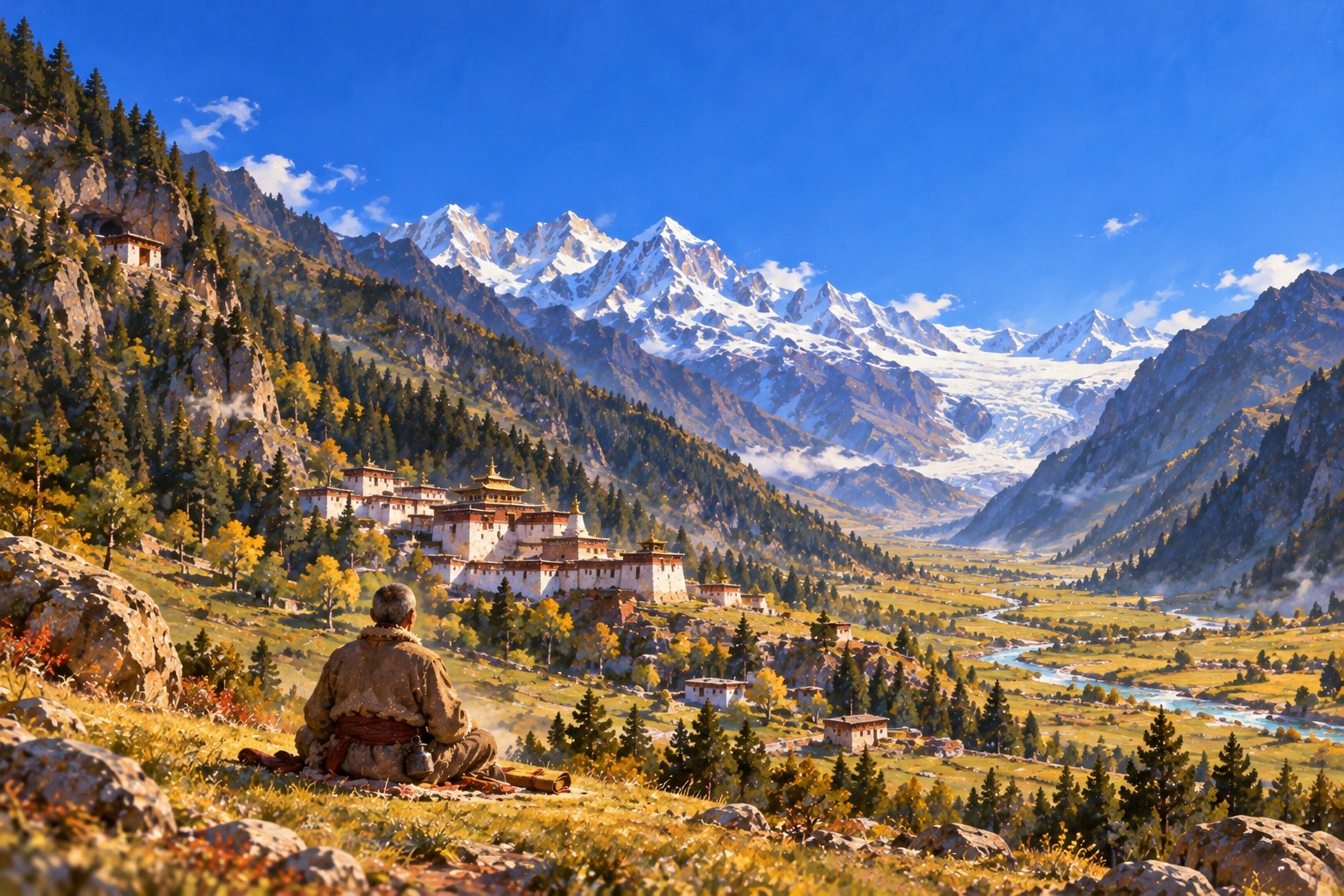
In time his fame spread. He taught kings and chieftains in Kham, and with Dodrupchen he had served the queen of Derge, once a student of Jigme Lingpa. The king of Chakla invited him to Dartsedo, a trading town on Tibet's eastern edge, and he stayed for years. That is how he came to be called Do Khyentse: the Khyentse of Dartsedo.
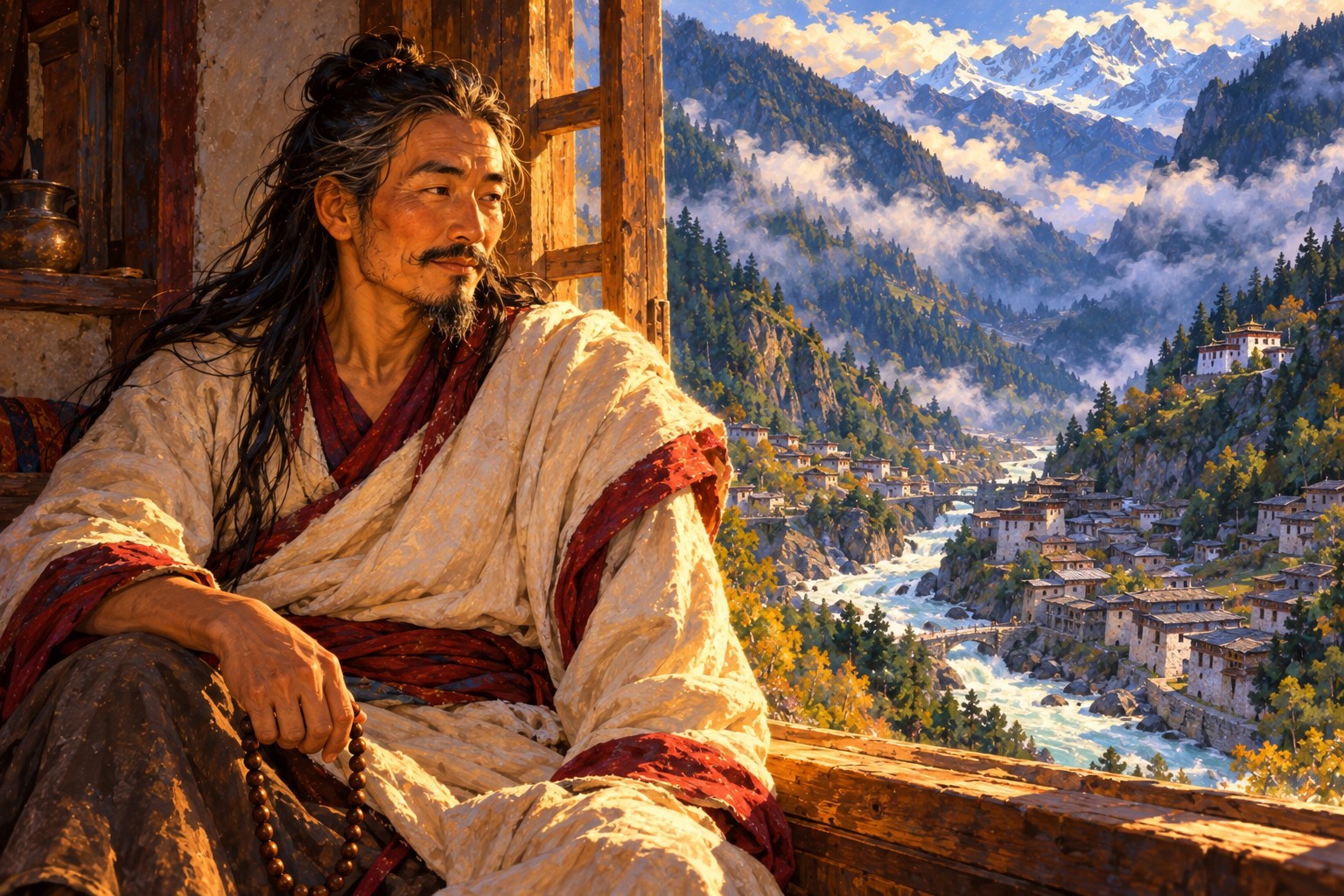
His treasures fill several volumes. Among those still practised are the Exceedingly Secret Heart Essence of the Dakini and the Natural Liberation of Grasping (Dzinpa Rangdrol), a cycle centred on Chöd, the practice of "cutting through" self-clinging. Lotsawa House also publishes short prayers to Guru Rinpoche that he wrote, among them a brief prayer for clearing obstacles from the path.
His lifelong companion was the yogini Lösel Drölma (1802–1861), who became the main holder of his teachings. Their children were a daughter, Khaying Dölma, and two sons: Sherab Mebar, recognized as Dodrupchen's rebirth, who died at fourteen, and Dechen Rigpai Raldri, who carried his father's teachings on. Through Raldri the family line continued into the twentieth century.
Leaving
Do Khyentse died in 1866. Drupon Rinpoche's account says that lights and sounds filled the air for days. At least two lines of his rebirths were later recognized, one in Minyak and one in Amdo, where the Alak Zenkar line continues.
His verse account of his own life ends not with boasts but with a prayer of regret, spoken for his disciples, asking pardon for their doubts and wrong views. It is a fitting close for a teacher who threw his finest student into the dust and gave him a name that set him free.
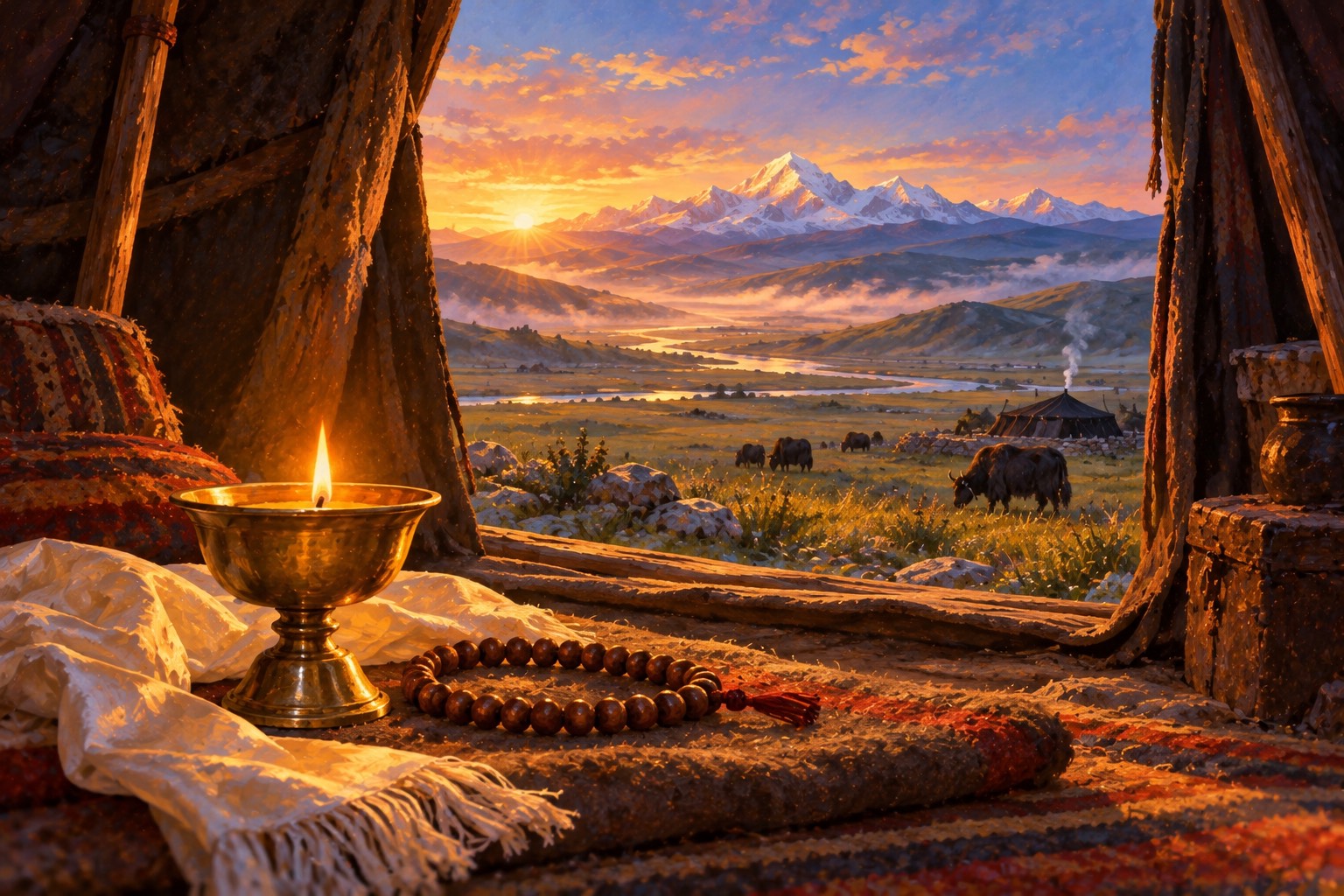
About the art
Do Khyentse is drawn from the two portraits on Himalayan Art Resources. The nineteenth-century painting (item 300, Rubin Museum) shows him in the visionary form of an Indian adept, with long loose hair, bone ornaments, a raised sword and a skull cup; the later woodblock print (item 80188) shows him calm, with his hair in a topknot and a plain shawl. The story pages keep his long hair, moustache and small beard, but dress him as the written sources describe his life: a lay yogi in a white wool coat, with a dark red sash and a white shawl bordered in red, the site's sign for a lay tantric practitioner. The sword, ornaments and skull cup belong to the painting's symbolic form and are left out here.
In two scenes he carries an old matchlock gun slung on his back, because one account of his life speaks of 'his gun' when he wandered as a hunter. No animal is shown harmed. The blue sheep (bharal) of the campfire scene is the wild sheep of the Tibetan uplands; it is shown alive and walking away, as the story ends.
The First Dodrupchen wears the maroon and saffron robes of a monk, following his painted portrait on Lotsawa House; his formal hat is left off in the tent scenes. Patrul Rinpoche wears his old sheepskin coat, as on his own page. Guru Rinpoche appears once, in his main form, on the Copper-Coloured Mountain: the lotus hat with a half-vajra and a single vulture feather, a five-pronged vajra at his heart, a skull cup with a long-life vase in his lap, and the khatvanga staff against his left shoulder, inside a sphere of rainbow light, with dakinis in flowing silks around him. Rainbow light is kept for that vision alone.
The treasure list in the lamplit scene is shown blank, and nothing in any picture carries script, syllables or mantras.
Why this matters for practice
Do Khyentse's life is full of the fifth line of the Seven-Line Prayer: from the age of two, he said, he was received by Guru Rinpoche amid his retinue of dakas and dakinis, and his best-known treasure is called the Heart Essence of the Dakini. His story also shows that devotion is not always tidy; Patrul's doubt became the very doorway of his awakening. Reciting the prayer, even with a doubting heart, is a way of calling on that same company.

If something in this story stirred you, even its wildness, you might pause tonight and recite the prayer once: a call to Guru Rinpoche and his retinue of dakas and dakinis, the same company Do Khyentse said he met when he was two years old.
Sources and further reading
- Do Khyentse Yeshe Dorje, by Alexander Gardner (December 2009), Treasury of Lives (Internet Archive snapshot, December 2014)
- Do Khyentse Yeshe Dorje, Rigpa Wiki (Internet Archive snapshot, November 2025)
- Do Khyentse Yeshe Dorje Series (author page), Lotsawa House
- The Hook Which Invokes the Blessings: A Supplication to the Life and Liberation of Rigdzin Jalü Dorje, by Do Khyentse, trans. Ryan Jacobson (2018), Lotsawa House
- A Very Brief Barche Lamsel; The Lightning Bolt of Compassion (Sampa Lhundrupma), by Do Khyentse, Rigpa Translations, Lotsawa House
- Teacher (Lama) - Do Kyentse Yeshe Dorje, item 300; item 80188; set 1914, Himalayan Art Resources
- Do Khyentse Takes Patrul by Surprise, from Matthieu Ricard, Enlightened Vagabond (Shambhala, 2017), Rangjung Yeshe Wiki (Internet Archive snapshot, December 2023)
- Do Khyentse Yeshe Dorje, Drupon Rinpoche (Karma Lhabu) website
- A Short Introduction to Do Khyentse's Life (mostly from Tulku Thondup, Masters of Meditation and Miracles, ch. 16), Tara Mandala (Internet Archive snapshot, January 2025)
- Do Khyentsé Yeshé Dorjé's Visionary Journey to Zangdok Palri (Phakchok Rinpoche, 2019), Nekhor
- Do Khyentse Yeshe Dorje, Encyclopedia of Buddhism
- Masters of Meditation and Miracles, by Tulku Thondup (Shambhala, 1996), pp. 179–197
This retelling is waiting to be read by a knowledgeable practitioner. Where the traditional accounts differ, the story says so; if you notice a mistake, please tell us through Share Your Story.