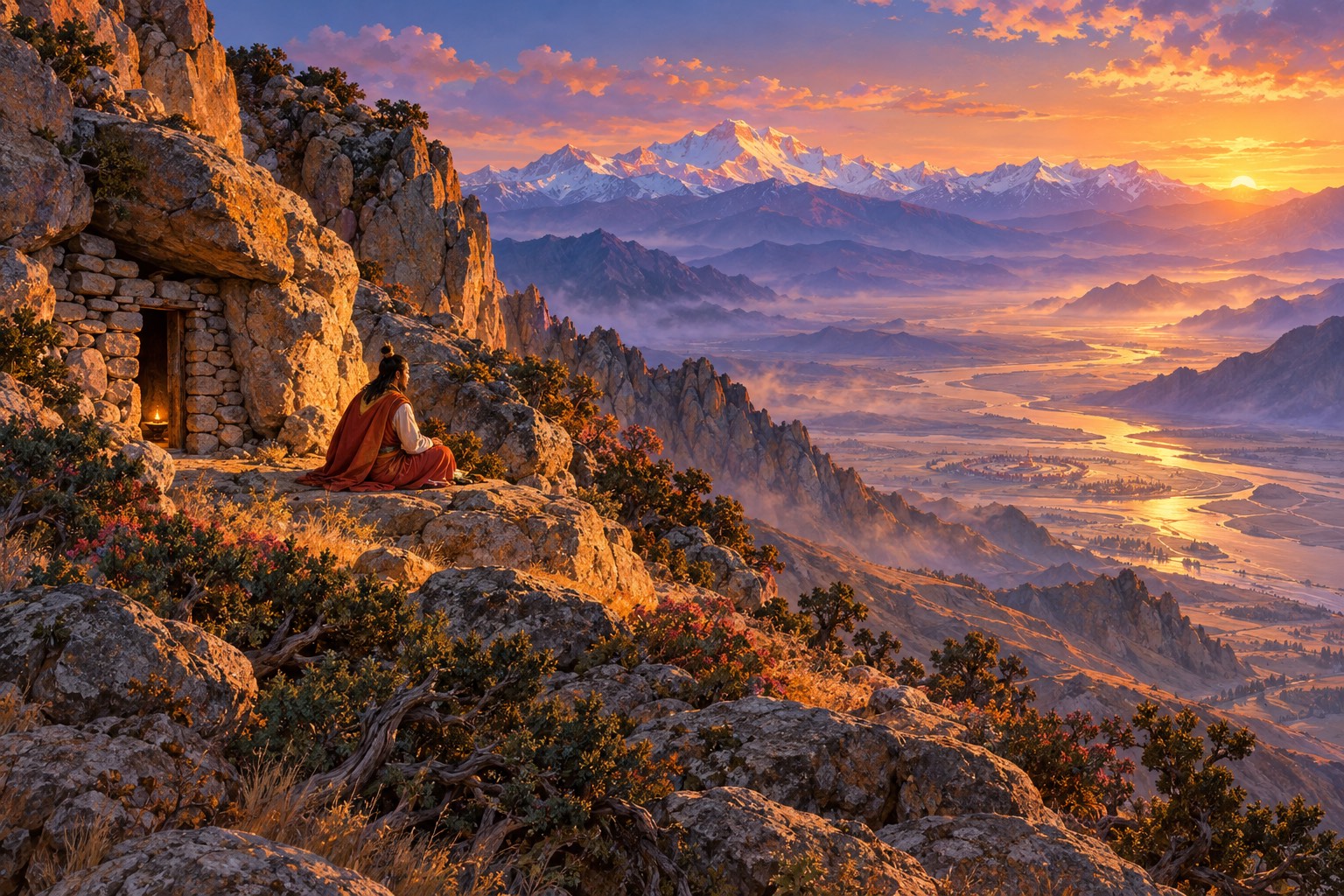
In Golok, the high grassland of north-eastern Tibet, there is a valley called Do. Tibetans still speak of one lama from that valley by a title rather than a name: Dodrupchen, "the great siddha of Do." A siddha is an accomplished master, someone who has carried practice all the way to its fruit.
His own name was Jigme Trinlé Özer, and he lived from 1745 to 1821. He was one of the closest students of Jigme Lingpa, whose story is told on this site. This is the story of the student, and of how he carried his teacher's teachings home.
A boy of the Do valley
The Treasury of Lives says he was born in the Do valley into the Mukpo clan. His father was Bochung Sönko and his mother Sönam Tso. Rigpa Wiki adds that from childhood he had many pure visions and showed unusual signs.
While he was still young he met the Second Shechen Rabjam, a great Nyingma lama of Kham. The accounts describe the meeting a little differently. Rigpa Wiki says the lama performed the ceremonial first cutting of the boy's hair. The Treasury of Lives says he gave him the refuge vow, the first formal step of taking the Buddha, his teaching and his community as one's guide.
 Illustration in preparation
Both agree on the name the lama gave him: Kunzang Shenpen, "All-Good Benefactor." Later he entered Gochen, a monastery linked to the great Nyingma seat of Palyul, where he was called Sönam Chöden and began to study.
The mountain of crystal
At twenty-one he set out on a long pilgrimage to central Tibet, learning from masters of other schools on the way. He visited Samye, Tibet's first monastery, and Tsari, the "Pure Crystal Mountain" of the south-east, counted among the three holiest places of Tibet.
Illustration in preparationTsari holds a moment that readers of the Seven-Line Prayer may want to know. Lotsawa House keeps a short four-line prayer of his addressed to Orgyen Rinpoche, "the Precious One of Oddiyana," one of the names of Guru Rinpoche. Its closing note says that during a visit to Tsari, Guru Rinpoche appeared to him in a vision, and the words of the prayer came from him at once.
Illustration in preparationThe note does not say which visit it was; he travelled to central Tibet four times. The prayer asks Guru Rinpoche for a life without obstacles, for good conditions, and for the attainments of the path. It is still among the best-loved short prayers to him.
Notice how it begins. It calls Guru Rinpoche by his homeland, Orgyen, the Tibetan name for Oddiyana. The first line of the Seven-Line Prayer begins in that same land.
A cave above Dzogchen
At twenty-five he went home to Golok to meet his family duties, and stayed five years. Then, the Treasury of Lives says, a strong weariness with the householder's life drove him back to his teachers.
He studied at Dzogchen Monastery in Kham, made a second pilgrimage, and returned for a long retreat in the hermitages of Gangtrö, high above the monastery. Here the accounts differ. Rigpa Wiki speaks of a seven-year retreat; the Treasury of Lives describes four years in one cave and further practice in a second.
The first cave came to be called Tsering Puk. The tradition says that Tseringma, a protector goddess of the snow mountains, came to him there and brought him yogurt to keep him alive. The Treasury of Lives does not hide the rest: the retreat also brought frightening visions and real hardship.
Illustration in preparationA book, and the man who wrote it
After the retreat the Third Dzogchen Rinpoche gave him a book, the Treasury of Precious Qualities, Jigme Lingpa's great guide to the whole Nyingma path. Rigpa Wiki adds that Dzogchen Rinpoche foretold that its author would be his principal teacher.
Illustration in preparationHe read it, and devotion to a man he had never met filled him. So he set out a third time for central Tibet.
In 1786 he reached Tsering Jong, Jigme Lingpa's small hermitage in the Chongye valley at the southern end of the Yarlung region. The Treasury of Lives gives his age as forty-one; Rigpa Wiki says thirty-nine.
Illustration in preparationJigme Lingpa recognized him as the main heir of the Longchen Nyingtik, "the Heart Essence of the Vast Expanse," the cycle of teachings Jigme Lingpa had revealed. Rigpa Wiki says Guru Rinpoche himself had foretold it. Jigme Lingpa also gave him the name he is known by. Jigme means "fearless," and trinlé özer means something like "light-rays of enlightened activity."
Rigpa Wiki says Jigme Lingpa also saw in him the rebirth of Prince Murum Tsenpo, a son of King Trisong Detsen, Guru Rinpoche's royal patron. A verse on his Lotsawa House page adds another past life, the treasure revealer Sangye Lingpa.
In those years, the Treasury of Lives says, he met a young man from Dzachukha named Jigme Gyalwe Nyugu and urged him to study with Jigme Lingpa.
Smoke over Hepori
He went back to his teacher again and again. On his last journey the two went together to Samye, made offerings, and he renewed his bodhisattva vow, the promise to work for the awakening of every being, in Jigme Lingpa's presence.
In 1791 an army from Nepal threatened Tibet. The government in Lhasa asked him for rites to turn the danger away. The Treasury of Lives says he made a smoke offering, the burning of fragrant juniper as a gift, and a further rite on Hepori, the rocky hill beside Samye where Guru Rinpoche is remembered to have tamed hostile forces.
Illustration in preparationThe same account adds, honestly, that the invaders had in fact been driven back by an army sent from Beijing. Even so he was given credit, and it says this is when people began to hail him as Dodrupchen.
Teacher to a queen
Back in Kham he gave the Longchen Nyingtik in the east for the first time, to the Third Dzogchen Rinpoche and the Second Dzogchen Pönlop.
Derge was the great kingdom of eastern Tibet. Its queen, Tsewang Lhamo, had met Jigme Lingpa in 1788. After her husband died she ruled as regent for her young son, and she kept Jigme Lingpa and Dodrupchen close as her religious advisors.
Illustration in preparationOlder histories said her favour toward Nyingma lamas stirred so much trouble at court that they were pushed out. The Treasury of Lives, drawing on the historian Jann Ronis, finds no evidence of that. The queen ruled until her death in 1812 or 1813, and Dodrupchen acted for her court in matters across Kham.
Carrying it home
His companion on many of these journeys was Jigme Gyalwe Nyugu. Rigpa Wiki, following Tulku Thondup's book Masters of Meditation and Miracles, says that in 1799 the two worked together on a monastery at Shukchen Tago in the Do valley, where Dodrupchen had laid the first foundations at the request of the chieftainess of Do.
Illustration in preparationThe lists of his monasteries differ a little. Rigpa Wiki names that first one, Dzagyal in Dzachukha, and Yarlung Pemakö in Serta. The Treasury of Lives names the first one, Yarlung Pemakö, and Arik Ragya beside the Yellow River, which he restored.
He taught the chieftains of Amdo as well, and Rigpa Wiki says his teaching reached as far as Lake Kokonor. He recognized a little boy of Golok as Jigme Lingpa's own rebirth, Do Khyentse, and he confirmed and named a baby from Dzachukha who grew up to be Patrul Rinpoche.
Among his writings is the arrangement of the Longchen Nyingtik ngöndro, the preliminary practices that prepare the ground for everything after. Lotsawa House publishes it as "arranged by" him, based on Jigme Lingpa's revelation, and it is still in use.
Its guru yoga, the practice of opening one's heart to the teacher as one with Guru Rinpoche, includes the Seven-Line Prayer. That practice is for a qualified teacher to give; the Find a Teacher page can help. The prayer on its own is open to anyone.
Ten years in one valley
In 1810 he founded a retreat community at Yarlung in Serta, on the south-western edge of Golok, and named it Pemakö Tsasum Khandro Ling. Rigpa Wiki, following Tulku Thondup, says he vowed never to leave it, and stayed there for the rest of his life.
Illustration in preparationLotsawa House keeps a set of aspirations he spoke as death drew near, written down by a disciple named Longsal. He prays never to hold even the slightest ill will toward any being, since all beings have been his parents, and he asks that his good intentions and actions "flow uninterruptedly like a stream" (translated by Adam Pearcey).
He died at seventy-seven, on the thirteenth day of the first Tibetan month of 1821. The Treasury of Lives says he described clearly to his students what he was experiencing as he passed, and that many relics were found after the cremation. They were kept in a golden stupa at Dodrupchen Monastery until its destruction in the 1950s.
Illustration in preparationHis line went on. Do Khyentse, the boy he had recognized, identified his rebirth, the Second Dodrupchen, and the Dodrupchen lamas later carried the line into exile in Sikkim.
The first line of the Seven-Line Prayer names the land Guru Rinpoche came from. Jigme Trinlé Özer is remembered by the name of the valley he came from, and he carried back to it everything he had been given.
About the art
The First Dodrupchen is drawn from the painted portrait on his Lotsawa House author page (courtesy of Terton Sogyal Trust): a round, gentle, beardless face, orange-red and saffron monastic robes, a red hat with a gold band and upturned side flaps, the right hand raised at the chest in the teaching gesture and a small golden vase held in the left hand. In the Derge scene he wears that hat. In his younger years he is shown bare-headed in plain maroon robes and a felt travelling cloak, and in old age without the hat, as in the site's earlier story of Do Khyentse. The plain clothes are the site's choice, since no portrait of his youth exists. He was a monk, so unlike his teacher Jigme Lingpa, a lay yogi with a topknot, he has a shaven head.
In the vision at Tsari, Guru Rinpoche appears in his main form, the form the Seven-Line Prayer calls on. He wears the lotus hat with a half-vajra and a vulture feather, holds the five-pronged vajra at his heart and a skull cup with a long-life vase in his lap, and has the khatvanga staff resting at his left shoulder. The rainbow sphere marks a vision; the account does not describe what he saw, so this is the site's usual way of showing one. The Second Shechen Rabjam wears the red-orange hat with upturned pointed flaps of his mural at Shechen.
Tseringma, the goddess of the snow mountains, is not drawn. Her gift is shown only as a bowl of yogurt on untrodden snow, so the picture tells the story without fixing her appearance. The rite on Hepori is shown only as juniper smoke: the burning of fragrant juniper, sang, is a common Tibetan offering. The book he reads has blank pages, because the site never draws script, and the butter lamps are the wide, stemmed brass lamps of Tibetan shrines.
Why this matters for practice
The first line of the Seven-Line Prayer names the land Guru Rinpoche came from, and the First Dodrupchen's own short prayer at Tsari calls him by that land, Orgyen. He took a teaching received far away back to his own valley, and arranged the preliminaries in which the seven lines are still recited. Saying the prayer once is a small way of doing what he did: calling on Guru Rinpoche from wherever you happen to be.
If something in this story moved you, perhaps a four-line prayer spoken on a mountain, or a bowl of yogurt left at a cave in the snow, you might pause tonight and recite the prayer once, calling on Orgyen Rinpoche as he did.
Sources and further reading
- The First Dodrubchen, Jigme Trinle Ozer, by Ron Garry (2007), Treasury of Lives (Internet Archive snapshot, January 2015)
- Dodrupchen Jikme Trinle Özer, Rigpa Wiki (Internet Archive snapshots, 2019 and 2026)
- Dodrupchen Monastery, Rigpa Wiki (Internet Archive snapshot, February 2026)
- Dodrupchen Incarnation Line, Rigpa Wiki (Internet Archive snapshot, December 2025)
- Jikme Lingpa Timeline, Rigpa Wiki (Internet Archive snapshot, 2024)
- Dodrupchen Jigme Trinle Özer Series, Lotsawa House
- The Prayer to Guru Rinpoche for Attainments, by the First Dodrupchen, Lotsawa House
- Aspiration at the Moment of Death, by Dodrupchen Jigme Trinle Özer, trans. Adam Pearcey (2018), Lotsawa House
- Beautiful Garland of Flowers: A Brief Prayer to the Successive Incarnations of Dzogchenpa Changchub Dorje, trans. Adam Pearcey (2022), Lotsawa House
- The Excellent Path to Omniscience: The Longchen Nyingtik Ngöndro arranged by Dodrupchen Jigme Trinle Özer, Lotsawa House (Rigpa Translations, revised for the Longchen Nyingtik Project)
- The History, Longchen Nyingtik Project
- Teacher: Jigme Lingpa (Main Page), Himalayan Art Resources
- Woodblock print, item 80186, Longchen Nyingtig lineage set, Himalayan Art Resources
- Tsari, Rigpa Wiki (Internet Archive snapshot, 2024)
- Tulku Thondup, Masters of Meditation and Miracles: The Longchen Nyingthig Lineage of Tibetan Buddhism (Shambhala, 1996)
This retelling is waiting to be read by a knowledgeable practitioner. Where the traditional accounts differ, the story says so; if you notice a mistake, please tell us through Share Your Story.