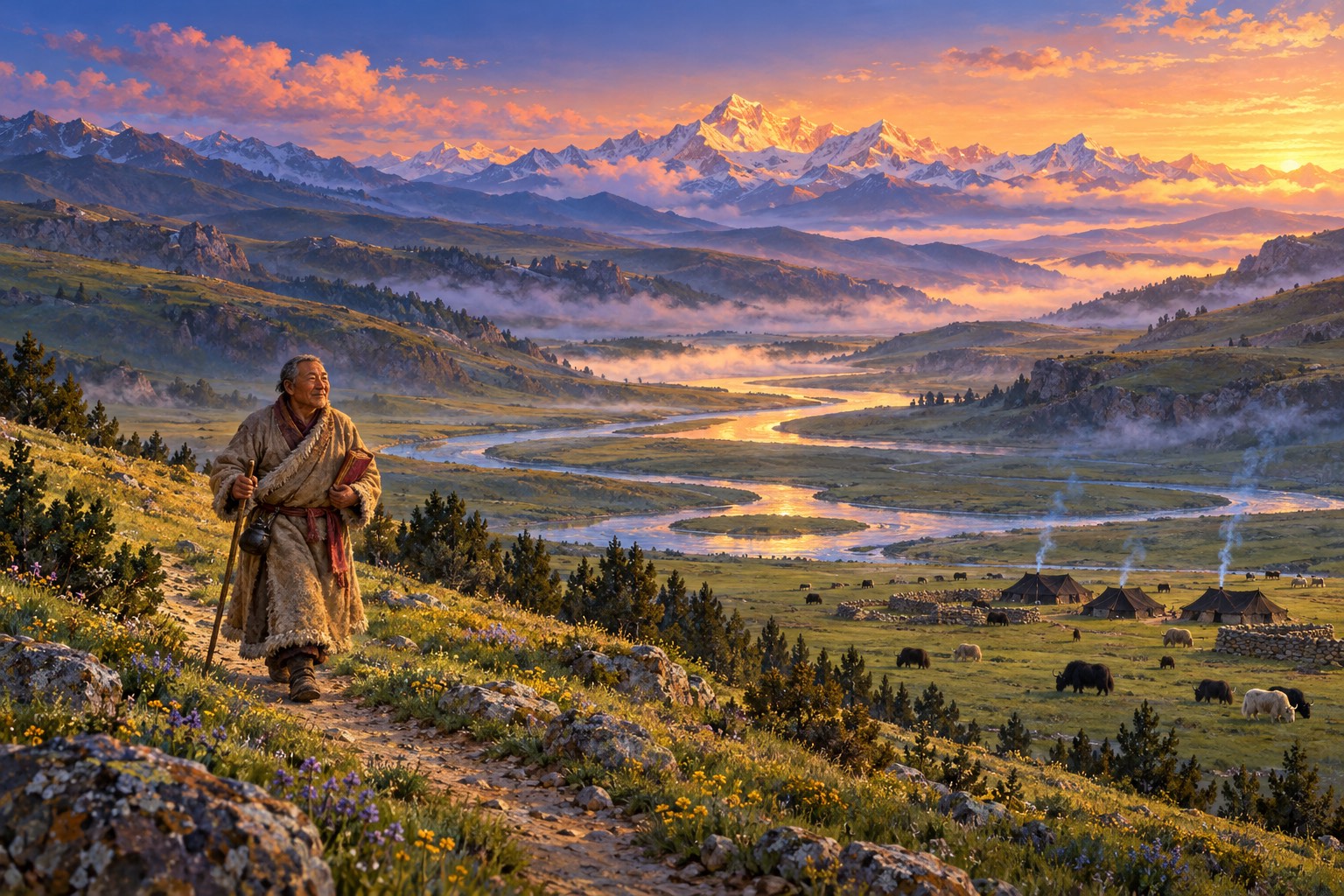
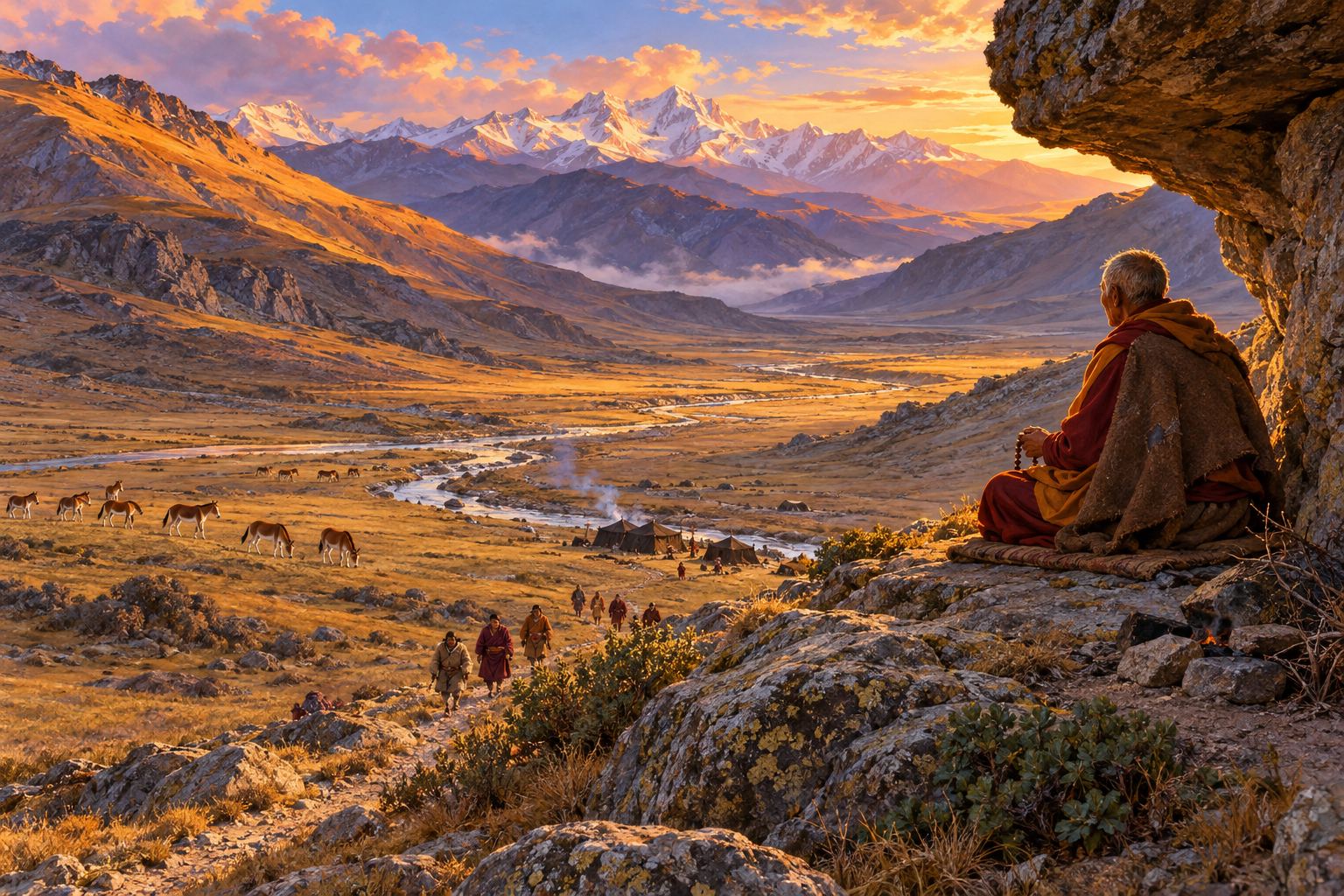
High in the nomad country of eastern Tibet there is a long, bare valley called Trama Lung. Herds of kiang, the chestnut-coated wild asses of the Tibetan plateau, graze the uplands of this country. For some twenty years, a hermit lived on one of its windswept slopes, with no house at all.
His name was Jigme Gyalwe Nyugu. Among the great teachers of his time he is remembered for one quiet gift: the teaching that his student Patrul Rinpoche wrote down as The Words of My Perfect Teacher, a book that has carried his voice to readers all over the world.
A boy of Dzachukha
He was born in 1765 in Dzachukha, the high grassland along the Dza river in Kham, eastern Tibet, into the Getse clan. His parents, Orgyen Tashi and Tashi Kyi, named him Pema Kunzang. The Treasury of Lives gives his death as 1842; Rigpa Wiki and others give 1843. Both agree he lived to seventy-nine by Tibetan reckoning.
Rigpa Wiki says that even as a child he longed to go off to solitary places and meditate. At fourteen he went on pilgrimage to Lhasa, and back home a local lama, the Second Getse, taught him a Dzogchen practice. Dzogchen, "great perfection," is the Nyingma school's teaching on the open, aware nature of mind.
But his father and several brothers had died, and the family needed him. He travelled on business with his elder brother. Rigpa Wiki says the cheating and lying he saw on the road filled him with weariness of samsara, the endless round of ordinary life. At seventeen he tried to slip away from a pilgrimage party to become a religious, and was brought home.
Then his elder brother died, and the pressure to marry and run the household grew. According to the Treasury of Lives, it was his mother who set him free. She told him that if he stayed he would never escape his duties. She gave him a piece of silver, some tea and food, and sent him off in secret.
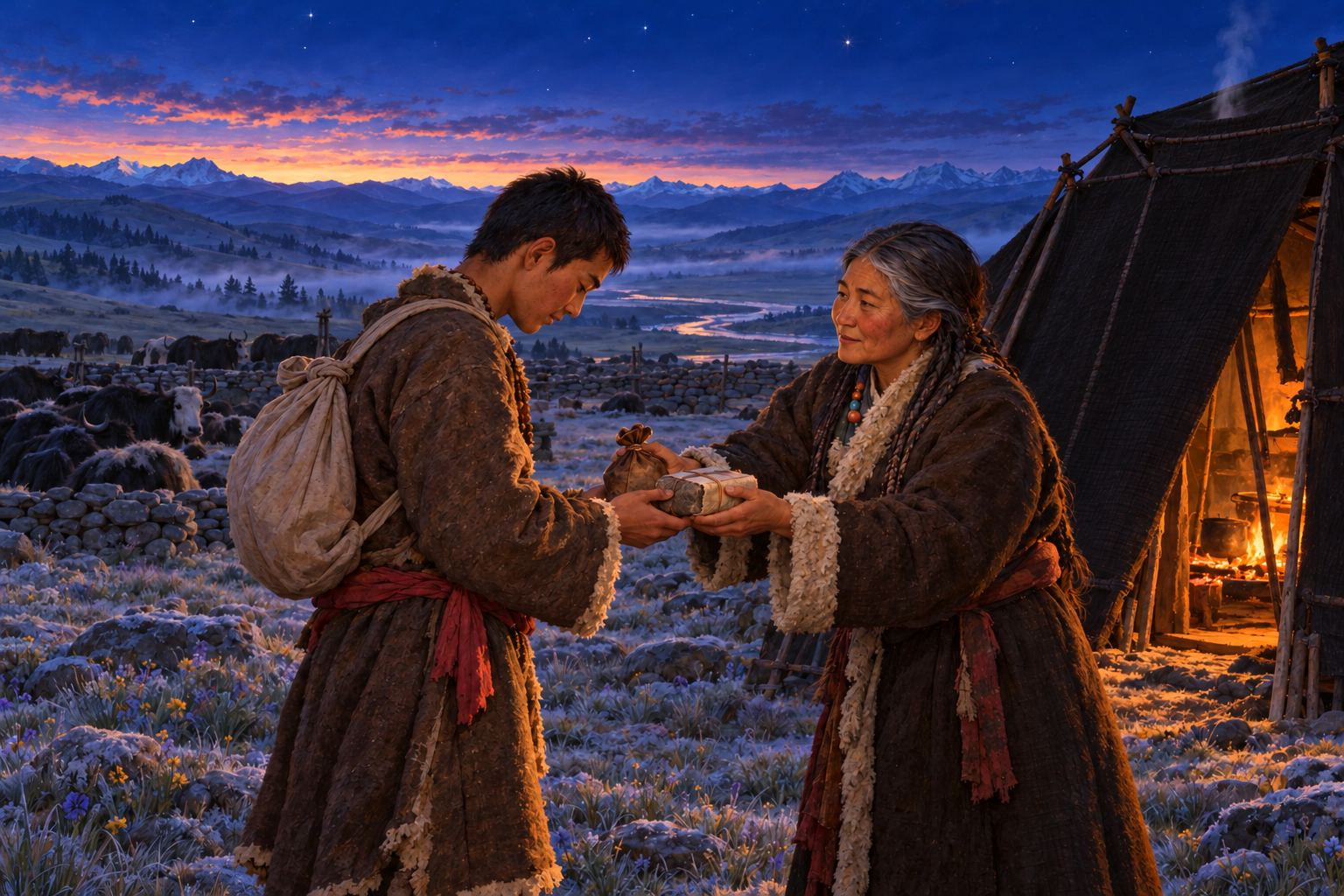
The road west
He went first to Dzogchen Monastery and met its head, the Third Dzogchen Rinpoche. There he gained a travelling companion, a young practitioner called Barchung Gomchung Rigdzin, and the two set off on the long walk to central Tibet.
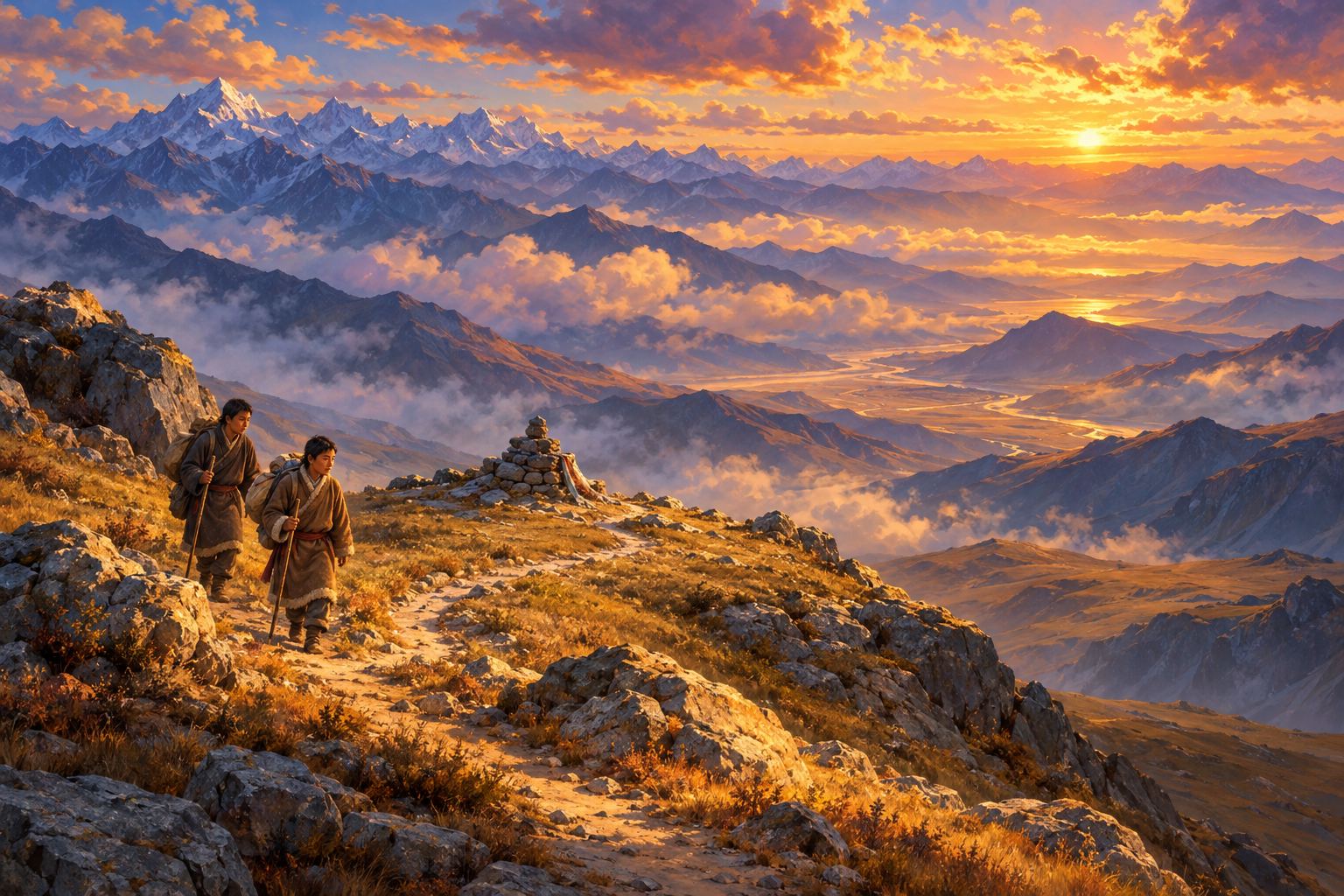
In Lhasa a thief dressed as a monk offered to change their piece of silver into coins, and vanished with it. It was all the money they had. The Treasury of Lives says the young man took it calmly: their own lack of merit, he said, simply meant they could not use it for their practice.
At Samye, the first monastery of Tibet, they met the First Dodrupchen, a disciple of the great master Jigme Lingpa whom Barchung already knew. Dodrupchen invited them to practise with him, but first he sent them to his own teacher, with a letter of introduction.
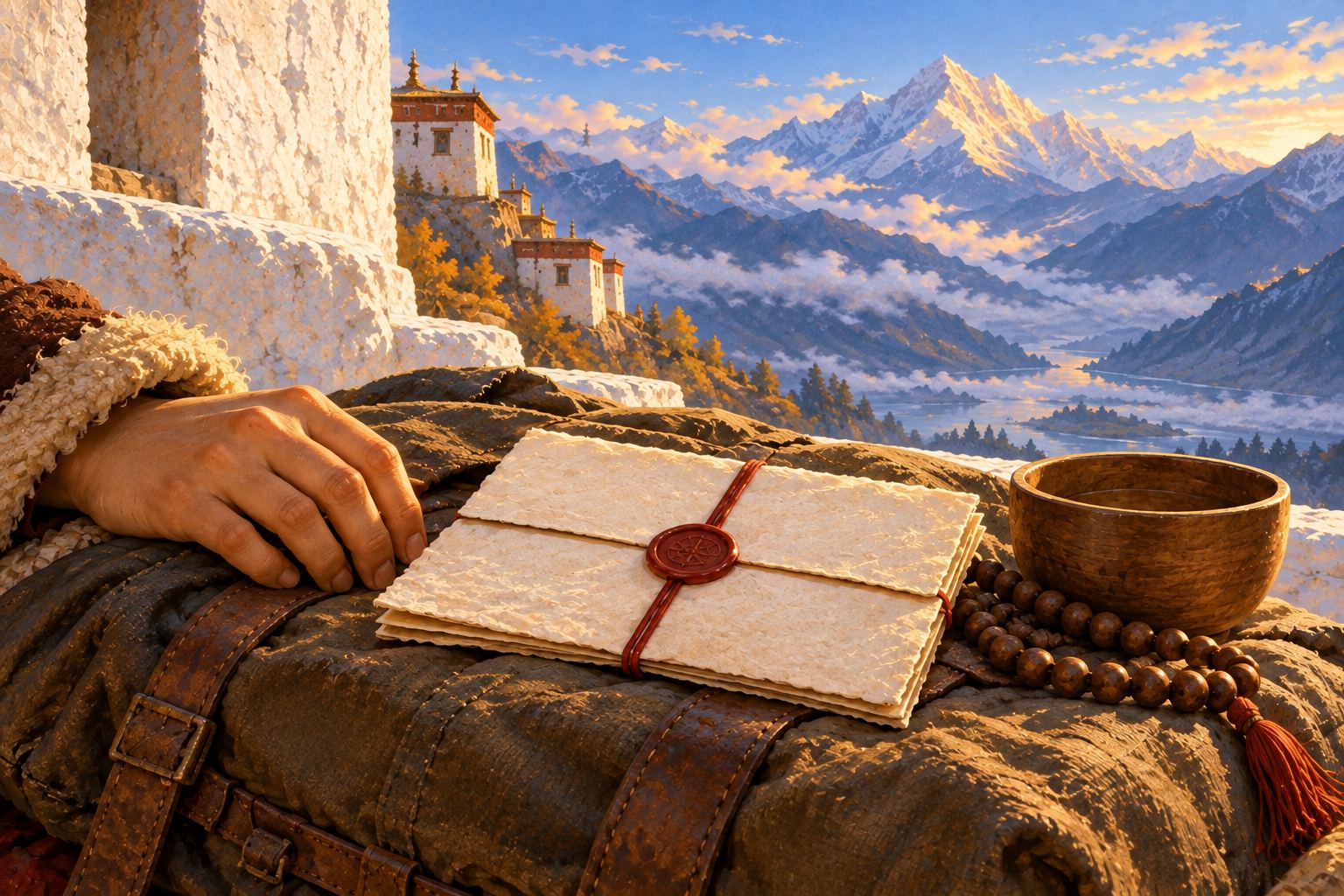
Meeting Jigme Lingpa
Jigme Lingpa (1730–1798) lived at Tsering Jong, a small hermitage in the Chongye valley. He had revealed the Longchen Nyingtik, "the Heart Essence of the Vast Expanse," a cycle of teachings that this site tells in the story of Jigme Lingpa.
When the young man from Dzachukha first saw him, the Treasury of Lives says, he felt that every prayer he had ever made had been answered, and he was flooded with joy and gratitude. Teaching began that very day.
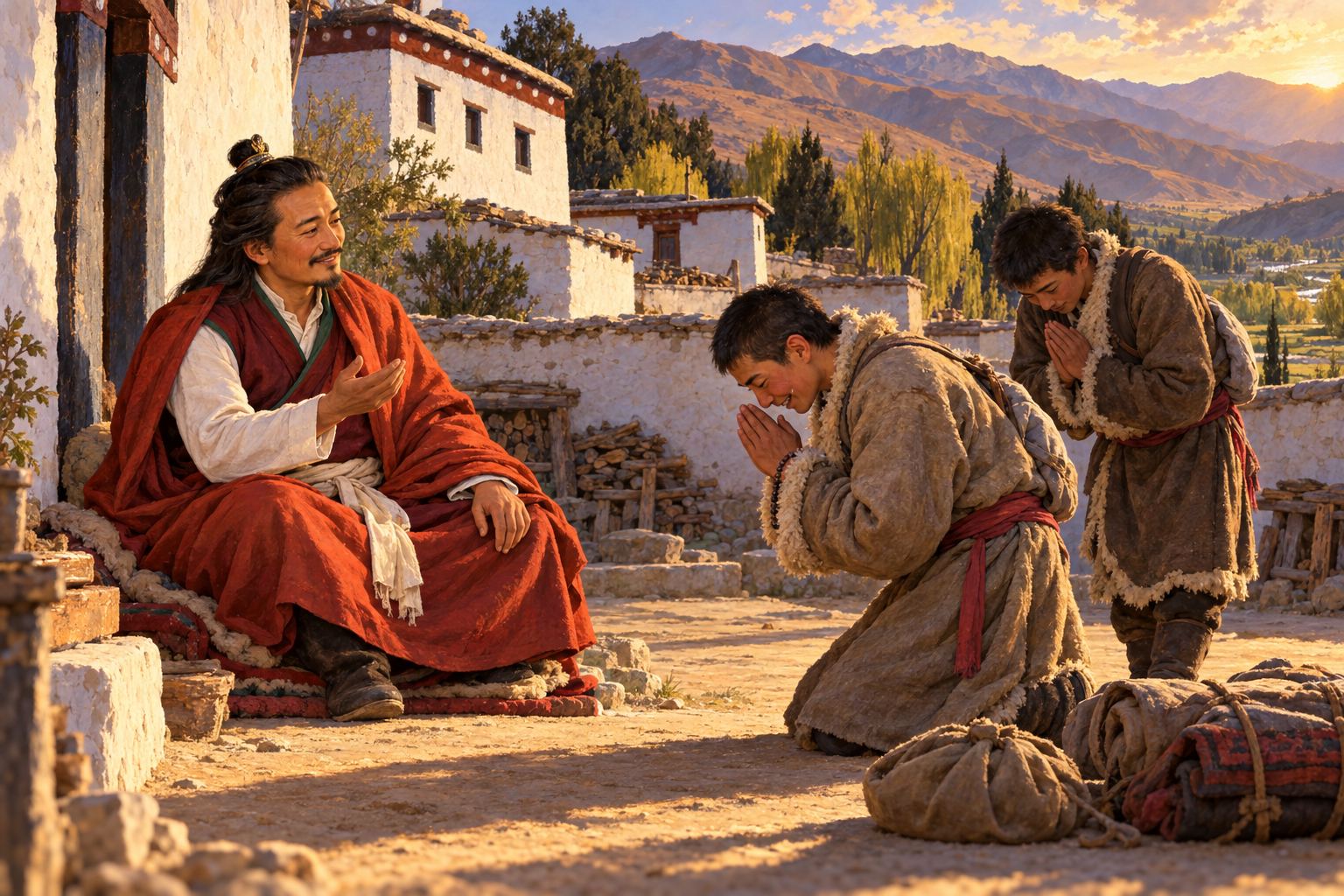
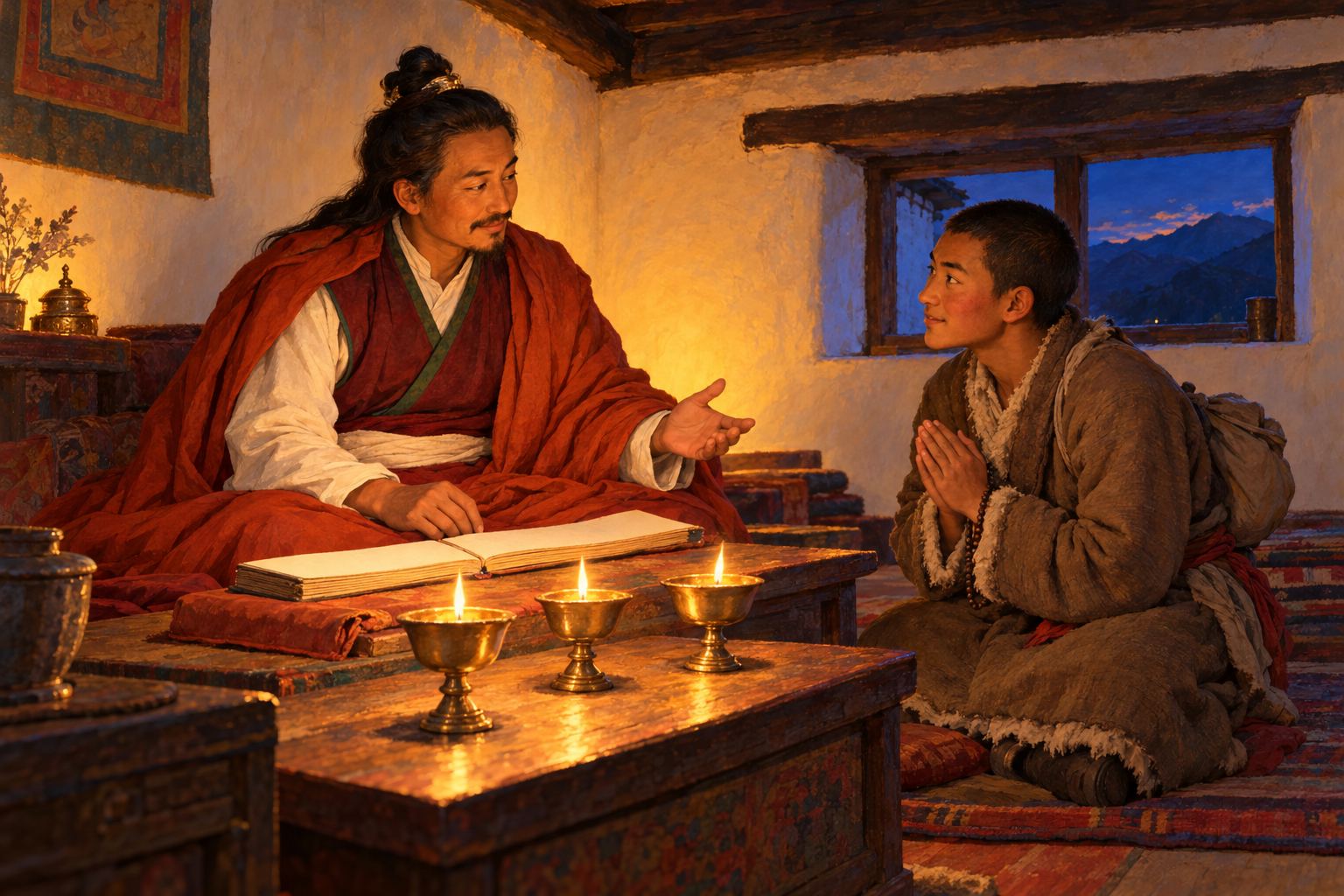
Jigme Lingpa gave him empowerments, the formal ceremonies that open a practice, including that of the Longchen Nyingtik's guru yoga, along with instructions and his own great work on the Nyingma path. He also gave his new student the name he was known by ever after: Jigme Gyalwe Nyugu. Jigme means "fearless," and gyalwe nyugu, "sprout of the Victorious Ones," is a way of speaking of a young bodhisattva, a child of the buddhas.
The sacred mountain
For several years he stayed in central Tibet, serving Dodrupchen as his attendant and sitting long retreats. On Jigme Lingpa's advice he went to Tsari, a sacred mountain of forests and snow passes in the south-east, and walked its hard pilgrimage circuit.
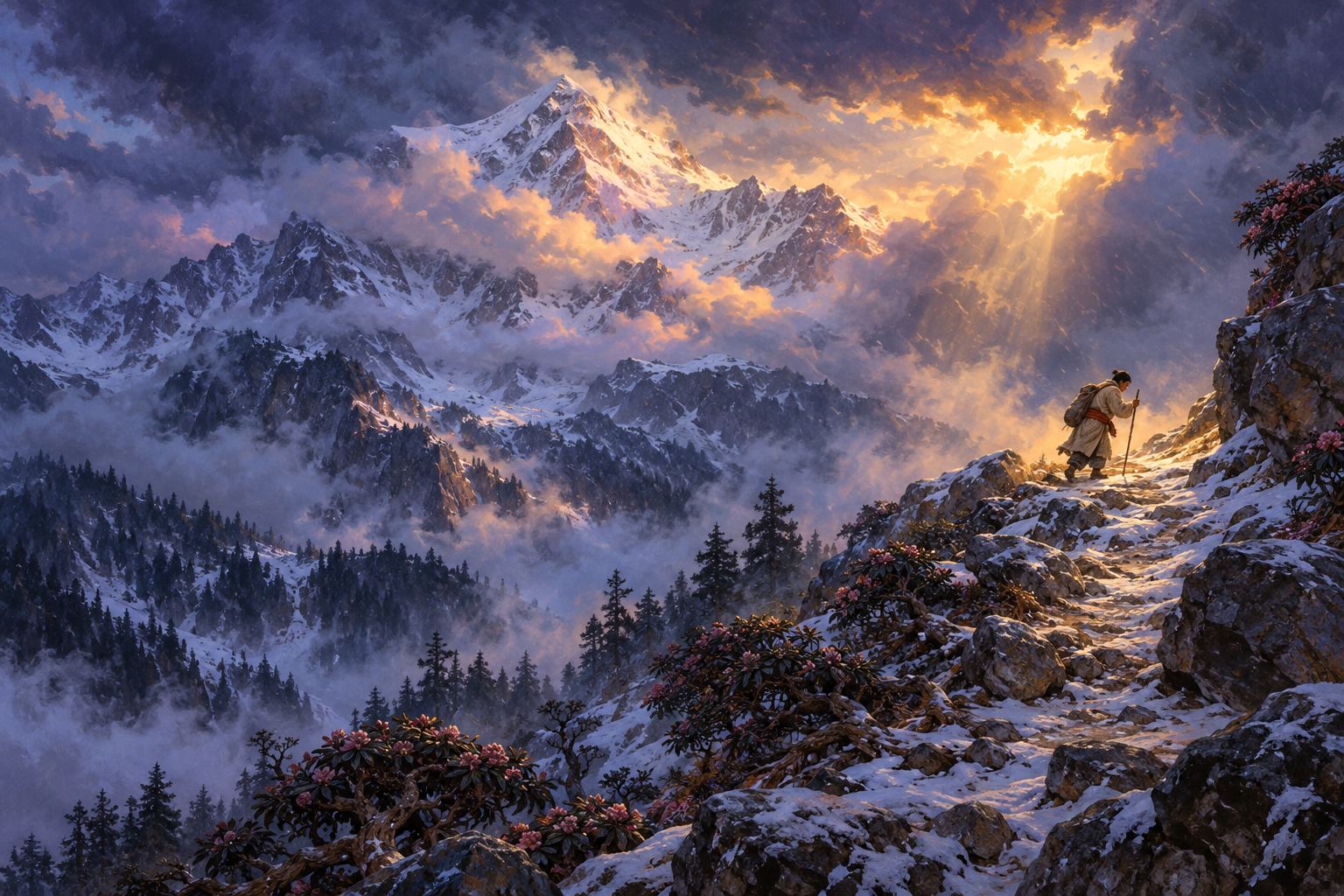
Then he stayed on the mountain in retreat. The Treasury of Lives speaks of a difficult nine months; Rigpa Wiki says six. Rigpa Wiki adds that through all the hardship he was held up by the memory of his teacher, and that in this retreat, through the blessing of the lama, he realized the ultimate nature of mind.
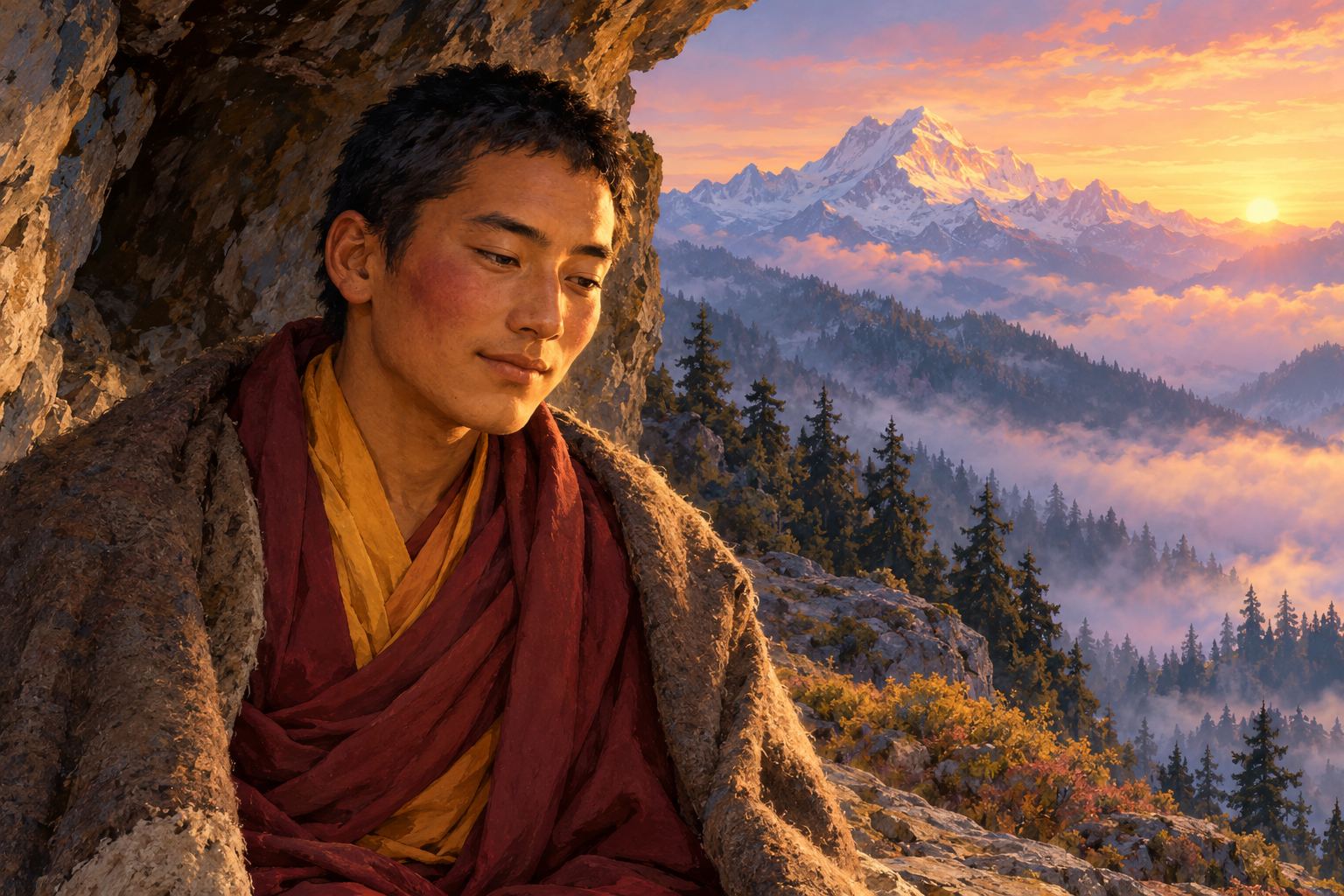
Around 1795 he went back once more to Tsering Jong. Jigme Lingpa asked him to stay for three years. He explained honestly that he had duties at home in Kham. So Jigme Lingpa advised him to stay in retreat as much as he could, and to teach whoever came to him.
The hermit of Trama Lung
Back in eastern Tibet he kept that advice. He sat retreats in the caves above Dzogchen Monastery and a three-year retreat at Getse, and helped Dodrupchen raise a new monastery. With Dodrupchen he founded Dzagyal Monastery in Dzachukha, which later became his seat and Patrul's.
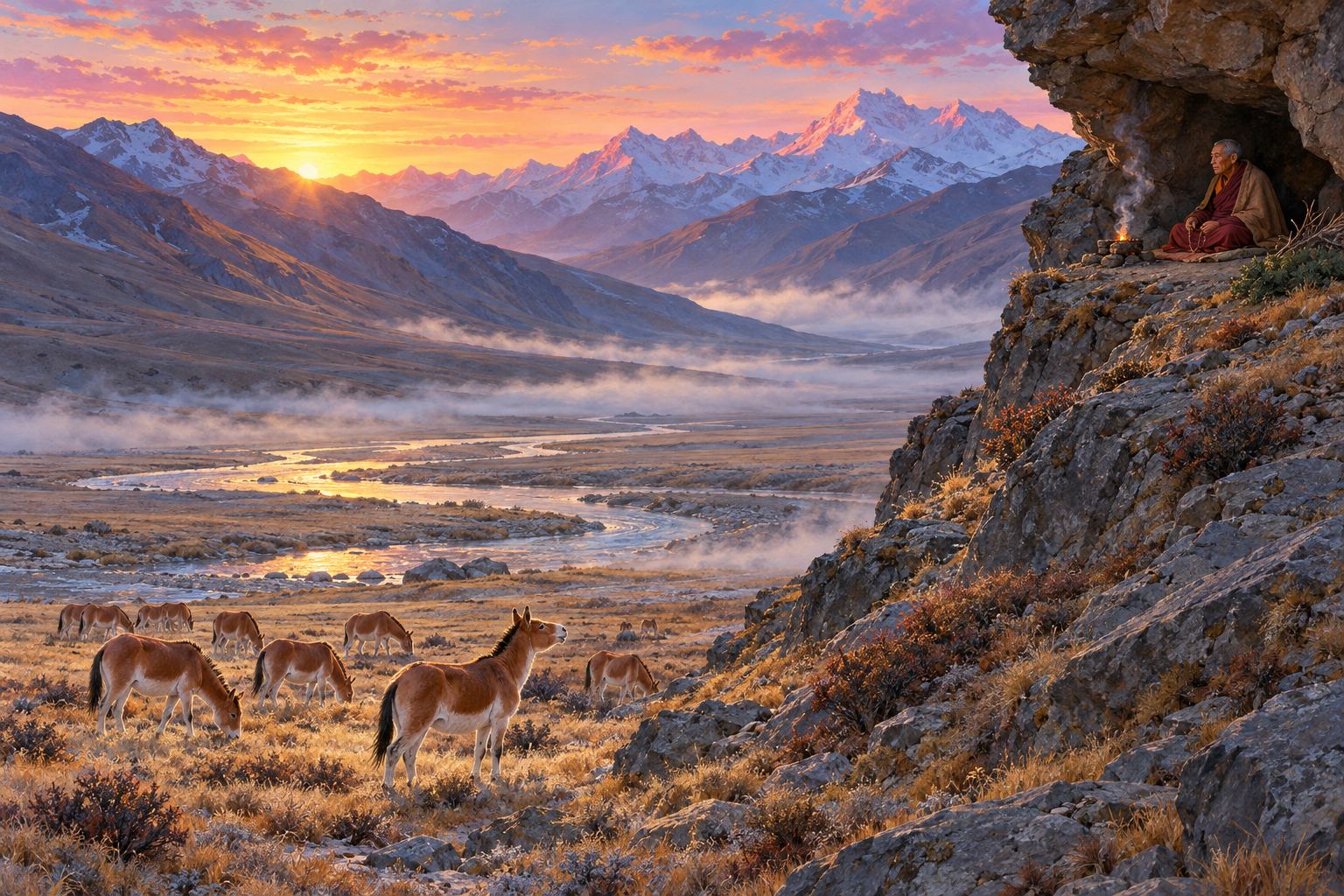
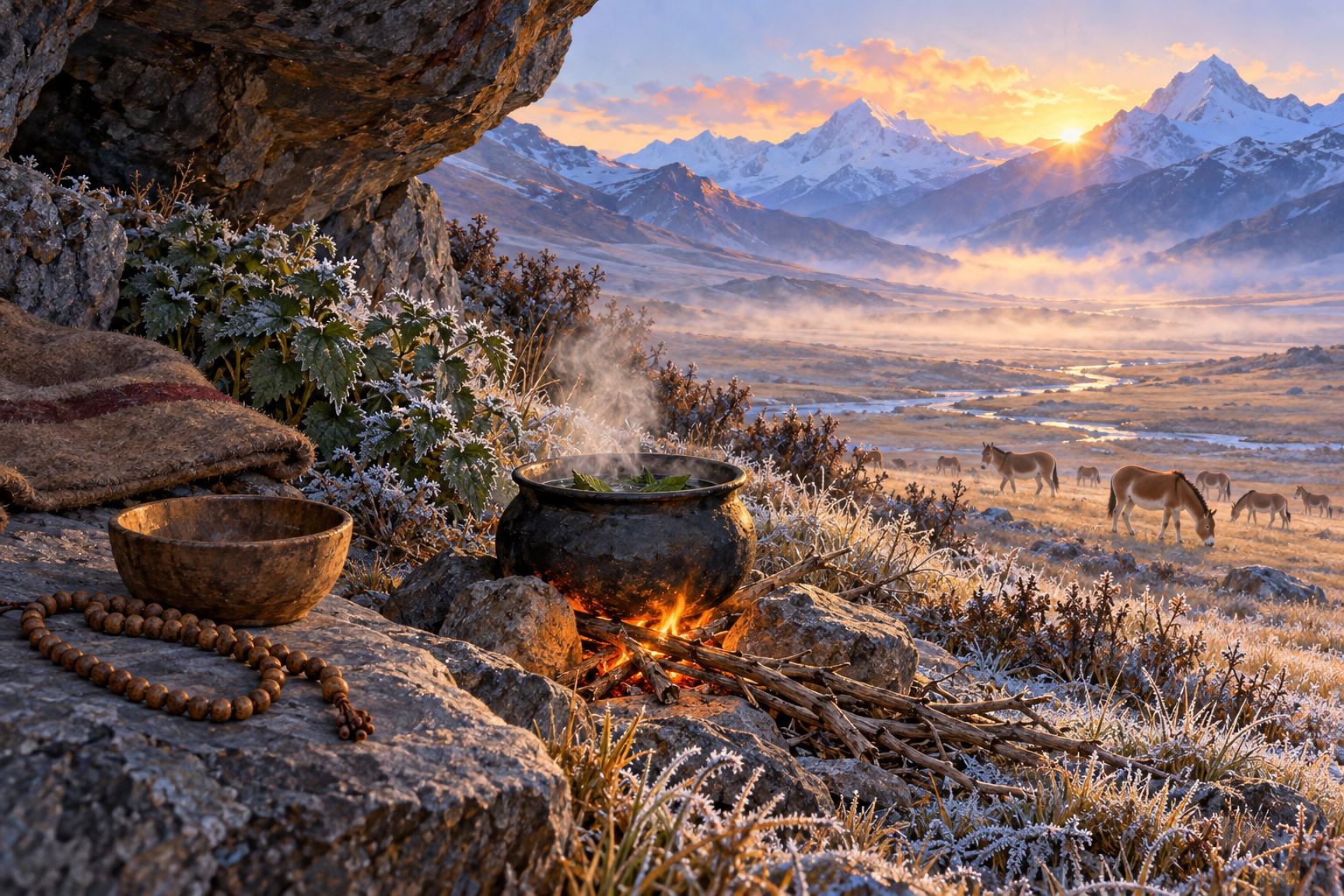
Then he went up into Trama Lung. Matthieu Ricard, in Enlightened Vagabond, understands the name as a valley of dry twigs. Ricard writes that he took no cave or hut but lived in the open, under a natural overhang or in a shallow hollow in the ground. He vowed not to leave until he had reached realization.
He ate wild plants and roots. Many retellings say his main food was nettles, the same humble plant remembered from the life of Milarepa. The older accounts behind this page speak only of wild plants, so take the nettles as the way the story is often told. The Treasury of Lives says people came to call him the "Hermit of Dzachuka."
A teacher in the open
In time students found their way up the valley and pitched their tents below his slope. As Jigme Lingpa had asked, he taught all who came sincerely. Even as a respected master, he kept receiving teachings himself, among others from Do Khyentse Yeshe Dorje, a wild yogi thirty-five years younger than he was.
One of those students was a boy from his own country, the young Palge Tulku, later called Patrul Rinpoche. Ricard writes that they first met at the boy's enthronement, and that the old hermit came down often to teach him. He told an old disciple, "When I come to Upper Dza, it's only for the sake of the Palge Tulku" (Ricard's translation).
What he taught again and again was the ngöndro, the preliminary practices of the Longchen Nyingtik. They begin with four reflections that turn the mind: on the rare chance of a human life, on impermanence, on the suffering of samsara, and on cause and effect. Then come taking refuge, arousing bodhichitta (the wish to awaken for the sake of all beings), the purification of Vajrasattva, the mandala offering, the offering called kusali, and guru yoga.
These are practices to receive from a qualified teacher, and this page does not describe how they are done. The Find a Teacher page can help.
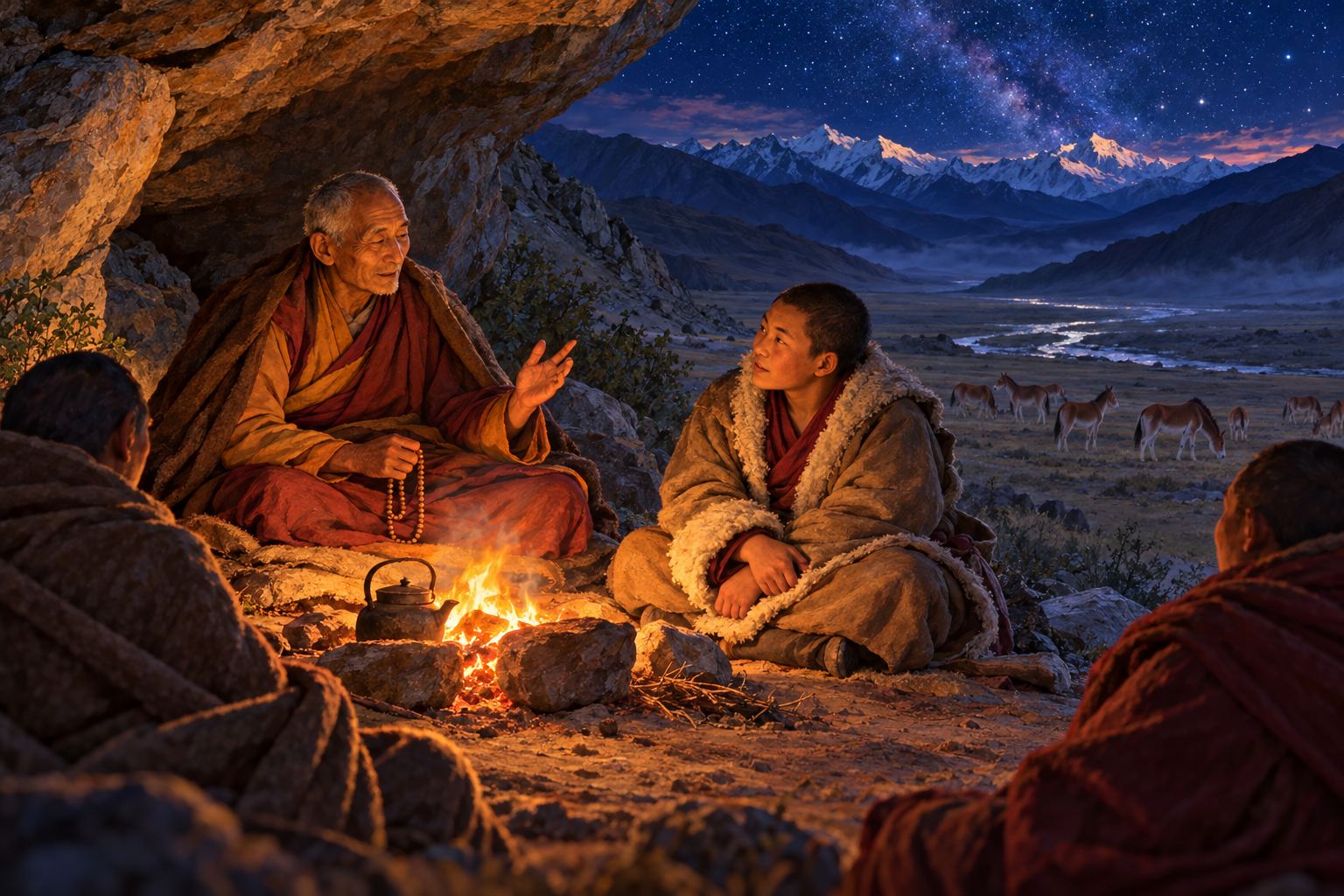
Patrul listened to his teacher explain them, by the usual count, twenty-five times. Then, years later, in a small cave above Dzogchen Monastery, he wrote them down as Kunzang Lamé Shelung, "the oral instruction of my all-good teacher," known in English as The Words of My Perfect Teacher. Rigpa Wiki calls it a faithful record of what Jigme Gyalwe Nyugu taught.
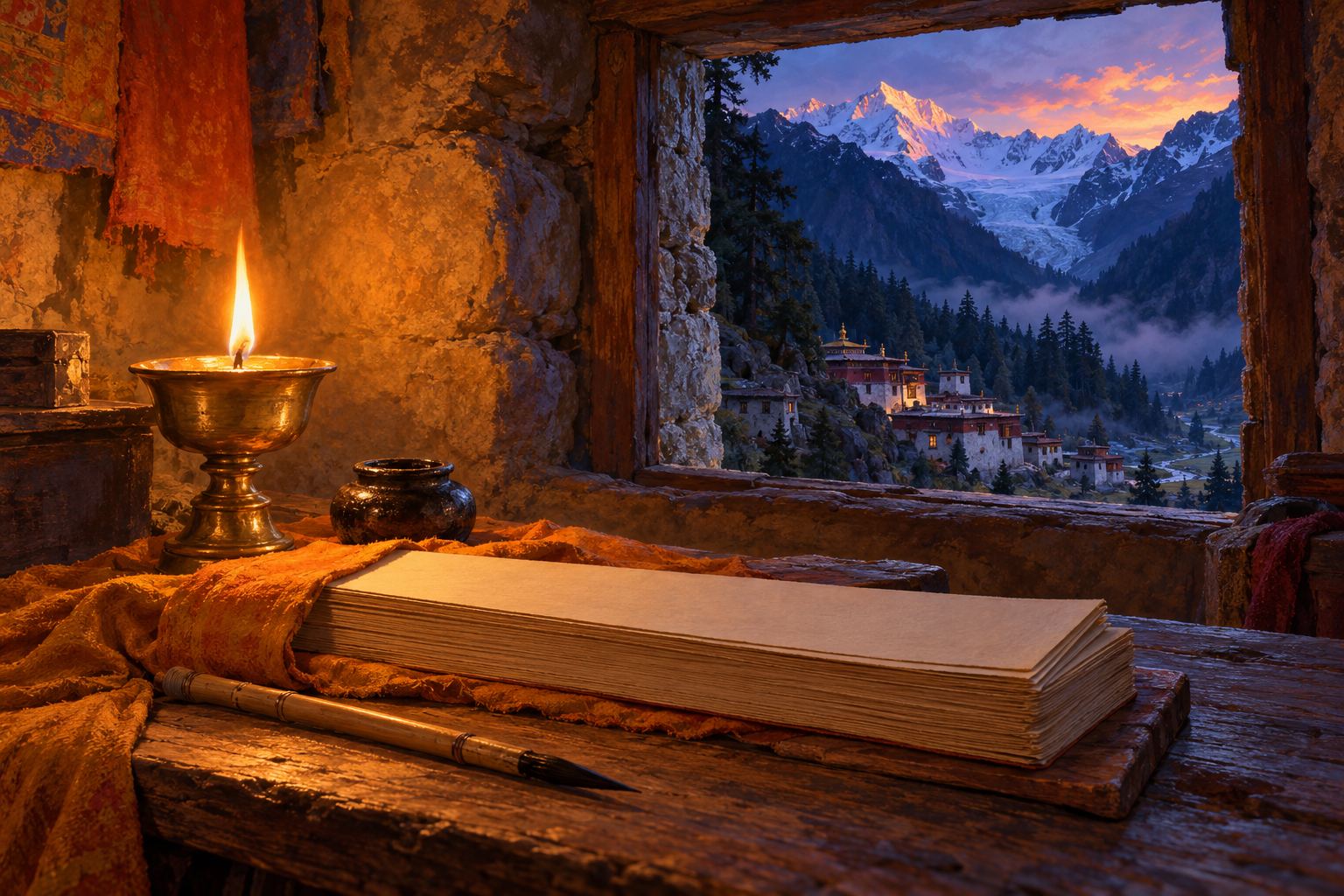
That is why its pages sound like a person talking: full of nomad life, plain examples and gentle humour. The book that so many people read today is, in a real sense, the voice of the hermit of Trama Lung, carried down the valley by his student. Its guru yoga, as Patrul's own story on this site tells, is where the Seven-Line Prayer is recited.
Leaving the valley
Jigme Gyalwe Nyugu died in 1842 or 1843, at seventy-nine. Rigpa Wiki and the Treasury of Lives name among his students Patrul, Jamyang Khyentse Wangpo and Gyalse Shenpen Thaye, the founder of Dzogchen's monastic college. The Fourth Dzogchen Rinpoche recognized his rebirth.
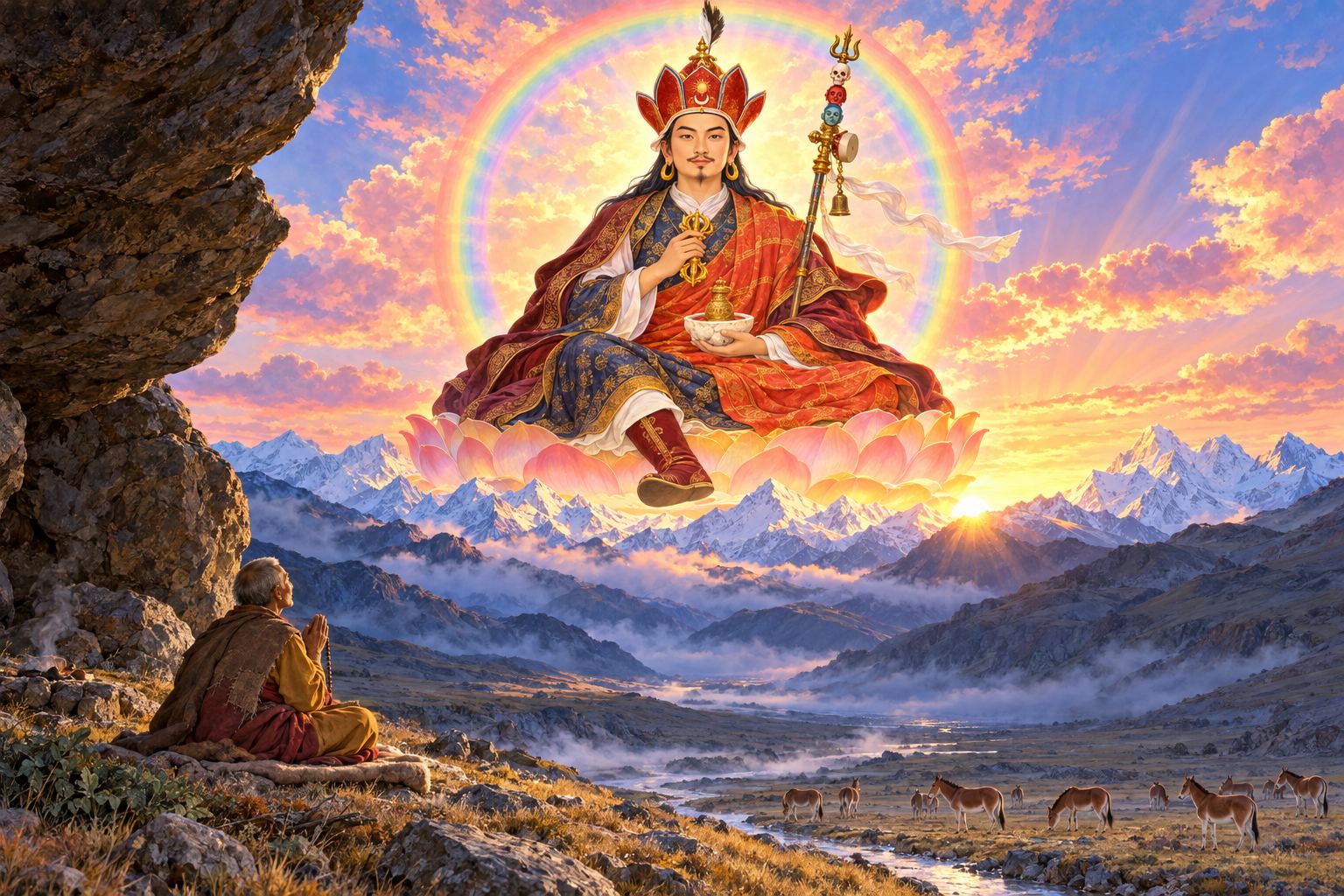
The third line of the Seven-Line Prayer remembers that Guru Rinpoche gained the supreme accomplishment. In the Nyingma tradition, that same accomplishment is what a practitioner like Jigme Gyalwe Nyugu sought, with very little to eat, under a rock, for years, held up, the sources say, by love for his teacher.
About the art
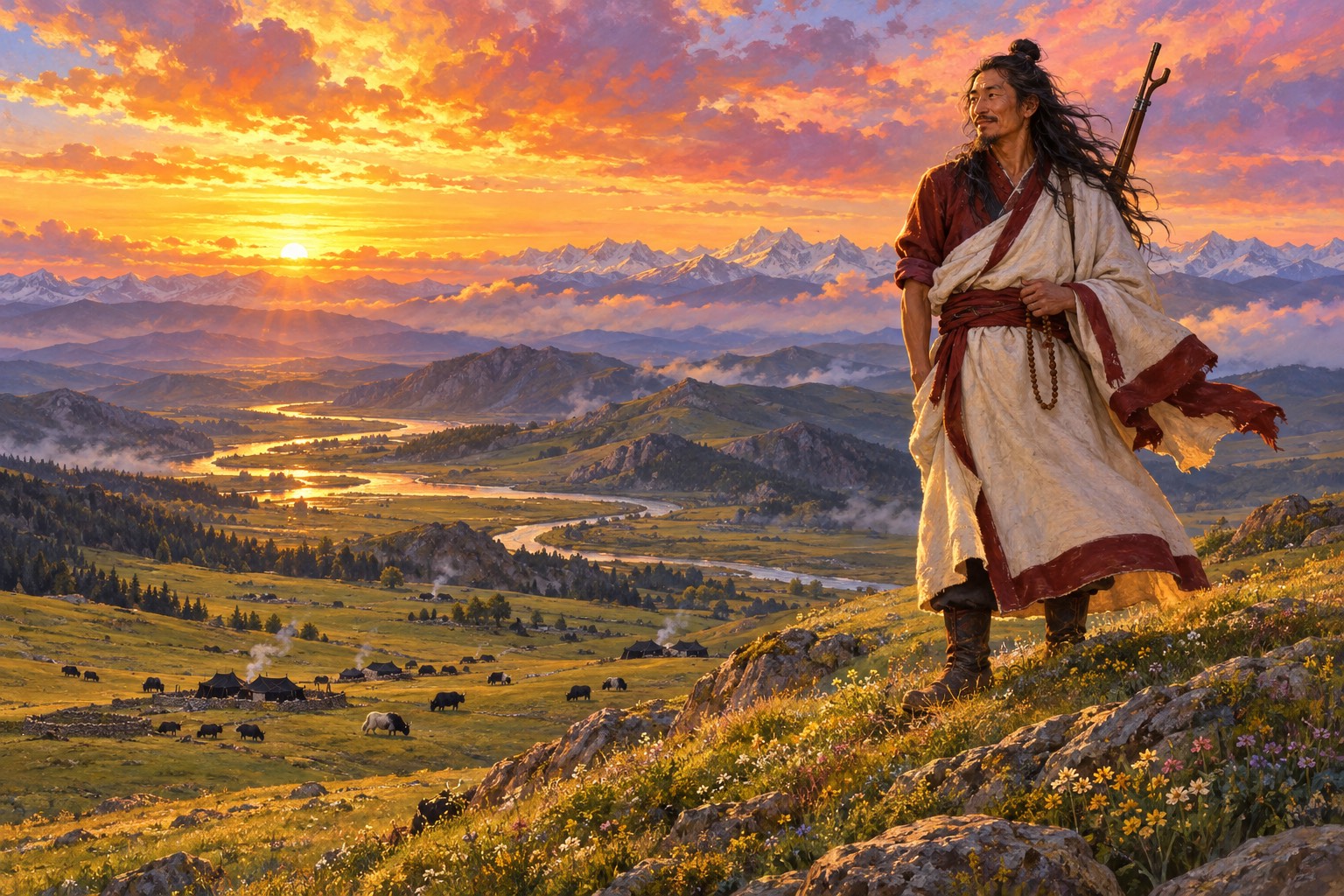
Jigme Gyalwe Nyugu appears twice: as a young man in a nomad's sheepskin coat, and as the old hermit in faded maroon and saffron robes with a brown felt cloak. His face follows the gentle, calm portrait on Lotsawa House, but he is shown without the gold-patterned brocade of that painting, because he lived in the open. He has no hat and no halo: he is drawn as an ordinary-looking practitioner, as the Nyingma tradition remembers him.
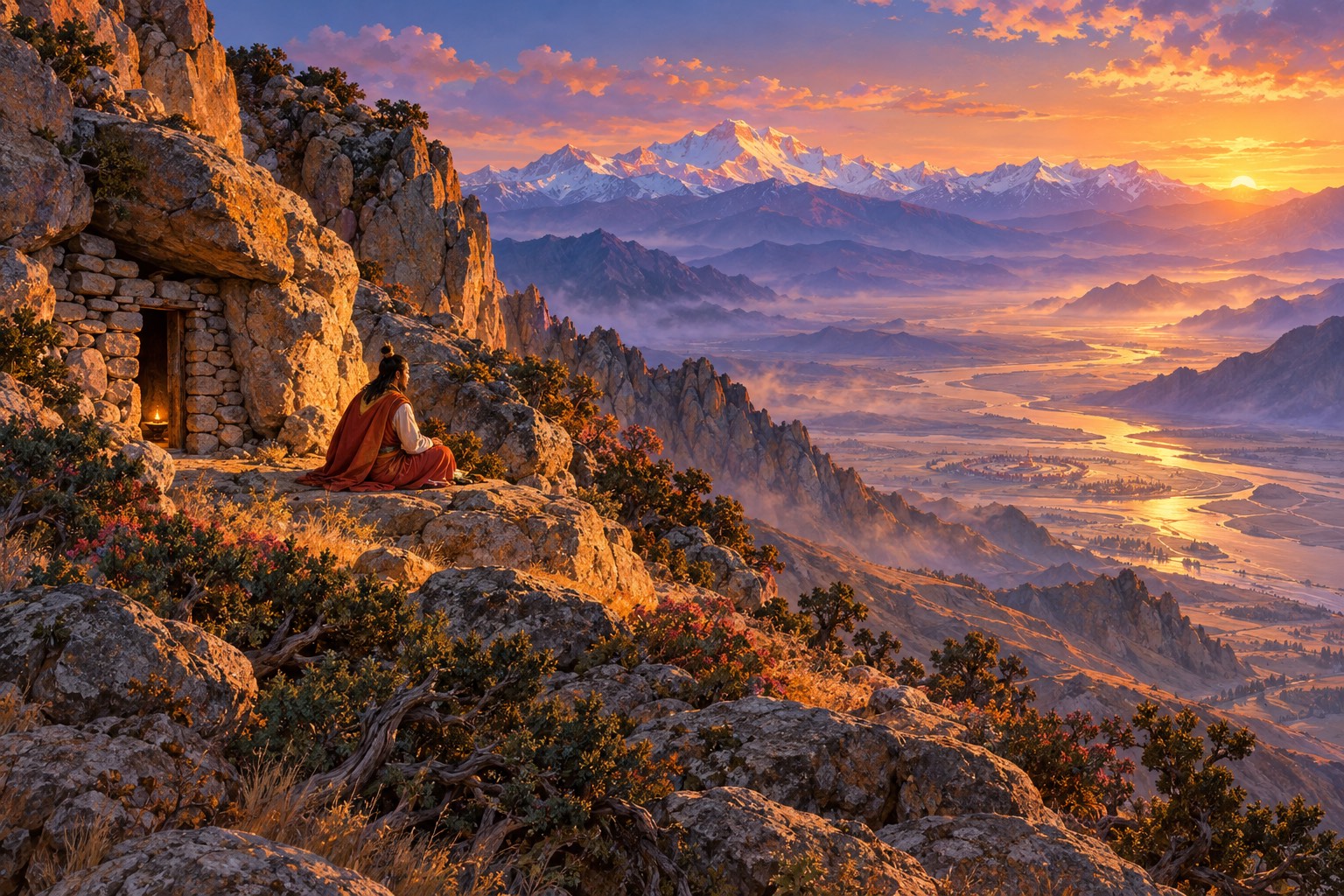
Jigme Lingpa wears his hair long and tied in a topknot, with a red-orange meditation cloak, because he lived as a lay yogi rather than a monk. The lamplit teaching scene illustrates the days of instruction in which he gave his student a new name; the sources do not describe the room or the moment.
The kiang are Tibetan wild asses, chestnut above and white below, with a dark stripe down the back. They live on the high grasslands of the Tibetan plateau. The nettles at the foot of the rock follow the way the story is often retold; the sources say only wild plants.
Books in Tibet are long, narrow, loose-leaf stacks of pages wrapped in cloth. Every page shown here is blank on purpose, since this site never places script in its images. Butter lamps are brass chalices with a single upright flame.
In the closing image Guru Rinpoche appears in his main form: the lotus hat with a half-vajra and a vulture feather, a five-pronged vajra in the right hand, a skull cup in the left, and the khatvanga staff in the crook of his left arm, seated within a sphere of rainbow light. It is a devotional picture of the prayer, not a vision recorded in Jigme Gyalwe Nyugu's life.
Why this matters for practice
The Seven-Line Prayer remembers that Guru Rinpoche attained the supreme accomplishment, and asks that we may follow him. Jigme Gyalwe Nyugu's life shows what that following looked like for one person: years of hardship held up by love for his teacher, and then a lifetime of teaching whoever came. Every time someone opens The Words of My Perfect Teacher, or recites the prayer in its guru yoga, his patient voice is still part of it.

If something in this story moved you, you might pause tonight and recite the prayer once, with whatever you have, wherever you are. A hermit with a felt mat and a handful of wild greens had no more than that.
Sources and further reading
- Jigme Gyelwai Nyugu, by Jakob Leschly (2007), Treasury of Lives (Internet Archive snapshot, December 2012)
- Jikme Gyalwe Nyugu, Rigpa Wiki (Internet Archive snapshot, December 2025)
- The Words of My Perfect Teacher, Rigpa Wiki (Internet Archive snapshot, January 2026)
- Dzagyal Monastery, Rigpa Wiki (Internet Archive snapshot, July 2025)
- Jigme Gyalwé Nyugu Series (author page), Lotsawa House
- Enlightened Vagabond: The Life and Teachings of Patrul Rinpoche, by Matthieu Ricard (Shambhala, 2017), Rangjung Yeshe Wiki, chapter 'Patrul's Root Guru' (Internet Archive snapshot, September 2021)
- Jigme Gyalwe Nyuku, Rangjung Yeshe Wiki (Internet Archive snapshot, December 2025)
- Jigme Gyalwai Nyugu, Encyclopedia of Buddhism
- Teacher: Jigme Lingpa (set 705) and Longchen Nyingtig Main Page (set 2504), Himalayan Art Resources
- Kiang, Wikipedia
- A Marvelous Garland of Rare Gems, by Nyoshul Khenpo (Padma Publishing, 2005), pp. 216–222, Book
- Masters of Meditation and Miracles, by Tulku Thondup (Shambhala, 1996), pp. 163–172, Book
This retelling is waiting to be read by a knowledgeable practitioner. Where the traditional accounts differ, the story says so; if you notice a mistake, please tell us through Share Your Story.