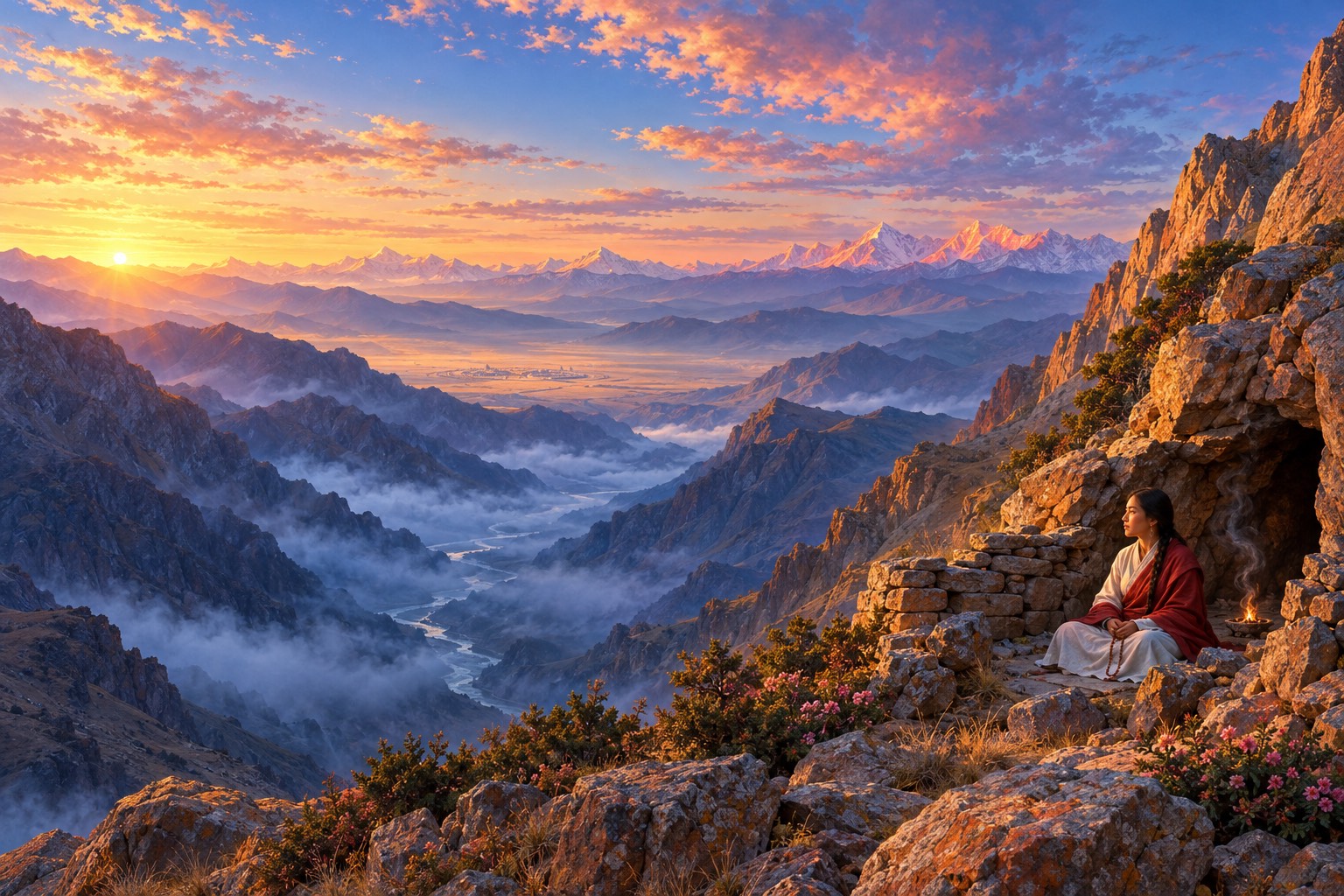
A short way north-east of Lhasa, a narrow side valley climbs away from the Kyichu river. Near its head stands a tall cliff of pale limestone, pitted with caves like the cells of a honeycomb. This is Drak Yerpa, the Rock of Yerpa.
Rigpa Wiki counts more than eighty caves. Nekhor, a pilgrimage guide to Guru Rinpoche's sacred places, speaks of a hundred and eight, the sacred number. For well over a thousand years people have climbed to them for one simple reason: to sit still and practise.
The tradition remembers many who came: a king, a master from Oddiyana, the woman who became his greatest disciple, and a teacher from Bengal. This is their story, told as the tradition tells it.
A king in the Dharma King's Cave
The oldest stories begin before Guru Rinpoche, with Songtsen Gampo, the seventh-century king remembered as the first of Tibet's three Dharma Kings. These were rulers who welcomed the Dharma, the Buddha's teaching. Tibetans regard him as an emanation of Avalokiteshvara, the bodhisattva of compassion.
Nekhor tells it this way. Troubles were spreading through the land, which the king understood as the work of hostile spirits. In a vision he saw Yerpa as the place from which they could be calmed. He went there with his queens and found the rock already marked with images and letters that had arisen by themselves, and old juniper trees all around, where the local spirits made their home.
The king, the account says, spent long stretches in a cave still called the Chögyal Puk, the Dharma King's Cave. There he deepened his practice and cleared away the obstacles to his great temple in Lhasa, the Trulnang, which most people now know as the Jokhang.
 Illustration in preparation
The tellings differ about who was with him. Nekhor names his Nepali and Chinese queens, Bhrikuti and Wencheng. Wikipedia, drawing on later histories, says it was his Tibetan queen, Mongza Tricham, who founded the first temple here, and the same histories add that King Trisong Detsen built at Yerpa a century later.
An old chronicle, The Clear Mirror, as quoted on Wikipedia, places a shrine for that queen and her son "upon the lap of a rocky mountain" shaped like Tara, the female buddha of swift compassion. The likeness has never been forgotten. Pilgrims are still shown how the whole cliff resembles Tara seated with one leg extended, with a cave at each breast: the Auspicious Cave on one side and the Moon Cave on the other.
Illustration in preparationSeven months in the Moon Cave
In the eighth century, while Samye, Tibet's first monastery, was being built, Guru Rinpoche came to Yerpa. Guru Rinpoche, Padmasambhava, the Lotus-Born, is the master to whom the Seven-Line Prayer is addressed.
Nekhor tells that the cave he chose, the Dawa Puk or Moon Cave, was small at first. He thrust his khatvanga, the slender trident-topped staff he carries, into its centre, and three chambers opened in the rock. This is the tradition's account of a wonder, and pilgrims still point to the opening where, they say, he first opened the cave.
Illustration in preparationThere, the accounts agree, he stayed in retreat for seven months. A retreat is a time set apart for meditation, away from ordinary business. The tradition says that when he rose, the shape of his body remained in the stone.
Illustration in preparationBefore he left, Nekhor's account continues, he made a small likeness of himself, the kind of image called a kutsap, a "representative." He blessed it and set it on the shrine as the cave's main sacred object, and it was said that simply seeing it could bring liberation.
He also hid treasures there, the accounts say. These are terma, teachings concealed for people of later times to find. The twentieth-century master Jamyang Khyentse Chökyi Lodrö, in a praise of Yerpa written in the Moon Cave, remembers both Guru Rinpoche and the abbot Shantarakshita hiding treasures in its cliffs and valleys.
Illustration in preparationIn later years, the same account says, Guru Rinpoche often reminded his disciples how precious Yerpa was, and how quickly practice there could ripen into realization.
Yeshe Tsogyal and the eighty
He did not practise alone. Yeshe Tsogyal, the Tibetan woman who became his closest disciple and who, the tradition says, reached full awakening, also meditated here. Wikipedia says the two practised together at Yerpa.
The accounts name the caves a little differently. Nekhor places the Guru mainly in the Moon Cave. Rigpa Wiki says the caves of Guru Rinpoche and of Yeshe Tsogyal are at the very top of the cliff, and gives one of them the name Sang Puk, the Secret Cave.
Illustration in preparationOther disciples came too. Nekhor names the translator Vairotsana, Namkhai Nyingpo, Khön Lu'i Wangpo and Gyalwa Chokyang, and says they showed great signs of accomplishment through their practice here.
Above all, Yerpa is remembered for its eighty siddhas. A siddha is someone who has reached siddhi, the accomplishment that practice brings. Rigpa Wiki says these eighty disciples of the Guru meditated together in a great cave lower on the cliff, the Drubtop Puk, the Cave of the Siddhas.
Illustration in preparationHow highly does the tradition rank Yerpa? The lists differ. Nekhor, following a well-known scheme of five places, gives the role of the mind to Lhodrak Kharchu in southern Tibet, and instead calls Yerpa the equal of Drak Yangdzong, the place of his enlightened body. Wikipedia, citing a modern handbook, calls the Moon Cave one of his three most important places of attainment.
The lists do not agree, but they point the same way. Yerpa is held to be a place where his realization touched the rock, and where others could follow.
After the empire
In the ninth century the Tibetan empire ended in turmoil. Some accounts say the monk Lhalung Palgyi Dorje, remembered for bringing King Langdarma's persecution of the Dharma to an end, spent the rest of his life as a recluse in a Yerpa cave, and that his hat was kept here until 1959. Others say he went east to Amdo.
The teacher from Bengal
In the eleventh century came Atisha (982–1054), a great monk-scholar from Bengal who spent his last years teaching in Tibet. Wikipedia says he taught widely in the Yerpa valley, and a cave there carries the memory of his stay: the Tendrel Puk, the Cave of Auspicious Connection.
From Atisha's teaching grew the Kadam tradition, known for its gentle, step-by-step training of the heart. In his praise, Chökyi Lodrö calls Yerpa the lotus grove where the Kadam teachings first blossomed.
Illustration in preparationA thousand years of retreat
After Atisha, Yerpa became one of the great retreat places of central Tibet. Its Kadam hermitage passed in time to the Geluk school. Wikipedia records that in 1618, when fighting broke out in Lhasa, the teacher Khöntön Rinpoche withdrew to Yerpa until calm returned.
From at least the nineteenth century, about three hundred monks lived here, and Yerpa served as the summer home of one of Lhasa's tantric colleges. Masters of every school kept coming to its caves; a few of them appear in other stories on this site.
Illustration in preparationIn the twentieth century the master Jokyab Rinpoche (1903–1960) offered a short prayer in the Moon Cave. It honours three figures who opened the way of the Dharma in Tibet: Songtsen Gampo, Padmasambhava together with the eighty siddhas, and Atisha. In a few lines it holds the whole long life of this cliff.
Most of Yerpa's buildings were destroyed in the twentieth century. Some of the cave shrines have since been partly restored, and on the cliff today a few people still keep the lamps lit.
Illustration in preparationWhere accomplishment is remembered
The third line of the Seven-Line Prayer says that Guru Rinpoche attained the wondrous supreme accomplishment. At Yerpa the tradition remembers that accomplishment in a way you can almost touch: the seven months in the Moon Cave, the shape it says he left in the stone, and the eighty disciples who are said to have reached accomplishment in the caves around him.
In his praise, Chökyi Lodrö calls Yerpa the stake that holds the life force of the temple in Lhasa. Perhaps that is the gentlest way to see it: a quiet place in the hills, keeping the heart of a busy city alive.
The prayer's sixth line asks to follow in his footsteps. For centuries people did that here quite literally, climbing the same paths to sit in the same caves. Most of us will never go. The prayer can be said wherever we are.
Illustration in preparationAbout the art
Guru Rinpoche appears in his main, peaceful form: the lotus hat with a half-vajra and one vulture feather, layered robes in white, blue, red-orange and maroon, a golden five-pronged vajra at his heart, a skull cup holding a small long-life vase in his lap, and the khatvanga, a slender staff crowned with a trident, resting against his left shoulder. The vajra stands for what cannot be broken; the vase for long life. A soft rainbow glow marks him as an awakened being, and only him.
Yeshe Tsogyal is shown as a yogini in simple white robes and a dark red shawl, with a mala, the string of 108 beads used to count recitations. King Songtsen Gampo wears the small red face of the Buddha Amitabha at the peak of his turban, as in his traditional statues and paintings; it marks him as an emanation of Avalokiteshvara, the bodhisattva of compassion, who is traditionally shown with Amitabha, the buddha of his family, crowning his head. Atisha wears the tall pointed red hat of an Indian scholar-monk and saffron robes, with his travel bag beside him, as in Kadam portraits.
The early scenes show Yerpa as bare cliff and juniper valley, with no temples, flags or chortens; the whitewashed retreat huts belong to later centuries. The Tara likeness of the rock is only suggested, never drawn as a figure. The body imprint in the Moon Cave is told but not shown, and the small clay likeness on the shrine is painted simply. The present-day pilgrim appears only as a pair of hands. As everywhere on this site, no script, syllables or mantras appear in the pictures.
Why this matters for practice
The Seven-Line Prayer's third line says that Guru Rinpoche attained the wondrous supreme accomplishment. Yerpa is one of the places where the tradition remembers that accomplishment most concretely: seven months in a cave, and eighty disciples who are said to have reached accomplishment around him. Reciting the prayer is a small way of joining the long line of people who came to that cliff simply to sit, practise and turn their minds toward him.
If something in this story stayed with you, the king in his cave, the seven months of silence, or the lamps kept lit by those who came after, you might pause and recite the prayer once.
Sources and further reading
- Drak Yerpa, Rigpa Wiki (Internet Archive snapshot, February 2026)
- Drak Yerpa, Nekhor
- Drak Yangdzong and Lhodrak Kharchu, Nekhor
- Yerpa, Wikipedia
- Lhalung Pelgyi Dorje, Wikipedia
- Drumbeat of the Gods: In Praise of the Great Place of Yerpa, by Jamyang Khyentse Chökyi Lodrö, translated by Adam Pearcey (2022), Lotsawa House
- A Prayer to the Three Progenitors of the Teachings, by Jokyab Pema Trinlé Nyingpo, translated by Stefan Mang (Samye Translations, 2026), Lotsawa House
- Drak Yerpa Series, Lotsawa House
- The three Dharma Kings, item 774, notes by Jeff Watt, Himalayan Art Resources (Internet Archive snapshot, 2024)
This retelling is waiting to be read by a knowledgeable practitioner. Where the traditional accounts differ, the story says so; if you notice a mistake, please tell us through Share Your Story.