The Seven-Line Prayer opens by naming a land: Oddiyana, in the far north-west. It is remembered as the place where Guru Rinpoche was born on a lotus. It is also remembered as the homeland of another child, born, the tradition says, long before him. His name was Garab Dorje, and he is honoured as the first human teacher of the Great Perfection.
The Great Perfection, Dzogchen in Tibetan, is the Nyingma teaching that the mind's true nature is already pure and awake, and that the whole path is to recognize it. That one sentence is as far as this page will go. The practice itself is given by a qualified teacher, in person.
Garab Dorje's life reaches us as sacred history, told and retold by later masters. This page mainly follows The Jewel Rosary History by the fourteenth-century master Longchenpa, recently translated by Adam Pearcey, and says where other tellings differ.
A nun on an island
In Oddiyana, the account says, there lived a king named Uparaja and a queen whose name means Radiant Light. Their daughter, Sudharma, had become a Buddhist nun. She lived simply on an island, giving her days to practice. One summary of another translation says the island lay in Dhanakosha, the same lake where Guru Rinpoche would later be found on his lotus.
One night, the accounts say, she dreamed of a man white as crystal, who placed a precious vase on the crown of her head. Another telling has him set it there three times, with light shining out from it.

Ten months later, Longchenpa writes, she gave birth to a son. A nun with a child had no easy place in the world, and the account says plainly that she was ashamed and hid the baby in a pit of ash.
Then she saw what the tradition remembers: dakinis, gods and nagas coming down from the sky to make offerings to the boy. Dakinis are female beings of wisdom; nagas are spirits of the waters. She asked his forgiveness, took him back and raised him herself. She gave him a name meaning "Bhava the Resurrected", and the dakinis, it is said, called him the Ashen One.

It is a hard beginning, and the tradition does not hide it. Perhaps that is part of its tenderness. The first teacher of the Great Perfection is remembered as a child who was once hidden away, and then taken back into his mother's arms.
The boy who answered the scholars
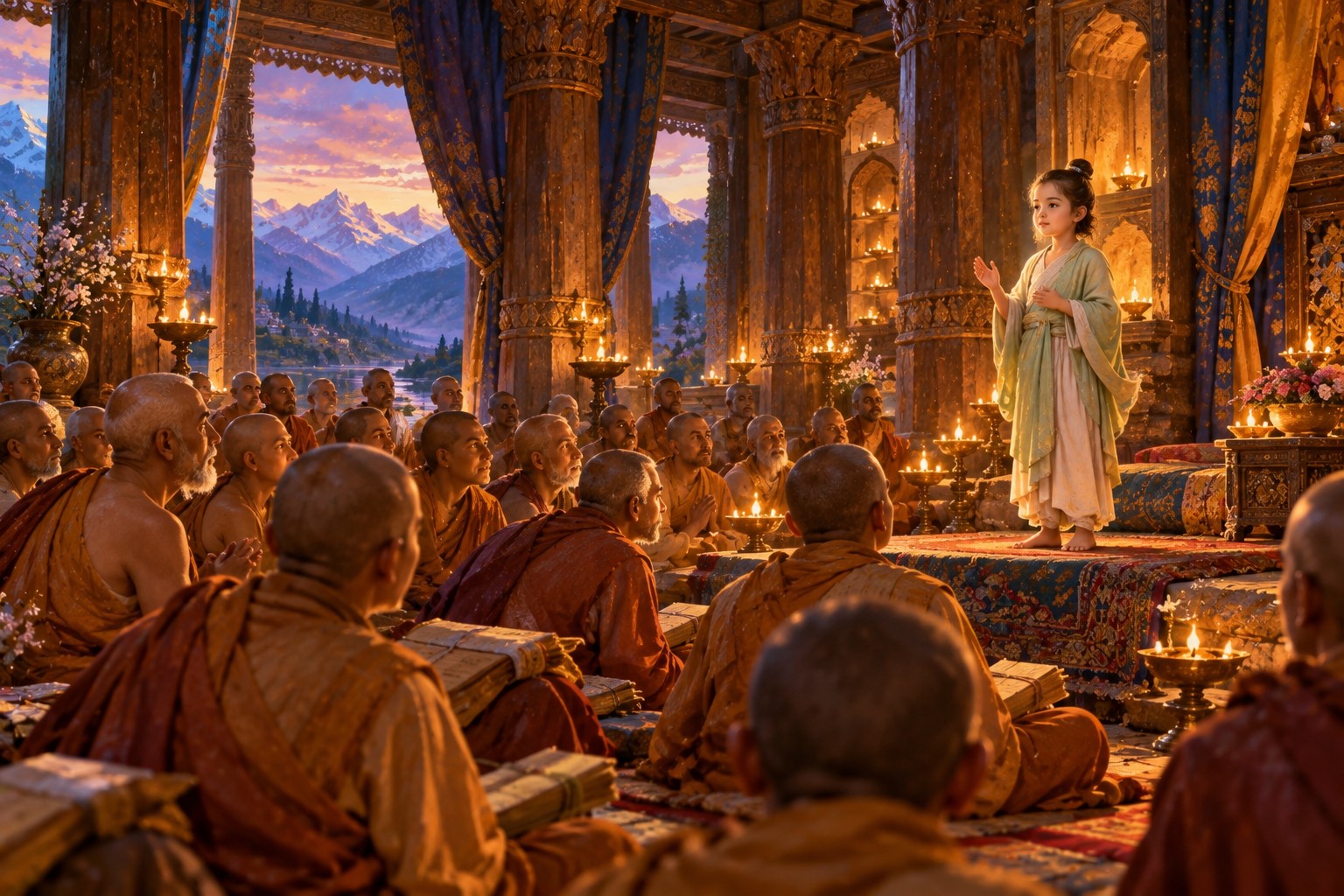
When he was seven, the account says, many of the Buddha's teachings arose in his heart by themselves. He asked his mother's permission to go to the royal court, where five hundred learned scholars, or panditas, served the king, his grandfather.

There he debated them, and they could not defeat him. The scholars gave him a name, Prajnabhava. The king, delighted, named him Prahevajra, which Pearcey translates "Supremely Joyful Vajra". The Tibetan name means much the same: garab is supreme joy, and dorje is the vajra, the diamond-like emblem of what cannot be broken.
Mountains and charnel grounds
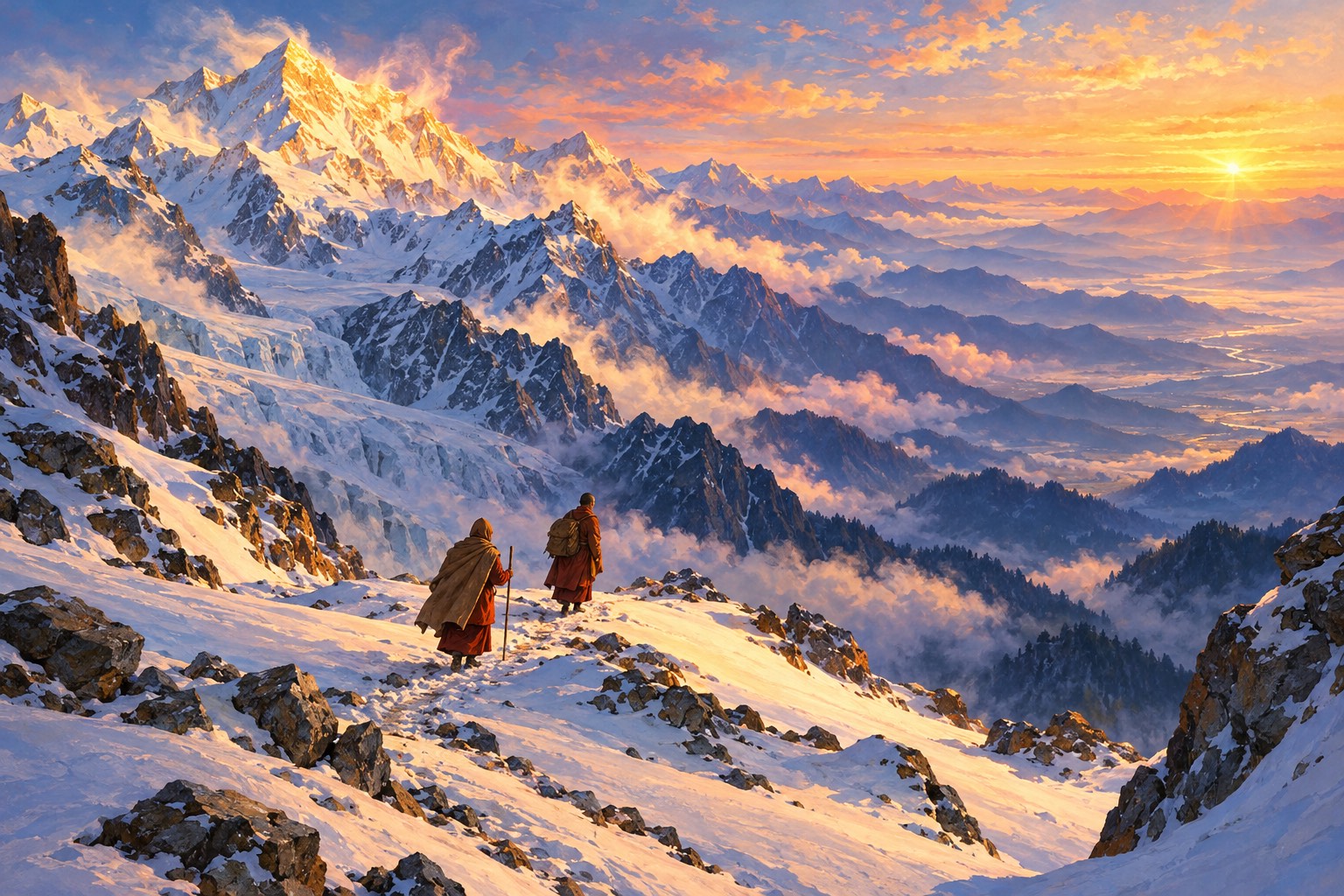
Then he left the court. Longchenpa says he meditated on a mountain called Suryaprakasha, "Light of the Sun", and afterwards went to a charnel ground where Vajrapani, a great protector of the teachings, taught him the Great Perfection.
A charnel ground is a place where the dead were cremated or laid out. In the Buddhist tantras it is a place of practice, because nothing there can be pretended away.
Other tellings describe the vision differently. Rigpa Wiki says it was Vajrasattva, a buddha of purity, who appeared to him and asked him to write the teachings down. Longchenpa too says he set them down in volumes and entrusted them to the dakinis for safekeeping.

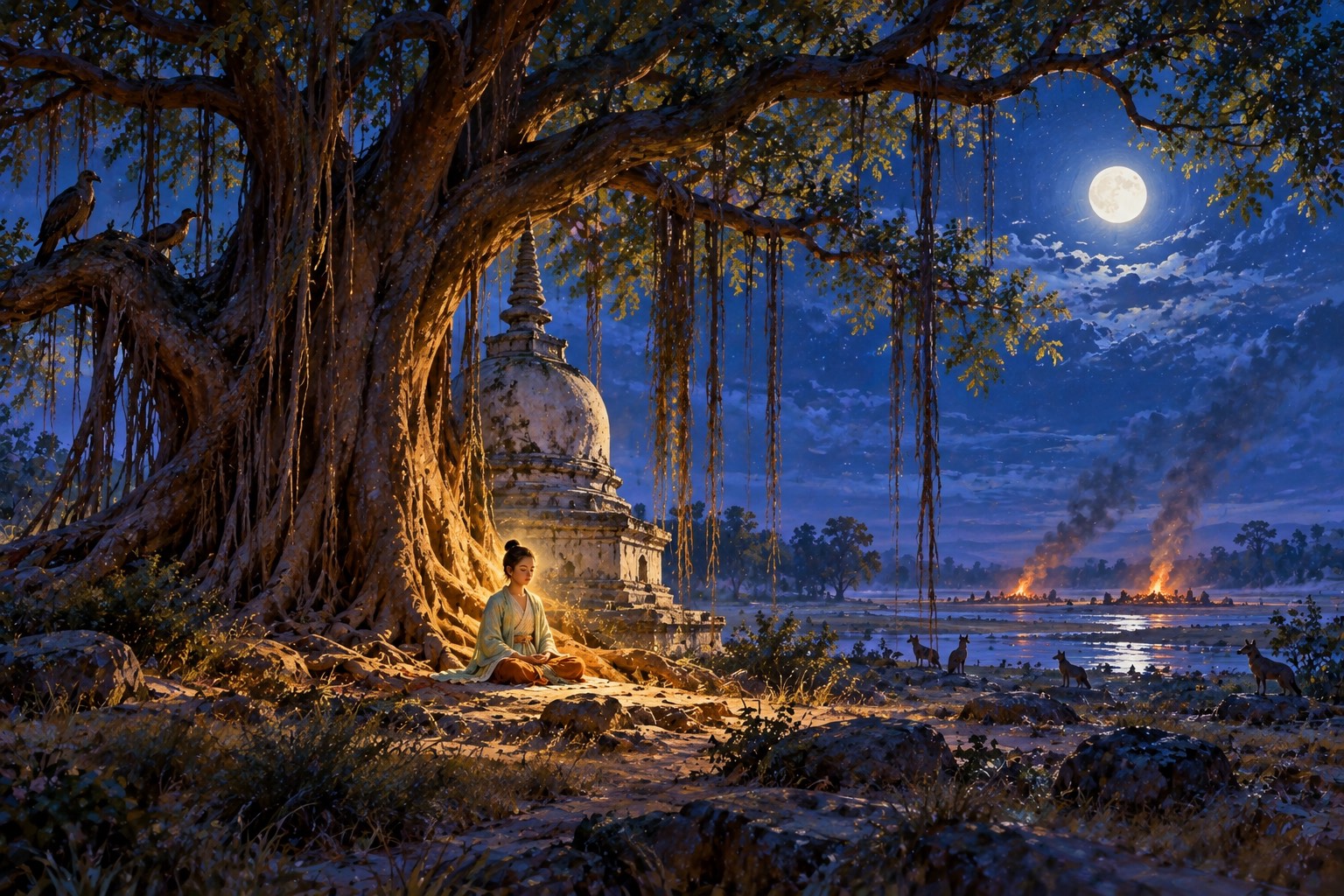
At last he settled in a great charnel ground called Shitavana, the Cool Grove, which tradition places not far from Bodhgaya, where the Buddha awoke. Readers of Guru Rinpoche's life may know the name. It is one of the places where he too is said to have practised.
Manjushrimitra
West of Bodhgaya, in a town called Dvikrama, a scholar named Manjushrimitra was born into a brahmin family. He mastered the five sciences, the whole learning of his day. The tradition remembers two ways he came to Garab Dorje.
In Longchenpa's telling, Manjushri, the bodhisattva of wisdom, told him that if he wished to awaken in a single lifetime, he should go to the Cool Grove, and he went at once. In another telling, summarized on Wikipedia, he came first as a debater, meaning to refute what he took for a wrong view. He lost, saw his mistake and asked to be taught.
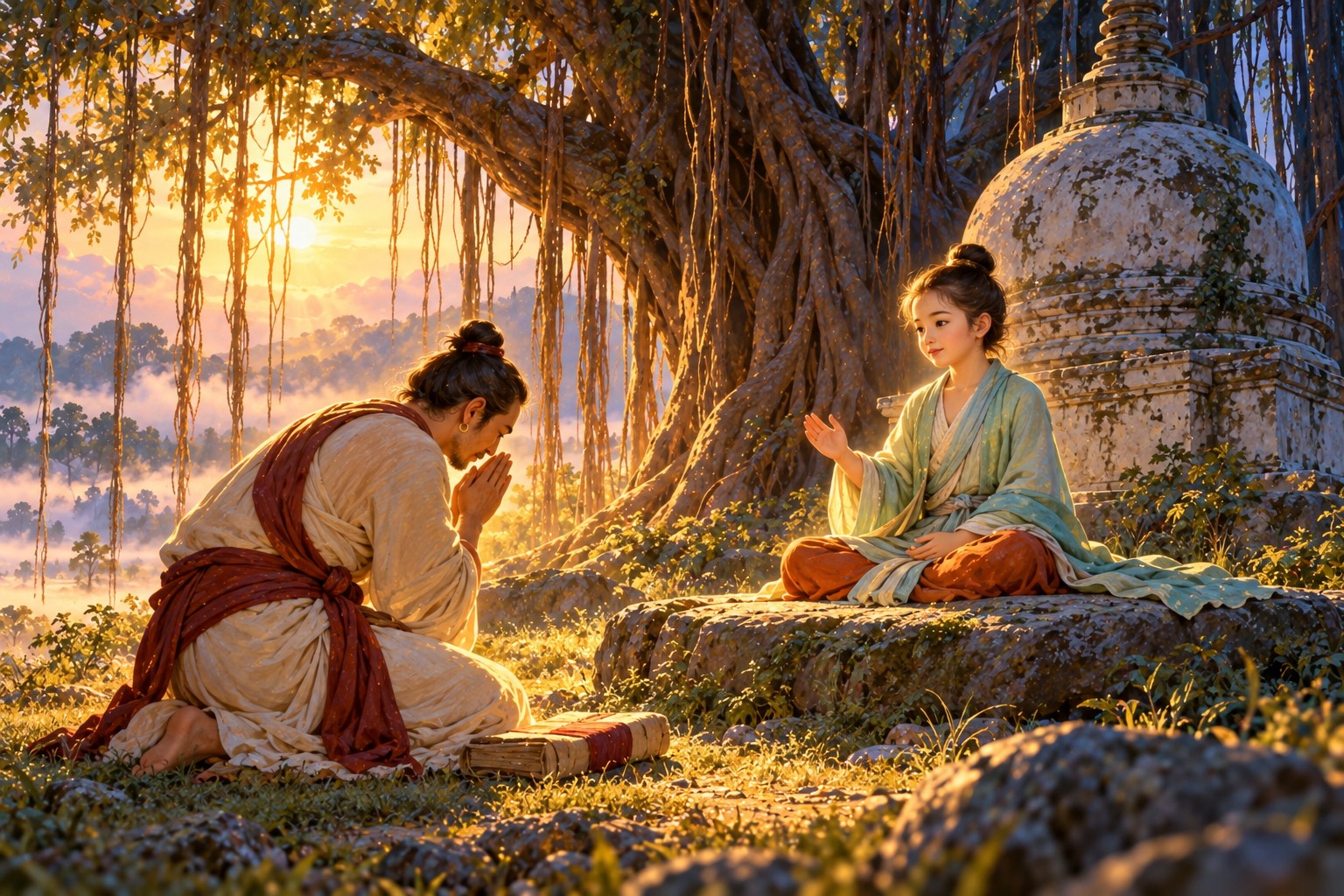
Either way, he stayed. He became Garab Dorje's chief disciple and received the whole of his teaching.
A small golden casket
Then came the parting. Tradition holds that Garab Dorje rose into the sky and dissolved into rainbow light. Manjushrimitra cried out in grief. In Pearcey's translation of Longchenpa, he asks, "who will dispel the darkness of the world?"
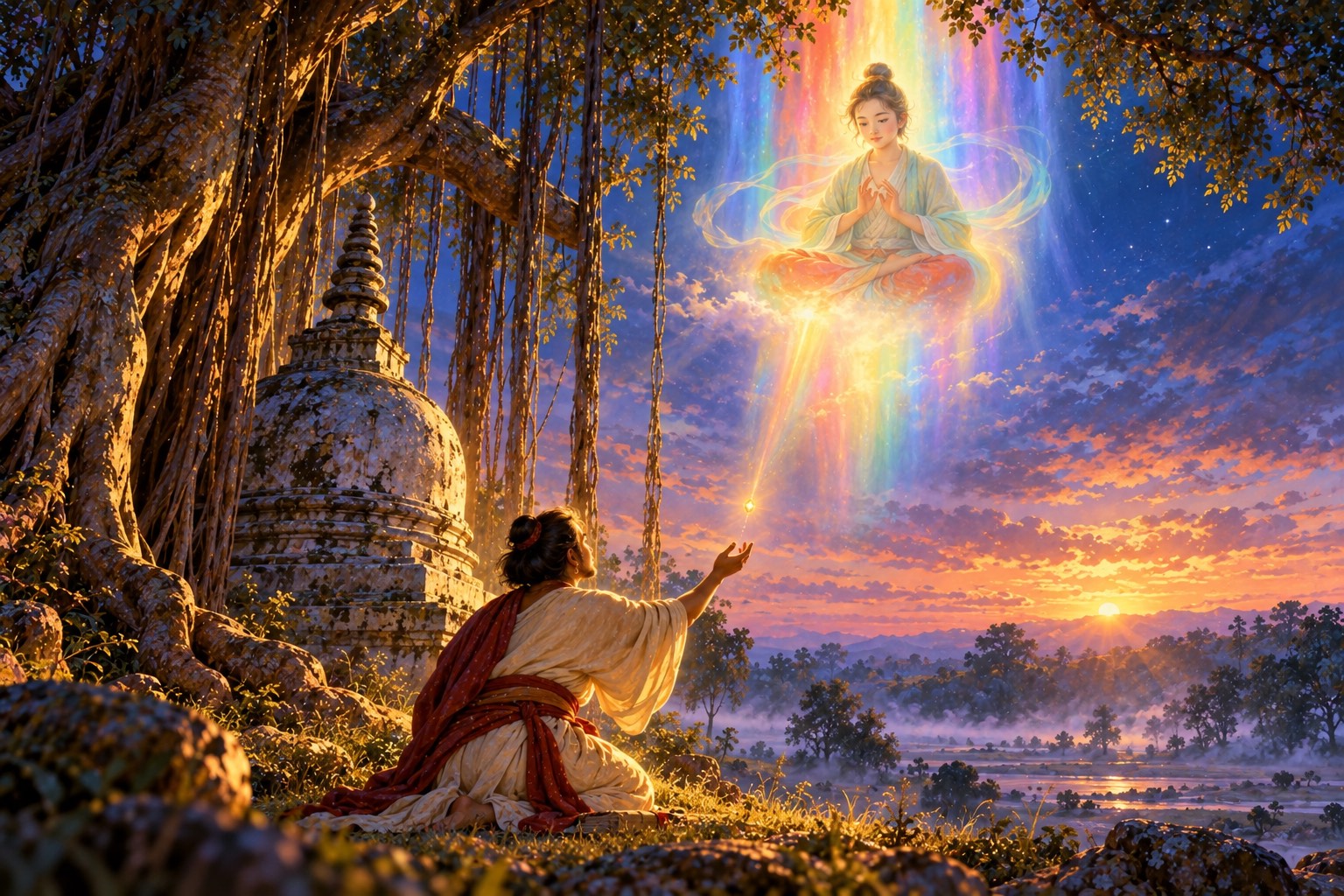
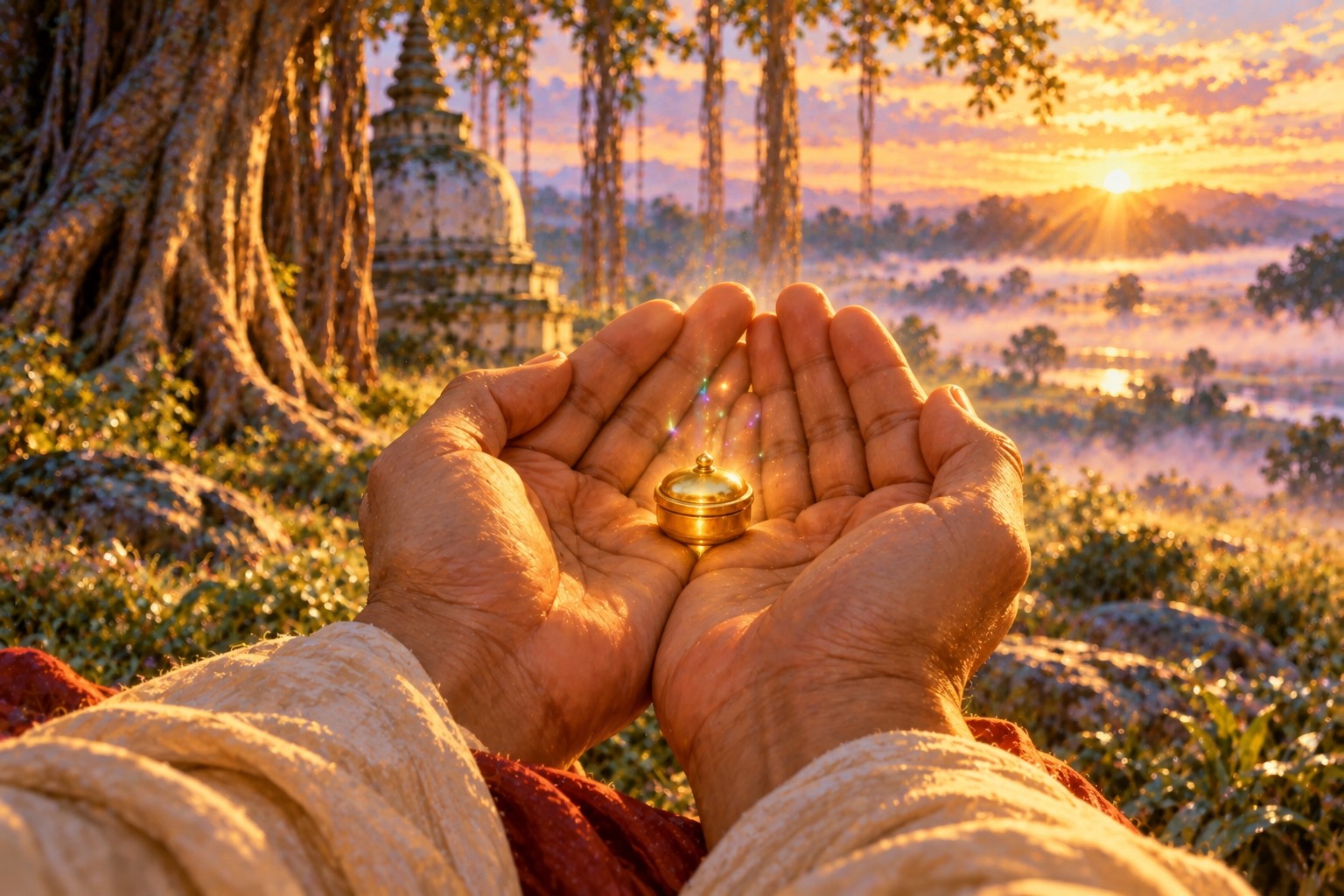
The answer, the accounts say, was a tiny golden casket, no bigger than a fingernail, which fell into his hands. Rigpa Wiki tells it more tenderly still: the master's hand appeared again in the light and let it fall.
Inside was Garab Dorje's last testament, known as The Three Statements That Strike the Vital Point, in Tibetan Tsik Sum Né Dek. Patrul Rinpoche's much-loved Special Teaching of the Wise and Glorious King is built on it. Lotsawa House marks the text as restricted, and this page leaves it there. Its meaning is something a teacher introduces in person.
From hand to hand
Manjushrimitra, the accounts say, sorted the teachings of the Great Perfection into three series, called Mind, Space and Pith Instruction. His own great student was Shri Singha. Longchenpa says Shri Singha came from China; Rigpa Wiki says from Khotan, an oasis kingdom on the Silk Road.
When Manjushrimitra in his turn passed into light, he too is said to have left a casket with a final testament for his student. The pattern repeats down the line, like one lamp lighting the next: from Shri Singha to Jnanasutra, and from Jnanasutra to Vimalamitra.
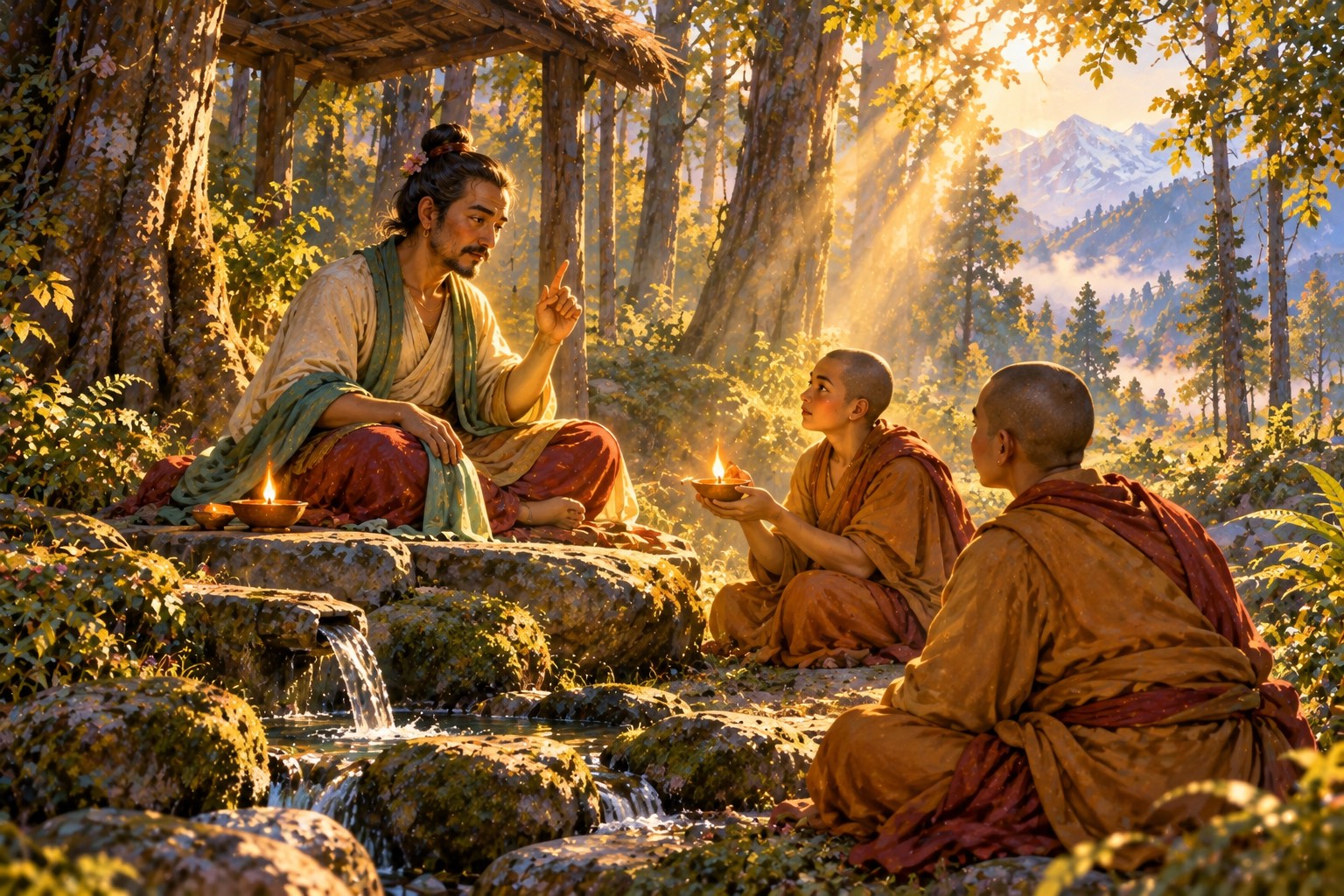
Jnanasutra and Vimalamitra, Longchenpa says, had been scholars together at Bodhgaya until a vision of Vajrasattva sent them in search of Shri Singha. Vimalamitra later carried these teachings to Tibet.
And Guru Rinpoche? Rigpa Wiki, following Nyoshul Khenpo's history of the lineage, says he received the Great Perfection from Shri Singha in a charnel ground and stayed with him for twenty-five years. It adds that he met Garab Dorje himself in a pure vision. Wikipedia instead traces his share of the teaching down the line through Vimalamitra. The tradition is content to hold more than one telling.
Guru Rinpoche's own birth in Oddiyana is told in The Lotus-Born. The Tibetan translator who crossed the Himalaya to study with Shri Singha has his own page, Vairotsana.
What historians say
Historians read all this differently, and it is fair to say so. From the travel records of Chinese pilgrims, most Western scholars identify Oddiyana with the Swat valley in northern Pakistan, though a few still doubt it. Buddhism flourished there for centuries, then declined. By the thirteenth century, a Tibetan pilgrim found it almost gone.
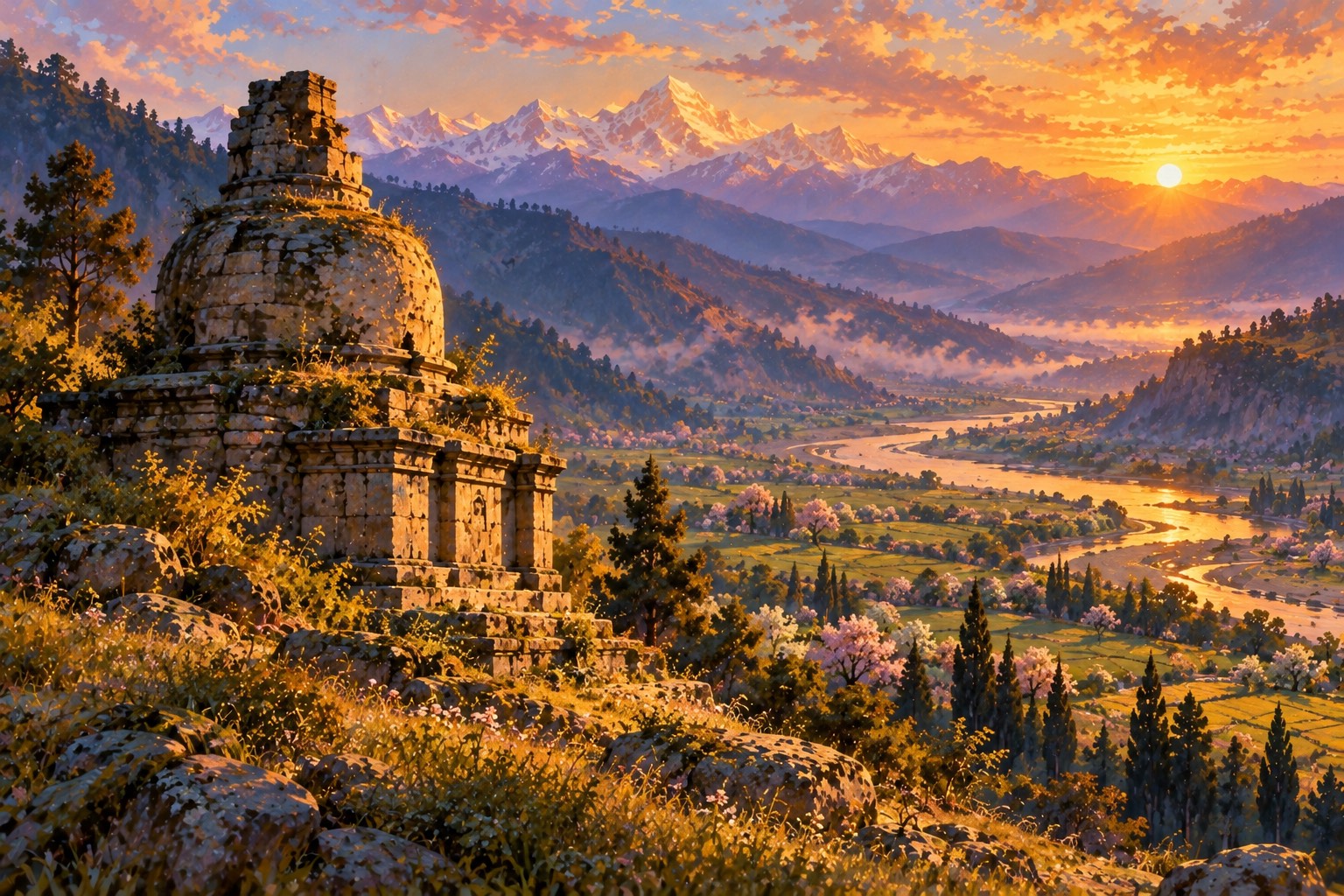
As for Garab Dorje, his dates cannot be fixed, and even his Sanskrit name is a later reconstruction. Modern scholars treat him as a figure of sacred history rather than a documented person; one, quoted on Wikipedia, calls him "historically problematic". The same is true, in varying degrees, of the early masters who followed him.
For the tradition, the heart of the matter lies elsewhere: a living understanding, passed from teacher to student, that reaches back to the land the prayer names in its first line.
Back to the first line
When you recite the Seven-Line Prayer, its first words turn toward Oddiyana. You might remember that Guru Rinpoche was born there, and that the Great Perfection is remembered as coming from there too, from a child once hidden in the ash.
About the art
Garab Dorje is painted in more than one way in Tibetan art. A fourteenth-century initiation card in the Rubin Museum shows him white-faced and crowned, in red and brown robes; a modern line drawing gives him the look of a buddha. We follow a nineteenth-century initiation card from the Shechen Archives: a youthful, beardless figure with pale white skin, his hair in a high topknot with a small jewel, wearing light green-blue silks and a red-orange lower cloth, his hands at his heart in the gesture of teaching. A silk upper garment has been added for modesty. As a newborn and a boy of seven he is shown simply, without silks or jewels.
Manjushrimitra appears in Himalayan art mostly as one of the Eight Vidyadharas, the Indian masters linked with Guru Rinpoche's main meditation practices, and there he sometimes raises a sword. We leave the sword out, because in this story he is a scholar who came to learn, and a sword would make him look like the bodhisattva Manjushri. Following a block print and an initiation card, he is clean-shaven, with his hair in a topknot; the cream shawl, red sash and palm-leaf manuscript are our own choices for a learned brahmin. Shri Singha keeps his look from the Vairotsana page: topknot, short beard, green scarf and the raised index finger of the paintings.
No portrait of Garab Dorje's mother, Sudharma, was found, so she is drawn as a young Indian nun in plain ochre robes. The offerings to the hidden child are shown as falling petals and soft light, with the beings themselves only suggested. The vase of the dream and the tiny golden casket are left completely blank: the sources speak of letters on the vase, but this site never puts script into its images. The rainbow light of Garab Dorje's passing follows the tradition's own description. The ruined stupa of the Swat valley is built in the grey-green stone and diaper masonry of the region's Buddhist sites, and no prayer flags appear anywhere, because they belong to later Tibet.
Why this matters for practice
The Seven-Line Prayer begins with Oddiyana, and Garab Dorje's story shows why that first line matters so much to the Nyingma tradition: the land of Guru Rinpoche's birth is also remembered as the source of the Great Perfection. His life is a picture of teaching passed from hand to hand, each teacher leaving something small and precious for the next. Reciting the prayer is one simple way of turning toward that source; anything deeper belongs with a qualified teacher.

If something in this story stayed with you, you might turn toward that far north-west for a moment and recite the prayer once. For the teachings Garab Dorje left behind, the right guide is a qualified teacher.
Sources and further reading
- Symbolic Transmission of the Vidyādharas, from The Jewel Rosary History, by Longchen Rabjam (trans. Adam Pearcey, 2025), Lotsawa House
- Garab Dorje Series, Lotsawa House
- Striking the Vital Point in Three Statements (topic page), Lotsawa House
- A Shower of Wisdom: A Guru Yoga of Garab Dorje, by Mipham Rinpoche, Lotsawa House
- Garab Dorje, Rigpa Wiki (archived snapshot)
- Mañjushrimitra, Rigpa Wiki (archived snapshot)
- Shri Singha, Rigpa Wiki (archived snapshot)
- Jñanasutra, Rigpa Wiki (archived snapshot)
- Uddiyana (Oddiyana), Rigpa Wiki (archived snapshot)
- Padmasambhava, Rigpa Wiki (archived snapshot)
- Dzogchen, Rigpa Wiki (archived snapshot)
- Garab Dorje, Wikipedia
- Indian Teacher: Garab Dorje (set 11956), with items 52848948, 741 and 66214, Himalayan Art Resources
- Indian Adept (siddha): Manjushrimitra, item 79628, and Eight Vidyadhara Main Page (set 5120), Himalayan Art Resources
- A Marvelous Garland of Rare Gems, by Nyoshul Khenpo (trans. Richard Barron, 2005)
This retelling is waiting to be read by a knowledgeable practitioner. Where the traditional accounts differ, the story says so; if you notice a mistake, please tell us through Share Your Story.