Long before there was printing in Tibet, the Buddha's teachings crossed the Himalaya on foot. Someone had to carry them, learn the languages they were written in, and find Tibetan words wide enough to hold them. Tibetans call such a person a lotsawa, a translator. They remember one above all: Vairotsana of Pagor.
His life comes down to us in more than one voice. The fullest is The Great Image, a long life story that its publisher describes as his own telling, given to a group of students near the end of his life. Another is the Pema Kathang, a treasure biography of Guru Rinpoche revealed centuries later by Orgyen Lingpa. Later histories summarize both.
The accounts agree on the shape of the story and differ on many details. Where they differ, this page will say so rather than choose for you.
One of the seven
Vairotsana was born into the Pagor clan of central Tibet. One lineage biography names his birthplace as Nyemo Chekar and remembers an unusually bright child. Other accounts say Guru Rinpoche recognized him as the rebirth of an Indian scholar.
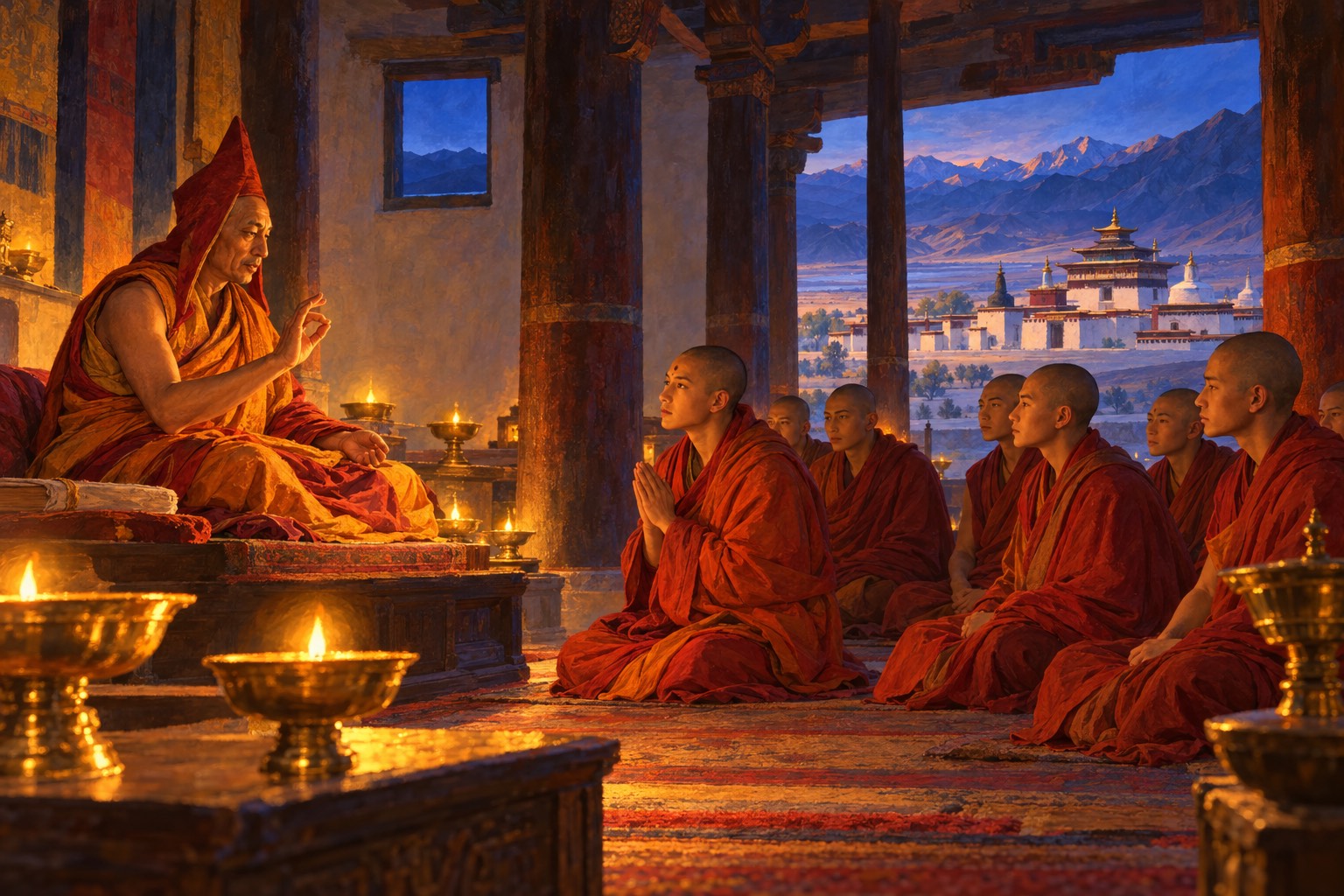
King Trisong Detsen was building Samye, Tibet's first monastery, and he needed Tibetans who could become monks and translators. The Indian abbot Shantarakshita ordained a small first group, to see whether Tibetans could keep the monastic vows. They are remembered as the "seven men who were tested." The lists of the seven are not quite the same in every source, but Vairotsana's name is on them.
Over the mountains
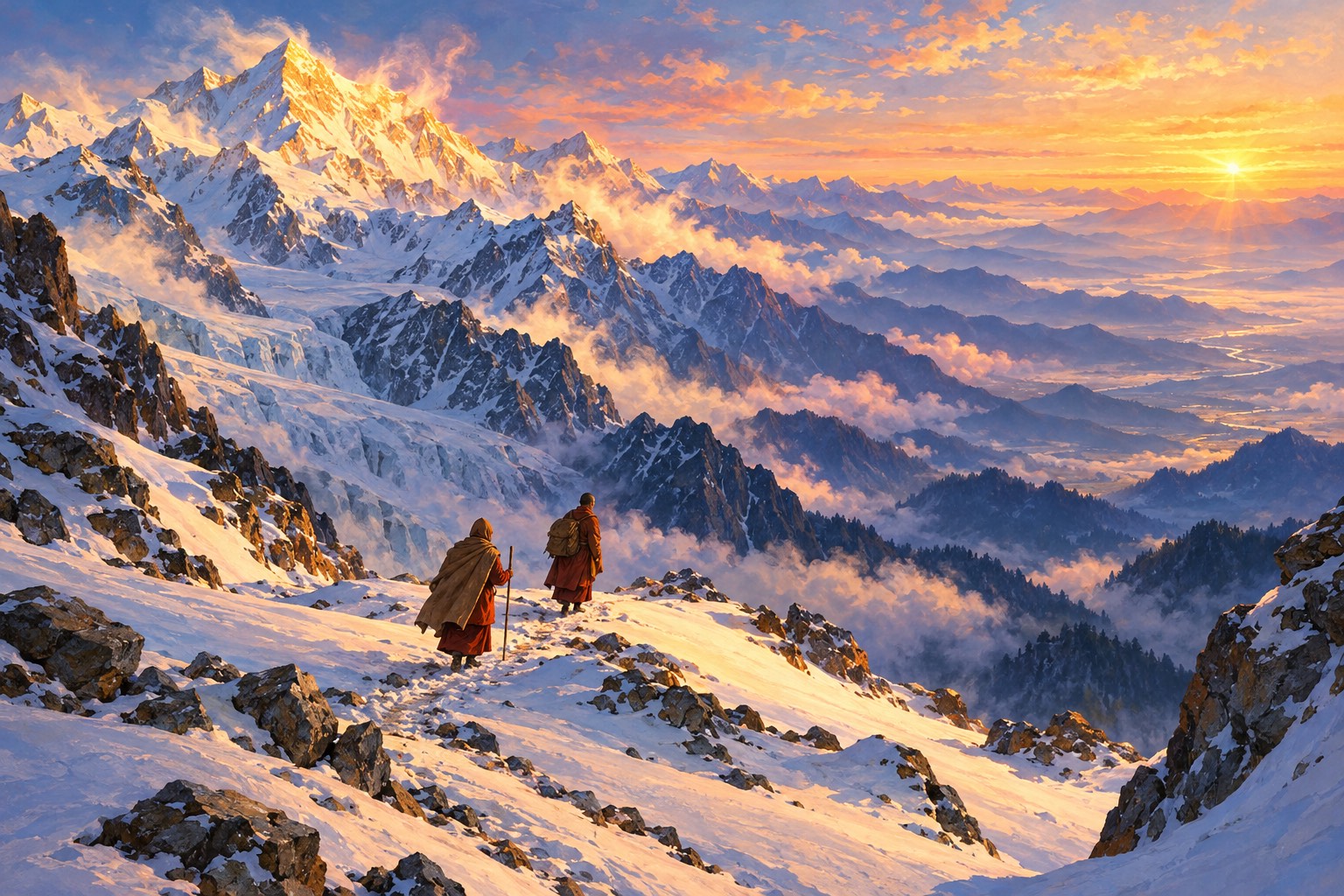
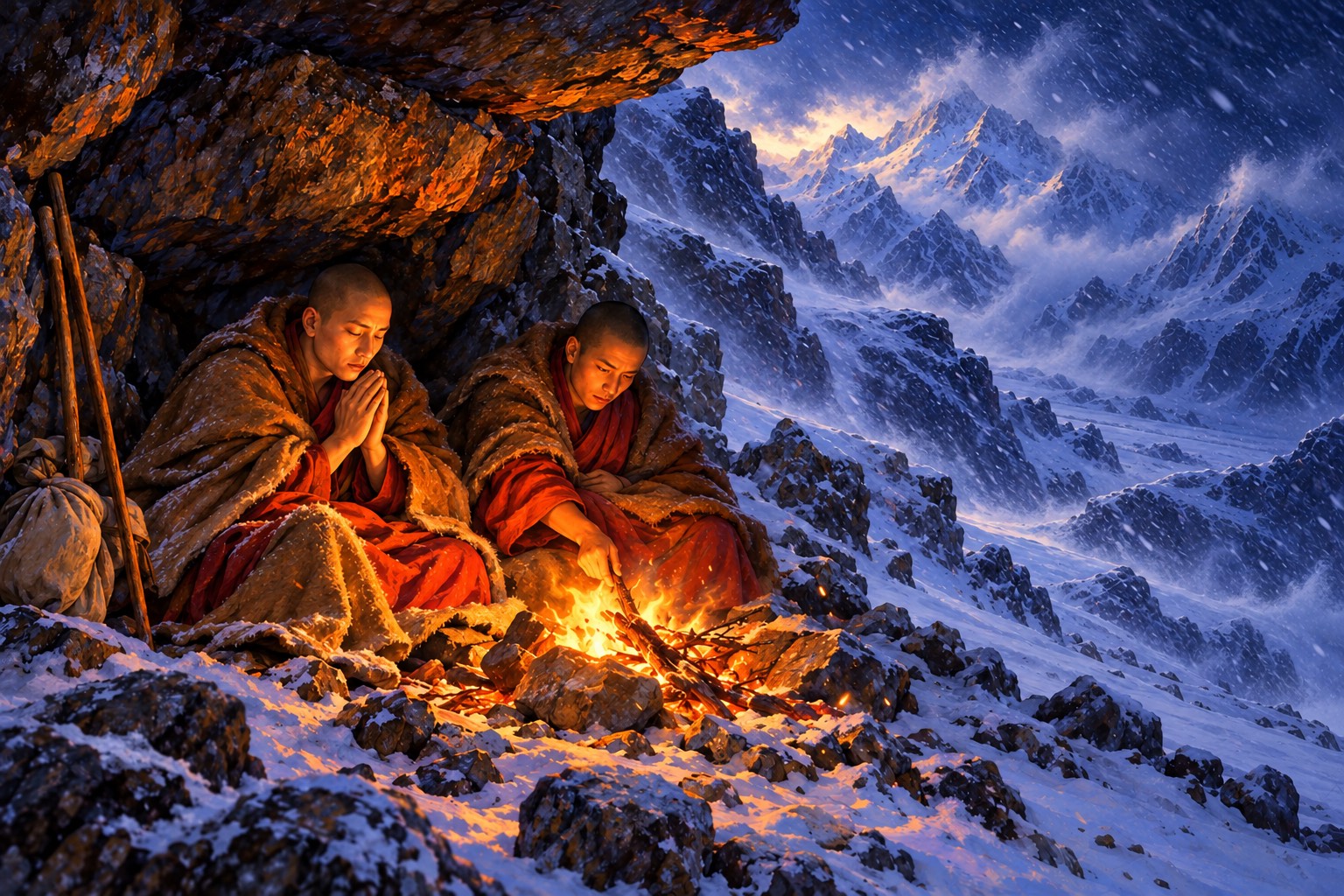
Then the king gave him a harder task. He was to go to India and bring back teachings that Tibet did not yet have. Many accounts send him with one companion, a monk named Lekdrub of Tsang. The Pema Kathang, as an encyclopedia article summarizes it, speaks of five monks sent together.
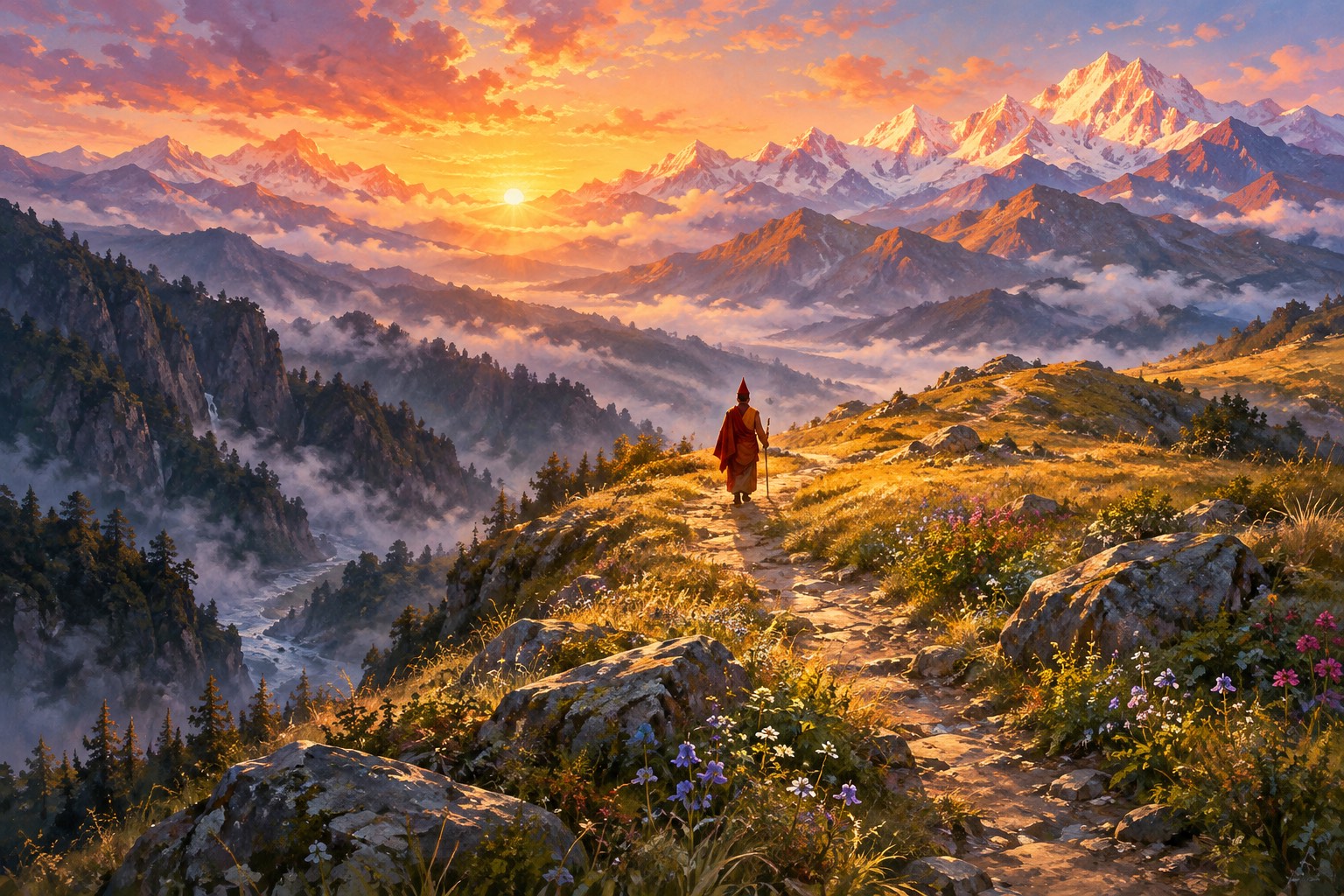
The road crossed the highest mountains on earth, on foot. The Great Image remembers the journey as a long chain of hardships and dangers. The summaries do not list them all, and this page will not invent them. It is enough to picture two young monks far from home, carrying gold for offerings and a king's hope.
The master in the forest
One account says that before he found his teacher, Vairotsana saw in a vision two of the first masters of the Great Perfection, Garab Dorje and Manjushrimitra, who blessed him and told him where the full teaching would be found. The Great Perfection, Dzogchen in Tibetan, teaches that the mind's true nature is already awake and complete.
The teacher was Shri Singha, and the sources do not agree on where he lived. Rigpa Wiki says he came from Khotan, an oasis kingdom on the Silk Road. A museum note says he was born in China. Wikipedia says Vairotsana went to Dhahena in India to find him. The translator Keith Dowman places him in Orgyen, the Tibetan name for Oddiyana.
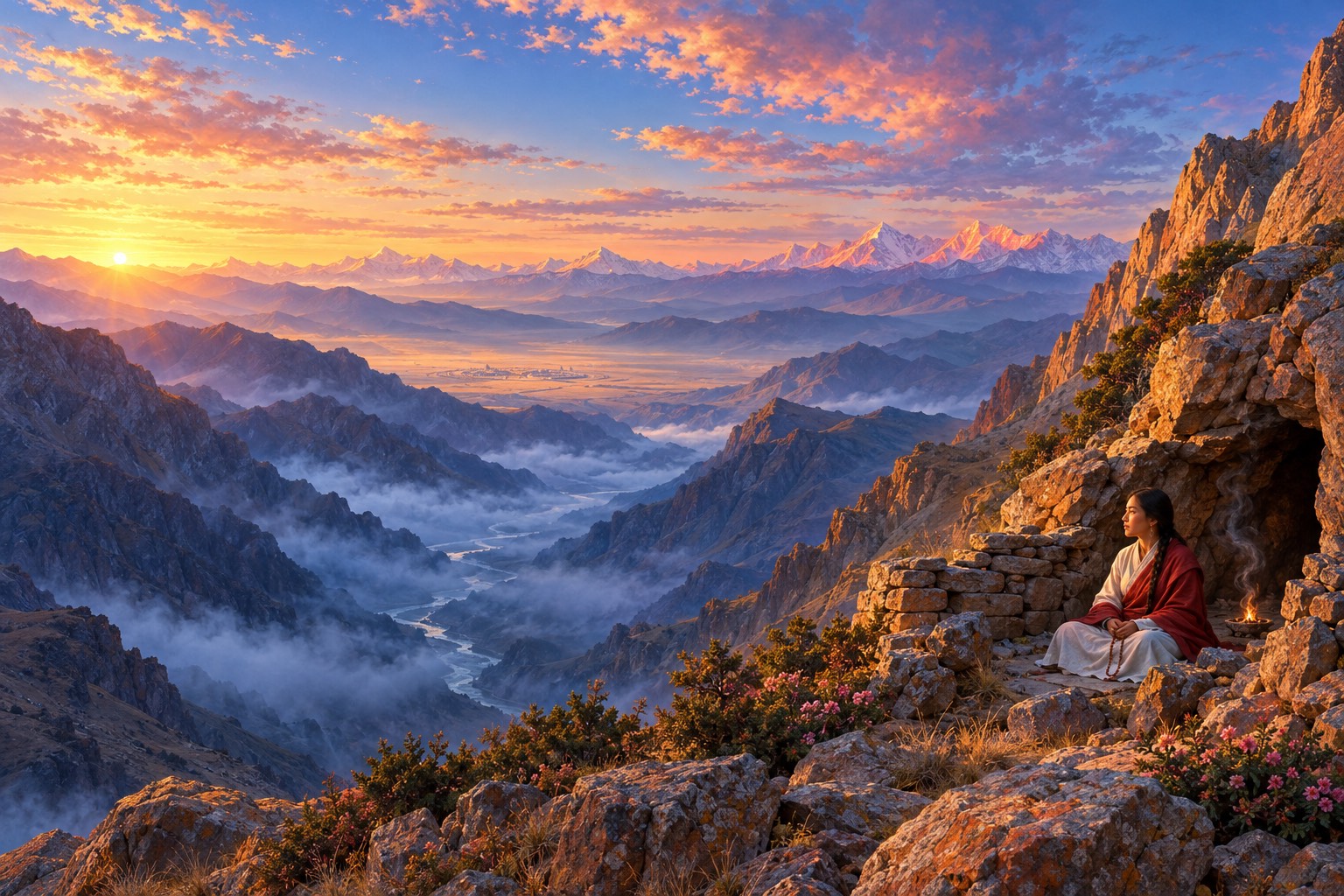
Oddiyana is the land named in the first line of the Seven-Line Prayer, where Guru Rinpoche was born. The tradition traces the Great Perfection back through Shri Singha's teachers to Garab Dorje of Oddiyana. One lineage biography says the two Tibetans found Shri Singha in a forest and offered him gold.
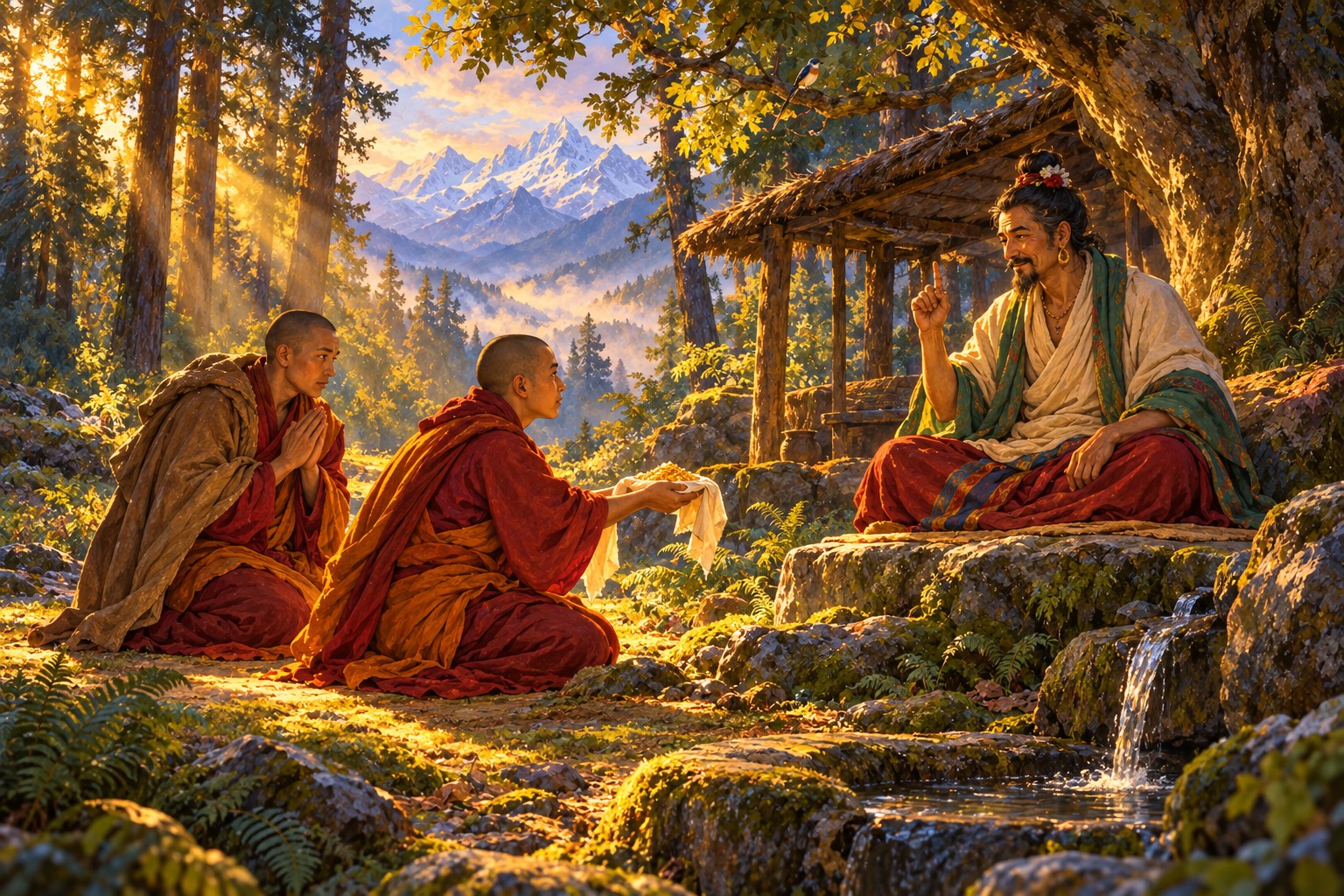
He agreed to teach them, but warned that these instructions were closely guarded and that the danger was real. So, the account says, they spent their days learning the ordinary teachings on cause and effect from other scholars, and their nights with him.
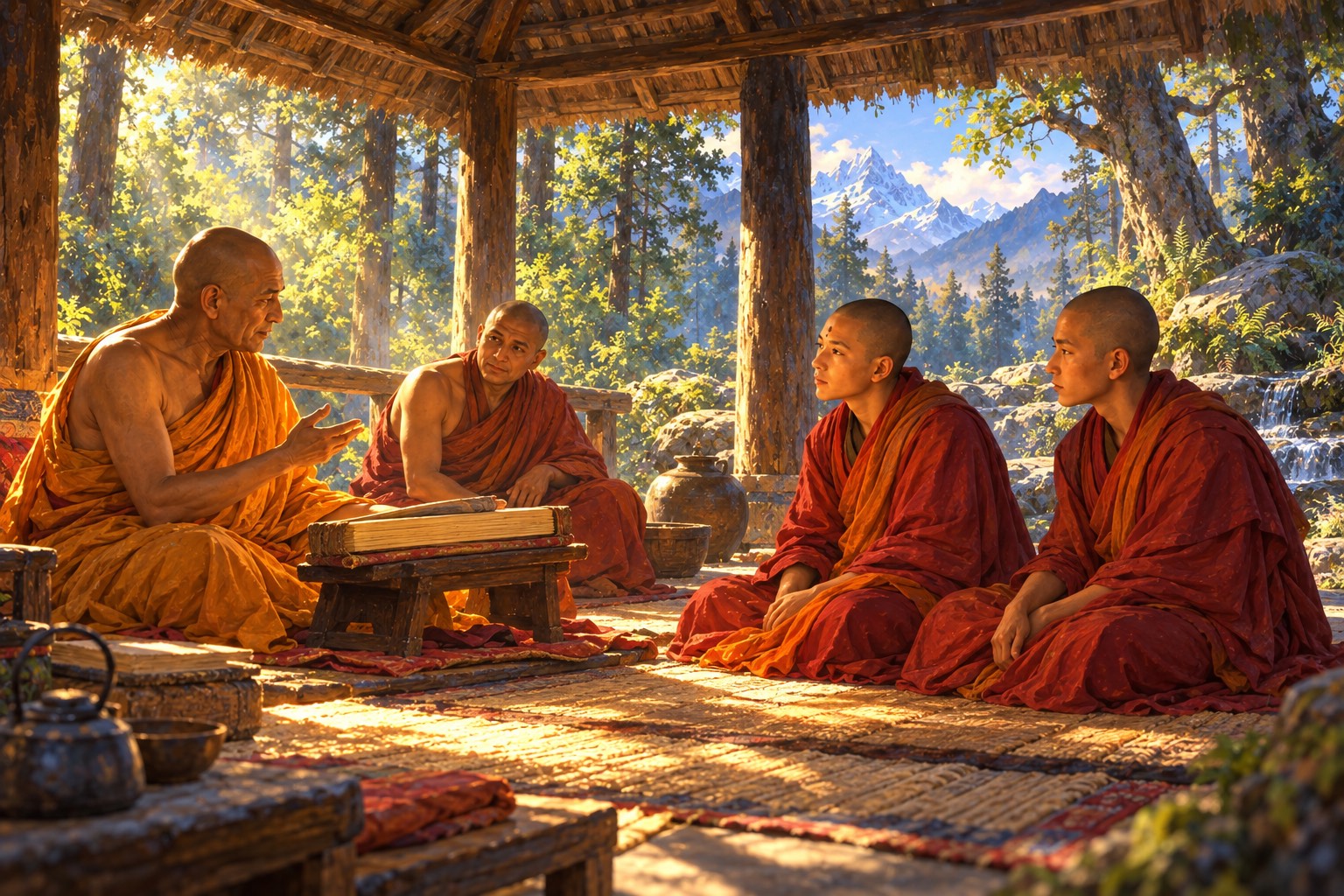
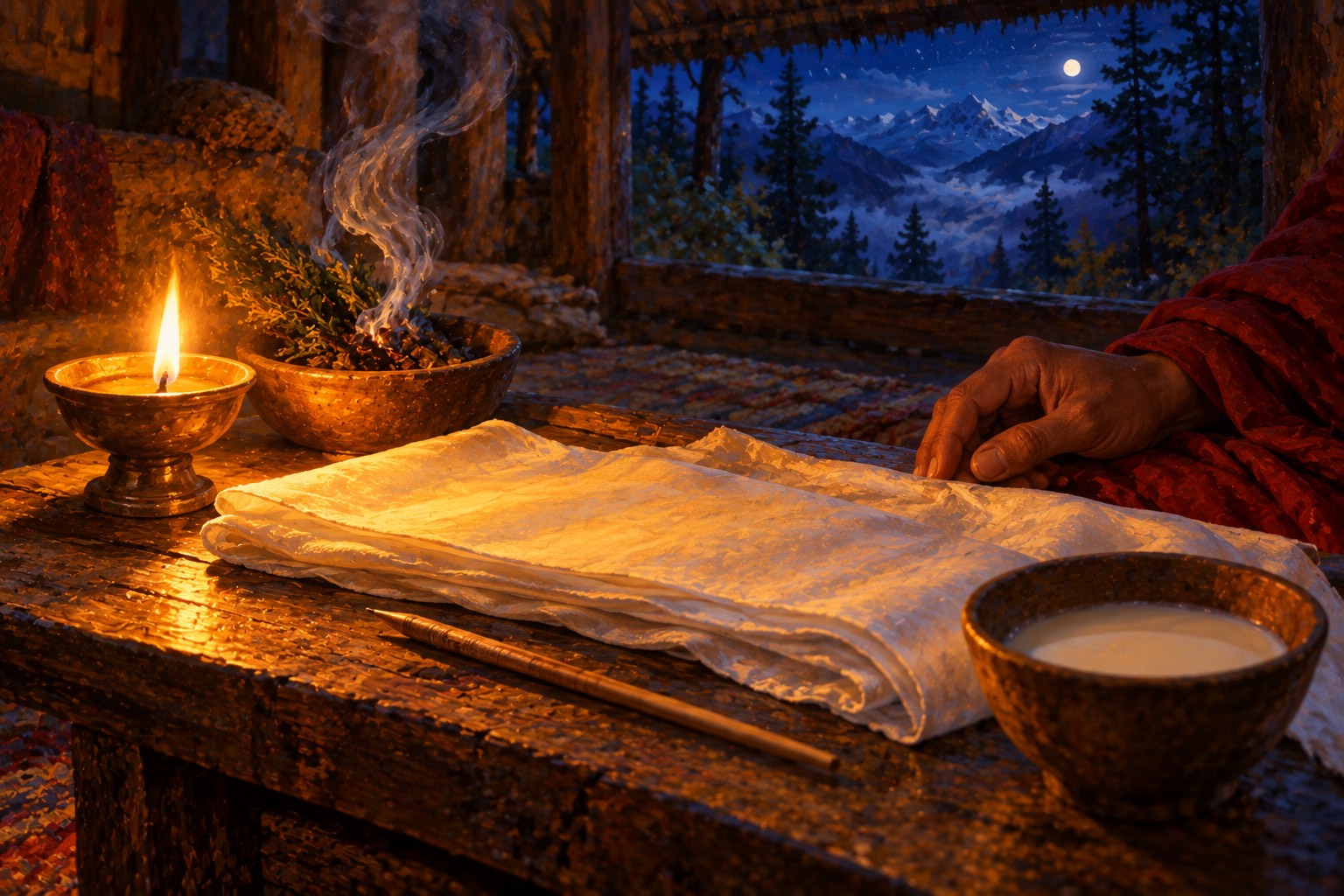
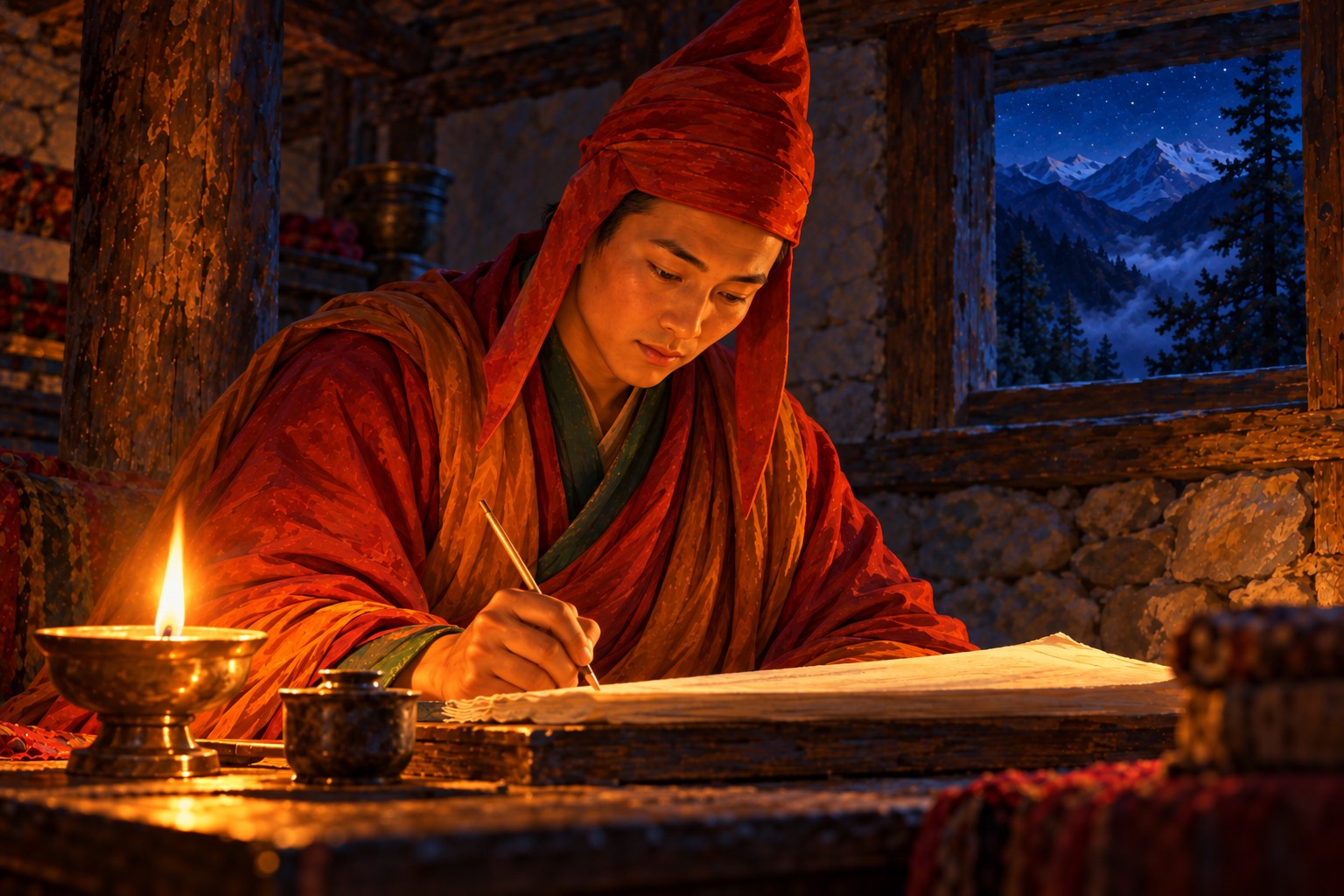
The tradition remembers how he kept the secret. At night, it says, he wrote the instructions on white silk with the milk of a white goat, and they could not be read until the cloth was held over smoke. It is a picture of a teaching so precious that it had to be hidden in plain sight.
Lekdrub felt he had received enough and set off home. He never reached Tibet; the accounts say he was killed on the road. Vairotsana stayed and asked for more, and Shri Singha gave him the whole of the teachings later called the Mind Series and the Space Series.
One account adds that he then met Garab Dorje himself in a charnel ground, or saw him in a pure vision. Another, as we saw, places that meeting before he ever found Shri Singha.
Day and night
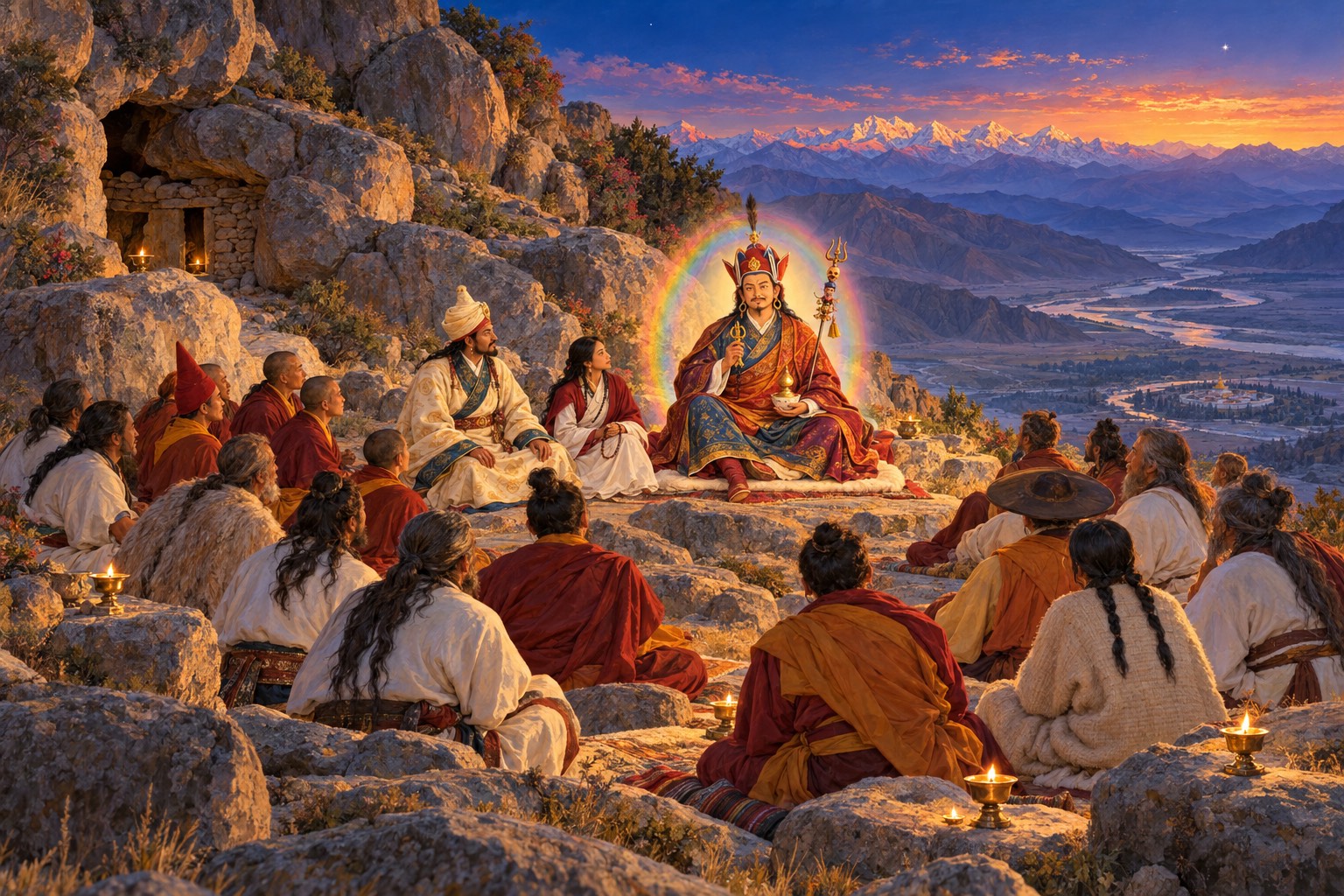
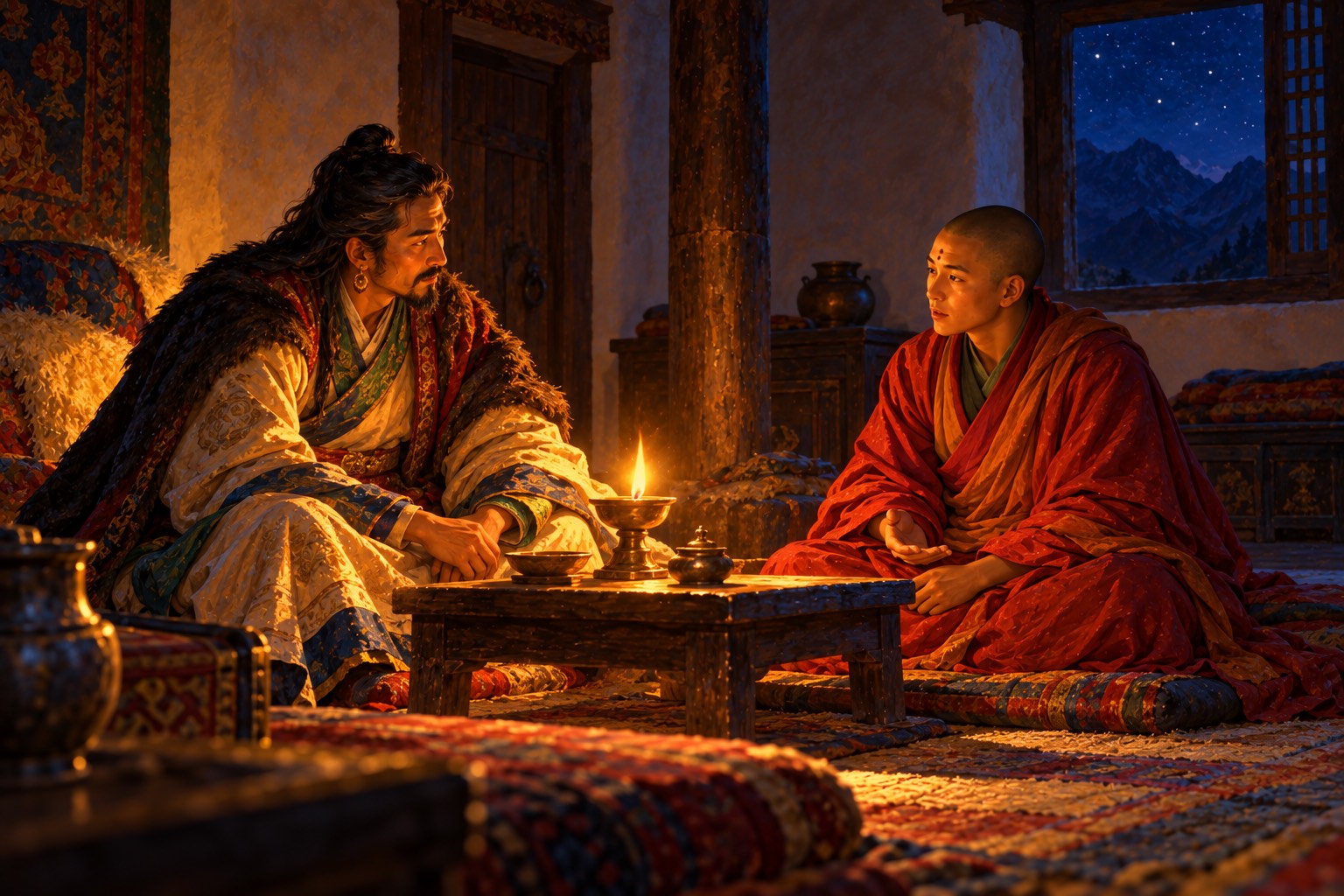
The accounts say Vairotsana came home quickly, crediting him with a yogic power of swift walking. At Samye he did as his teacher had done. By day he taught the king and others the ordinary teachings, and by night he gave the Great Perfection to the king alone.
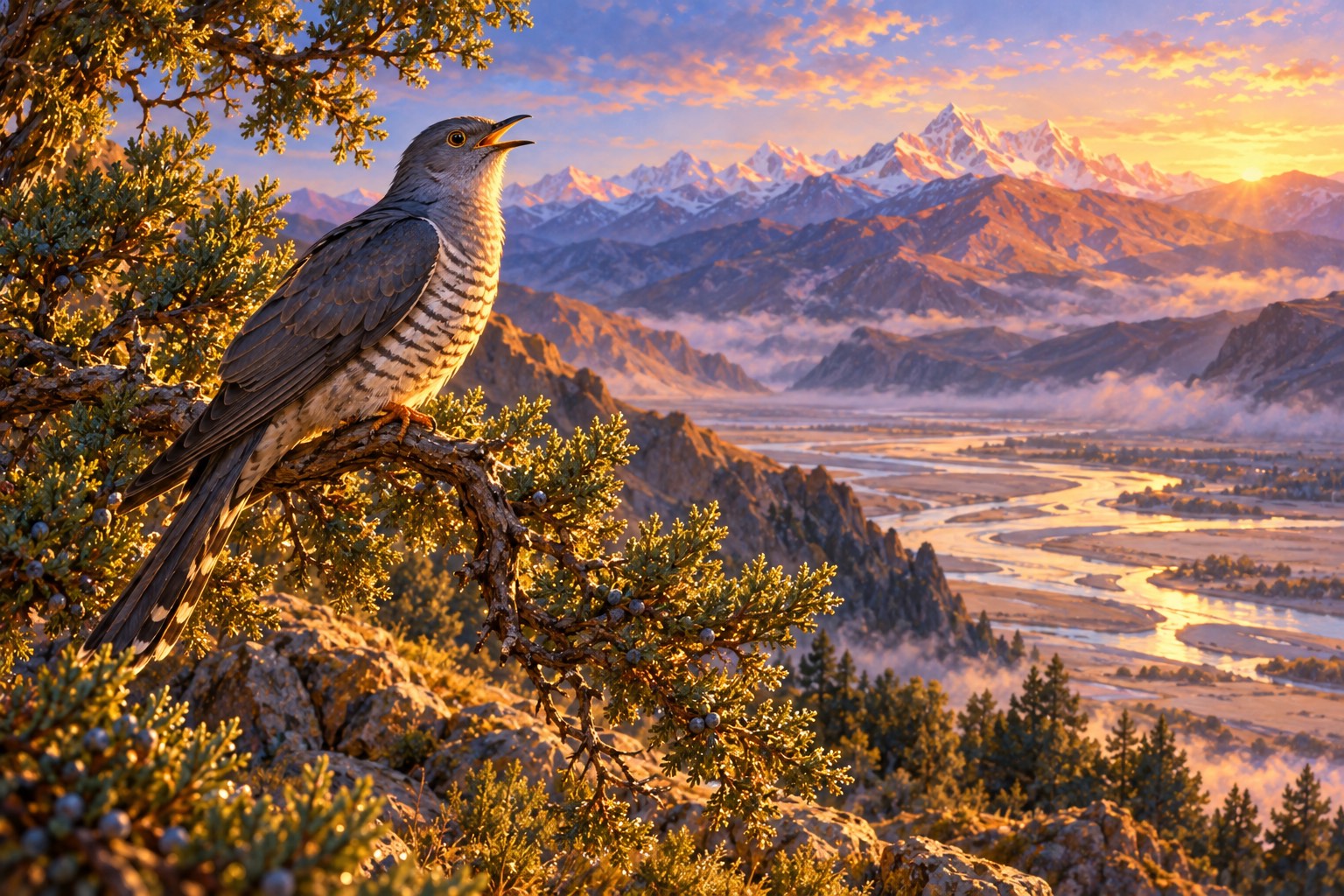
He also began to translate. The first five texts of the Mind Series that he put into Tibetan are known as the Five Early Translations. Among them are short texts called The Cuckoo of Awareness and Gold Refined from Ore. Scholars have found early manuscripts of some of these among the documents sealed in the Dunhuang caves, a sign of how old they are.
The exile
Then the trouble came. One lineage biography says that some in India, resenting that the teachings had gone to Tibet, spread a rumour that his translations were not the Buddha's teaching at all. At court, Queen Tsepongza and ministers hostile to the new religion took up the charge.
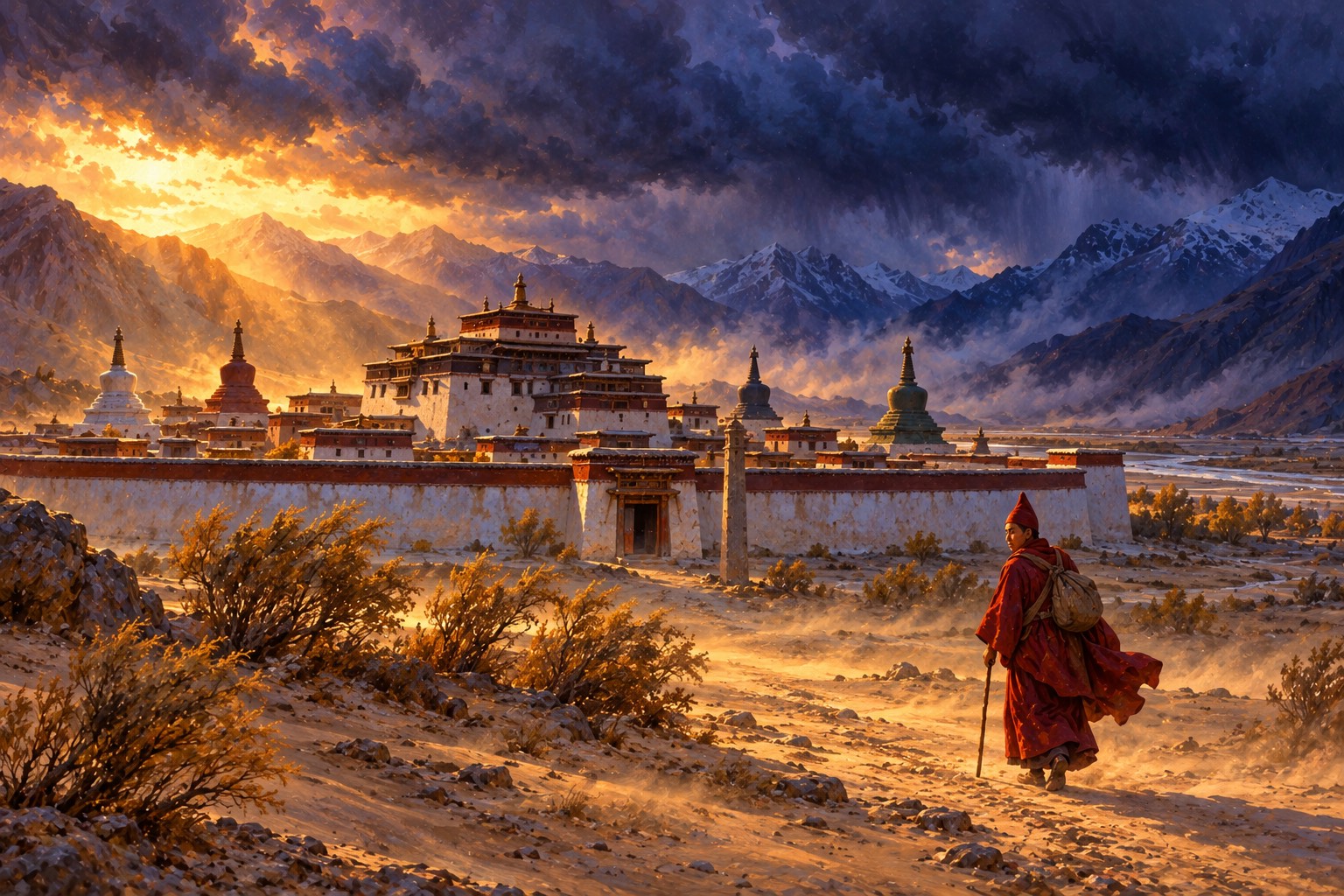
The Pema Kathang, as summarized in an encyclopedia article, gives the queen a fierce public speech against the strange ritual objects of the tantras. It says the king tried to protect the translators by hiding them until his secret was found out. Summaries of The Great Image also show the king trying to shield Vairotsana, in a version of their own. In every telling the end is the same: he was sent into exile, far to the east.
It is fair to add that the Treasury of Lives notes "little about her can be confirmed historically." Like many figures of those years, the queen reaches us through stories told by one side.
A home at the edge
His place of exile was Gyalmo Tsawarong, the Gyalrong country, a land of deep forested gorges on the border between Tibet and China. The accounts say he did not waste it. He won over the local king and his people, and took as a student a young prince, Yudra Nyingpo.
Yudra Nyingpo grew into a great scholar and translator. A Tibetan dictionary calls him the rebirth of Lekdrub, the companion who died on the road from India; another account names a different fellow student. If the first is right, a friendship broken on the journey was taken up again in the east.
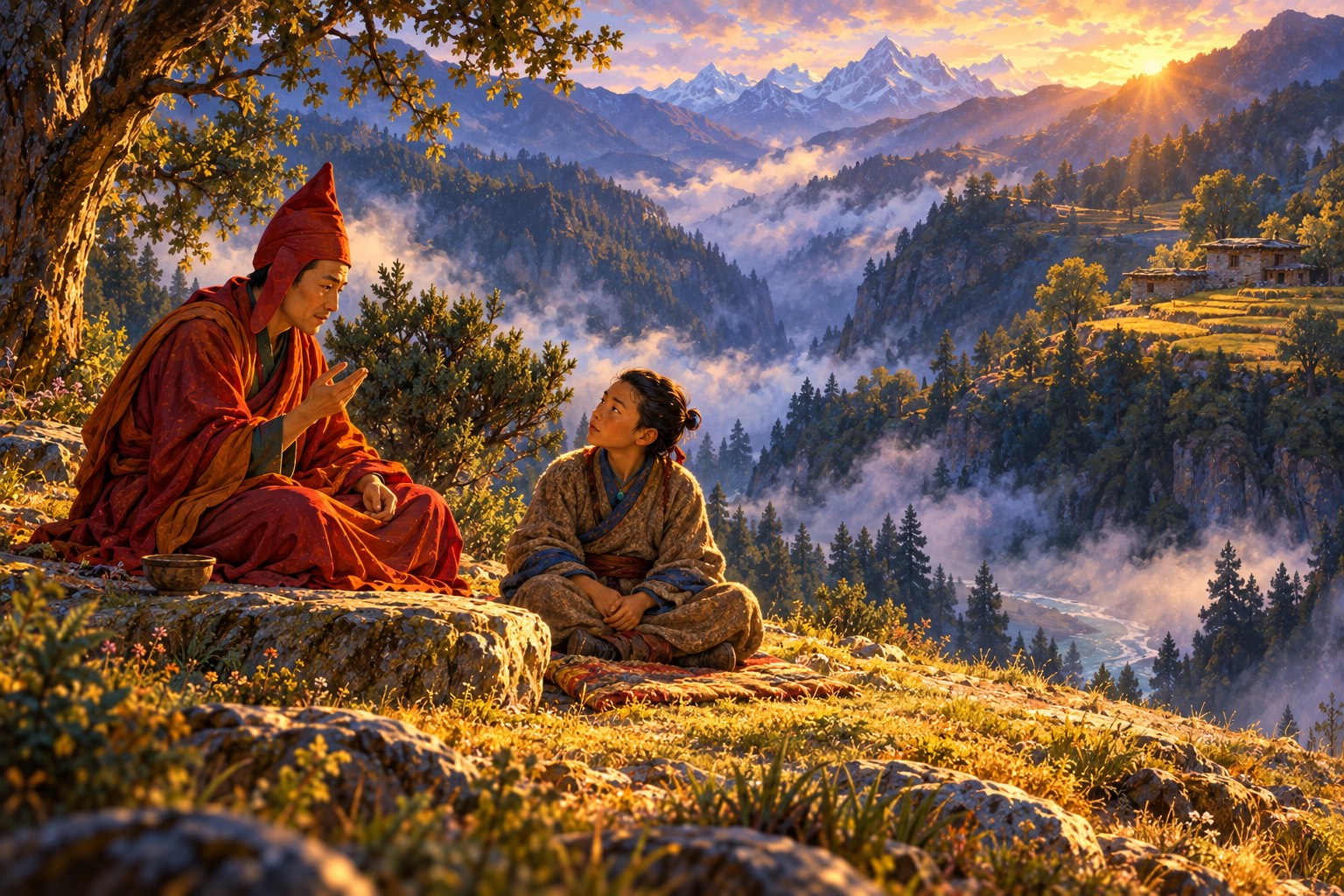
He taught others there too, among them Sangtön Yeshe Lama and an old man named Mipham Gönpo. The tradition says that, through the instructions Mipham Gönpo received, his line of students attained the rainbow body for seven generations: at death, the body is said to dissolve into light, a sign the tradition reads as complete realization.
Called home
In time Yudra Nyingpo travelled to central Tibet himself. There, the lineage accounts say, he met the Indian master Vimalamitra, who had come to Tibet, and Vimalamitra persuaded the king to end Vairotsana's exile. Rigpa Wiki says simply that Trisong Detsen recalled him. In this telling, the student's learning spoke for his teacher.
Yudra Nyingpo is credited with translating the remaining thirteen of the eighteen texts of the Mind Series. Vairotsana kept translating too, tantras and sutras alike, including part of the long Perfection of Wisdom in a Hundred Thousand Lines. Rigpa Wiki notes that no one can now count exactly how many works he translated, because early translators' names were not always recorded.
The translator's gift
One account says that at the end of his life, at a place called Bhasing in Nepal, Vairotsana passed into the rainbow body. Later masters, among them Tsele Natsok Rangdröl and Terdak Lingpa, were counted as his rebirths.
Perhaps his truest monument is quieter. A translator's work is to disappear into the words, so that others can meet the teaching directly. Every Tibetan who has read the Great Perfection in their own language has, in some measure, read it through him.
The Seven-Line Prayer begins in Oddiyana, the place of origin. Vairotsana spent his life on the road between a far land where the teachings began and his own people, so that they could hear them at home.
About the art
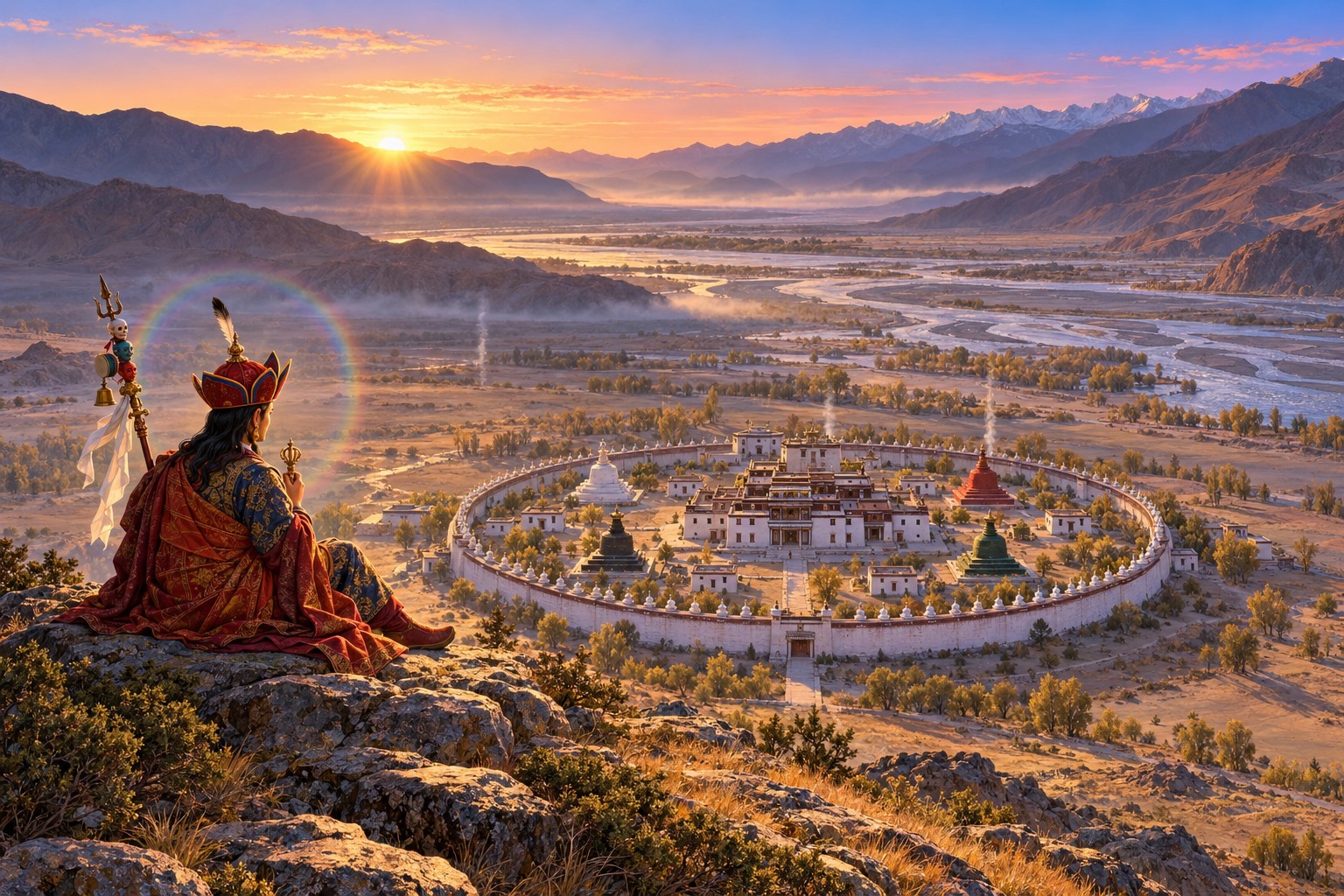
Vairotsana wears the tall, pointed red pandita hat with long side flaps, a hat that in Himalayan art marks a learned scholar. Himalayan Art Resources notes that he is identified more precisely by a small third eye set vertically on his forehead, so we keep it, small and calm. His robes are the ochre-red of the first Tibetan monks. On the journey and in his first years as a monk he appears bareheaded and younger, because the hat is a painting convention for the mature master rather than something we know he wore on the road.
Shri Singha appears in two forms in Tibetan paintings: as a monk in a pandita hat, and as an Indian adept, or siddha. We follow the adept form, from a nineteenth-century painting in the Rubin Museum and a photograph in the Shechen Archives: hair in a topknot tied with flowers, a moustache and short beard, a long green scarf looping over his shoulders, and the right hand raised with one finger pointing upward. A shawl has been added for modesty. Shantarakshita and King Trisong Detsen are drawn as elsewhere on this site, the abbot in his pointed red hat and the king in dress based on surviving images of the Tibetan empire. Lekdrub and the young Yudra Nyingpo have no traditional portraits we could find, so their looks are our own careful guess.
The white silk is painted blank on purpose. The tradition says the goat's-milk letters stayed invisible until held over smoke, and this site never puts script into its images. No prayer flags or cairns appear on the eighth-century mountain roads, because we could not confirm them for that period. The cuckoo in the last picture is an ordinary bird, chosen because one of Vairotsana's early translations takes its name from the cuckoo, whose call in Tibet announces spring.
Why this matters for practice
The Seven-Line Prayer begins by naming Oddiyana, the place of origin, and Vairotsana's story shows how what began in such a far place reached the people who now pray in their own language. Every time the prayer is recited in Tibetan, or in a translation, it rests on the patience of translators like him. His exile may also speak gently to anyone who feels far from home or from practice: in the tradition's telling, the far place became the place where the teaching took root.

If something in this story stayed with you, you might think of everyone who carried these words across the mountains, and recite the prayer once. For the deeper teachings he gave his life to carry, a qualified teacher is the right guide.
Sources and further reading
- Vairotsana, Rigpa Wiki (archived snapshot)
- Seven men to be tested, Rigpa Wiki (archived snapshot)
- Shri Singha, Rigpa Wiki (archived snapshot)
- Yudra Nyingpo, Rigpa Wiki (archived snapshot)
- Pema Kathang, Rigpa Wiki (archived snapshot)
- Vairotsana (Vairochana or Bairotsana), Drupon Khen Rinpoche Karma Lhabu, lineage pages
- Vairotsana, Wikipedia
- Magyal Dongkar, Wikipedia
- Margyel Dongkar (Joseph McClellan, 2023), The Treasury of Lives (archived snapshot)
- bai ro tsa na (TBRC P5013), The Treasury of Lives (archived snapshot)
- Vairotsana, the great translator, Tibetan Buddhist Encyclopedia
- Yudra Nyingpo, Wikipedia
- Yudra Nyingpo, Encyclopedia of Buddhism
- Semde, Wikipedia
- Sri Singha, Wikipedia
- Vairotsana Series, Lotsawa House
- Śrī Siṃha Series, Lotsawa House
- Ani Jinba, Lotsawa House
- Eye of the Storm: Vairotsana's Five Early Transmissions, KeithDowman.net
- The Great Image (publisher description), Goodreads
- The Great Image: The Life Story of Vairochana the Translator, trans. Ani Jinba Palmo (Shambhala, 2004), Book
- Teacher: Vairotsana/Vairochana (25 Disciples), Himalayan Art Resources
- Shri Simha (item 510, Rubin Museum), Himalayan Art Resources
This retelling is waiting to be read by a knowledgeable practitioner. Where the traditional accounts differ, the story says so; if you notice a mistake, please tell us through Share Your Story.