
Few women in Tibetan history had their lives written down in full. One who did is Jetsün Mingyur Paldrön, a nun and teacher who lived from 1699 to 1769. When war left the monastery she grew up in badly damaged, she helped raise it again. She then spent fifty years passing on what it held.
Jetsün is a title of deep respect, something like "venerable one." Her story comes to us mainly from a long life story by her disciple Gyurmé Ösel, finished in 1782, and from the scholar Alison Melnick Dyer, who has studied it closely.
A daughter of Mindrolling
She was born at Mindrolling, a monastery in the Drachi valley, south of the great Tsangpo river in central Tibet. Her father, Terdak Lingpa, had founded it in 1676. Her mother was Phuntsok Paldzom, and she was the fourth of their seven children.
Terdak Lingpa was a tertön, a treasure revealer. The Nyingma tradition holds that Guru Rinpoche hid teachings long ago, to be found centuries later by destined people. Among the treasures credited to Terdak Lingpa is a cycle of practice centered on Guru Rinpoche in a fierce, protective form.
With his brother, the great scholar Lochen Dharmashri, he also gathered and set in order the older Nyingma teachings so that they would not be lost. And he wrote a ritual manual so that Guru Chöwang's Lama Sangdü, the treasure cycle that contains the Seven-Line Prayer, could be offered at Mindrolling on the tenth day of every lunar month, the day associated with Guru Rinpoche.
It was on one of those tenth days, in 1710, that the girl was given her name. Her biography says her father cut a lock of her hair, gave her refuge, the first step of a Buddhist life, and named her Mingyur Paldrön, "Unchanging Glorious Lamp." He spoke often of the great hope he had for her.

He then did something uncommon for his time: he taught his daughter alongside his sons. From him she received his own treasure teachings and the teachings of Dzogchen, the Great Perfection, along with many other lineages. The accounts say that as a small child she already recognized statues of Guru Rinpoche and the master Longchenpa with great devotion.

Terdak Lingpa died in 1714, when she was fifteen. Her uncle Lochen Dharmashri then became her main teacher. She spent much of the next years in retreat, and around this time she became a nun.

The years of war
In 1717 Tibet fell into civil war. Dzungar Mongol troops had taken Lhasa, and they began arresting and putting to death leaders of the older schools. Mindrolling was badly damaged. Lochen Dharmashri and her eldest brother, Pema Gyurme Gyatso, both lost their lives.
The sources tell this part a little differently. Mindrolling's own history says they died when the monastery was attacked; Melnick Dyer, reading the biography, says they were taken to Lhasa and executed there. Her brother Rinchen Namgyal escaped, to Kham in the east by Mindrolling's account, to Bhutan by Melnick Dyer's reading.
Mingyur Paldrön escaped too. Her biography says she slipped out through a window and hid among boulders in a nearby valley for two days and nights. People dressed as ordinary householders brought her food after dark.

Then she set out on foot, dressed as a beggar, with a few companions: her old nursemaid, a kitchen maid and two monks. She is said to have carried a small statue of her father. They went by way of Yardrok and over the Karo pass toward Sikkim, a small Himalayan kingdom to the south.
Her biography says their pursuers could not see them, and it credits the compassion of Guru Rinpoche, among other blessings, for that. It also tells of a snowstorm that turned the pursuers back. These are the tradition's ways of telling a very narrow escape.

A teacher in Sikkim
In Sikkim the royal family welcomed her. Melnick Dyer notes that she was allowed to teach monks and lay people alike, something without precedent for a woman from outside the kingdom. Her mother and sisters soon joined her.
At Pemayangtse, a monastery on a ridge facing the snows of Kangchenjunga, the community asked her to teach. Her biography says she would not go through the gates, saying a woman's presence might harm the monks, so they built her a stone throne just outside. A whitewashed stone seat said to be that throne can still be seen there.

This was her first large public teaching, and royalty and commoners came alike. She also helped arrange her younger sister's marriage to the Sikkimese king, and she made a home near present-day Gyalshing.
Some accounts, including Mindrolling's own, say she founded Pemayangtse. Other histories date the monastery to before she came, and Melnick Dyer describes her as an honored teacher there. The sources also differ on how long she stayed: about two years in Mindrolling's account, as many as five in a Sikkimese history.

Raising the walls again
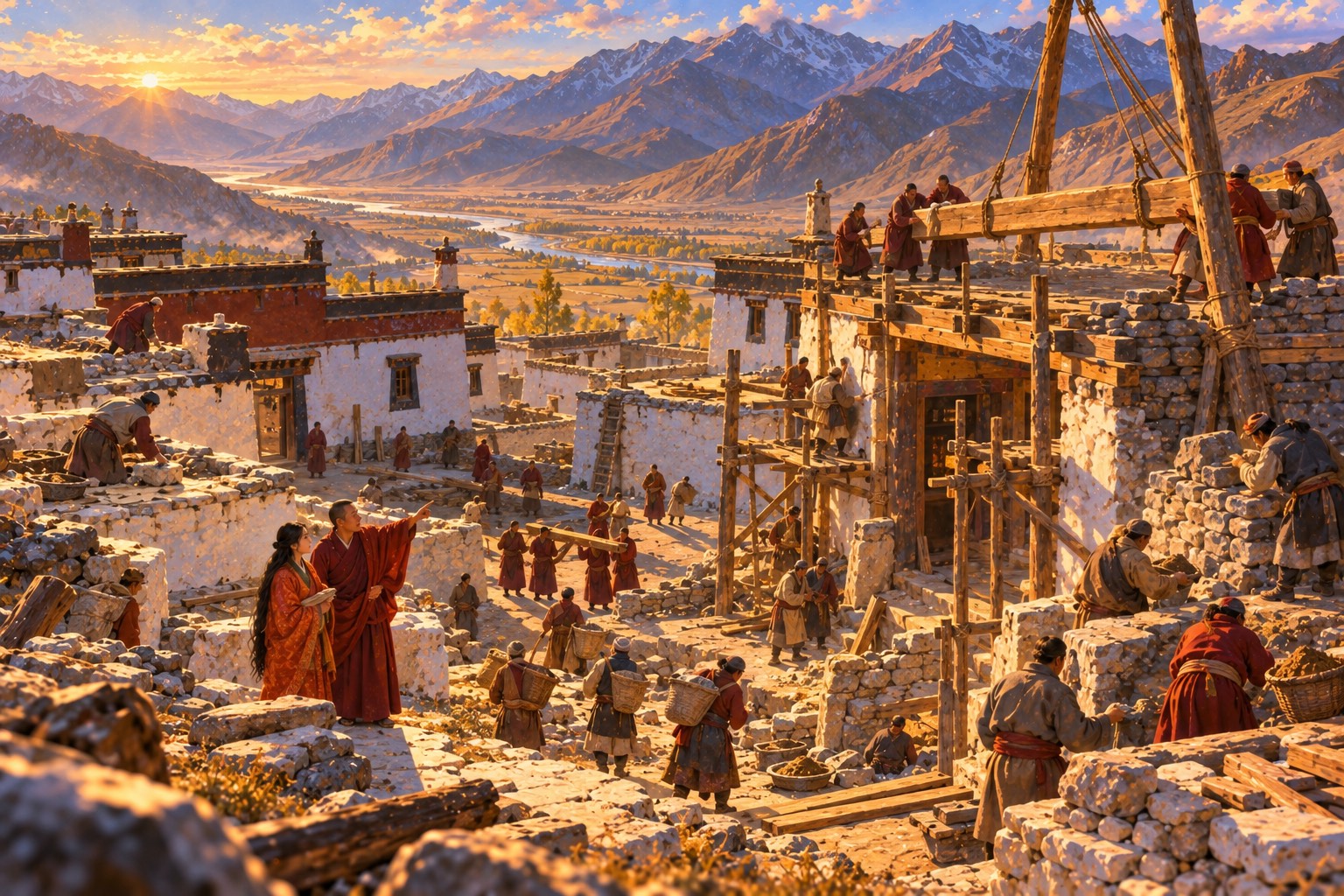
When word came that it was safe, she went home. She was about twenty, and Mindrolling lay in ruins. Her biography says she oversaw the first repairs herself, and that Rinchen Namgyal took over the building work after he returned.

The work took years and much help. The nobleman Polhané, who later ruled Tibet, gave the largest share of the funds. The buildings were repaired, and the community of monks gathered again. Mindrolling's histories give the brother and sister the credit together.
Many Tibetan monasteries were rebuilt after wars. It is rarer to know that a woman stood at the center of the work. The Seventh Dalai Lama, whom she came to know, gave her a further name, Sherab Drönma.
The lamp passes on
In 1732, at about thirty-three, she gave her father's collected works to more than 270 disciples. She also gave the Nyingtik Yabzhi, a great collection of Dzogchen teachings. She gave empowerments, ceremonies that formally open a practice to a student. She gave reading transmissions, in which a lineage holder reads a text aloud so that it is passed on, and she gave explanations. Mindrolling credits her with keeping those lineages unbroken.
Over the following decades she held large teachings across central Tibet for nuns, monks, nobles and ordinary lay people. In 1736 a famous lama proposed that she become his partner in practice. She declined, explaining that her father had asked her to remain celibate for the sake of the Dzogchen teachings.
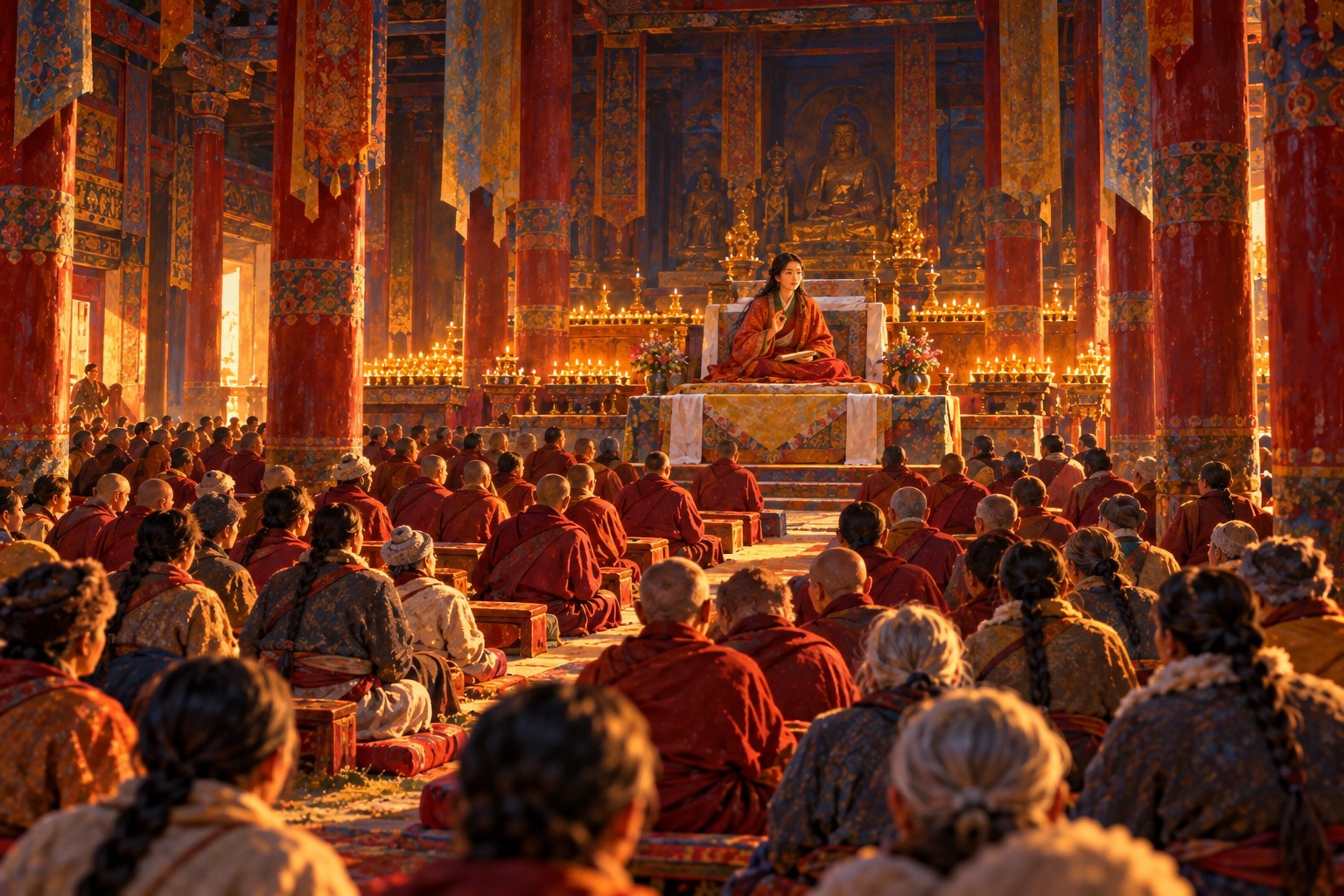
She founded a nunnery called Samten Tse a short distance from Mindrolling and spent much of her later life there, practicing, teaching and writing. A few of her writings, among them a prayer of aspiration for Dzogchen practice, can be read in English on Lotsawa House.
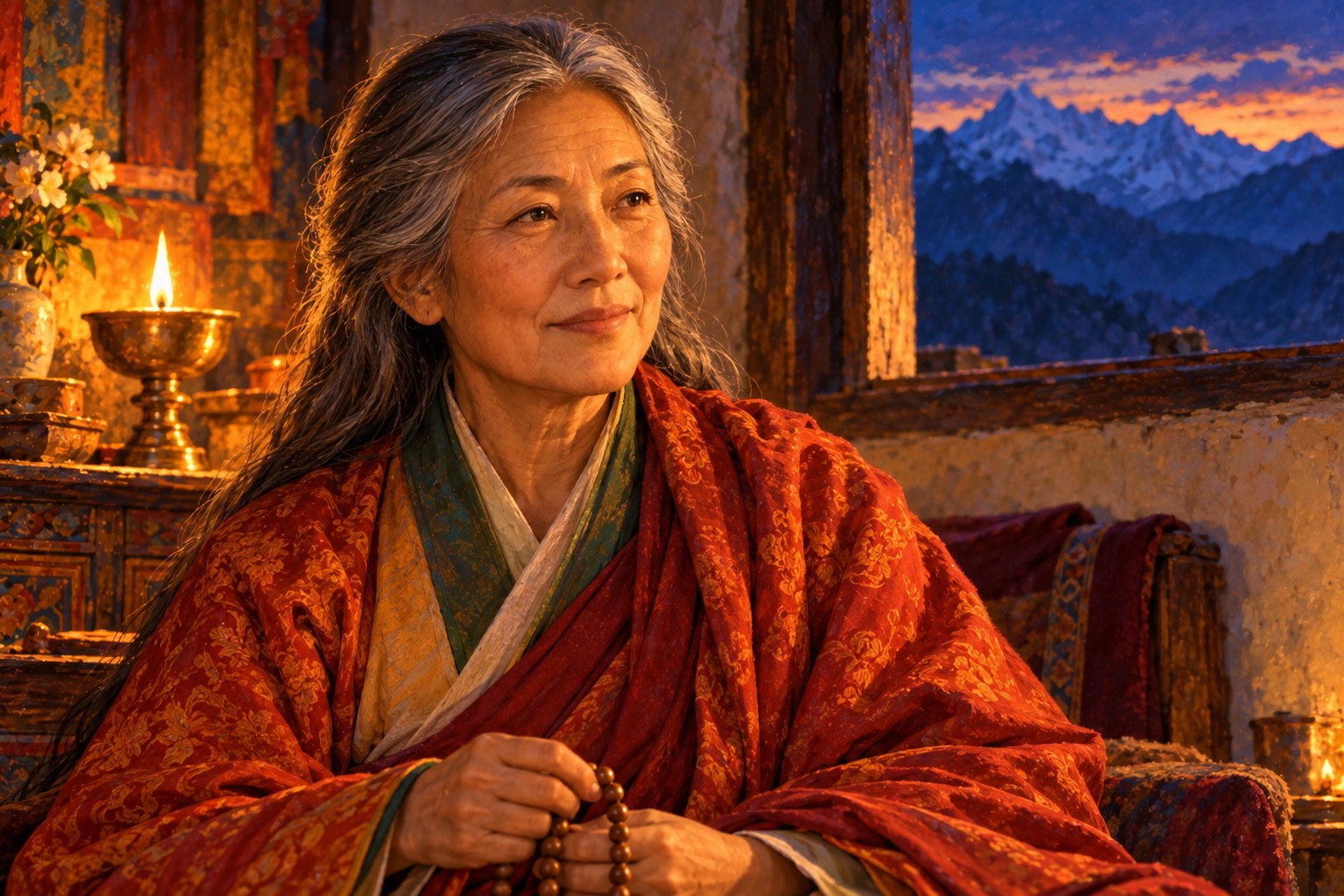
She died in 1769, at seventy. The biography says that even in her last months she taught gatherings of hundreds. As Tibetan life stories often do for great teachers, it reports rainbows and other signs at her passing. For several years afterward, her memorial was held on days devoted to Guru Rinpoche.
Mindrolling remembers her as the first of its jetsünmas, the women teachers of its founding family, a line that continues today.
An unchanging lamp
Did she recite the Seven-Line Prayer? No source I found says so directly. But she was named on a Guru Rinpoche day, at a monastery that kept his practice every tenth day, and her life story credits his compassion with carrying her through her darkest days.

Her name means an unchanging lamp. Through exile, a ruined home and decades of patient teaching, she kept her father's lineages alight, and she passed them on to many others.

About the art
Mingyur Paldrön is shown as she appears in a lineage mural at Mindrolling Monastery in India, photographed for Himalayan Art Resources: a woman with long black hair parted in the middle and no hat, in a red-orange robe with a faint gold pattern, her right hand raised at her heart in the gesture of teaching and a small folded text in her lap. Other images of her differ. A bronze shows her with a scholar's hat, a mural in Sikkim adds a fan-shaped hat and earrings, and one printed image shows her with a shaved head. No portrait from her own lifetime is known to the writer, so these pictures follow tradition, not a likeness.
Her father Terdak Lingpa is drawn after an early painting now in the Rubin Museum. He wears a lay master's white robes with an orange cloak and a blue lotus-shaped hat topped with a small golden vajra. He is shown with a square casket, the usual sign of a treasure revealer. His hat has no vulture feather, so it is not confused with Guru Rinpoche's.
Guru Rinpoche appears once, in his best-known form. He wears the lotus hat with a half-vajra and one vulture feather, holds a five-pronged vajra at his heart and a skull cup with a small long-life vase in his lap, and a slender staff, the khatvanga, rests against his left shoulder. The image does not record a vision of hers. It is a picture of the devotion her monastery kept on the tenth day of each lunar month.
The buildings of eighteenth-century Mindrolling and Pemayangtse are not described in detail in the sources, so they are drawn simply, from the general architecture of the period. The war is shown only through what it left behind: damaged walls and a long walk over a mountain pass.
Why this matters for practice
The sixth line of the Seven-Line Prayer expresses the wish to follow in Guru Rinpoche's footsteps, and Mingyur Paldrön's life shows what following can look like in hard times: carrying a lineage on foot over a mountain pass, rebuilding what was broken, and teaching patiently for decades. She was named on a Guru Rinpoche day, at a monastery that kept his practice every tenth day of the month. One recitation, offered on a tenth day or any day, joins that same current of devotion.

If something in this story stays with you, you might pause tonight and recite the prayer once, for every teacher who kept a light burning so that it could reach you.
Sources and further reading
- The Tibetan Nun Mingyur Peldrön: A Woman of Power and Privilege, by Alison Melnick Dyer (2022), University of Washington Press, open-access edition on Manifold
- Female Masters of Mindrolling, Mindrolling (mindrolling.org)
- Jetsün Mingyur Paldrön, Rigpa Wiki (Internet Archive snapshot, 2010)
- Jetsün Mingyur Paldrön (author page), Lotsawa House
- Mindrolling lineage mural (item 51294), with the 'Female Teachers' set, Himalayan Art Resources
- Terdak Lingpa (Gyurme Dorje), item 65032, and the Terdak Lingpa set, Himalayan Art Resources
- Chögyal Terdag Lingpa, Mindrolling International
- Mindrolling Monastery, Wikipedia
- Pemayangtse Monastery, Wikipedia
- Mingyur Peldron, by Alison Melnick (2015), Treasury of Lives (Internet Archive snapshot, 2015)
- Lama Sangdü Series, Lotsawa House
This retelling is waiting to be read by a knowledgeable practitioner. Where the traditional accounts differ, the story says so; if you notice a mistake, please tell us through Share Your Story.