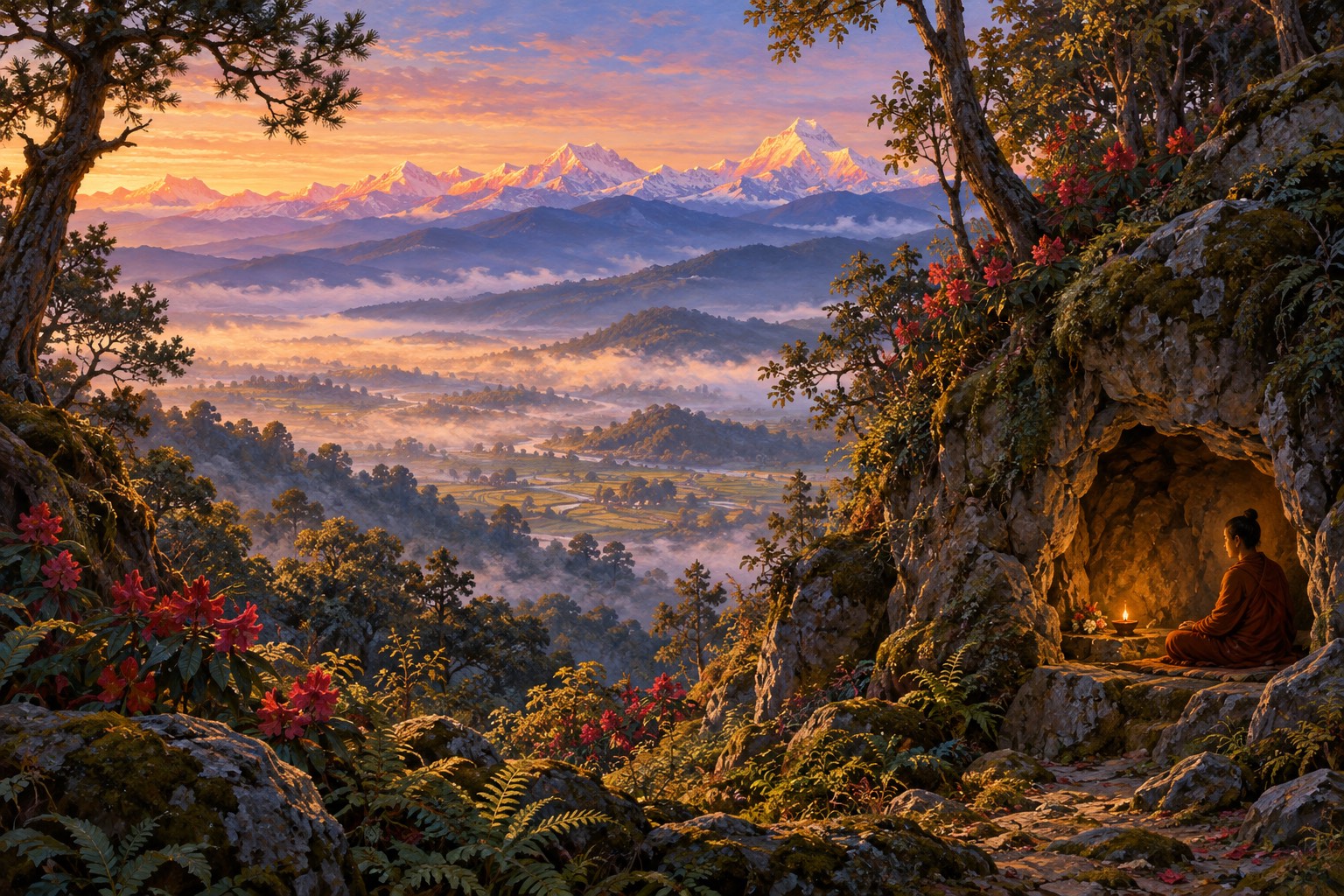
In the far south of Tibet, a little north of the mountains of Bhutan, two rivers meet beneath grey cliffs and a deep forested gorge. High in those cliffs are small caves. The traditional accounts say that a monk once lived in one of them, and that in the early light he could ride on the rays of the sun.
His name was Namkhai Nyingpo, which means something like "Heart of the Sky." He was one of the twenty-five closest Tibetan disciples of Guru Rinpoche, the circle Tibetans remember as "the king and subjects." That whole circle has its own page, The Twenty-Five Disciples. This one walks a little further down his road alone.
A son of the Nub clan
Traditional sources, as Rigpa Wiki gathers them, say he was born into the Nub clan, at a place called Nyang Karda Shambu. Another great master of the same clan, Nubchen Sangye Yeshe, has his own story on this site. The two are easy to confuse, but they are different men.
When the abbot Shantarakshita ordained the first Tibetan monks at Samye, Tibet's first monastery, Namkhai Nyingpo was among them. He became a disciple of Guru Rinpoche, and he learned the languages of India. Rigpa Wiki admits no one is sure which ones: perhaps Sanskrit, the spoken languages of India, or Newar, the language of the Kathmandu valley.
Five travellers
The Pema Kathang, a treasure biography of Guru Rinpoche revealed in the fourteenth century, says King Trisong Detsen sent him to India with four companions to seek teachings. Their names are kept: Drugu Epagsha, Rugyong Vira, Langchen Palseng and Dretsün Gyalwe Lodrö. Gyalwe Lodrö is himself remembered among the twenty-five.
 Illustration in preparation
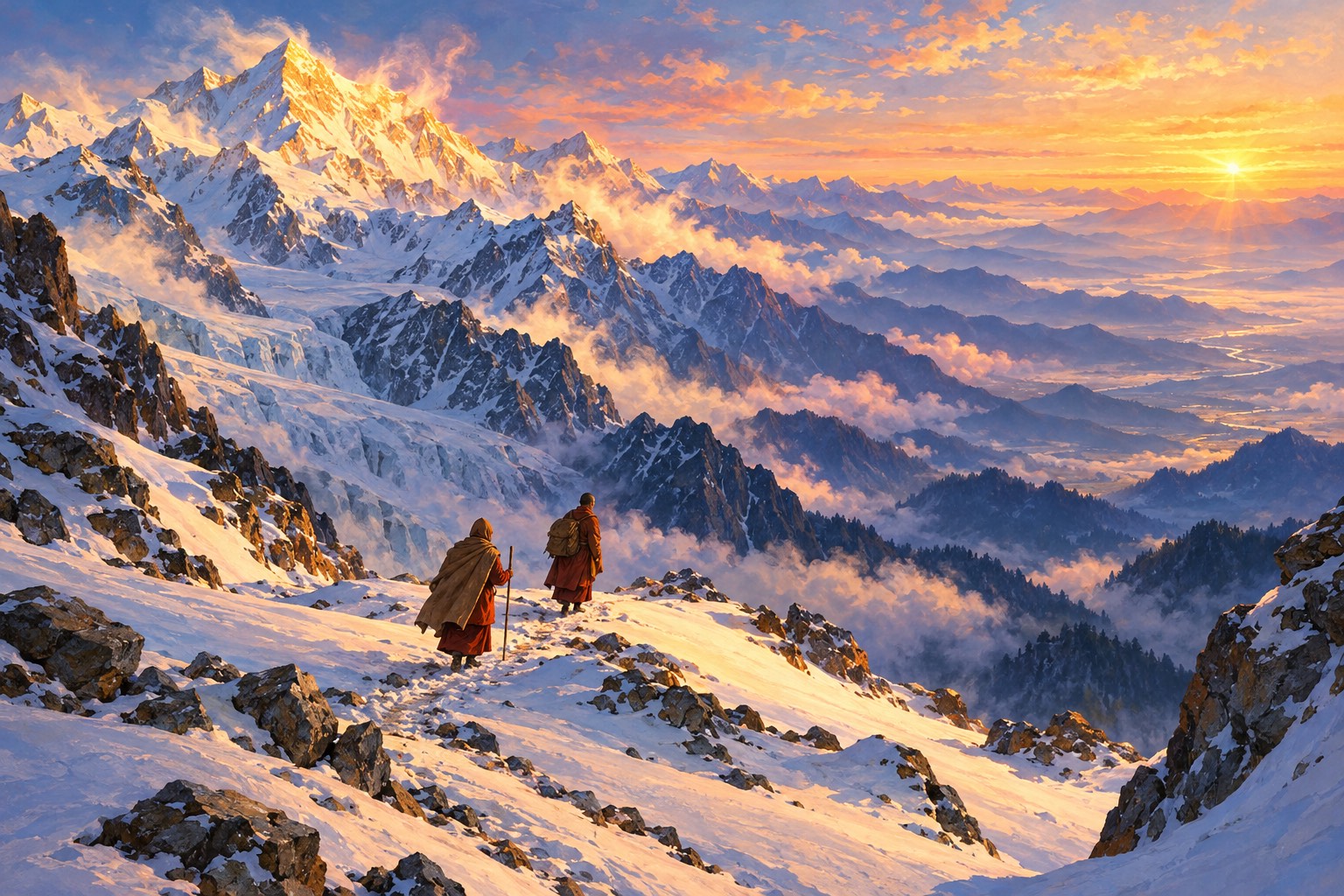
The summaries say little about the road, and this page will not invent it. It is enough to picture five young monks, a long way from home, looking for a teacher.
The teacher Humkara
They found one in Humkara. The Nyingma tradition counts him among the eight great vidyadharas of India, "awareness-holders," masters whose realization was complete. Rigpa Wiki, following Dudjom Rinpoche and the historian Taranatha, says he was born into a Brahmin family in the Kathmandu valley and became a monk at Nalanda, the great monastic university of northern India.
Illustration in preparationFrom Humkara, Namkhai Nyingpo received the practice of Yangdak Heruka, called Vishuddha in Sanskrit, a meditational deity who embodies the awakened mind of the buddhas. This page only names it. Its practice is received from a qualified teacher, and the Find a Teacher page can help.
Here the accounts differ a little. The Pema Kathang places his first meeting with this practice in India. Other sources, Jamgön Kongtrul among them, say Guru Rinpoche had already entrusted it to him at Chimphu, above Samye, before he ever set out. Rigpa Wiki puts it kindly: all the sources agree he was a close student of both masters.
A small trace of his work in India survives. The Tengyur, the Tibetan collection of Indian treatises, keeps one text he translated, written by Humkara himself. Its closing note says the translation was made at Nalanda, at the king's command, with the author there to guide it.
Illustration in preparationHe kept the teachings in a humbler way too. With the translator Kawa Paltsek he is remembered as a compiler of the Lhenkarma, one of the earliest surviving catalogues of the Buddhist texts translated into Tibetan: a careful list of everything that had crossed the mountains so far.
Home, and away again
Back in Tibet he grew close to the king. Rigpa Wiki says he served Trisong Detsen as both teacher and healer, and passed on to him the Yangdak teachings he had carried home.
Illustration in preparationComing home with something new is not always easy. Like his fellow traveller Vairotsana, whose story is told on its own page, Namkhai Nyingpo found that not everyone at court wished him well. Rigpa Wiki says ill-willed ministers had him exiled. A translator's note on Lotsawa House says it was the king who sent him away. The sources do not explain the difference, and this page will not guess.
Illustration in preparationEither way, he went south, to Lhodrak, a land of steep, secluded valleys whose name means "southern cliffs."
Illustration in preparationThe cave of the awakened mind
The pilgrimage guide Nekhor describes Kharchu as cradled between two rivers, the Kuru-chu and the Tamzhol-chu, which meet beneath it. It says Guru Rinpoche himself practised Yangdak there and blessed the caves as one with his own awakened mind, and that at Chimphu he had told Namkhai Nyingpo to practise there too.
So in the tradition's telling, the road of exile led him exactly where his teacher had pointed. Pilgrims are still shown Guru Rinpoche's long cave there, called Chakpurchen. Nekhor says that just to its left are the caves where Namkhai Nyingpo attained liberation.
Illustration in preparationHe stayed and practised. Rigpa Wiki says that through this retreat he reached the same realization as his teacher Humkara, so that he became, as it were, Humkara's Tibetan counterpart. Centuries later, in 1956, the master Jamyang Khyentse Chökyi Lodrö passed through Kharchu and wrote a praise of the place that names Namkhai Nyingpo above all those who practised there.
Riding the sun
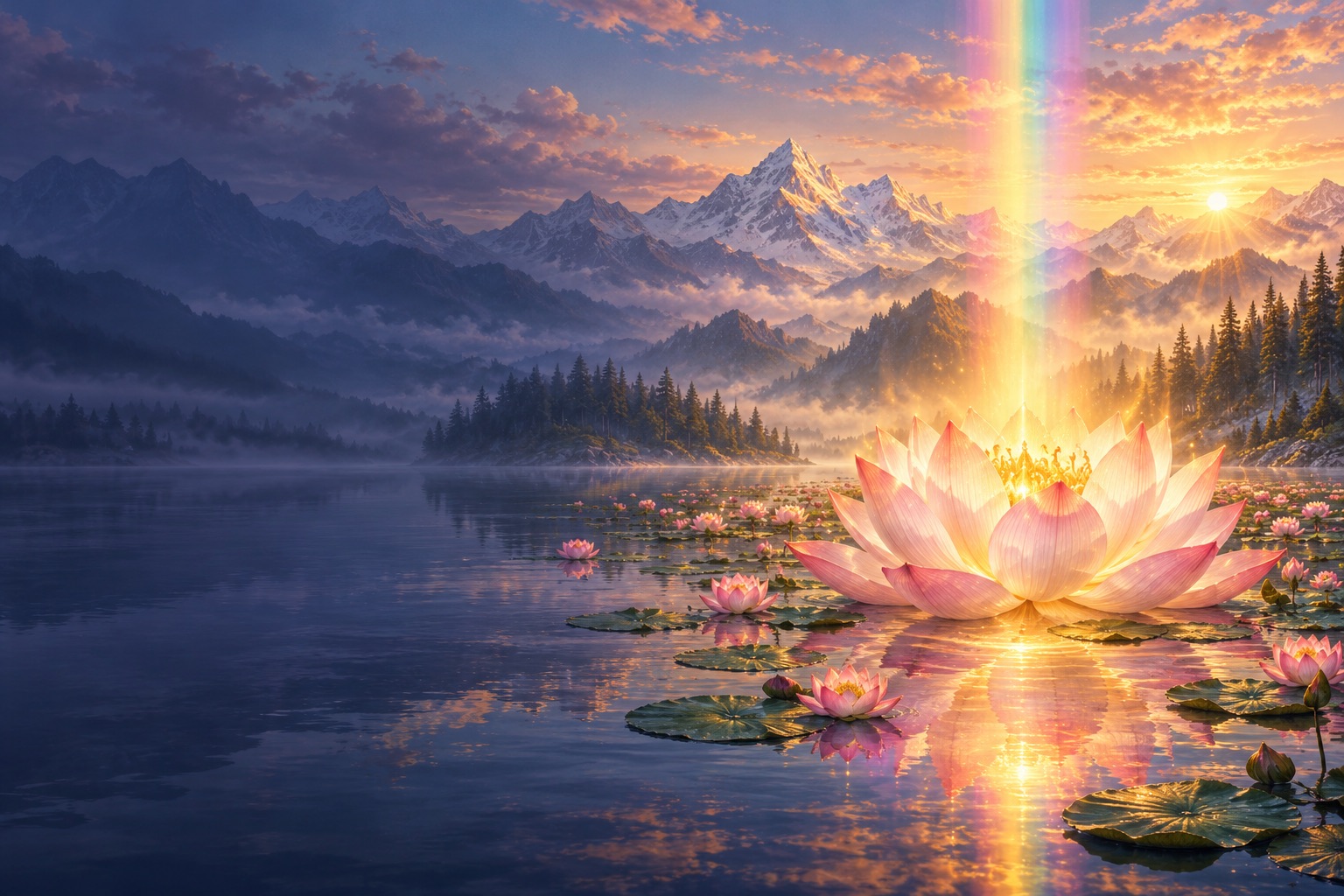
The traditional accounts say that, as a sign of his realization, he could fly through the sky riding the rays of the sun. Painters have shown him that way ever since: a slight monk in red robes, seated on a thin beam of light that rises from the disc of the sun. A prayer to the twenty-five by Changdak Tashi Tobgyal calls on him as the one "who rides the rays of the sun."
Illustration in preparationWe do not need to explain the story in order to keep it. It is a gentle picture: no armour, no weapons, nothing to fight, only a monk and the morning light. Perhaps it is also a picture of his name, a heart as open as the sky.
Kharchu did not stay empty. Yeshe Tsogyal came there, the accounts say, and her own page tells that part. Nekhor names Vairotsana and, centuries later, Nyangral Nyima Özer and Guru Chöwang among those who practised there. The note on Lotsawa House adds that Kharchu monastery later became the seat of Namkhai Nyingpo's own rebirths.
A prayer he asked for
One more thread ties him to Guru Rinpoche, and to anyone who prays. The Le'u Dünma, the Prayer in Seven Chapters, is a treasure revealed in the fourteenth century by Tulku Zangpo Drakpa. Most of its chapters are prayers Guru Rinpoche is said to have given when a disciple asked. The fourth was requested by Namkhai Nyingpo.
Illustration in preparationIn it, as the Lotsawa House translation gives it, he asks for a prayer to the masters of the lineage. Guru Rinpoche answers with a long chain of teachers, one stream of teaching after another, each verse returning to a prayer to the Lotus-born Guru of Orgyen. Humkara's name is in that chain. The student's request kept his own teacher in the prayer.
At the very end, Guru Rinpoche tells Namkhai Nyingpo to recite the prayer continually. Of everything in this story, that is the one part any of us can do today.
Light at the end
No one knows his exact dates; Rigpa Wiki places him in the eighth and ninth centuries. But a very old voice may remember his passing. The scholar Matthew Kapstein translated a short passage from a manuscript found in the sealed library cave at Dunhuang, on the Silk Road, which tells of lights appearing when Namkhai Nyingpo died.
Illustration in preparationKapstein notes that these lights closely resemble the signs told of at the passing of masters of the Great Perfection, the tradition's teaching on the mind's own awake nature. It is a small, quiet witness from more than a thousand years ago.
Illustration in preparationAbout the art
Namkhai Nyingpo is shown as a slender, shaven-headed monk in the ochre-red robes of the first Tibetan monks, with no hat; that keeps him distinct from Vairotsana, whom paintings give a pointed red scholar's hat. The image of him seated on a thin beam of sunlight rising from the sun's disc follows how traditional paintings show him, among them a nineteenth-century initiation card in the Shechen archives catalogued by Himalayan Art Resources. We painted him calm and seated, never in a flying pose, because the tradition presents this as a sign of realization, not a feat.
Humkara is drawn as an Indian monk-scholar of Nalanda, bareheaded and in Indian monastic robes with the right shoulder bare, because the sources we read describe him as a monk ordained there. Traditional paintings of the eight vidyadharas may show him differently, and we could not consult them. Nalanda appears as its excavated monasteries suggest: red-brick courtyards ringed with monks' cells, a shrine chamber facing the entrance, palms and ponds around it. The palm-leaf pages and the Dunhuang scrolls are always closed, since this site never paints script.
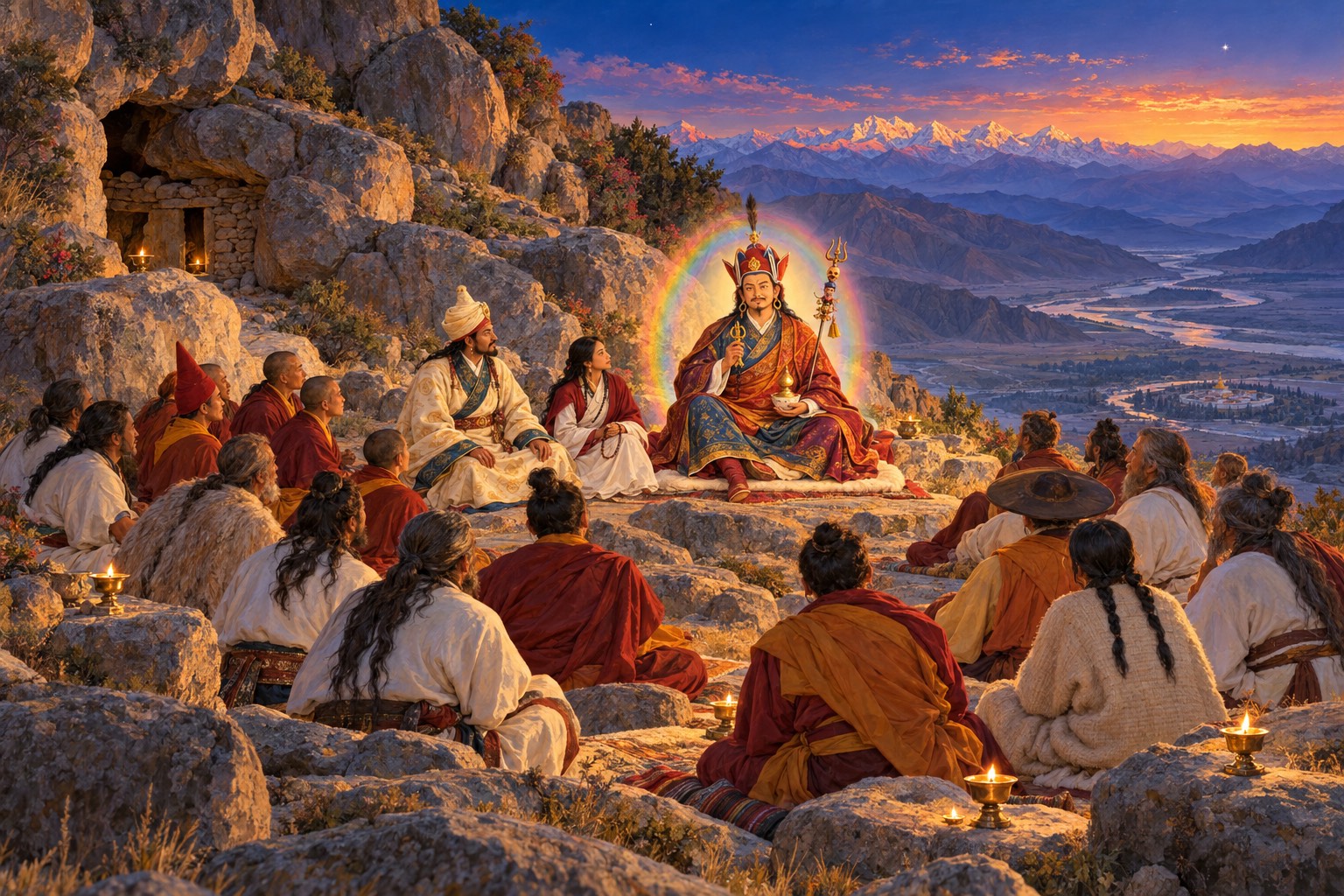
Guru Rinpoche appears once, in his main form with the lotus hat, at Chimphu, the mountainside above Samye where several accounts place his teaching of the twenty-five. Kharchu is shown as the tradition remembers it in the eighth century: caves in grey cliffs above a forested gorge where two rivers meet, with no monastery, prayer flags or carvings, because the buildings there came centuries later.
Why this matters for practice
The fifth line of the Seven-Line Prayer pictures Guru Rinpoche surrounded by his retinue, and Namkhai Nyingpo is one of the human faces of that retinue: a student who travelled, studied, was sent away, and practised where his teacher had pointed. He is also remembered as the one who asked Guru Rinpoche for a prayer, and was told to recite it continually. Reciting the Seven-Line Prayer, even once, is a small way of standing in that same circle.
If something in this story stayed with you, the five young travellers, the exile who found his teacher's cave, or the monk in the morning light, you might pause and recite the prayer once, as he was told to. For Yangdak, and for anything beyond recitation, a qualified teacher is the right guide.
Sources and further reading
- Namkhé Nyingpo, Rigpa Wiki (archived snapshot)
- Humkara, Rigpa Wiki (archived snapshot)
- Le'u Dünma, Rigpa Wiki (archived snapshot)
- Le'u Dünma – Chapter 4: The Prayer Requested by Namkhe Nyingpo, Lotsawa House
- Prayer to the King and Twenty-Five Disciples, by Changdak Tashi Tobgyal, Lotsawa House (Samye Translations, trans. Stefan Mang, 2016)
- Praise and Prayer to Kharchu, Great Sacred Place of Lhodrak, by Jamyang Khyentse Chökyi Lodrö, Lotsawa House (trans. Adam Pearcey, 2018)
- Lhodrak Kharchu, Nekhor
- Namkhai Nyingpo, The Treasury of Lives (archived snapshot, 2019)
- Initiation Cards: Longchen Nyingtig Terma Cycle, item 52848957, Himalayan Art Resources (archived snapshot)
- Nalanda mahavihara, Wikipedia
- The Life and Liberation of Padmasambhava (Pema Kathang), revealed by Orgyen Lingpa, Dharma Publishing, 1978
- Matthew Kapstein, 'The Strange Death of Pema the Demon Tamer', in The Presence of Light (2004), University of Chicago Press
This retelling is waiting to be read by a knowledgeable practitioner. Where the traditional accounts differ, the story says so; if you notice a mistake, please tell us through Share Your Story.