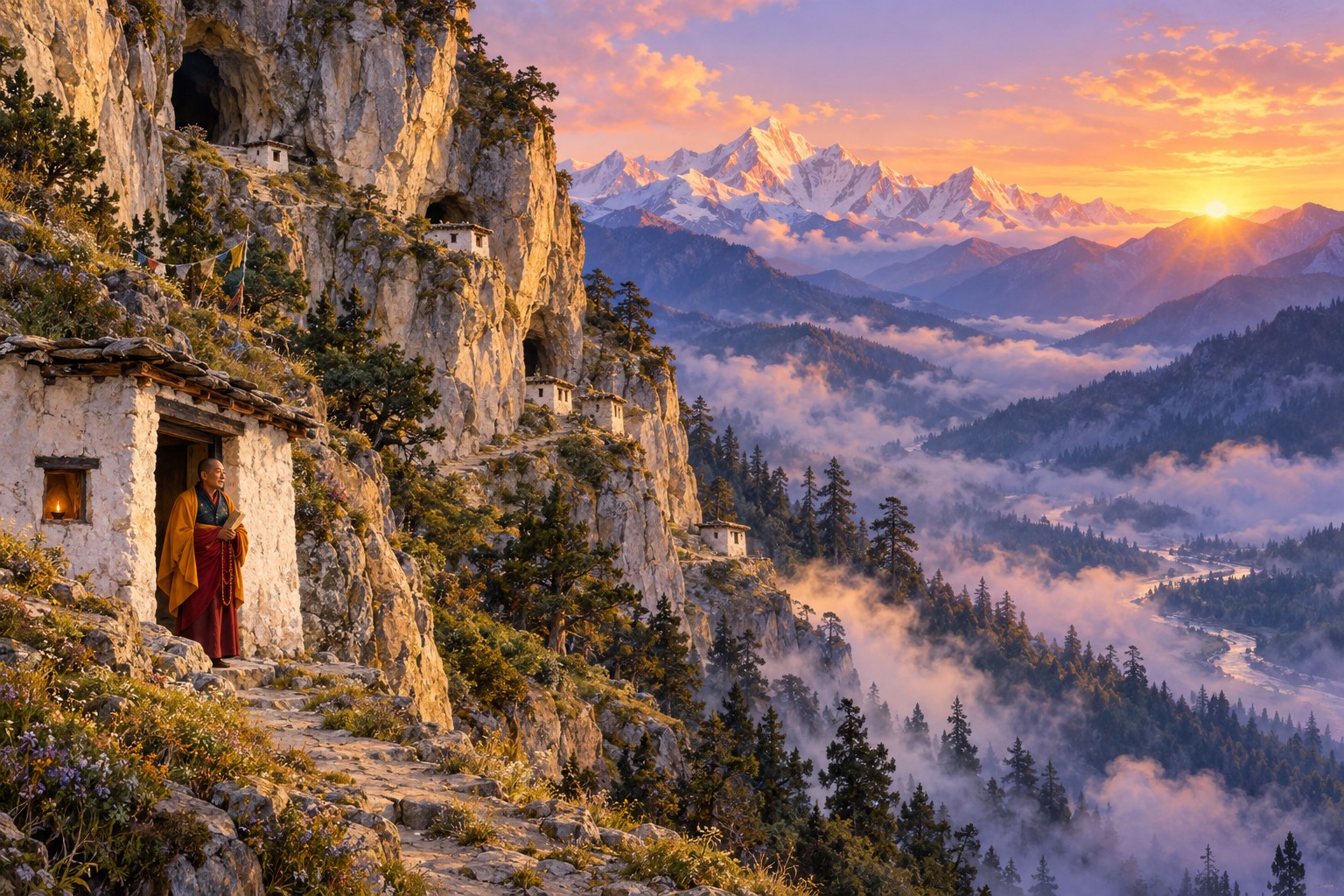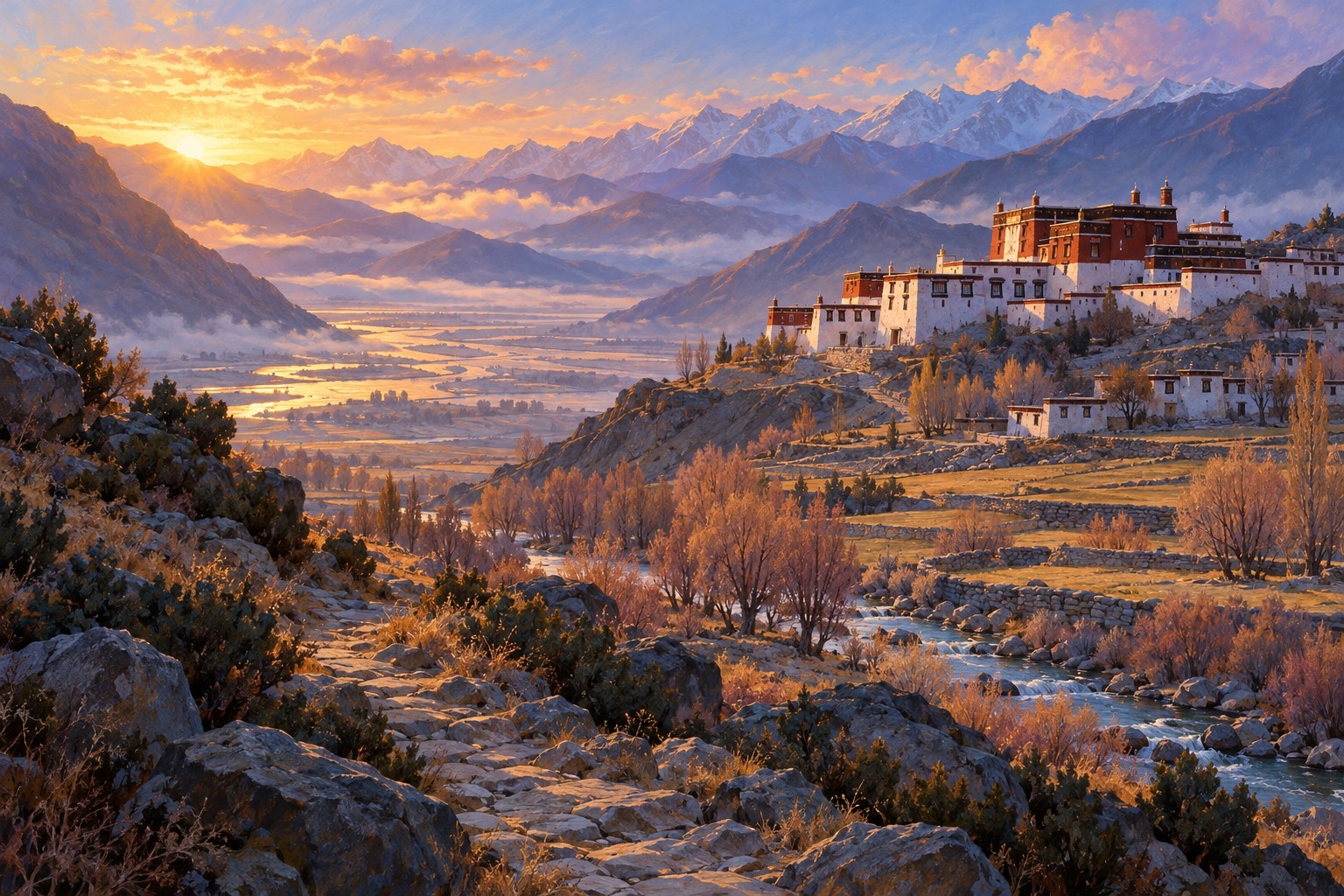
In the high valleys of Derge, in Kham in the far east of Tibet, there is a monastery called Shechen. It is one of the six great "mother monasteries" of the Nyingma, the oldest school of Tibetan Buddhism and the school of the Seven-Line Prayer to Guru Rinpoche.
Its full name is Shechen Tennyi Dargye Ling, which means roughly "the place where the two teachings flourish." Two lamas, one after the other, gave it life. Both carried the title Rabjam, "vast learning." This is their story, and the story of what grew from their work.
A runaway scholar
The first was Tenpai Gyaltsen, born in 1650 in central Tibet to a powerful family. The Treasury of Lives, an online encyclopedia of Tibetan lives, says that at thirteen he ran away from home to study.
 Illustration in preparation
He studied first at a monastery of the Sakya school, then at colleges of the Geluk school. He became a novice monk and earned the title Rabjampa, given to scholars of very wide learning.
Illustration in preparationWhile he was serving a close aide of the Fifth Dalai Lama, he went to hear teachings at Yerpa, a place of cliff caves north of Lhasa. The teacher was Dzogchen Pema Rigdzin, whose life is told in Story 48, "Pema Rigdzin and the Valley of the Great Perfection."
Tenpai Gyaltsen took him as his teacher for life. Rigpa Wiki says he received from him the Nyingtik, the "heart essence" teachings of the Great Perfection, the Nyingma name for recognizing the true nature of mind. Such teachings are given by a teacher in person, and this story only tells where they were taught. Soon people called him Dzogchen Rabjam.
Illustration in preparationA small beginning in Kham
The Treasury of Lives says the Fifth Dalai Lama sent Tenpai Gyaltsen east with his teacher, to help found Dzogchen Monastery. At some point during that work, the same account says, he moved a little way off and began a community of his own.
Here the dates part ways, and it is kind to say so. One history gives 1690 and the name Shechen Orgyen Chödzong: an assembly hall and monks' quarters, with a first abbot remembered as Pema Wangchuk, the "Laughing Lama." Shechen's own website and Rigpa Wiki give 1695. An earlier Treasury of Lives page says the place was built on a hermitage made in 1692 by Nyima Drakpa, another of Pema Rigdzin's disciples.
Illustration in preparationTenpai Gyaltsen did not stay long. The king of Derge offered him a monastery of the Karma Kagyu school, and he lived there for some years. He left when its monks made plain that they did not want a Nyingma lama in charge. He chose to spend the rest of his life in retreat.
Then, in 1697, word came that Pema Rigdzin had died. Tenpai Gyaltsen went back to Dzogchen to help with the funeral rites. He stayed there until his own death in 1704.
Illustration in preparationThe boy who came back
Around 1717 a small boy was recognized as Tenpai Gyaltsen's rebirth. He was the younger brother of the Second Dzogchen Rinpoche, and he was given the name Gyurme Kunzang Namgyal. The Treasury of Lives dates his birth to 1713; Rigpa Wiki gives 1711. He was brought to the little community at Orgyen Chödzong, which needed its founder back.
He grew up learning from the heads of several mother monasteries: his own brother at Dzogchen; Rinchen Namgyal, the third throne-holder of Mindrolling; the Fifth Dorje Drak Rigdzin; and Drime Zhingkyong of Katok. Alexander Gardner of the Treasury of Lives says this shows how closely those great houses were bound together.
Illustration in preparationMindrolling, in central Tibet, had been founded by the treasure revealer Terdak Lingpa, whose story is Story 40, "Terdak Lingpa and the Island of Liberation." He and his brother had gathered and set in order the Nyingma's oldest lines of teaching. Through Rinchen Namgyal that inheritance reached the young Rabjam in Kham.
Tennyi Dargye Ling
Around 1734 or 1735, when he was just over twenty, the Second Rabjam built anew. Sources differ on whether he moved the old community or began a new one across the valley. Either way, it was called Tennyi Dargye Ling, and this is the Shechen that grew. Rigpa Wiki places it in the Wood Tiger year, when he was twenty-five by the Tibetan count.
Illustration in preparationSo Shechen has at least four founding years: 1690, 1692, 1695 and 1734 or 1735. Gardner writes that Tibetan monasteries often begin with a master and a few disciples and a small hut, and grow from there, so they often have more than one start date.
Rigpa Wiki, describing the six mother monasteries, says Shechen "unifies the kama and terma lineages." The kama are teachings handed down unbroken from teacher to student since the early days of Buddhism in Tibet. The terma are treasures, teachings Guru Rinpoche is said to have hidden for later revealers to find.
Lotsawa House, a library of translated Tibetan texts, keeps one work by the Second Rabjam in English: The Flight of the Garuda, a long aspiration prayer for the passage through death and rebirth, composed in 1758. He died in 1769.
Illustration in preparationA centre of learning
Shechen grew into a great centre of study and practice. Rigpa Wiki and Shechen's website both speak of about one hundred and sixty branch monasteries, and of its fame for its college, its hermits and its sacred arts of ritual, chant and dance.
Two lines of reincarnated lamas grew up there. The Rabjams continued; Rigpa Wiki counts seven. A second line, the Shechen Gyaltsaps, or "regents," began in the eighteenth century with Gyaltsap Pema Sangak Tenzin (1760–1817).
Lotsawa House keeps a prayer to Guru Rinpoche revealed as a treasure by the Fourth Rabjam, Garwang Chökyi Gyaltsen (1811?–1862). Its note says the present Rabjam Rinpoche has recommended it in times of crisis.
Illustration in preparationMipham's Shechen
In the nineteenth century, the movement later called Rimé, "without bias," gathered teachings from every school of Tibet, and Shechen's lamas were among its teachers. Rigpa Wiki says Jamgön Kongtrul, one of its founders, studied with Gyurme Thutop Namgyal of Shechen. Jamyang Khyentse Wangpo, another, wrote a short prayer to the same lama, among his prayers to his own teachers.
Both became teachers of Jamgön Mipham, the master who wrote the White Lotus commentary on the Seven-Line Prayer. Mipham had become a novice at twelve at Ju Mohor, a branch of Shechen. Rigpa Wiki names his chief disciple as Shechen Gyaltsap Pema Namgyal, the fourth of the regents. Mipham's own story is Story 12, "Mipham and the White Lotus."
Illustration in preparationThat Gyaltsap became the root teacher of Dilgo Khyentse Rinpoche (1910–1991), who entered Shechen at eleven, Rigpa Wiki says, and later spent years in a hermitage above the monastery.
Ruin, and lamps lit again
In the late 1950s Shechen and its branch monasteries were destroyed. Shechen's website dates this to 1957, and says 110 branch monasteries were razed with it. Rigpa Wiki says its three main lamas of that time died in Chinese prisons.
Illustration in preparationIn exile, Dilgo Khyentse Rinpoche began a new Shechen Tennyi Dargye Ling in 1980 at Boudhanath, near the great stupa outside Kathmandu in Nepal. His grandson, the Seventh Shechen Rabjam, has been its abbot from the start.
Shechen's website says craftsmen, painters and sculptors worked for almost ten years on the new monastery, and that its temple walls were painted with the history of all four schools of Tibetan Buddhism. The website adds that the earthquakes of 2015 destroyed the walls that carried those paintings. Rigpa Wiki says the great communal practices and sacred dances of the old Shechen were revived there, with care for every detail.
In 1985, after more than twenty-five years away, Dilgo Khyentse Rinpoche went back to Kham and found only ruins. Shechen's website says the monastery there has since been rebuilt with his encouragement, and its college is full again.
The same name, the same dances and prayers, now live in two places.
Illustration in preparationAbout the art
The First Shechen Rabjam is drawn after an old woodblock print reproduced by the Treasury of Lives: a tall pointed scholar's hat with long lappets falling to the shoulders, monastic robes with a large shawl, and books beside him. The print has no colour, so the red hat and the saffron and maroon robes are our choice. As a boy and a young scholar he is drawn bareheaded.
The Second Rabjam follows his portrait in the murals of Shechen Monastery, shown on Lotsawa House: a red-orange hat with upturned pointed flaps, a saffron patchwork shawl with a brocade border, and the teaching gesture, thumb and forefinger joined. The flowers at his shoulders carry a flaming sword and a book, the emblems of Manjushri, the buddha of wisdom, and of learning. Mipham wears his blue-green vest and saffron shawl, as in Story 12, and Pema Rigdzin his orange-red hat, as in Story 48. Books are always shown blank.
The great bird on the wall in scene 9 is the garuda, a mythical bird of Indian and Tibetan art; it stands here only for the title of the Second Rabjam's prayer. Guru Rinpoche appears once, as a devotional image, in his main form: the lotus hat with the half-vajra and one vulture feather, the five-pronged vajra at his heart, the skull cup holding a long-life vase, and the khatvanga staff in the crook of his arm. The eighteenth-century buildings are a modest reconstruction, since no source used here describes them. No twentieth-century or living teacher is pictured.
Why this matters for practice
The Rabjams spent their lives following their teachers and then making a place where others could follow too, which is what the sixth line of the prayer asks: to follow in Guru Rinpoche's footsteps. Shechen gathered the teachings handed down since his time and the treasures he is said to have hidden, and its lamas wrote and revealed prayers to him. Its deeper teachings belong with a teacher, but the seven lines are open to anyone, and one recitation joins the same current.
If something in this story moved you, perhaps a runaway boy who loved learning, or a community that kept beginning again, you might pause and recite the prayer once. Your voice would join the prayers to Guru Rinpoche that Shechen's lamas have written, revealed and recited, in both its homes.
Sources and further reading
- Treasury of Lives: Nyingma Founders Part 6, Zhechen Monastery (Alexander Gardner), Tricycle: The Buddhist Review
- Shechen (institution page); The First Shechen Rabjam, Tenpai Gyeltsen; The Second Zhechen Rabjam, Gyurme Kunzang Namgyel (Samten Chhosphel), The Treasury of Lives (via web.archive.org)
- Shechen Monastery; Shechen Rabjam Tenpé Gyaltsen; Gyurme Kunzang Namgyal; Shechen Rabjam Incarnation Line; Shechen Gyaltsab Incarnation Line; Six "Mother" Nyingma Monasteries, Rigpa Wiki (via web.archive.org)
- Second Shechen Rabjam; Fourth Shechen Rabjam; Shechen Öntrul Gyurme Tutob Namgyal; Shechen Gyaltsab Gyurme Pema Namgyal, Lotsawa House
- Shechen Monastery, Tibet; Shechen Tennyi Dargyeling Monastery, Baudanath, Nepal, shechen.org
This retelling is waiting to be read by a knowledgeable practitioner. Where the traditional accounts differ, the story says so; if you notice a mistake, please tell us through Share Your Story.