From the beginning to the end
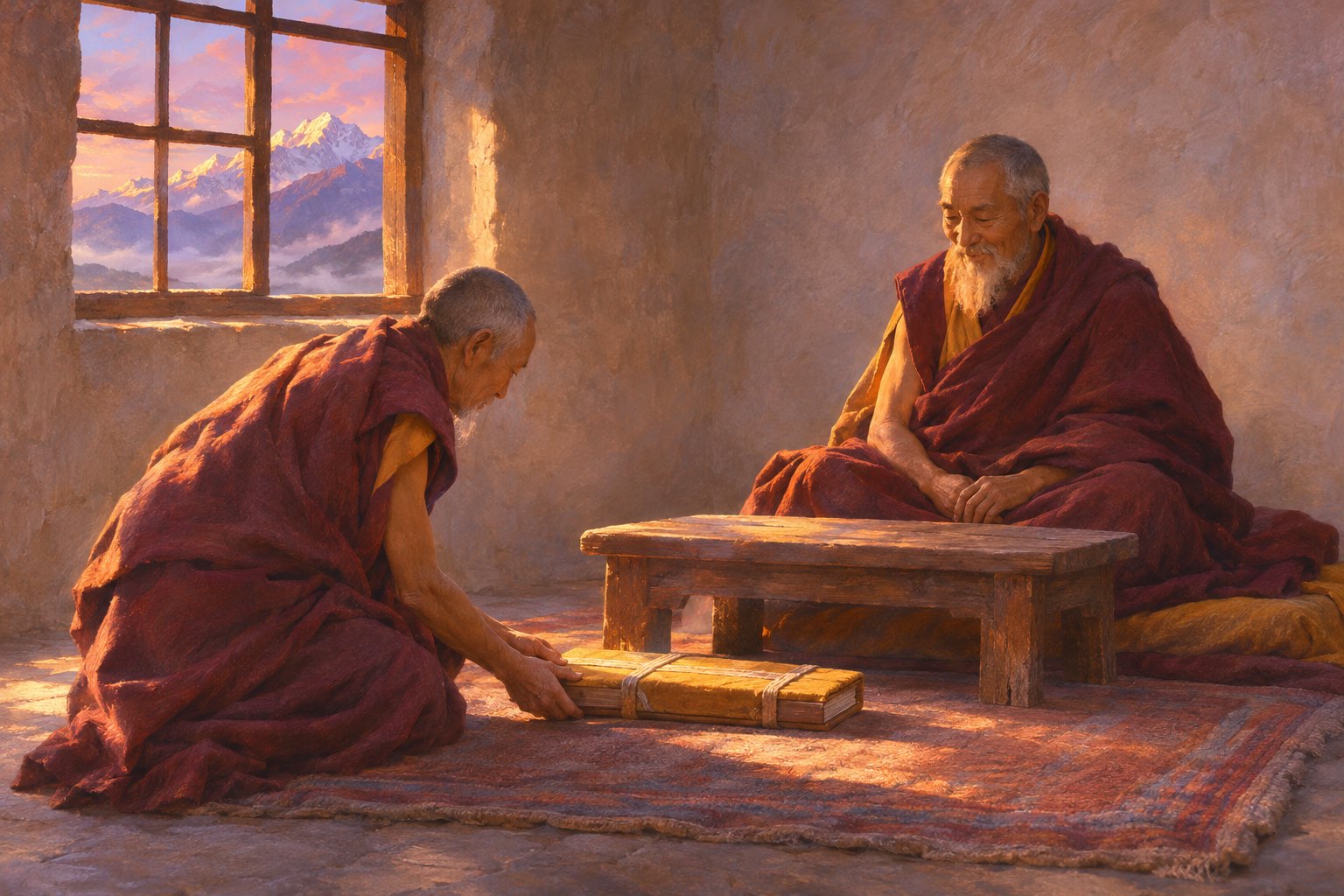
Jamgön Kongtrul gave Shechen Gyaltsab a reading transmission of the whole Treasury of Knowledge. Alak Zenkar’s biography remembers its completeness: the beginning and the ending were both included. It also remembers Kongtrul giving permission for the student to transmit the work onward.
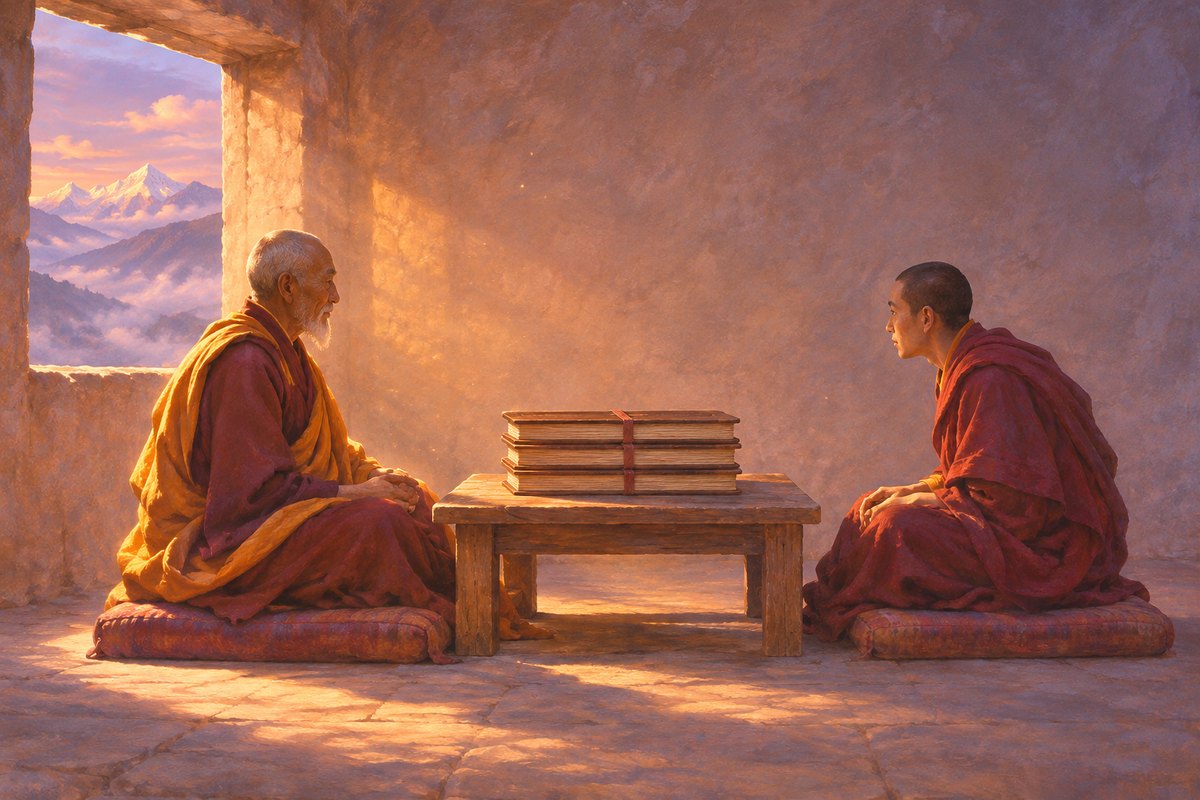
The painting shows two anonymous teachers beside a book. It does not attempt to recreate the precise ceremony. The relationship is the centre of the episode. Something large had been received, and with it came a responsibility toward people who were not yet in the room.
The uncle who taught reading
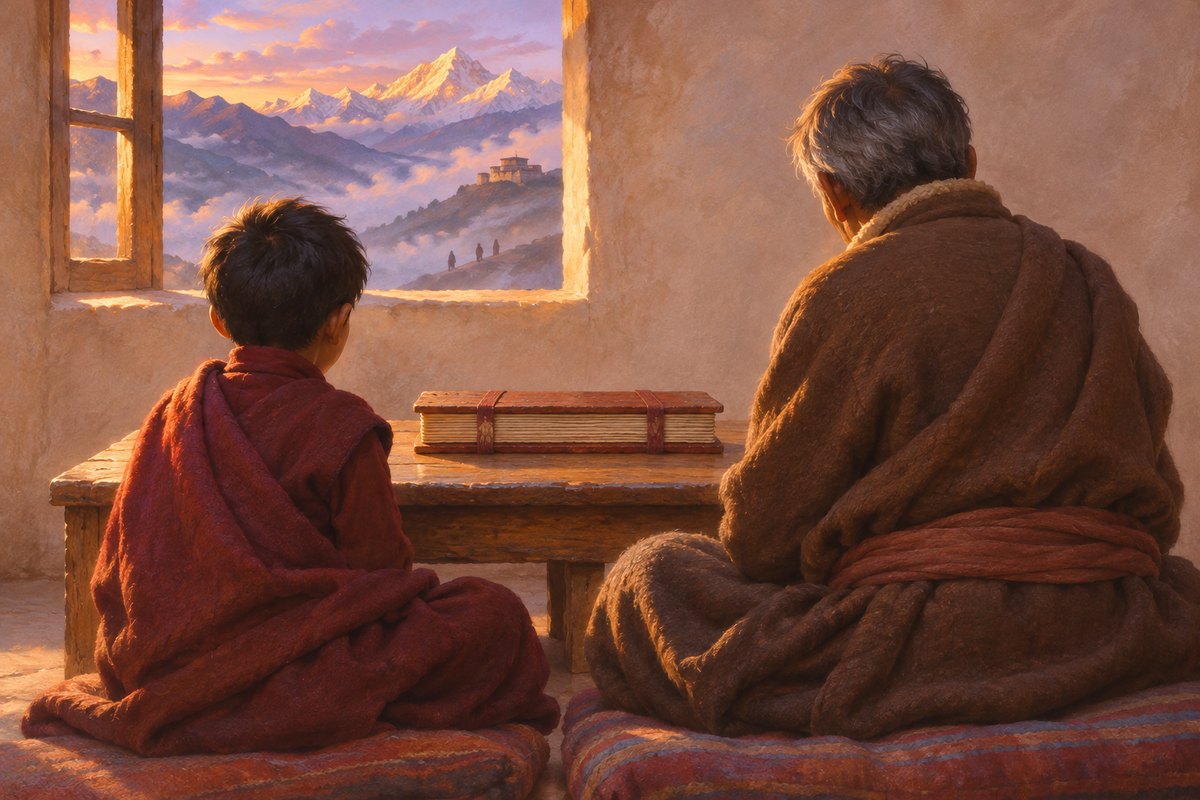
Before he could receive great collections, he had to learn to read. His uncle Pema Wangchen helped provide that early education. The biography’s account of a celebrated teacher therefore includes a familiar beginning: an older person sitting with a younger one over the work of learning.
The child in the illustration has no claimed facial likeness. The scene is not a recovered childhood memory. It gives space to the simple fact that reading is taught. The scholar later remembered through volumes and lineages began with someone willing to help him make sense of words.
More than one field
His education included grammar, poetry and other traditional sciences alongside religious study. A narrow picture of a teacher might omit those fields. The biography keeps them within the shape of his learning.
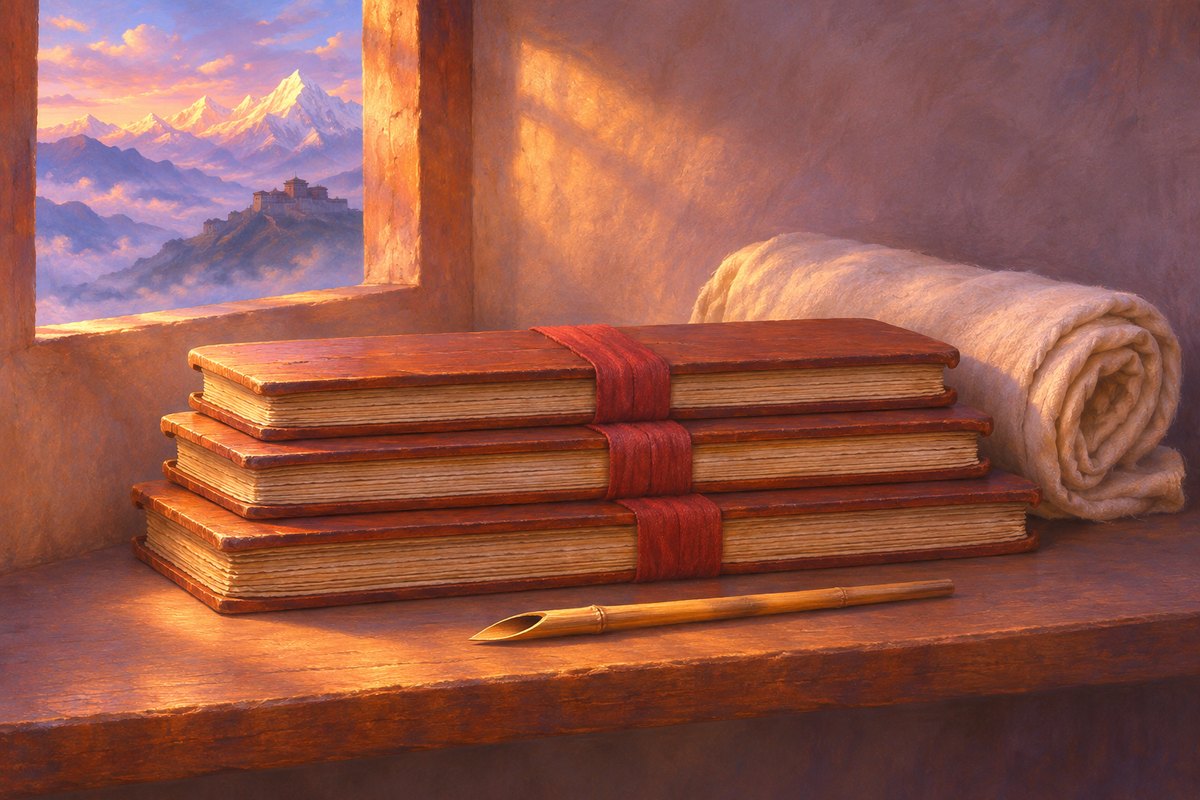
A grammar exercise and a great commentary do not have to compete for a place in the story. Attention to words can serve attention to meaning. The books on the shelf stand for that breadth without pretending to identify every volume he used. What would later seem a great store of knowledge was formed through many particular acts of study.

The teachers he followed
The record connects him with Jamyang Khyentse Wangpo, Kongtrul, Mipham, Patrul, Pema Vajra and other masters. Shechen Gyaltsab’s life belongs to the Nyingma tradition and to a period of rich exchange among Tibetan teachers.
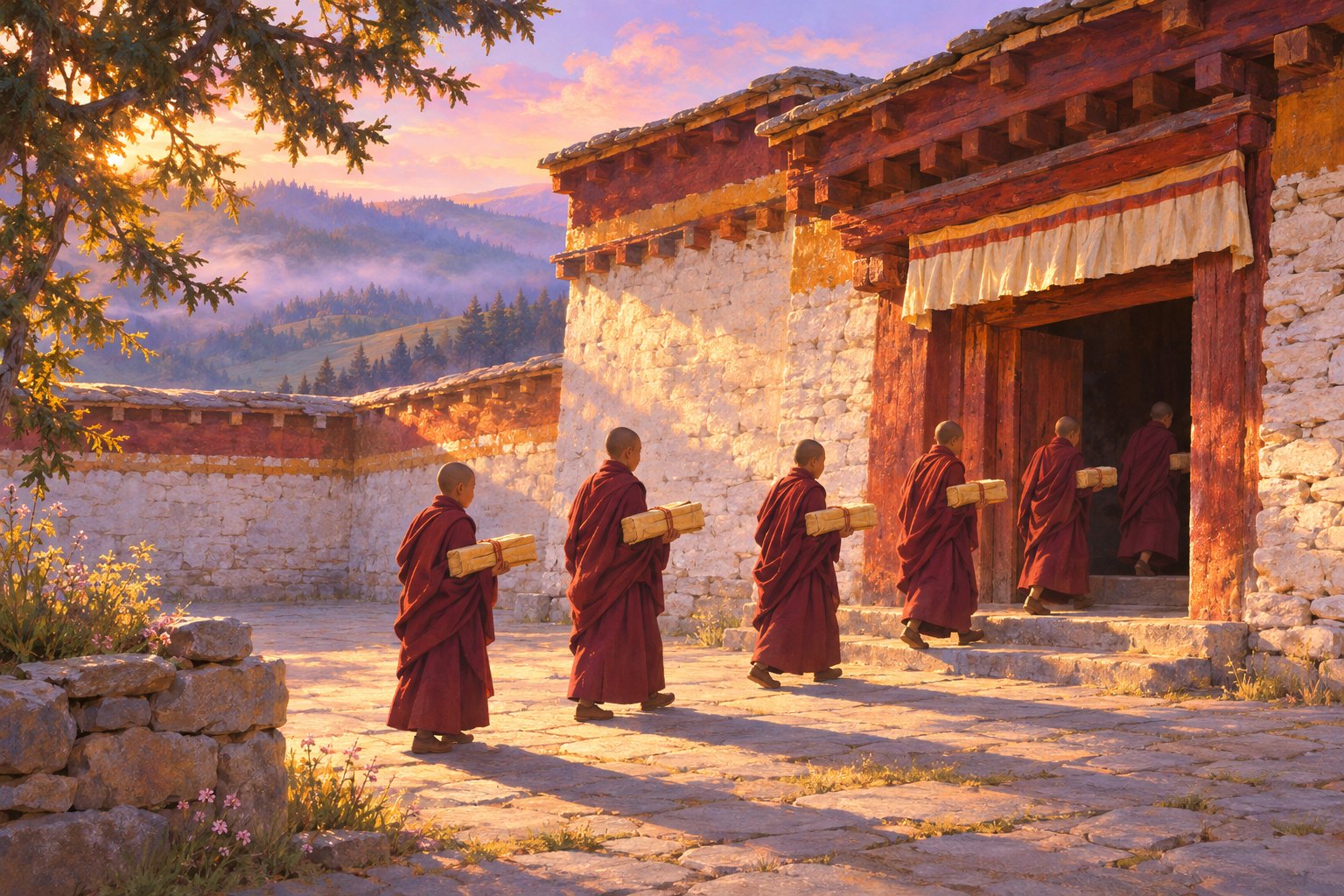
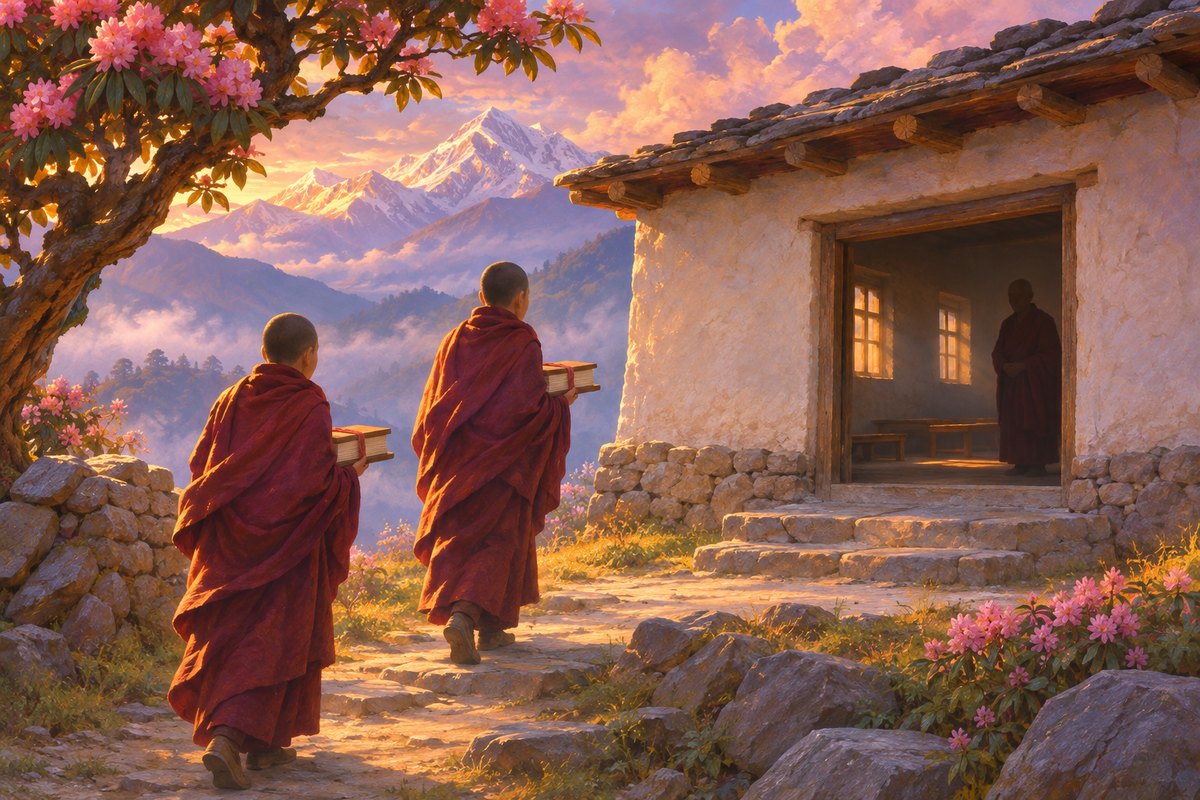
Those names can look like a completed list until one remembers that each relationship involved receiving. No student begins by possessing all that others can offer. The path between the modest buildings in the illustration is symbolic, but it holds that movement clearly: the future teacher goes to learn.
The whole Treasury
A transmission from beginning to end requires time. Even the phrase asks a listener to imagine remaining present after the opening has become familiar and before the conclusion is near. Kongtrul’s permission to teach it onward gives that reception a further direction.
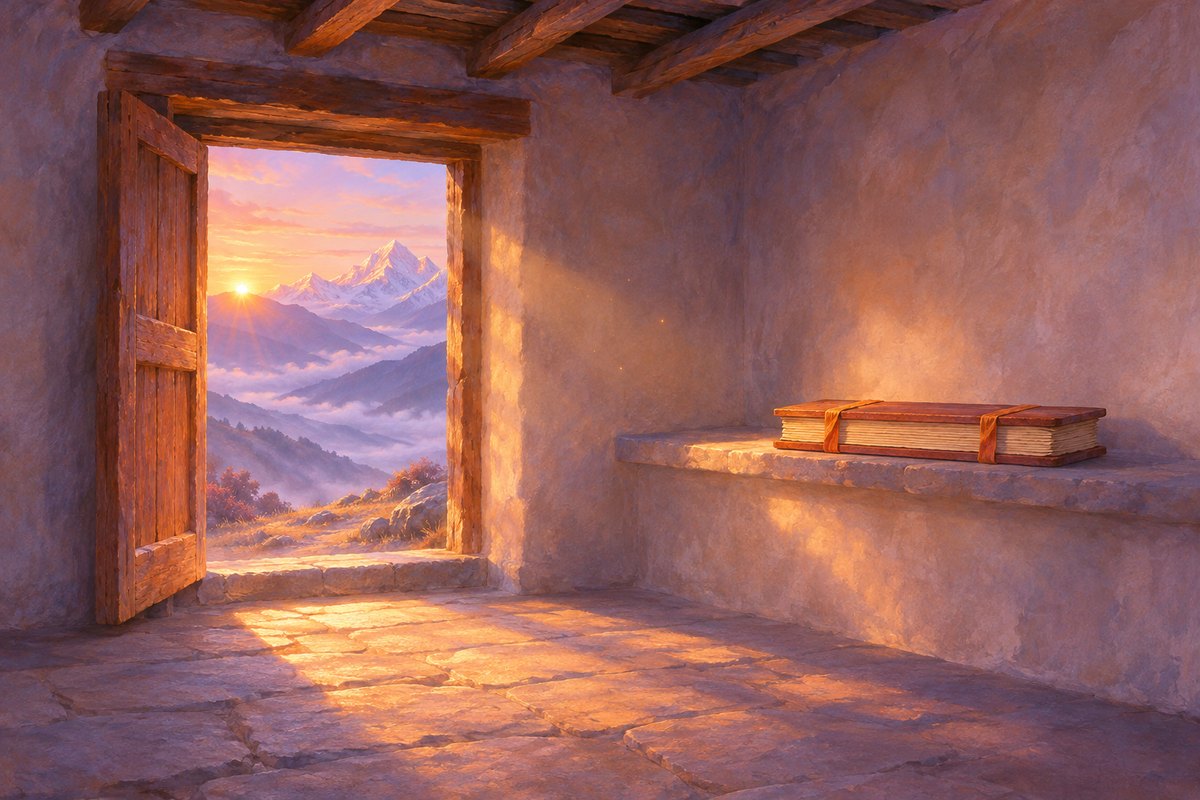
The three wrapped books in the scene illustrate the Treasury’s traditional three-volume form. They are not authenticated copies. The biographical episode matters because a collection of knowledge was entrusted through a personal relationship. Its future did not depend only on the survival of paper, but also on someone prepared to receive and transmit it.

The quiet part of the life
Alak Zenkar’s biography also remembers sustained practice. That part of the life should not disappear behind a catalogue of learning. The plain closed doorway in the painting leaves the interior private while allowing the years of commitment to remain in view.
The story offers no method for reproducing experiences attributed to a master. Nor can an image establish realization. What can be followed publicly is the shape of the account: listening and study were accompanied by practice, and later activity grew from more than the accumulation of information.
The students at the door
Among those who later learned from him were Khyentse Chökyi Lodrö and Dilgo Khyentse. The official Shechen account identifies him as a root teacher of Dilgo Khyentse, whose education brought him to Shechen while young.
The earlier student had become someone others approached. That change does not erase his own teachers; it extends their relationships into another generation. The figures in the illustration stay distant because the scene represents a teaching relationship, not a claim to recover the faces or exact arrival of particular people.

The writings he left
His collected writings fill thirteen volumes. In the biography, they include historical works, advice, prayers and treatments of fields of study as well as specialized religious subjects. The collection records a teacher’s response to many kinds of need.
A shelf of wrapped volumes can look still. Behind it lie occasions on which someone composed, explained or answered. The image does not display invented titles. It asks the reader to consider the work that becomes easy to overlook once a substantial collection is simply available to be named.
Learning made available
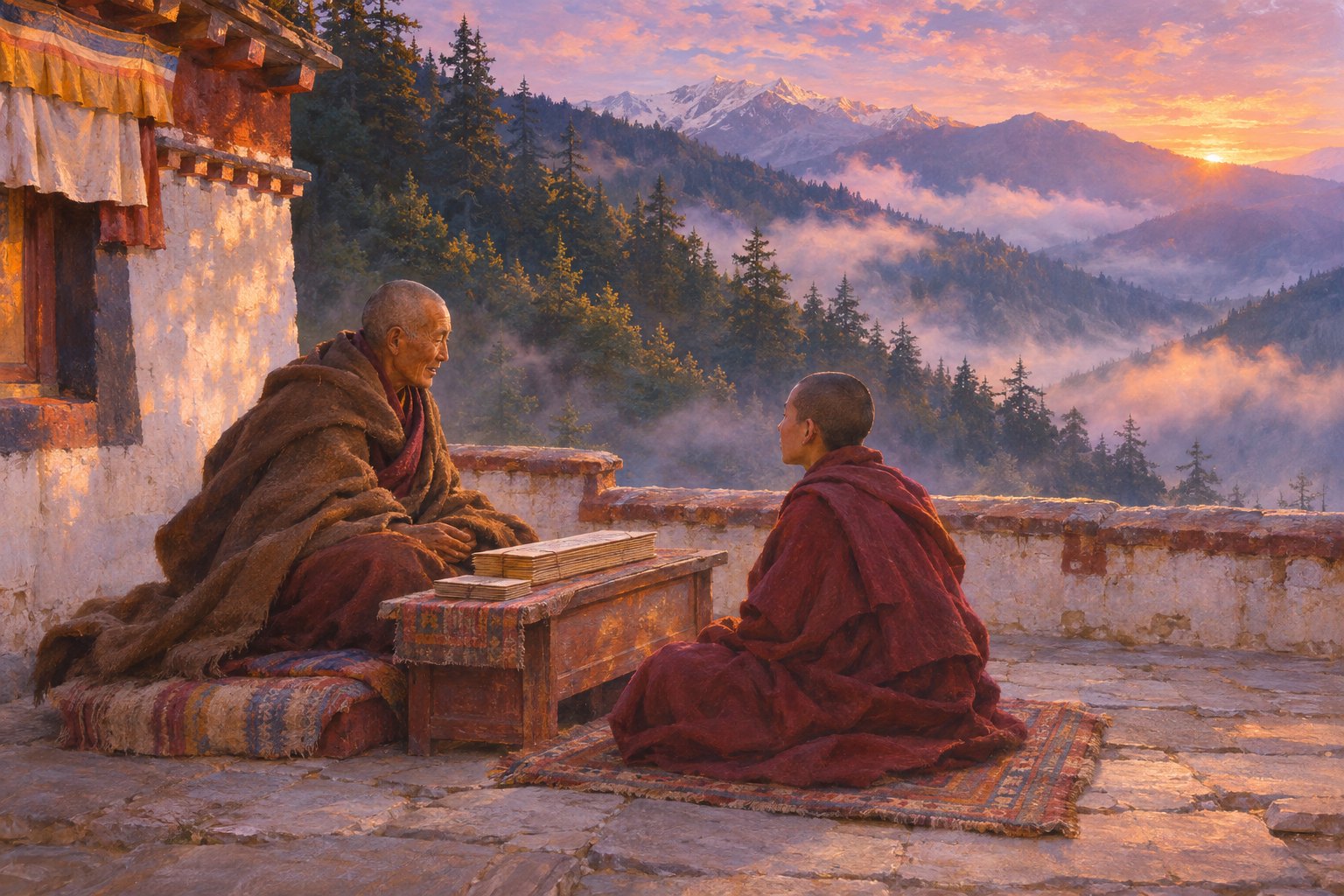
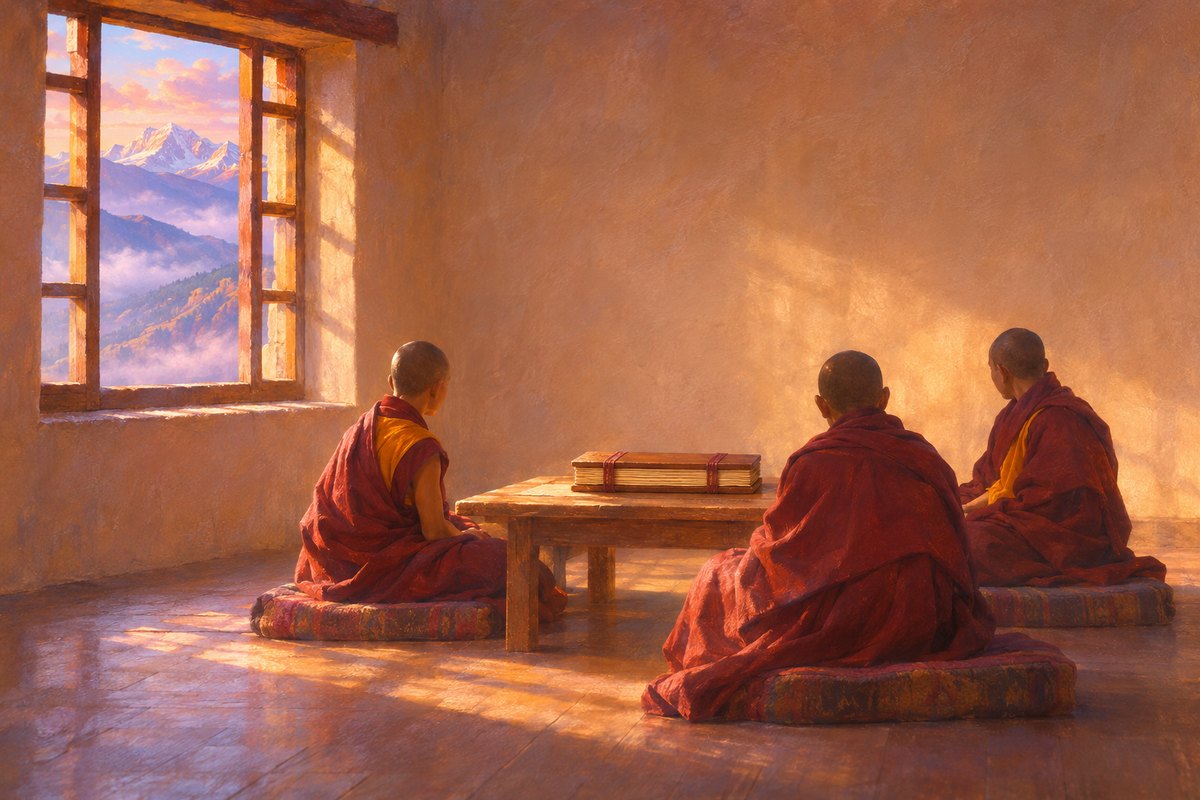
The biography joins learning and reflection with activities directed toward others: teaching, discussion and writing. A room in which people can ask and receive becomes one visible result of the years of preparation.
That room is illustrative. The gathering is not an invented historical event. Its purpose is to keep the human scale of transmission in view. A later master’s name may become famous, but an actual listener still needs a place to sit and enough patience from another person to begin understanding a difficult point.
Another generation’s morning
Shechen Gyaltsab died in 1926. His birth year is often given as 1871; the translator explains that the recorded lunar date falls in January 1872. The story follows that clarification without making the difference obscure the life it remembers.
The Seven-Line Prayer expresses the wish to follow Guru Rinpoche. This episode offers a thematic connection through receiving a teacher’s trust and making what was learned available to others. No recitation occasion is invented. The book once entrusted at one meeting enters another generation’s morning, carried by the people who received it.
About the art
AI-painted scenes use anonymous period figures, not authenticated portraits or precise architectural reconstructions. Recent historical masters remain distant.
Workshops and object arrangements illustrate the publicly documented craft and lineage history. Printing surfaces and pages conceal script rather than invent sacred writing. No private practice or visionary sequence is shown.
Why this matters for practice
The wish to follow Guru Rinpoche in the Seven-Line Prayer is considered through learning, preservation and transmission. The connection is thematic; no historical recitation scene or outcome is invented.

If something in this story moved you, you might pause and recite the Seven-Line Prayer once.
Sources and further reading
- Lotsawa House — Life of Shechen Gyaltsab, Lotsawa House
- Shechen — Dilgo Khyentse Rinpoche, Shechen
- Tsadra — Introduction to Dilgo Khyentse Tashi Paljor, Tsadra
- Lotsawa House — Shechen Gyaltsab collection, Lotsawa House
This retelling is waiting to be read by a knowledgeable practitioner. Where the traditional accounts differ, the story says so; if you notice a mistake, please tell us through Share Your Story.