Tibetans have long spoken of neighbours they rarely see. In clear lakes, in springs that bubble up between stones, among the roots of old trees, the tradition says, live the nagas: serpent-bodied beings of the waters, called lu in Tibetan.
This is a story about them, and about how Guru Rinpoche, the Lotus-Born master of the Seven-Line Prayer, is remembered as making peace with them. It is gathered from several life stories, and they do not always agree. Where they differ, this page will say so.
Who are the nagas?
Rigpa Wiki describes nagas as serpent spirits who live beneath the earth, in water, and in trees or rocks, rich in wealth and in magical power. Indian stories of nagas came to Tibet with Buddhism and met Tibet's own lu, the old spirits of its waters. In time the two became one family of beings.
In paintings, as the translator Stefan Mang sums it up for Lotsawa House, a naga has a human head and body joined to the long coiled tail of a serpent, often crowned by a fan of serpent hoods. Peaceful nagas hold a wish-granting jewel, a vase of nectar, or a hidden text.
 Illustration in preparation
The stories show them as beings capable of both harm and devotion. They are said to love clean water and quiet ground. When their springs are fouled, or the earth over their homes is dug carelessly, they are believed to take offence, and Tibetan medicine counts certain illnesses as "naga sickness."
For this reason Tibetans have long made offerings to the nagas before building, and in times of illness. Those rites belong with a teacher, and this page does not describe them. What the stories offer every reader is simpler: a habit of treating water and land as someone's home.
Keepers of scripture
Nagas keep treasures, and not only gold. The best-loved story comes from India. The tradition says the Buddha entrusted the Perfection of Wisdom sutras, the Prajnaparamita, to the nagas, who guarded them beneath the ocean until the world was ready to receive them.
Centuries later, it is said, the great teacher Nagarjuna journeyed to the naga realm and brought those sutras back. Rigpa Wiki remembers him as the founder of the Middle Way school of Buddhist philosophy. His name, fittingly, begins with the word naga.
Illustration in preparationKeep that picture in mind: a library beneath the water, patiently guarded by beings most people never see. It will come back at the end of this story.
Trouble at Samye
In the eighth century King Trisong Detsen set out to build Tibet's first monastery, Samye. How its walls kept falling, and how Guru Rinpoche was invited to help, is told on its own page, The Building of Samye. This page follows a quieter thread in that story: the nagas.
Building means digging, cutting timber and moving earth, and the tradition understands that this disturbed many unseen neighbours. The life stories describe Guru Rinpoche crossing Tibet and binding the spirits of its lakes and passes by oath. The Wish-Fulfilling Tree, a life story revealed by the treasure revealer Chokgyur Lingpa, names many kinds of naga among them.
Some did not come easily. The historian Taranatha tells of one naga who opposed the Dharma and fled to the farthest ocean the moment the master thought of taming it. Only after three days of meditation in a cave, he says, was the land at peace again.
The naga king of Maldro
The best-remembered naga of these stories is the king of the nagas of Maldro, a district near Lhasa. His Tibetan name, Zichen, means something like "Splendid"; Taranatha gives it in Sanskrit as Manasvi.
As Stefan Mang summarizes the life stories, Guru Rinpoche first tried to win him gently, by building the nagas a temple at Lake Maldro. Yet their minds were still untamed.
Illustration in preparationSo, these accounts say, Guru Rinpoche sat in meditation joined with the power of the garuda, the great mythical bird whom the nagas hold in awe, and the nagas yielded. The stories do not tell of their destruction. They tell of an agreement.
Illustration in preparationThe accounts differ on where this happened. Taranatha places it at a palace called Zurphü Kyangbu Tsal. Jamyang Khyentse Wangpo's verse summary of the Pema Kathang, another great life story, places the taming of the nagas at Chimpu, the hermitage caves above Samye.
Above the ground and below it
Then comes the part people love best. In Taranatha's telling, the naga king spoke up for himself. Above the ground, he said, King Trisong Detsen was the greatest; below it, he himself was. Why should the two not be allies?
Illustration in preparationAs a sign of friendship, Taranatha says, he offered fourteen mule-loads of gold dust for the building of the temple, sent from a gold mine called Lanpo Na, and it came just as he had said. In Mang's summary, gold washed up on the shores of the lake, and the nagas supplied the timber the monastery still needed.
Illustration in preparationThe Wish-Fulfilling Tree tells it in a few lines: a covenant was made between the king and the nagas, and they were given the task of filling the land with golden dust. When Samye was consecrated, it adds, the nagas came bearing gifts of precious gems.
Illustration in preparationJamyang Khyentse Wangpo's summary adds one more touch: the nagas were entrusted with guarding Samye's wealth. Those who had resisted the building became its keepers.
Water for a dry land
Taranatha remembers one more gift of water. Guru Rinpoche urged the king to turn Tibet's sands into meadows and bring water to its parched lands. When the king asked to see it done, the master meditated, and in a dry place at Drakmar a great pond welled up. It was named Ludzing, the Naga's Pond.
Illustration in preparationSand became meadow, Taranatha says, and a forest appeared below a cliff. But some ministers feared the foreign master's power, and the work was stopped. In the same telling, Guru Rinpoche later said that one of the three rounds of binding Tibet's spirits, the nagas among them, was left undone.
The king's illness
Because the tradition links nagas with illness, it is natural to wonder whether they had a part in the king's own sickness. Here the sources this page could check are quiet.
Jamyang Khyentse Wangpo's summary of the Pema Kathang tells that some time later the king fell sick, and that he was restored through the blessings of Namkhai Nyingpo, one of Guru Rinpoche's Tibetan disciples. Rigpa Wiki remembers Namkhai Nyingpo as the king's teacher and healer.
Illustration in preparationThat summary names no cause for the sickness. Whether some fuller telling blames offended nagas, this page cannot confirm, and it will not guess. What the story does keep is a picture of care: a king in need, and a disciple carrying his teacher's blessing to him.
The library beneath the water
Now remember the sutras in the naga realm. The tradition says Guru Rinpoche hid many teachings, called treasures or terma, for later times, and that some were entrusted directly to naga guardians. Naga realms, Mang notes, are counted among the places where treasure revealers, the tertons, recover them.
Illustration in preparationIn 1866 Chokgyur Lingpa drew such teachings from the lake of Sengö Yumtso. In his own account, as Mang quotes it, the "bodhisattva nāga kings tossed flowers of gold dust on the shore." Some of that gold, it is said, later went into the wall paintings of Dzongsar monastery.
Illustration in preparationNeighbours of the water
So the patient keepers of scripture and the restless spirits of Samye's building site turn out, in these stories, to be the same beings. In the tradition's telling they were not simply defeated. They were met, honoured, bound by promise, and given work worth doing.
For many practitioners, the prayer's line about following in Guru Rinpoche's footsteps can hold this too: walking softly by springs, keeping water clean, remembering that every place is someone's home.
Illustration in preparationAbout the art
The nagas on this page follow the description Stefan Mang gives for Lotsawa House, after Robert Beer: a human head and upper body joined to a coiled serpent tail, with a canopy of serpent hoods above the head. The naga king has seven hoods, the number another Lotsawa House text gives for the great naga kings; his attendants have one or three. Peaceful nagas hold a wish-granting jewel, a vase, a pearl or a wrapped scripture. They are drawn calm and fully robed, never as dragons, and never with fangs or weapons.
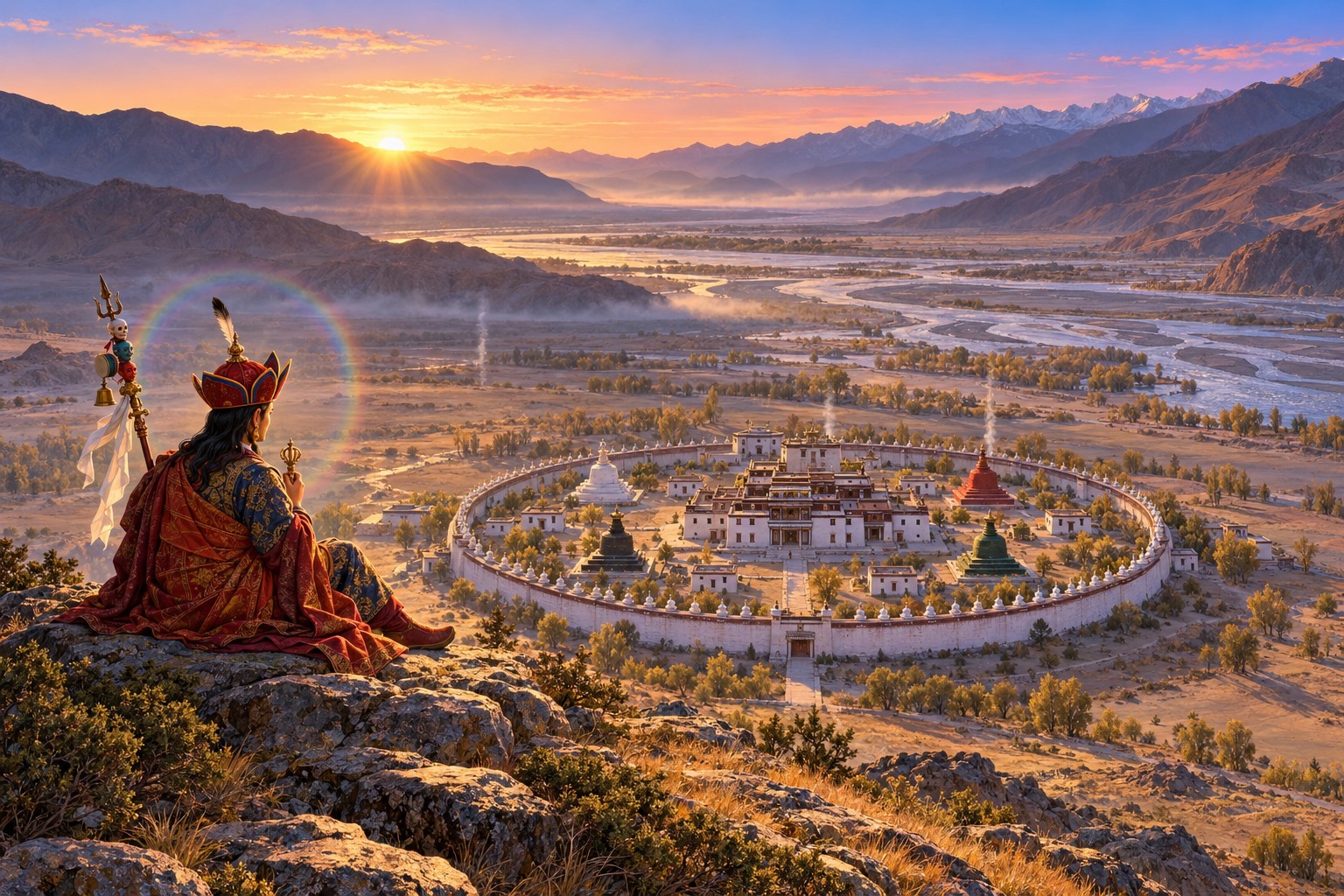
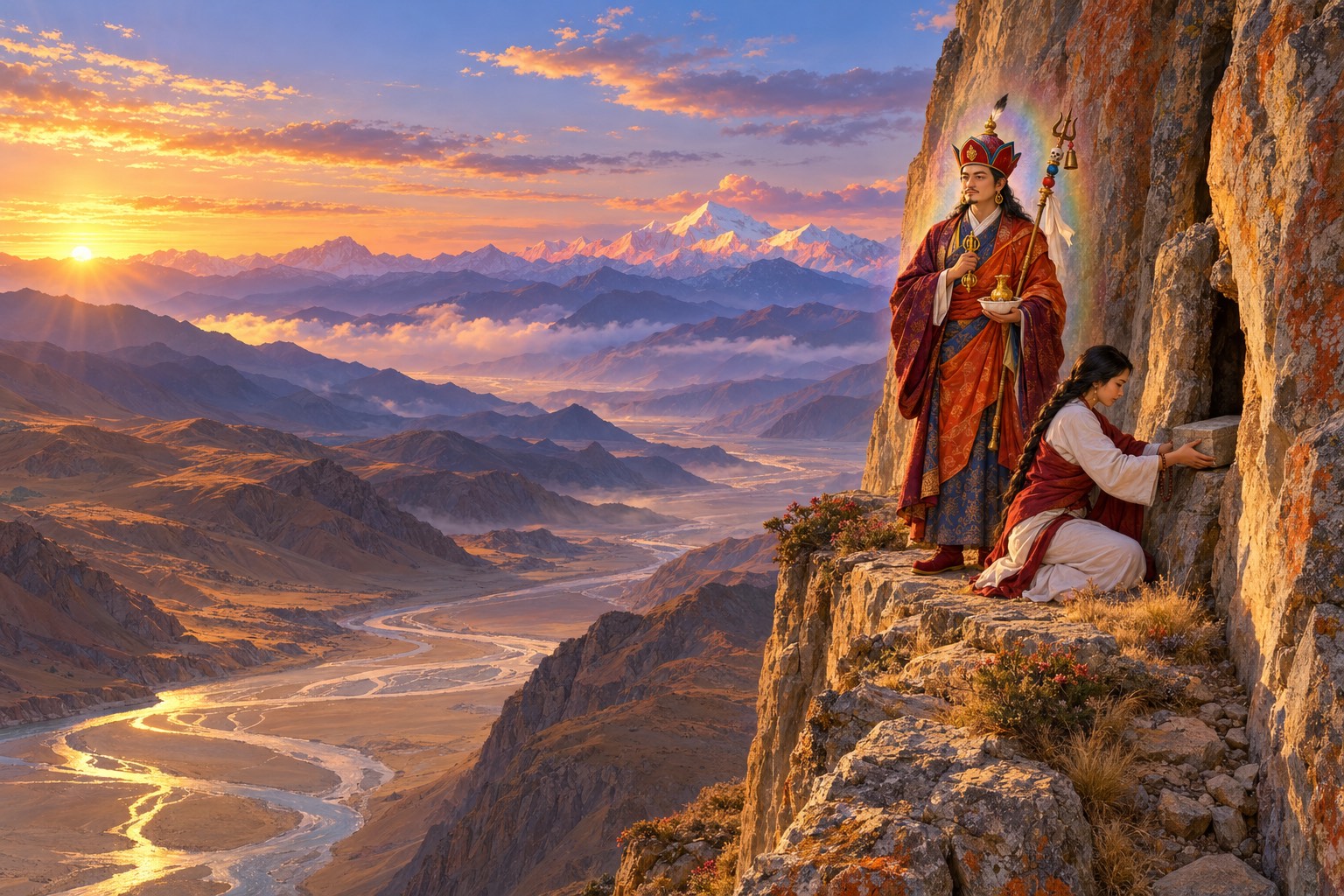
Guru Rinpoche appears in his main form: the lotus hat with its half-vajra and single vulture feather, the five-pronged vajra at his heart, the skull cup with its long-life vase in his left hand, and the khatvanga staff resting against his left shoulder. The five-colour sphere around him marks a sacred presence; the nagas and the king have no halo.
King Trisong Detsen wears eighth-century Tibetan imperial dress modelled on Dunhuang murals; in the sickroom scene his tall turban is set aside. The underwater hall and the lake are imagined, since no source describes their appearance, and Samye is shown before its later gilded roofs. No script appears anywhere, even on the scripture bundles and the treasure casket.
Why this matters for practice
The prayer's sixth line expresses the wish to follow in Guru Rinpoche's footsteps. In these stories his way with the nagas is to meet, honour and befriend the beings of a place rather than simply overpower them. Reciting the prayer can be a quiet way of taking up that same respect for the land and water around us; anything beyond recitation, including the traditional naga rites, belongs with a teacher.
If something in this story moved you, you might sit near water tonight, or simply beside a glass of it, and recite the prayer once, slowly, with goodwill toward every unseen neighbour.
Sources and further reading
- Introduction to Nāgas (Stefan Mang), Lotsawa House
- Three Reasons for Confidence: the Life of Padmakara (Taranatha, trans. David Teasdale), Lotsawa House
- The Wish-Fulfilling Tree: The Life Story of the Master of Uḍḍiyāna (Chokgyur Lingpa, trans. Erik Pema Kunsang and Samye Translations), Lotsawa House
- A Beautiful and Wondrous Udumbara Garland: A Supplication and Summary of the Chronicles of Padma (Jamyang Khyentse Wangpo, trans. Samye Translations), Lotsawa House
- Naga, Rigpa Wiki (archived snapshot)
- Nagarjuna, Rigpa Wiki (archived snapshot)
- Eight Great Naga Kings, Rigpa Wiki (archived snapshot)
- Namkhai Nyingpo, Rigpa Wiki (archived snapshot)
- Lasel Chenmo: A Sang Offering to the Nāgas (Karma Chakme, trans. Adam Pearcey), Lotsawa House
- Nāga, Wikipedia
- The Lotus-Born: The Life Story of Padmasambhava (Yeshe Tsogyal, revealed by Nyangral Nyima Özer, trans. Erik Pema Kunsang), Shambhala, 1999
- Following in Your Footsteps: The Lotus-Born Guru in Tibet, vol. 3 (Samye Translations), Rangjung Yeshe Publications, 2023
This retelling is waiting to be read by a knowledgeable practitioner. Where the traditional accounts differ, the story says so; if you notice a mistake, please tell us through Share Your Story.