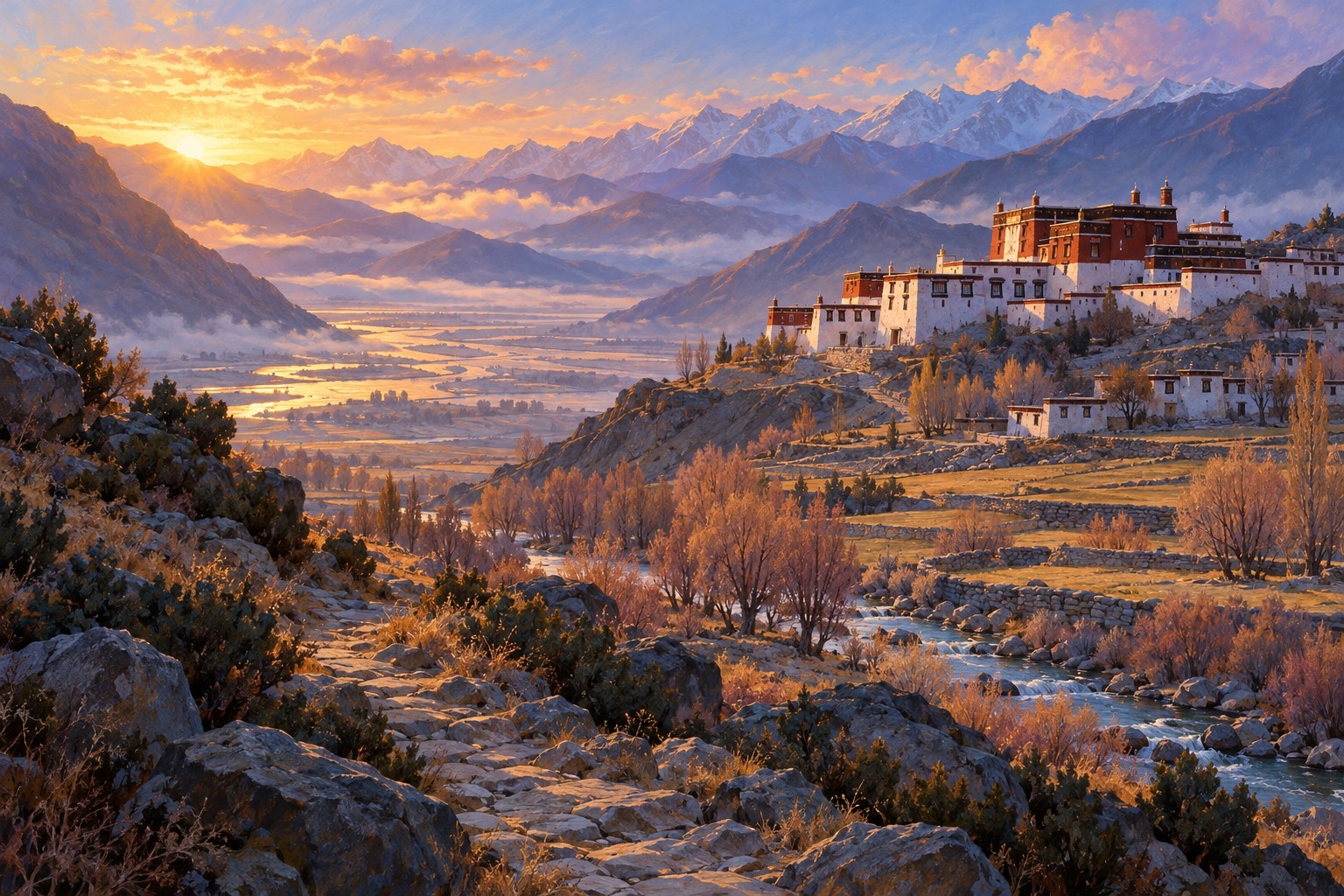
In 1848, in the Rudam valley of Kham in eastern Tibet, new walls began to rise on the valley floor below the glaciers. They belonged to a shedra, a monastic college where monks spend years studying the great texts. It was named after Shri Singha, an early Indian master of the Great Perfection.
The man who built it was Gyalsé Shenpen Thayé. Story 48 tells how Dzogchen Monastery began in this valley, and Story 11 tells of Patrul Rinpoche, who taught here for years. This is the story of the scholar who stands between them, and who is less often remembered.
His name is almost a portrait. Gyalsé means "heir of the Victorious Ones," a title for a bodhisattva, someone who lives for the awakening of others. Shenpen Thayé means "boundless benefit to others."
A boy from Gemang
The Treasury of Lives, an online encyclopedia of Tibetan lives, says he was born in 1800 at Gemang, in the north of Kham. His father was Tsewang Norbu and his mother Karma Chödrön. Rigpa Wiki, a reference site kept by a Buddhist community, also names Gemang as his birthplace.
His life stories say that the heads of several monasteries each hoped to claim the child as the rebirth of one of their own lamas. His parents turned them all away.
 Illustration in preparation
Then sorrow came. While the boy was still young, his father went out to stop bandits who were driving off his horses, and was killed. The Treasury of Lives says it was this loss that turned the boy toward the religious life.
Around that time he met a lama from Dzogchen Monastery named Dola Jigme Kelzang. The boy went back with him and was presented to the head of the monastery, the Fourth Dzogchen Rinpoche, Mingyur Namkhai Dorje (1793–1870).
Illustration in preparationAt some point he was recognized as the rebirth of Terdak Lingpa, the great master who founded Mindrolling Monastery in central Tibet. His story is Story 40.
Many teachers
At Dzogchen he studied both the Kama and the treasures. Kama means "the spoken word": teachings handed down without a break from teacher to student, many of them reaching back to the time of Guru Rinpoche in the eighth century. The treasures, terma, are teachings Guru Rinpoche is said to have hidden for later revealers to find.
In 1818, at nineteen, he went with a few close friends to the First Dodrupchen, a great disciple of Jigme Lingpa (Story 86). He served and studied with the old master for about three years, until Dodrupchen's death in 1821.
Illustration in preparationHis teachers were many. Both sources name Jigme Gyalwe Nyugu, Patrul's root teacher (Story 43), and a quiet scholar named Sengtruk Pema Tashi. The lists hold a small surprise: the Treasury of Lives names Patrul among both his teachers and his students, and Rigpa Wiki does the same with Jigme Gyalwe Nyugu. Friends in that world often received teachings from one another, so both may be true.
Then he travelled. The Treasury of Lives follows him across Kham and lower Amdo, to a cave of the translator Vairotsana in Gyalrong (Story 26). Rigpa Wiki says he practised at sacred places from Mount Kailash in the far west to a mountain in China, and became a master of both learning and realization.
Illustration in preparationThe Treasury of Lives adds a quiet detail. His life story says he was destined to reveal treasures himself, but he chose not to. Instead, late in life, he took full monastic vows from Sengtruk Pema Tashi.
Rigpa Wiki says that after the First Dodrupchen died, he looked after Dodrupchen's monastery for some years. There he began a yearly forty-five-day practice of the Guhyagarbha Tantra, the great tantra at the heart of the Kama. In the first year young Patrul was his assistant, and in the next two Patrul led it himself. Practices like this are received only from a qualified teacher; the site's Find a Teacher page can help.
The earthquake
In 1842 an earthquake almost destroyed Dzogchen Monastery. The Fourth Dzogchen Rinpoche was then staying with the king of Derge, Damtsik Dorje, who paid for the rebuilding. The Treasury of Lives says the work was carried out under Shenpen Thayé's direction. Rigpa Wiki says he took charge of the monastery and rebuilt it entirely.
Illustration in preparationGifts from disciples across the region let him do more. In 1848, the Treasury of Lives says, he founded the Shri Singha college, known locally as Shri Sengge Ri.
Two wonders at the founding
The tradition remembers the founding with two wonders, and the Treasury of Lives tells them as legend. Shenpen Thayé is said to have chosen the site after a vision of Shri Singha himself, the master of long ago, sitting on a rock in the Rudam valley.
Illustration in preparationWhen the college was consecrated, the same account says, the wild yogi Do Khyentse Yeshe Dorje (Story 29) suddenly appeared and drove a ritual dagger into the ground, blessing the place.
Illustration in preparationThe sources differ a little on who led the college first. The Treasury of Lives says Sengtruk Pema Tashi was enthroned as its first abbot, with Shenpen Thayé as the second. Rigpa Wiki simply calls Shenpen Thayé its founder. Either way, the college was his work.
Keeping the spoken word
What he is remembered for most is care for texts. The Treasury of Lives says he gathered many Nyingma works, among them the great commentaries on the Guhyagarbha. From central Tibet he brought back collections of teachings that were missing or incomplete in Kham.
At the request of two of his students, Minling Trichen Sangye Kunga and Pelri Tulku Pema Wangyal, he gathered the ritual texts of the Kama into a set that could be published. Rigpa Wiki speaks of a few volumes, the Treasury of Lives of one. He also had woodblocks carved, so that texts could be printed again and again.
Illustration in preparationRigpa Wiki says he then began a yearly cycle at Dzogchen of all the rituals, ceremonies and sacred dances of thirteen great practice cycles of the Kama, and that many Nyingma monasteries later took up the custom. He also set a careful monastic discipline, with a yearly retreat in the rainy season, as in the Buddha's own time.
It was patient, unglamorous work. Because of it, a whole thread of the old tradition kept its strength in the east.
The teacher
As abbot of the college, the Treasury of Lives says, he taught above all the Guhyagarbha. His own writings fill two volumes, with commentaries on that tantra and on grammar among them.
Illustration in preparationHis students became the great names of the next generation. Rigpa Wiki lists Patrul, Do Khyentse and Jamyang Khyentse Wangpo, the three masters remembered as rebirths of Jigme Lingpa. Khenpo Pema Vajra, who later headed the college, was another.
Rigpa Wiki quotes the great Dudjom Rinpoche, who wrote that his kindness and legacy to the teaching "surpass the imagination." It adds that Tulku Thondup, a modern scholar of the Nyingma, felt he had never been properly acknowledged.
Illustration in preparationDevotion to the Lotus-Born
His love for Guru Rinpoche shows quietly in his writings. Lotsawa House, a library of translated Tibetan texts, keeps a short prayer of his that calls on Padmakara, the Lotus-Born, as the one who "embodies all the buddhas' compassion," appearing in this age in the saffron robes of the Indian master Atisha.
Lotsawa House also has his commentary on a well-known smoke offering. In it he retells a story from the tradition: at Samye, when King Trisong Detsen fell ill, Guru Rinpoche had clean wood burned as a smoke offering, and the king recovered.
Illustration in preparationIn later years he founded a monastic centre at Gemang, his birthplace, and stayed there from time to time. So he is also remembered as Gemang Rinpoche, the first of a line of Gemang lamas.
The records do not agree on when he died. Lotsawa House and Rigpa Wiki give 1855, and Rigpa Wiki adds that some say 1869 or 1870; the Treasury of Lives gives 1855 or 1869.
His college outlived him by far. Rigpa Wiki's list of those who studied or taught there reads like a roll call of the next century's great scholars, Mipham among them (Story 12).
Illustration in preparationThe fifth line of the Seven-Line Prayer pictures Guru Rinpoche surrounded by a great retinue of dakas and dakinis. Shenpen Thayé spent his life gathering a retinue of his own: teachers, students and old texts, so that words handed down from Guru Rinpoche's time would go on being heard.
About the art
Gyalsé Shenpen Thayé is drawn after his mural portrait at Shechen Monastery, shown on his Lotsawa House author page: an older monk with a greying beard, a tall pointed red hat with long side flaps, red and maroon robes over a gold-yellow vest, and both hands held together at the heart in the gesture of teaching. That hat is the scholar's hat of learned teachers and abbots, so he wears it in his portrait. In the other scenes he is bare-headed. As a boy he wears the sheepskin of a nomad child. As a young man he wears a plain maroon robe, because the Treasury of Lives says he took full monastic vows only late in life.
Shri Singha appears as a vision, seated on a rock in a soft rainbow sphere. On this site rainbow light marks only sacred figures and wonders. He is an Indian master, so he has a topknot, a cotton shawl and silk scarves, not Tibetan robes. Do Khyentse has the long hair and white robe of a lay yogi. The ritual dagger is shown only as a plain handle in the earth, because the site does not draw its details.
The books are the long, loose-leaf pages Tibetans wrap in cloth and keep between wooden boards. The woodblocks are what such books were printed from. As everywhere on the site, the pages and blocks are blank, because the art never shows script. The juniper smoke is sang, the purifying smoke offering whose story he retold. The butter lamps are the wide, stemmed brass lamps of Tibetan shrines.
Why this matters for practice
The fifth line of the Seven-Line Prayer pictures Guru Rinpoche surrounded by his retinue. Gyalsé Shenpen Thayé gave his life to keeping that circle unbroken, gathering the teachers, students and texts through which Guru Rinpoche's words were handed down. Each time someone recites the seven lines, they join that long circle for a moment. A single recitation is enough to begin.
If something in this story moved you, perhaps a boy who turned his grief toward study, or a scholar who would not let the old words be lost, you might pause tonight and recite the prayer once.
Sources and further reading
- Gyelse Zhenpen Taye Ozer, by Samten Chhosphel (2011), Treasury of Lives (Internet Archive snapshot, October 2012)
- Gyalsé Shenpen Tayé, Rigpa Wiki (Internet Archive snapshot, September 2024)
- Shri Singha Shedra, Rigpa Wiki (Internet Archive snapshot, 2024)
- Dzogchen Gemang Incarnation Line, Rigpa Wiki (Internet Archive snapshot, 2024)
- Kama, Rigpa Wiki (Internet Archive snapshot, 2024)
- Gyalse Shenpen Thaye Series, Lotsawa House
- Brief Sukhāvatī Aspiration, trans. Adam Pearcey (2019), Lotsawa House
- The Gentle Rain of Benefit and Joy: An Explanation of the Practice of Sang Offering, trans. Adam Pearcey (2006), Lotsawa House
- A Marvelous Garland of Rare Gems, by Nyoshul Khenpo, trans. Richard Barron (2005), Padma Publishing (book)
This retelling is waiting to be read by a knowledgeable practitioner. Where the traditional accounts differ, the story says so; if you notice a mistake, please tell us through Share Your Story.