
A voice for his teacher
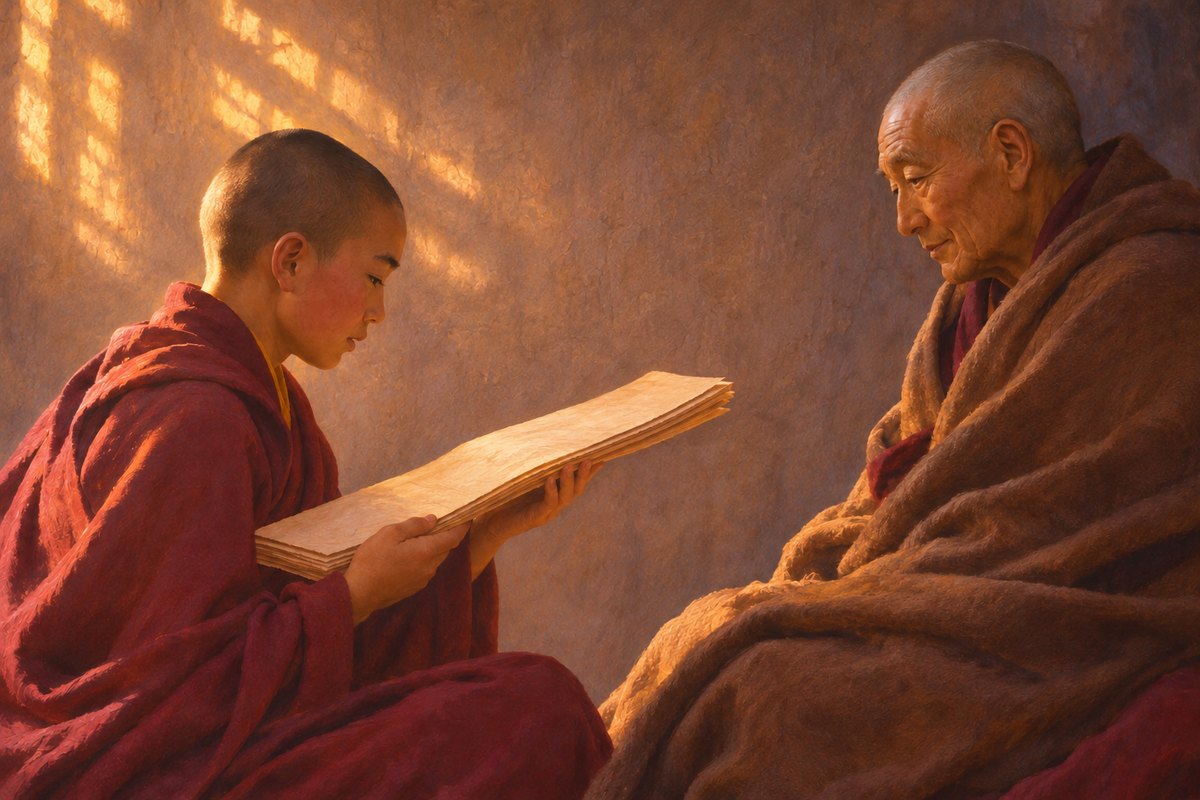
The young Kunzang Palden read aloud while Patrul Rinpoche listened. A later tribute by Jamyang Khyentse Chökyi Lodrö remembers the readings with affection: texts, praises, songs, and chapters offered in the teacher’s hearing. The future scholar first appears here as someone using his own voice in another person’s presence.
It is a quiet beginning. The reader is not announcing himself to posterity. The teacher listens, and the words are given time to sound. Beside the later books, this small remembered service helps us feel the relationship out of which the written work grew.
The name Kunpal
Kunzang Palden, often shortened to Kunpal, lived from 1862 to 1943. He belonged to the Nyingma tradition and studied with Patrul, Mipham, Orgyen Tendzin Norbu, and other masters. Treasury of Lives records those relationships alongside the students and institutions connected with his later teaching.
The name on a book cover can make its author seem self-contained. Kunpal’s life opens in the other direction, toward the people from whom he learned. The commentary for which he is remembered did not come out of an empty room. It grew in the space between teaching, listening, remembering, and putting words down carefully.
Months beside the text
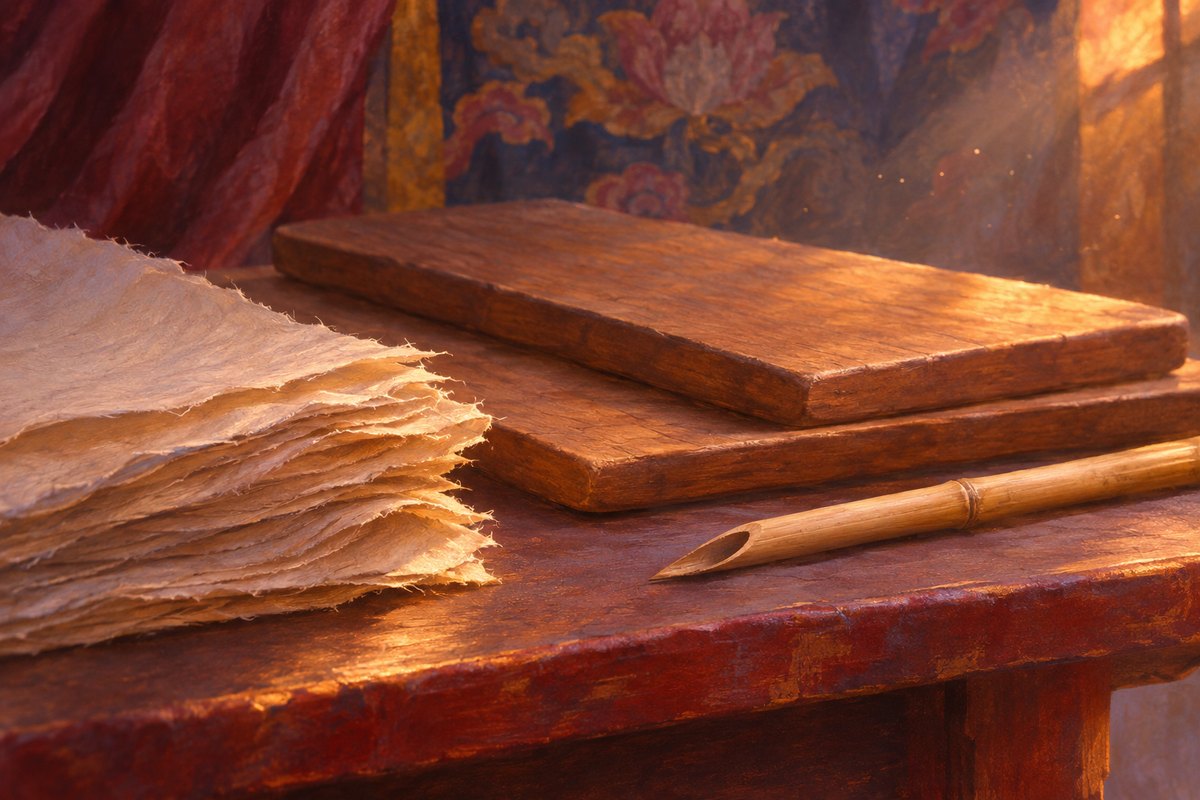
Khyentse Chökyi Lodrö’s praise describes six months of Bodhicaryāvatāra instruction and the notes Kunpal made. The Bodhicaryāvatāra is Śāntideva’s guide to the bodhisattva’s way of life. Its concern is not private achievement alone, but awakening directed toward the welfare of beings.
Months of listening have a different rhythm from a single memorable sentence. A difficult point returns; a familiar passage acquires weight; the learner has time to discover what has not yet been understood. The notes could hold something of that patient work after the spoken lesson had ended.
What was heard
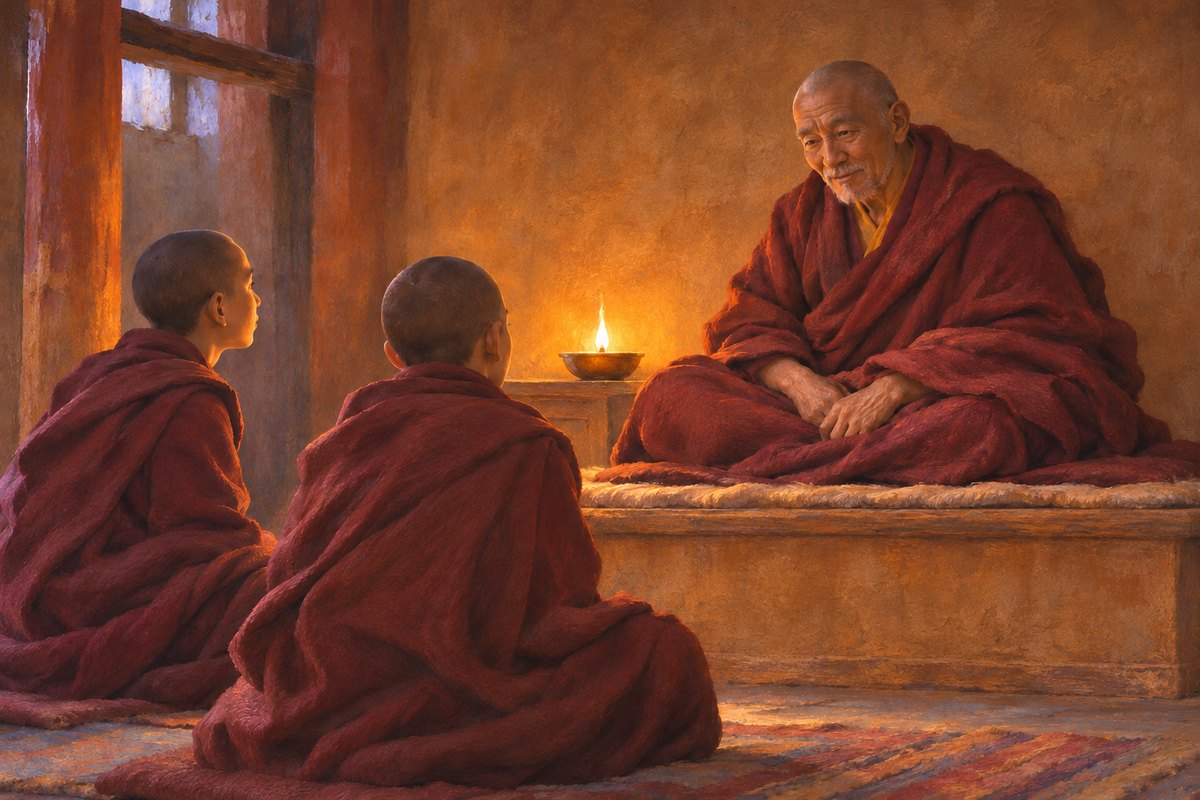
Tsadra Foundation describes his commentary as a compilation of Patrul’s oral instructions gathered over years. The work became known in English as The Nectar of Manjushri’s Speech. It helps later readers approach the root text with explanations that would otherwise have remained in the memories of particular listeners.
The written page cannot become the whole living encounter. It cannot give us every pause, every question, or the exact sound of a teacher’s voice. But it can preserve more than a memory left entirely unrecorded. The care taken by one listener becomes help for someone who arrives much later.

More than copying
The commentary offers both explanations of words and a structured guide to the meaning of the text. Tsadra’s record identifies the author, the later translators, and the book’s continuing place alongside Śāntideva’s verses. It is a substantial work of scholarship as well as an act of preservation.
To keep a teaching is not always to repeat a sentence without understanding it. A later reader needs orientation: where a point belongs, how one passage connects with another, why a word is being used. The scholar’s responsibility is therefore close to the listener’s responsibility. Both must attend rather than merely collect.
Learning continued
Kunpal did not learn from one teacher only. The biographical records name Tendzin Norbu and Mipham among those who helped shape his scholarship. Khyentse’s praise honours the care with which he kept his teachers’ explanations and treated the Indian and Tibetan commentarial traditions.
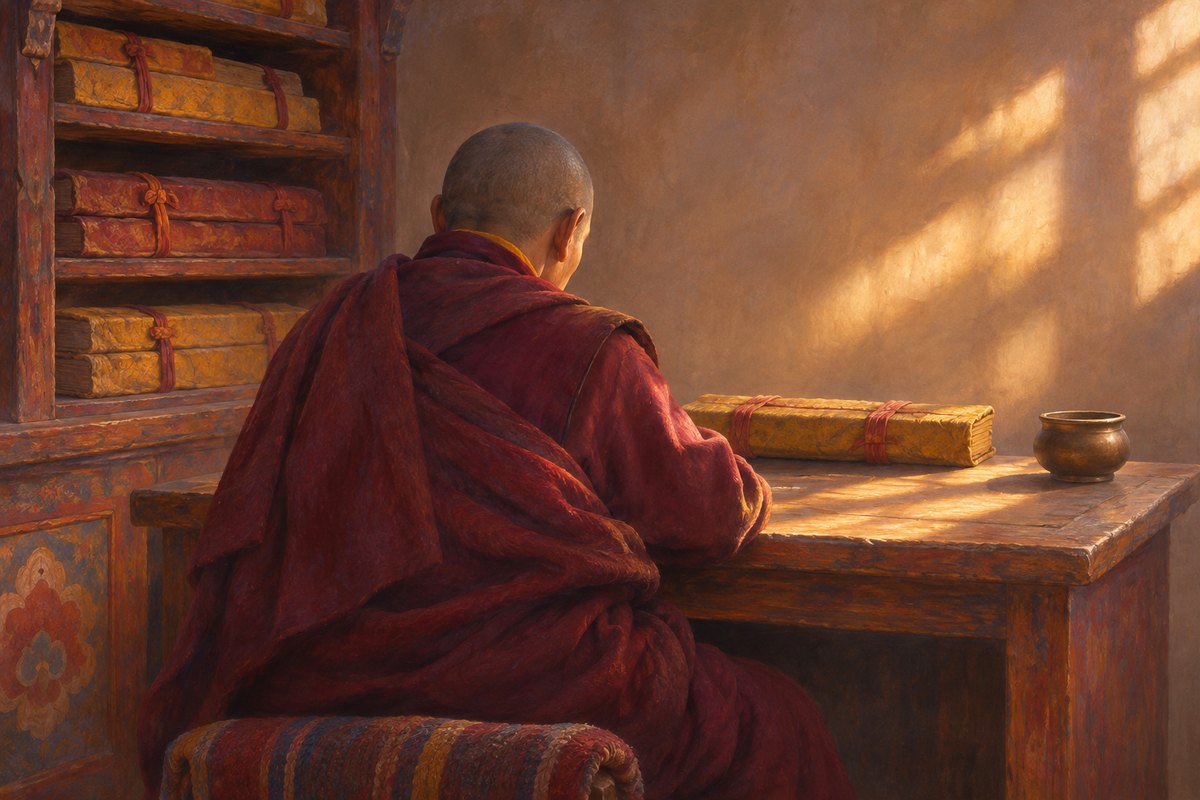
The story’s picture of a mature scholar is deliberately anonymous. We are not claiming to recover the expression on his face as he worked. It is enough to keep the work in sight: books received, explanations considered, and the discipline of not replacing what one has been taught with an easier or more flattering invention.

Others came to hear
The records connect Kunpal’s teaching with centres including Katok and Gegong. Khyentse Chökyi Lodrö was among the people who learned from him. The student who had read aloud in Patrul’s hearing became a teacher whose own kindness would be remembered in another student’s words.
That turn gives the story its shape. Gratitude does not remain directed only backward. What was received can become care extended forward, to someone who is still learning. The painting of students carrying books toward a room is an image of that continuation, not a reconstruction of an attendance list.

The commentary on the shelf
A later reader may first encounter Kunpal through the book and only afterwards discover the life behind it. The link runs in both directions. The biography makes the commentary less anonymous, and the commentary shows one enduring result of the attentive years beside a teacher.
No single volume contains every relationship that made it possible. Behind it are teachers, listeners, people who preserved manuscripts, and translators who made the work available in another language. The wrapped book on the shelf stands for that wider care. It is small enough to be carried; what it carries reaches further than its covers.

News in winter
In early 1944, Khyentse Chökyi Lodrö heard that Kunpal had died in late December. He answered with a lament, Lightning Bands of Compassion. The prayer speaks from the loss of a guide and the wish that the teacher’s compassionate activity continue.
Later, he also wrote a long tribute remembering Kunpal’s kindness. In those texts, the great scholar is not only a holder of information. He is someone whose care had helped a student grow. The empty cushion in the illustration is symbolic, but the grief behind the remembered words belongs to the source itself.

The words he kept
One date in the tribute needs care: it appears to put Kunpal’s birth in 1872. The translator notes that Kunpal’s own statement of his age supports 1862, the date used here and in Treasury of Lives. Remembering faithfully includes allowing even a devoted tribute to be checked.
The sixth line of the Seven-Line Prayer expresses a wish to follow Guru Rinpoche. Kunpal’s story offers a way to consider that wish through listening, preservation, and gratitude. The words he kept still help others hear. A reader returning after a long absence may begin there too: by giving a teaching enough attention that it is not simply heard and lost.
About the art
These AI-painted storybook scenes use anonymous period figures, not authenticated portraits. Rooms, routes and object arrangements are atmospheric reconstructions rather than records of exact historical appearances.
Tibetan books are shown as flat pecha bundles with wooden boards and cloth covers. Generated writing is omitted. Empty cushions, a travelling bundle, flowers and night scenes are symbolic where the caption says so; no private ritual or visionary sequence is reconstructed.
Why this matters for practice
The sixth line of the Seven-Line Prayer expresses the wish to follow Guru Rinpoche. This story offers a Nyingma setting in which to consider learning, devotion and the care taken with a teacher’s words. The connection is thematic and carries no promise of outcomes. For personal guidance beyond recitation, the Find a Teacher page is a starting point.

If something in this story moved you, you might pause and recite the Seven-Line Prayer once.
Sources and further reading
- Offering the Flowers of Remembered Kindness, Lotsawa House
- Lightning Bands of Compassion, Lotsawa House
- Kunzang Pelden, Treasury of Lives
- The Nectar of Manjushri’s Speech, Tsadra Foundation
- Khenpo Kunzang Palden Series, Lotsawa House
- Seven-Line Prayer, Lotsawa House
This retelling is waiting to be read by a knowledgeable practitioner. Where the traditional accounts differ, the story says so; if you notice a mistake, please tell us through Share Your Story.