A different road
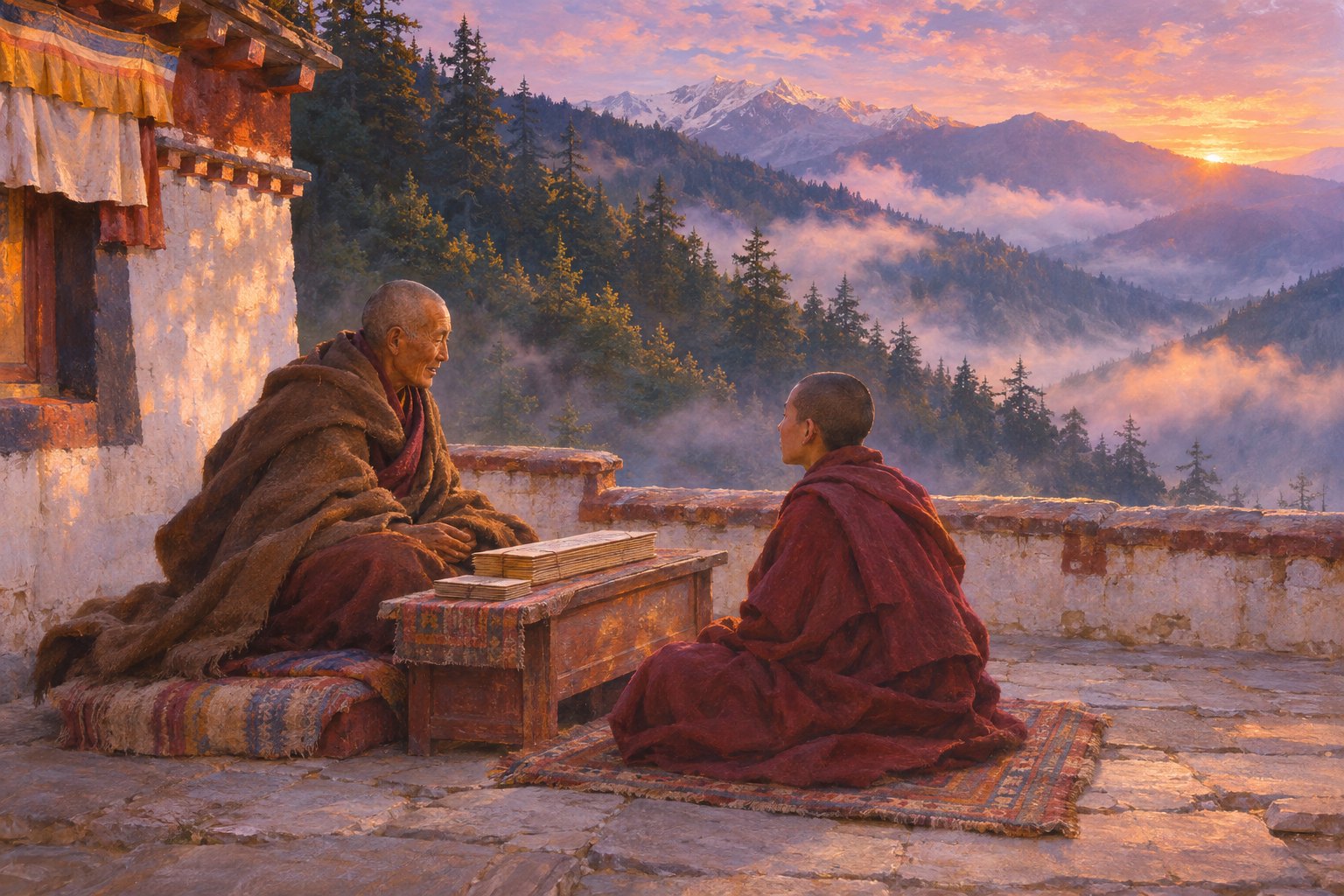
Orgyen Tendzin Norbu wanted the life of a wandering hermit. In the lineage account preserved by Orgyen Khandroling, Patrul Rinpoche asked him to teach instead. He followed that advice. The life that might have been imagined as a succession of solitary places became a life to which students could come.
No grand public scene is needed to hold that turning. A person has a wish, receives a different responsibility, and remains available to it. The picture of a forked path is symbolic, but the choice it stands for belongs to the remembered account. His story unfolds on the road he did not initially seek.
The student of Patrul
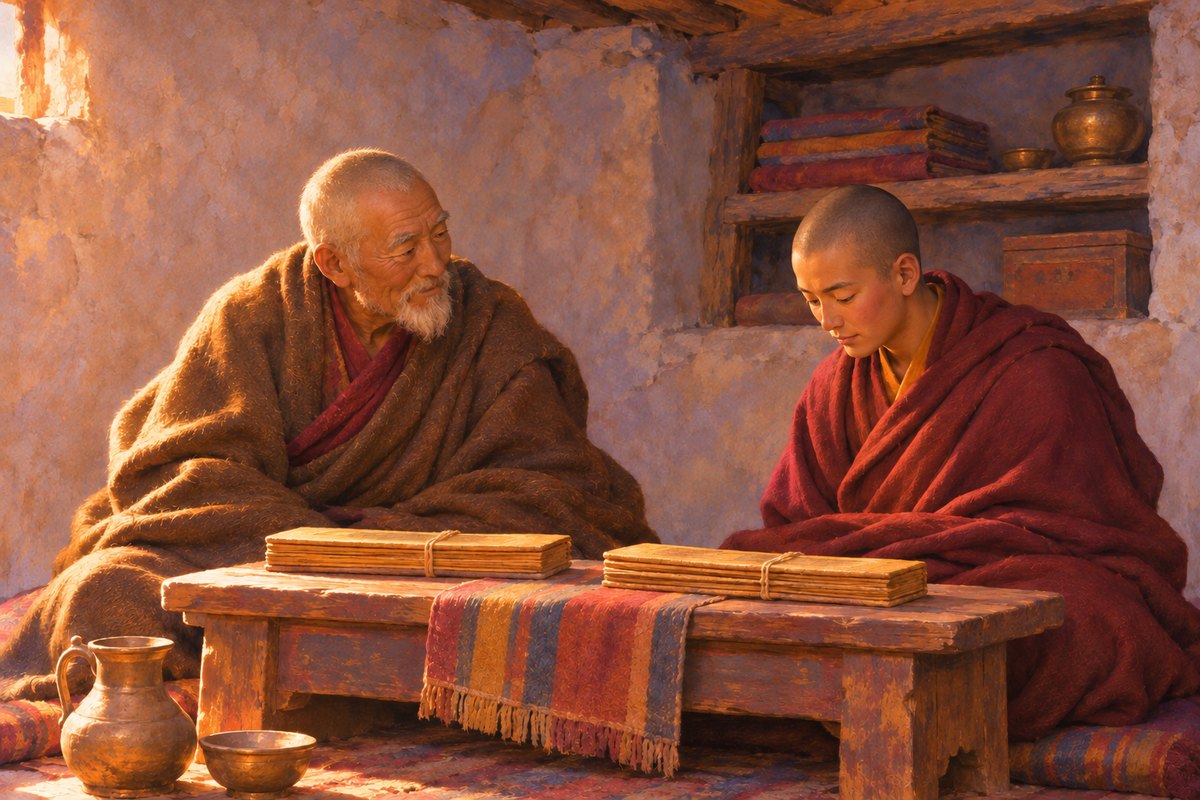
He was one of Patrul’s principal disciples and also studied with masters including Pema Vajra and Jamyang Khyentse Wangpo. Treasury of Lives records his place in the Nyingma tradition and the teaching relationships surrounding him. His own years with Patrul gave him much to pass on.
A later reader can sometimes see the famous teacher more easily than the person who stood beside him. But there must be someone able to receive closely, remember faithfully, and answer when the next student arrives. In this story, Tendzin Norbu gradually becomes visible in that place, with responsibilities of his own.
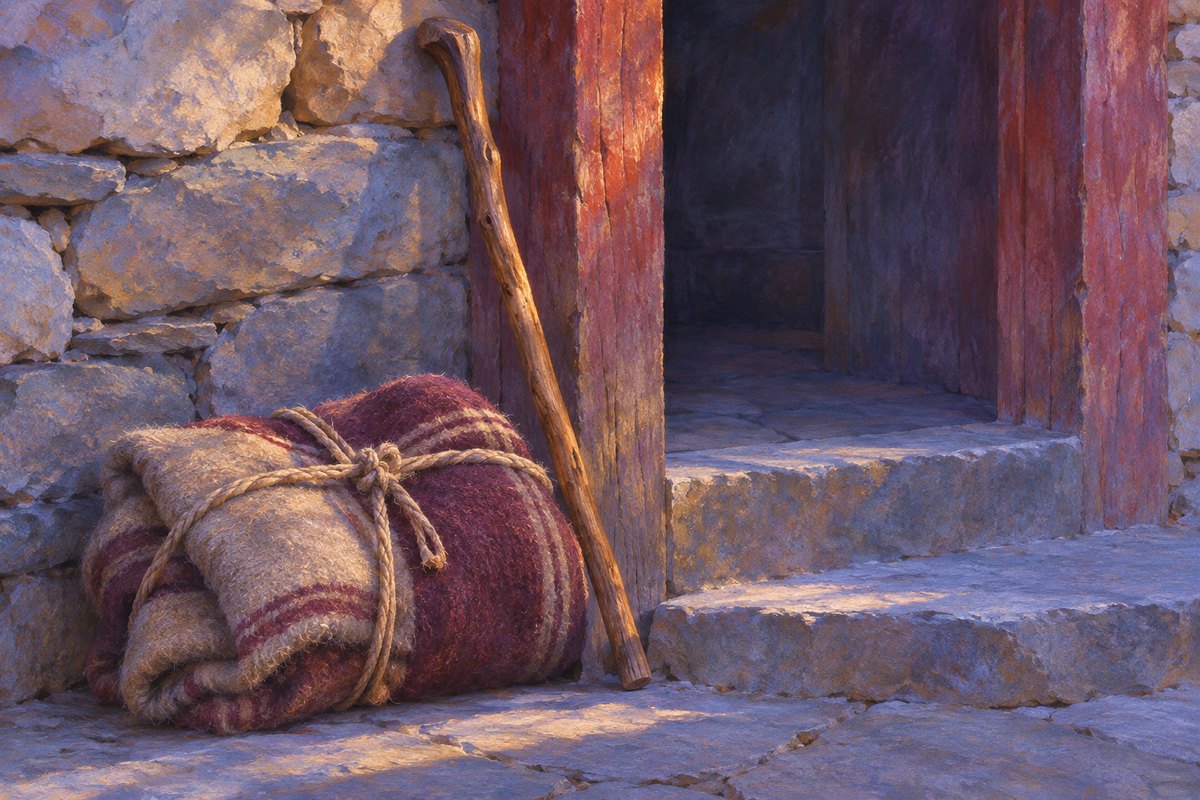
The bundle not carried away
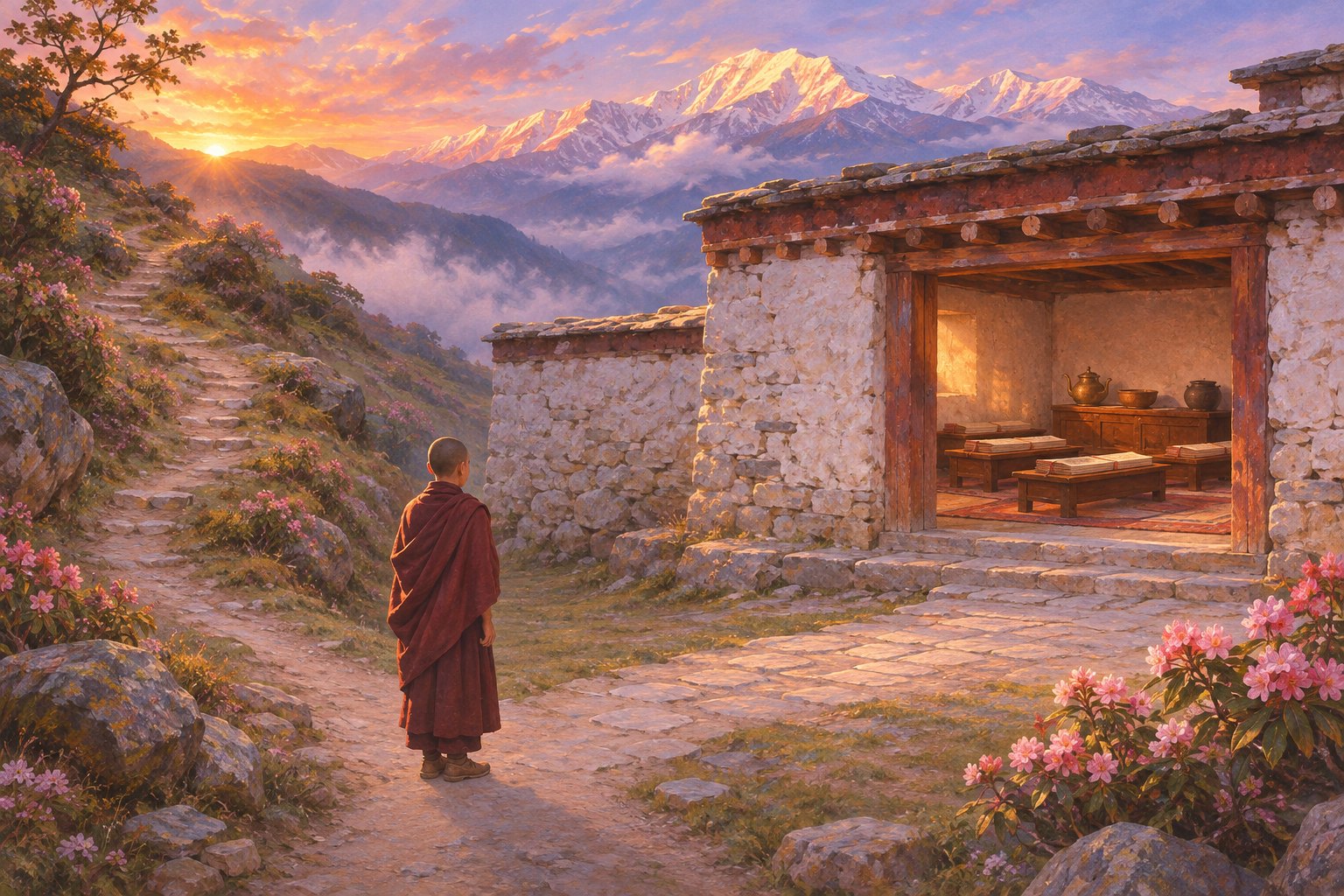
The wish for solitude did not have to become contempt for the people who needed instruction. According to the catalogue’s account, Patrul’s direction changed the course of his activity for the rest of his life. The wandering bundle in the illustration remains at a doorway.
There are several ways to hear that image. The story does not tell us that the same decision belongs to every practitioner. It records this teacher responding to this situation. A calling can include work one had not pictured at the beginning, and devotion can include accepting that the useful place to stand is closer to others than one expected.
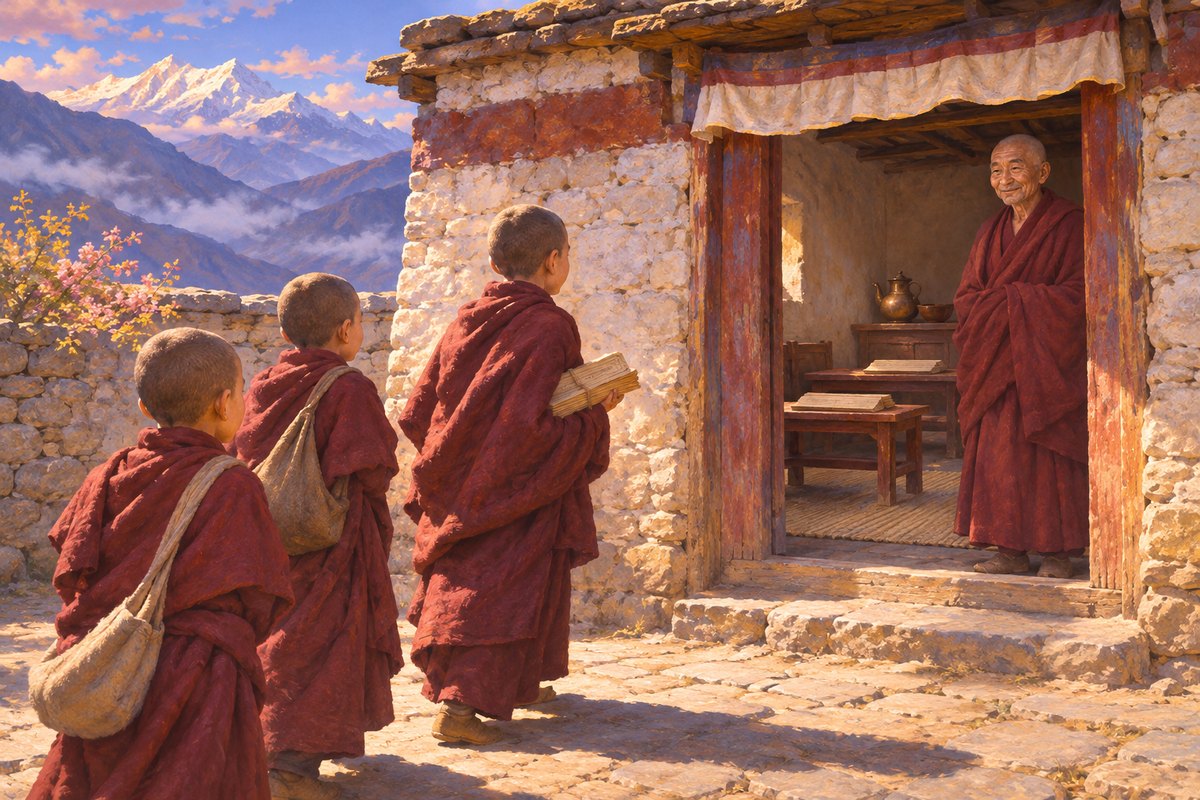
When new people came
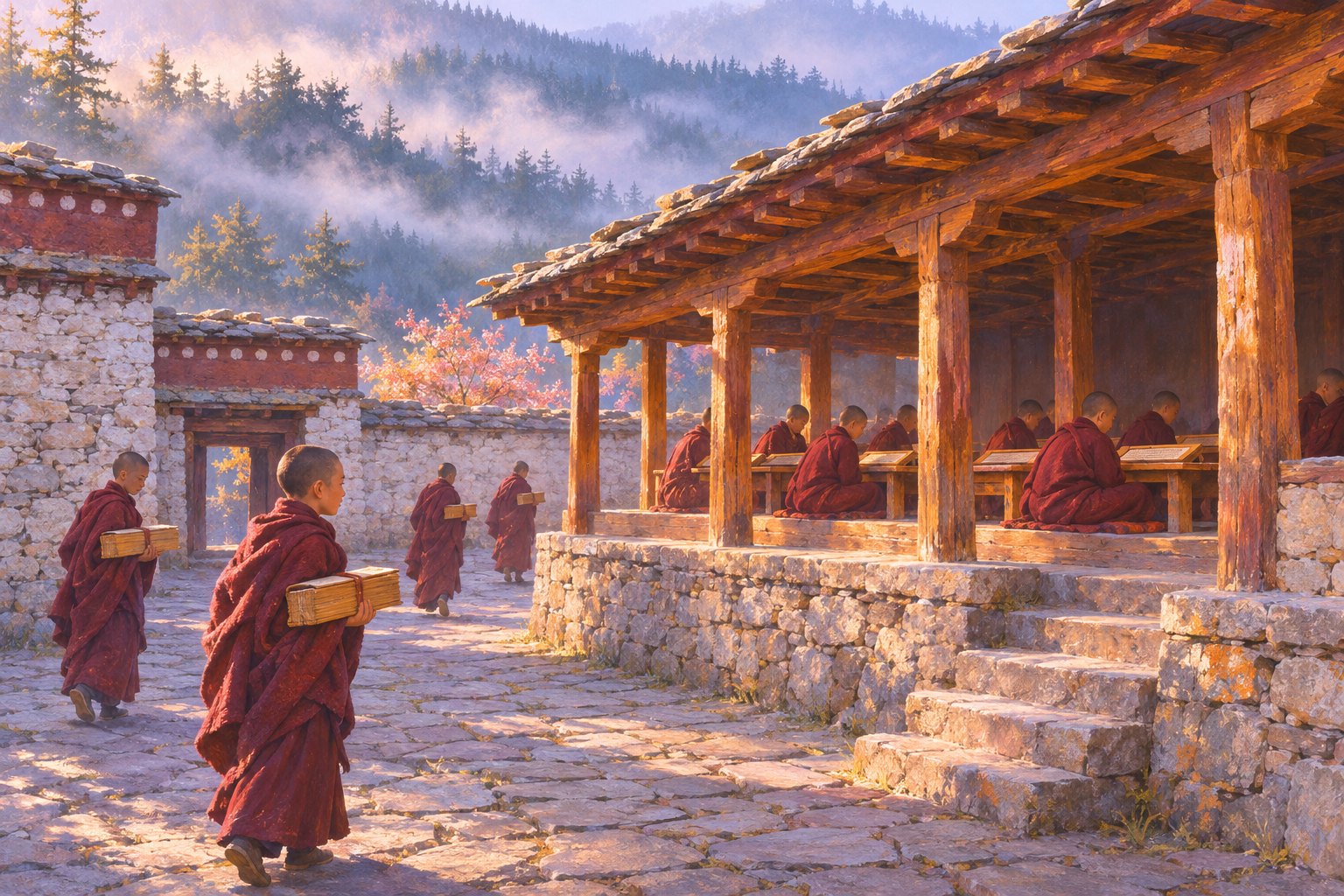
From 1883, the lineage account says, Patrul stopped taking new students and directed newcomers to Tendzin Norbu. A teacher’s confidence became a responsibility carried in ordinary encounters. Someone who had come looking for Patrul now had to be received and taught by another person.
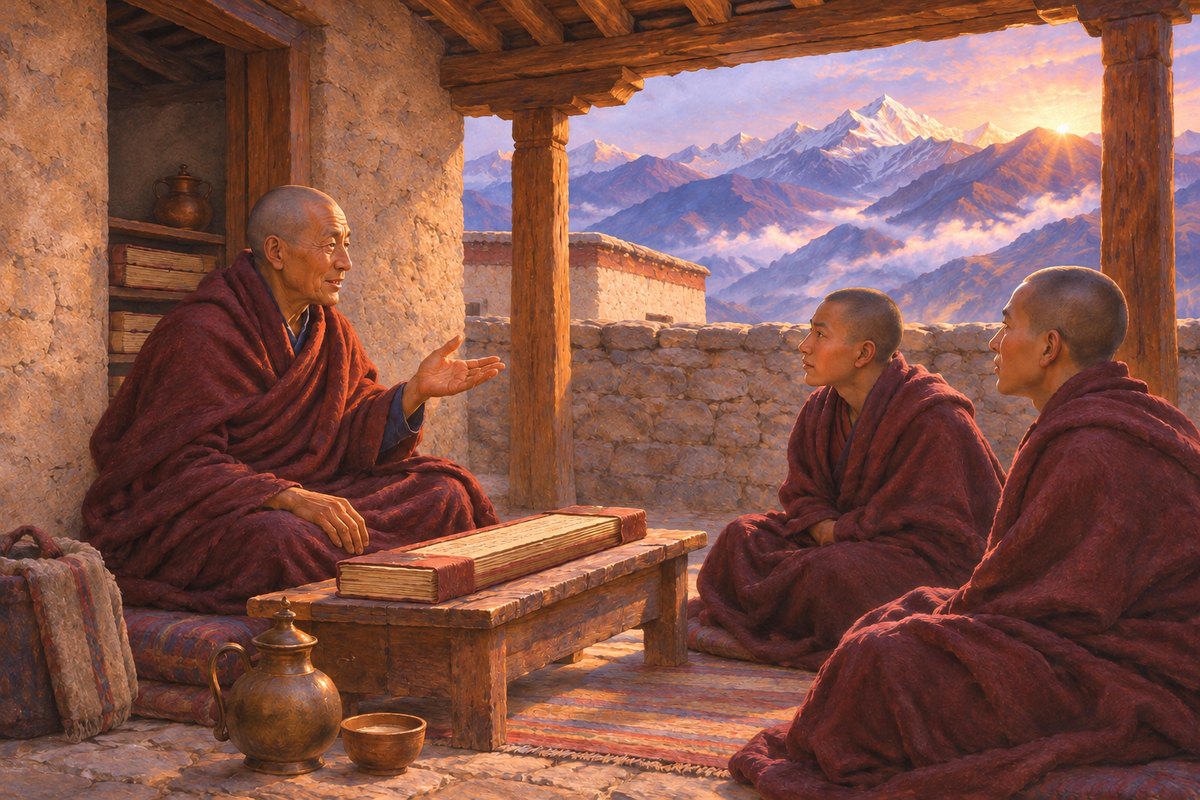
The relationship did not end at the first teacher’s door. Later students would meet the teachings through the person to whom they were sent. This is how a lineage can widen without ceasing to be a chain of personal relationships. The crowded doorway in the picture is an illustration of that continuity, not a count of an actual day’s visitors.
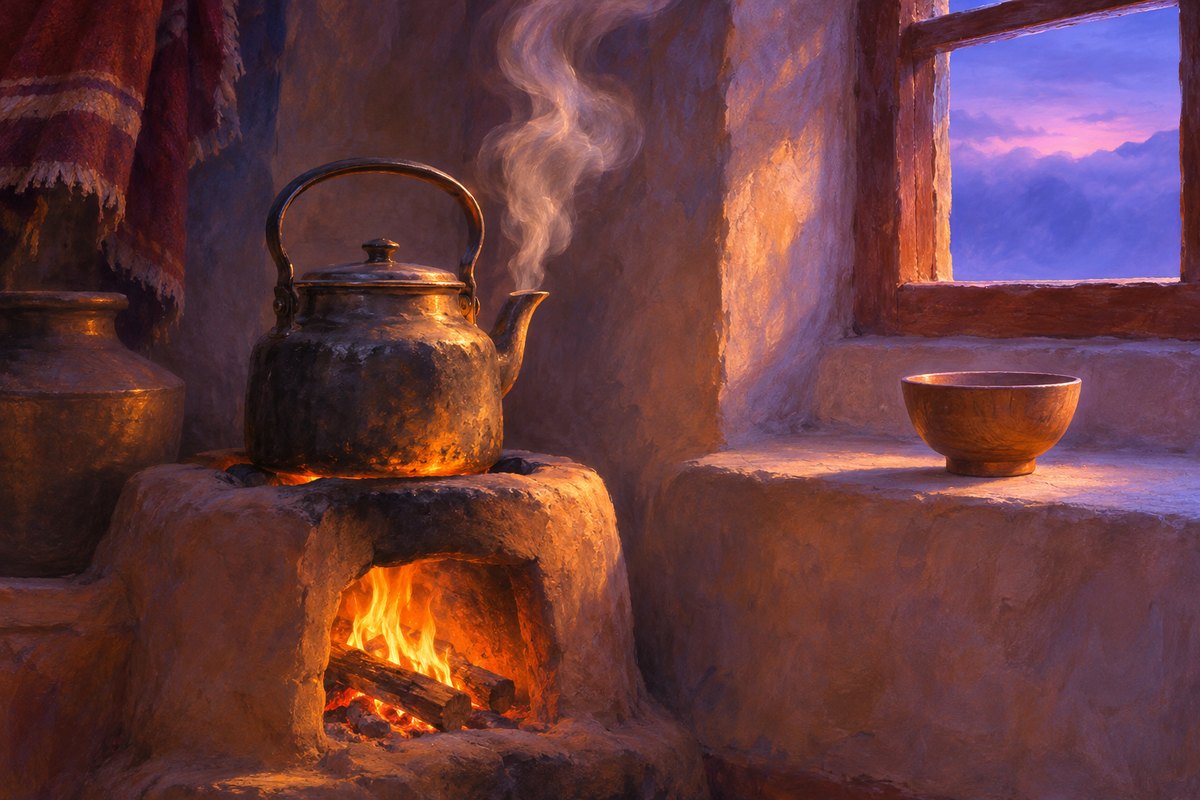
The kettle
Adam Pearcey’s historical introduction recalls a teacher who lived simply and had no attendant to prepare his tea well into later life. Beside the great teaching record, that small household detail is especially clear: the work of receiving others did not remove every ordinary task.
The kettle becomes a useful pause in the story. The remembered master was not only an answer to other people’s questions. There was also the simple maintenance of a life. A bowl had to be filled, a room kept usable, and another day begun. Those ordinary acts need not be treated as obstacles to the life the account honours.
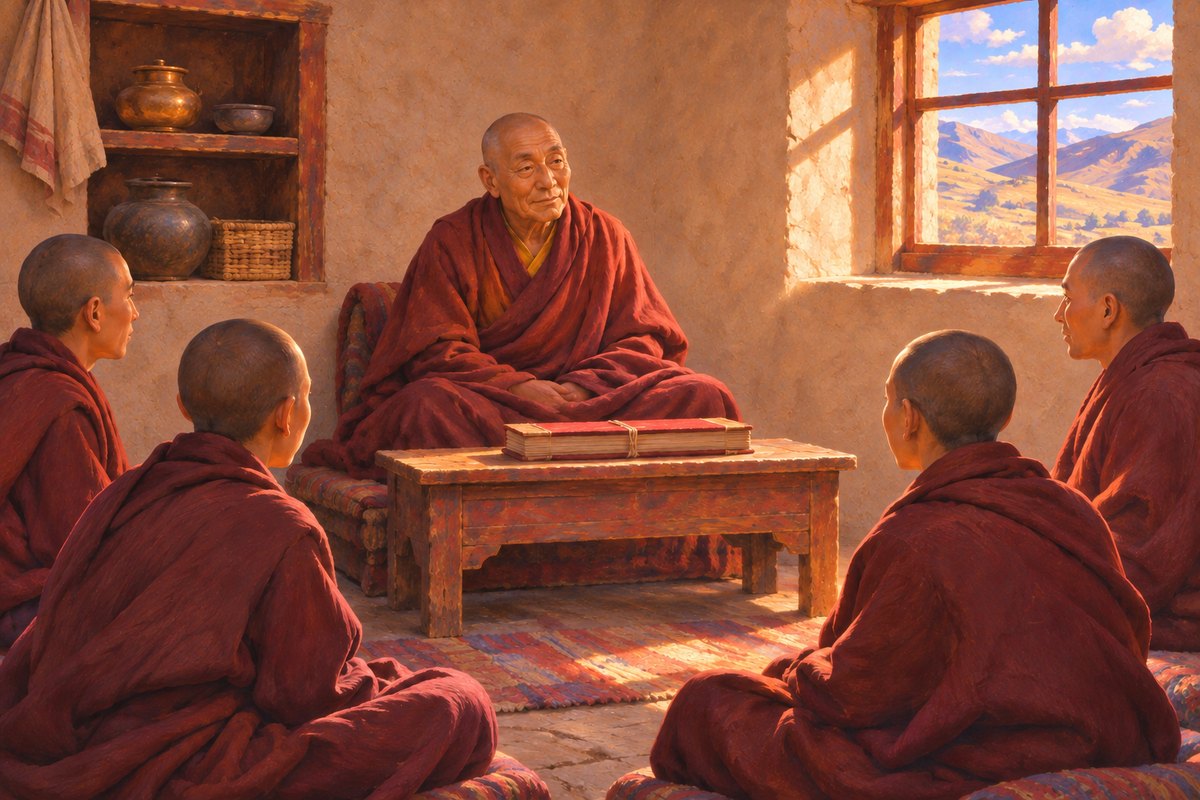
The teaching returned to
He was remembered for teaching the Bodhicaryāvatāra repeatedly. This is Śāntideva’s guide to the bodhisattva’s life, a work concerned with awakening for the benefit of beings. Pearcey’s introduction describes an extensive teaching activity alongside his simple way of living.
Repetition in a teaching life is different from running out of something to say. Each gathering includes people who have not yet heard, or who need to hear more carefully. The text stays, while listeners change. The master who wished to travel became someone willing to return with others to the same demanding and generous questions.
After Patrul’s death
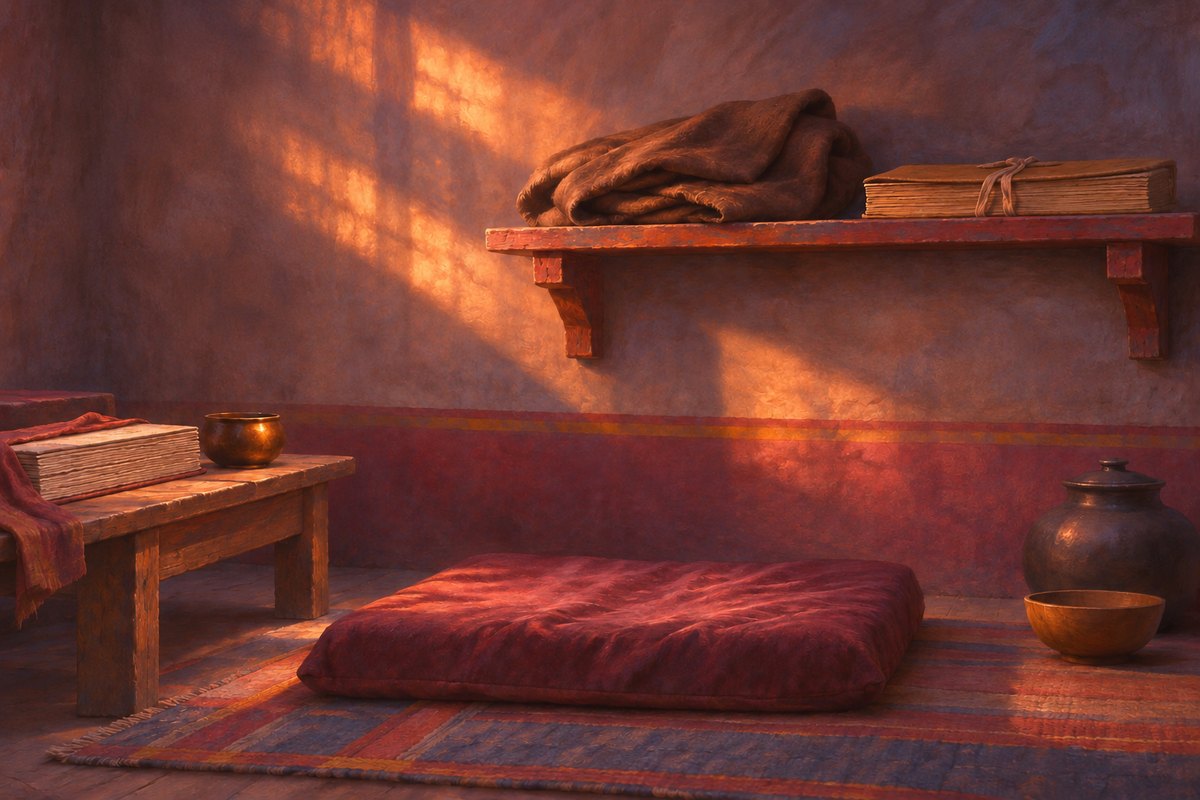
When Patrul died, Tendzin Norbu helped arrange what followed and gathered his teacher’s writings. The scholarly introduction and the lineage catalogue both remember this care. The catalogue describes the result as a compilation in six volumes.
The work belongs beside teaching, though it is less easy to picture as a great event. Loose writings can scatter; a remembered explanation can remain with one listener and go no further. Gathering gives what survives a chance to reach someone who was not present. It is one of the forms gratitude took after there was no longer a living teacher to serve in the old way.
A human link
Among those who received from Tendzin Norbu were Khenpo Shenga and Kunzang Palden. Their names appear in the biographical records, and later scholarship traces the explanation lineage of the Bodhicaryāvatāra through this network. The work that came to him did not stay with him alone.
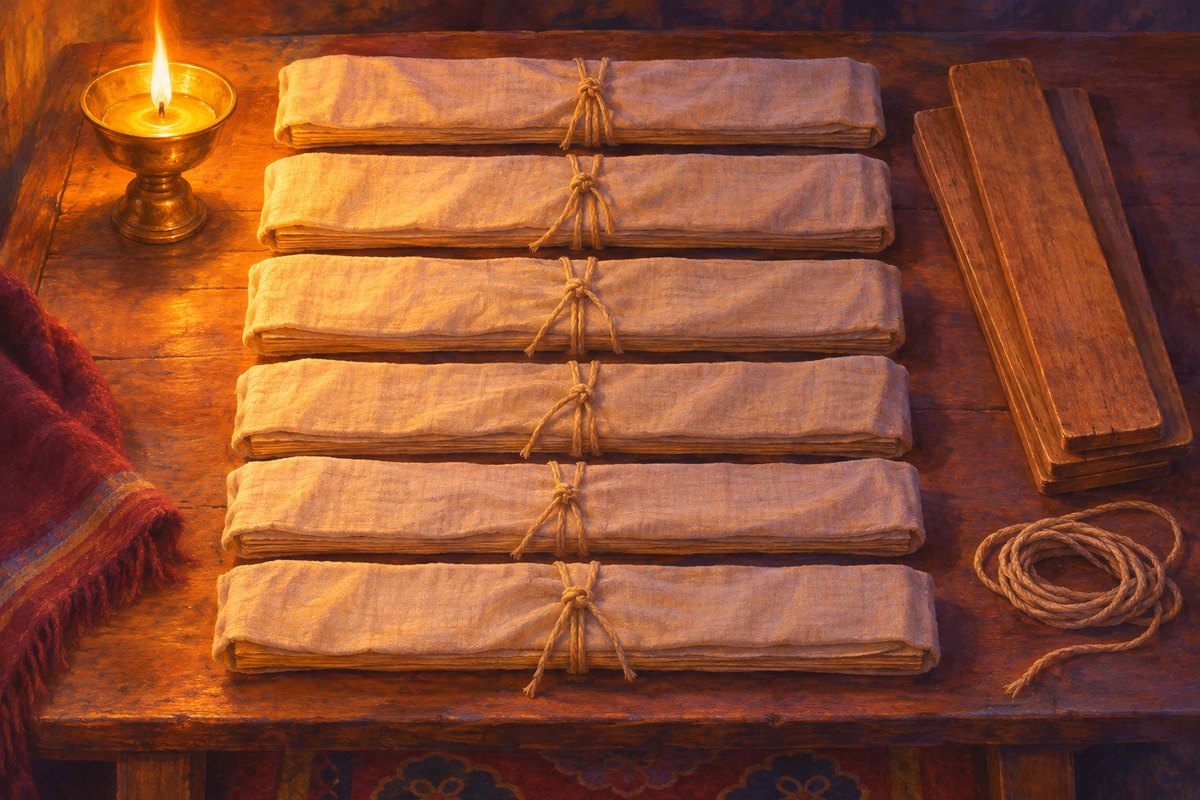
A chain of names can look complete while hiding the work between them. Someone had to listen to a question, explain a difficult point, or keep a set of notes. The wrapped bundles on the table stand for that patient activity. Their appearance is illustrative; what matters historically is that preservation and teaching both continued.
The dates left open
Even his dates are not wholly settled. Lotsawa House uses 1841–1900, while the catalogue gives 1851 as the birth year and Treasury of Lives retains alternatives and uncertainty. This telling does not turn that disagreement into a falsely exact childhood chronology.
The uncertainty does not erase the shape of the life. Patrul’s disciple, a teacher in his own right, a keeper of writings, and a source for later scholars: those relationships remain visible. A careful history can keep a question open and still let a reader meet the person whose work it is trying to remember.
The door kept open
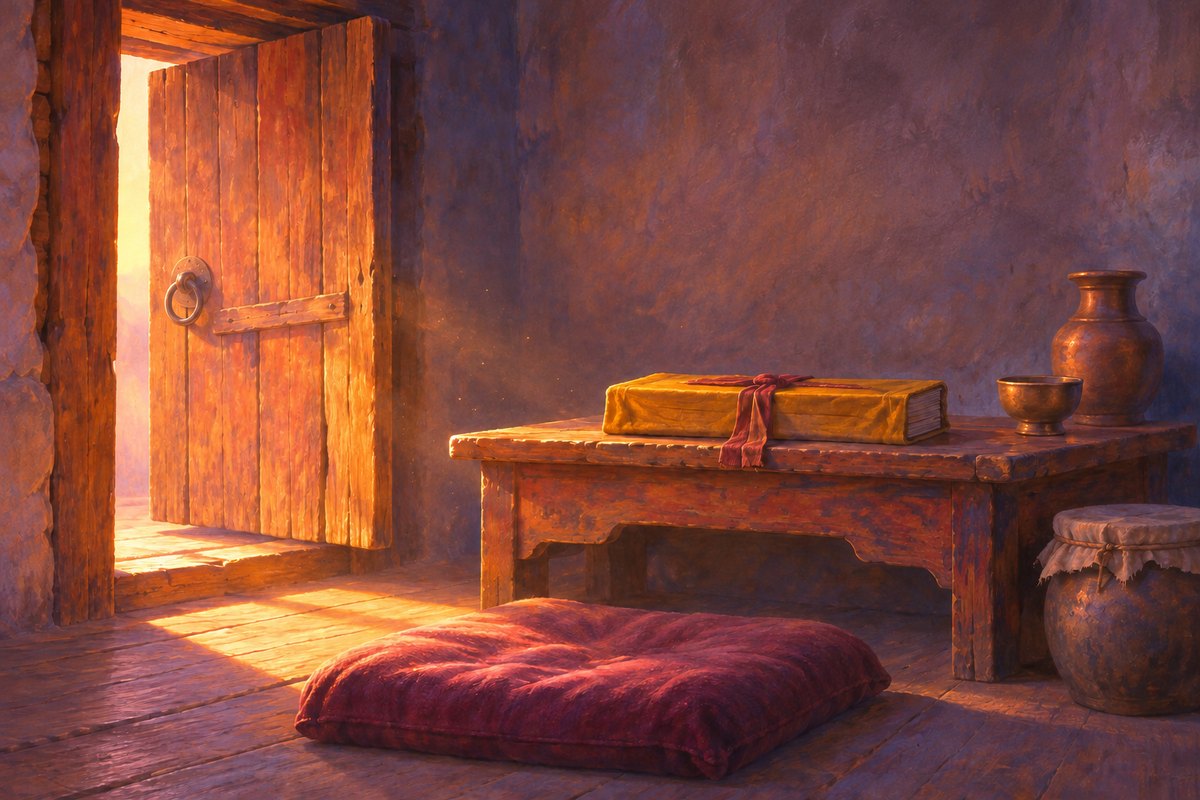
The Third Dodrupchen later wrote about Tendzin Norbu’s final words, another sign of the esteem in which he was held. Here the story returns to the earlier choice: a man who had wanted to wander accepted the work of teaching and made room for others.
The sixth line of the Seven-Line Prayer expresses the wish to follow Guru Rinpoche. In this remembered life, following included remaining available, explaining again, and caring for what a teacher had entrusted. The connection is thematic, rather than an invented story of recitation. The empty cushion at the end waits for the next person who will need to begin.
About the art
These AI-painted storybook scenes use anonymous period figures, not authenticated portraits. Rooms, routes and object arrangements are atmospheric reconstructions rather than records of exact historical appearances.
Tibetan books are shown as flat pecha bundles with wooden boards and cloth covers. Generated writing is omitted. Empty cushions, a travelling bundle, flowers and night scenes are symbolic where the caption says so; no private ritual or visionary sequence is reconstructed.
Why this matters for practice
The sixth line of the Seven-Line Prayer expresses the wish to follow Guru Rinpoche. This story offers a Nyingma setting in which to consider learning, devotion and the care taken with a teacher’s words. The connection is thematic and carries no promise of outcomes. For personal guidance beyond recitation, the Find a Teacher page is a starting point.

If something in this story moved you, you might pause and recite the Seven-Line Prayer once.
Sources and further reading
- Orgyen Tenzin Norbu, Orgyen Khandroling Catalogue
- On the Final Words of Orgyen Tendzin Norbu, Lotsawa House
- Orgyen Tendzin Norbu, Treasury of Lives
- Orgyen Tendzin Norbu Series, Lotsawa House
- Sacred Words, Living Practice: Patrul Rinpoche and the Bodhicaryāvatāra, Tsadra Foundation
- Seven-Line Prayer, Lotsawa House
This retelling is waiting to be read by a knowledgeable practitioner. Where the traditional accounts differ, the story says so; if you notice a mistake, please tell us through Share Your Story.