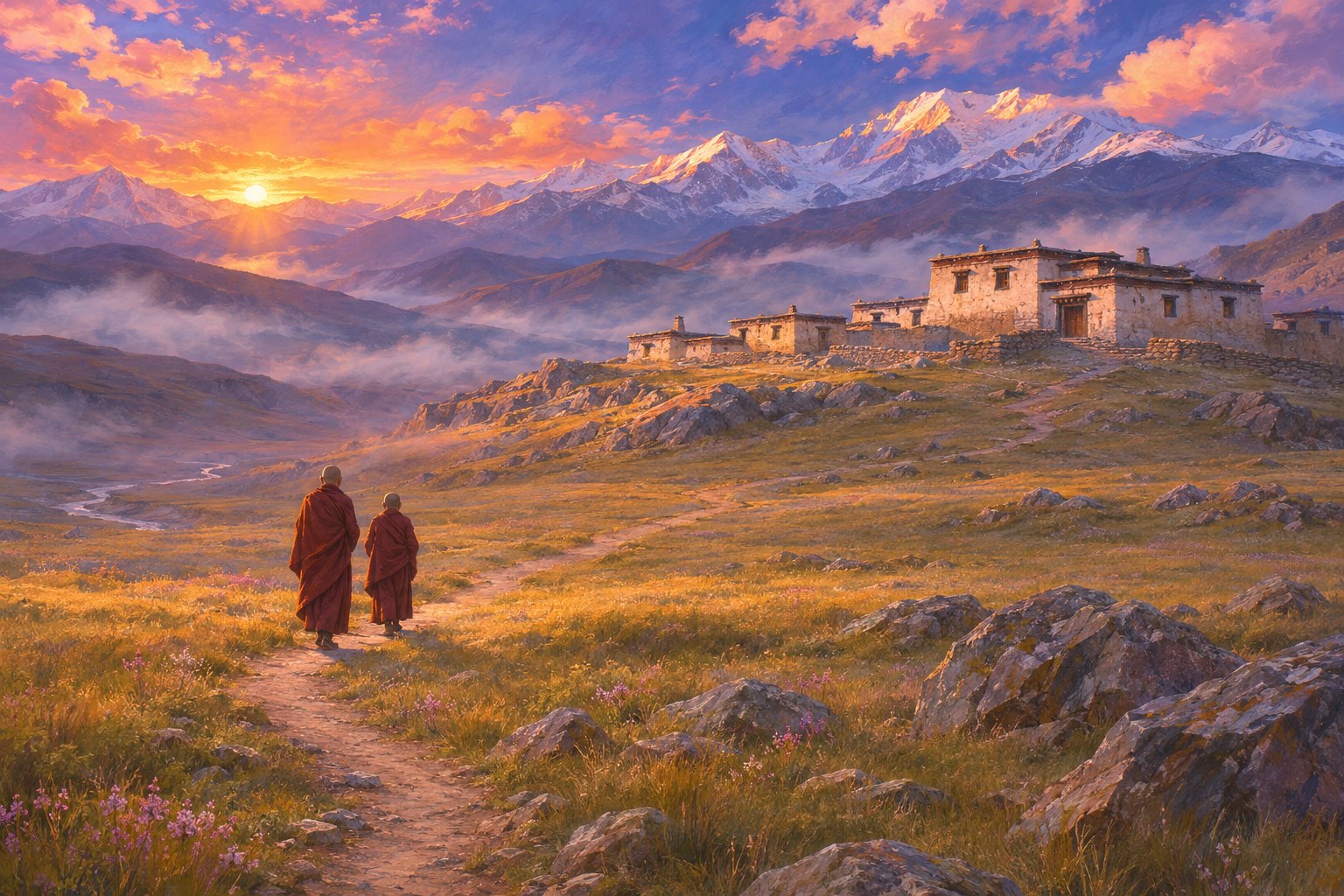
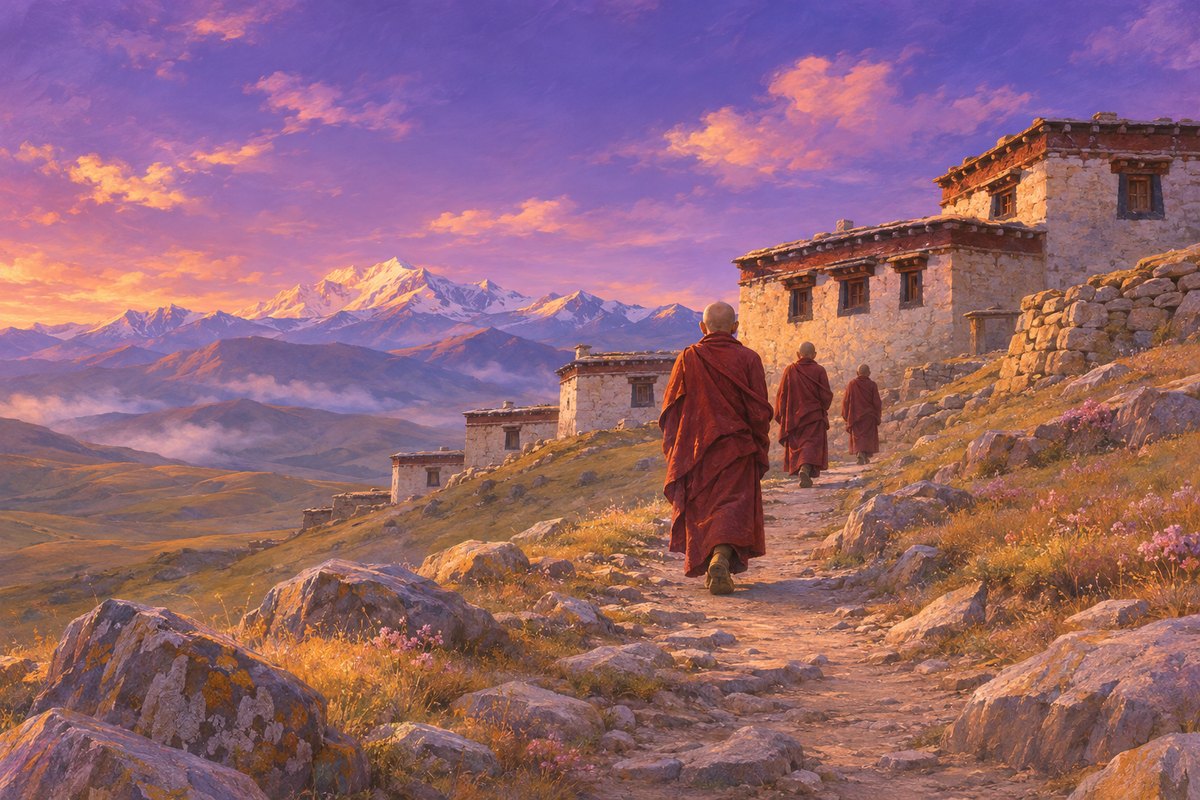
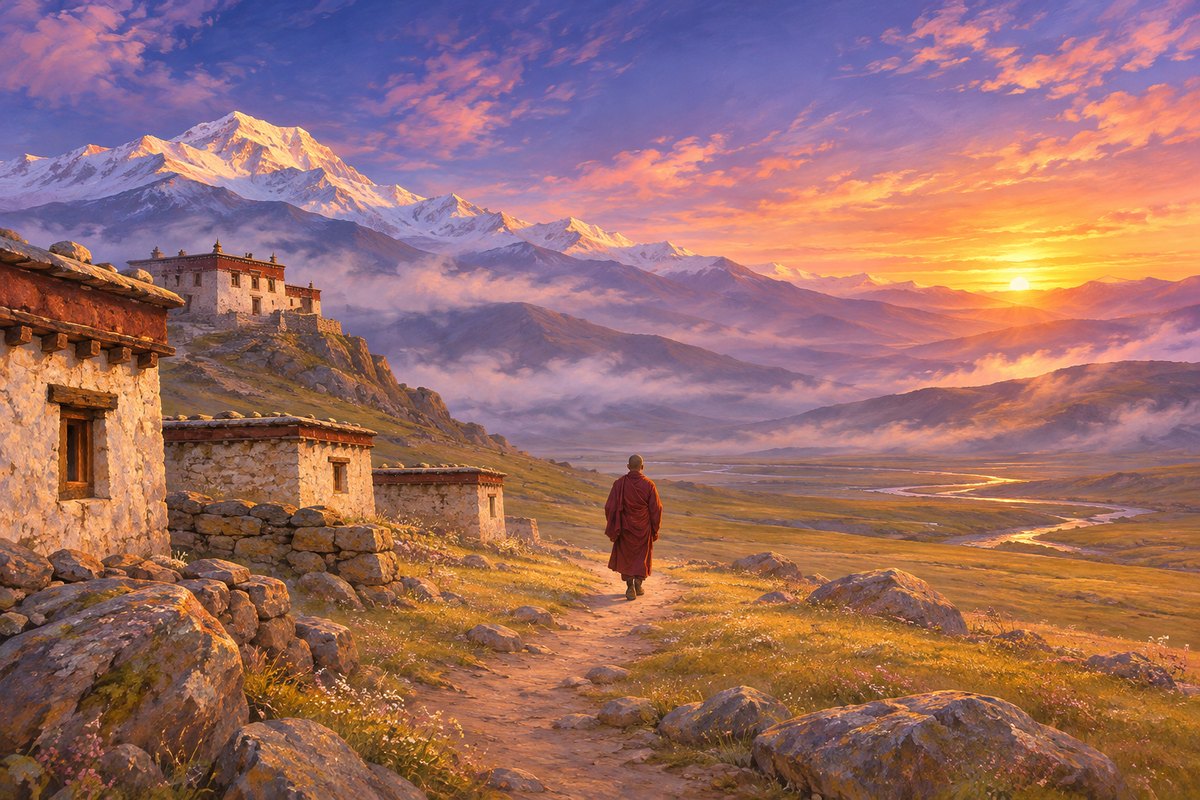
This is a source-based Nyingma lineage story. Recorded events are distinguished from the reflections offered here. The illustrations are atmospheric reconstructions, not historical portraits or records of particular rooms.
The long apprenticeship
Nyoshul Lungtok Tenpé Nyima lived in nineteenth-century eastern Tibet. He is remembered in the Nyingma tradition as one of Patrul Rinpoche’s foremost disciples. The lineage account preserved by Amnyi Trulchung Rinpoche’s community says that he remained with his teacher for about twenty-eight years. That is the scale on which this story begins: not a single remarkable evening, but a large part of a human life.
Twenty-eight years is easy to pass over on a page. It is harder to hold in mind as time actually lived. A pupil grows older. A teacher grows older. Familiar words must be heard again without deciding that familiarity is the same thing as understanding. The record gives the length of their companionship; it does not give a diary of its days.
What was being carried
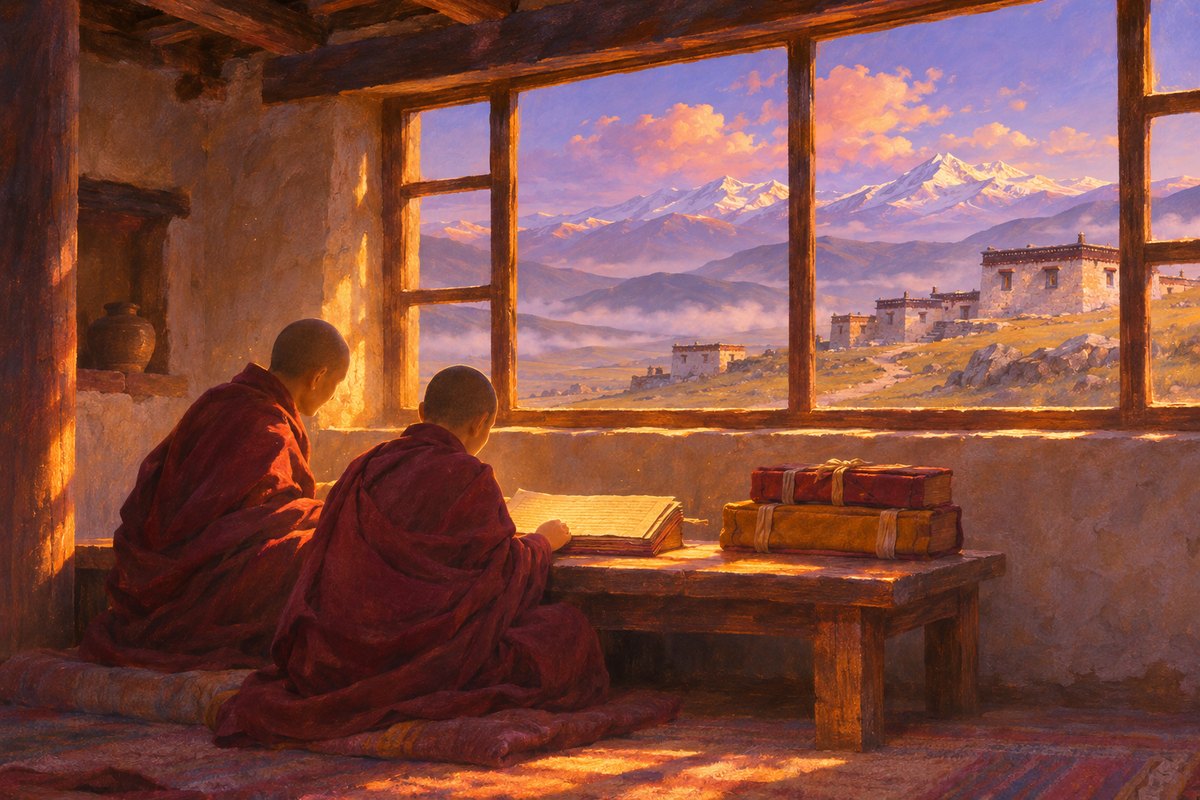
Lungtok received teachings from the Nyingtik traditions of Longchen Rabjam and Jigme Lingpa. Nyingtik means Heart Essence; these lineages belong to the Nyingma, the Ancient Translation school of Tibetan Buddhism. Here, a lineage means teachings passed through teachers and students, with their explanations and living guidance, rather than a collection of names alone.
It would be tempting to fill the years with imagined conversations. We do not have to. The important relationship is already there in the account: a student stayed, listened, and continued to learn. No invented reply can tell us more securely what passed between them than the later place Lungtok held among the transmitters of Patrul’s teaching.
A question in the forest
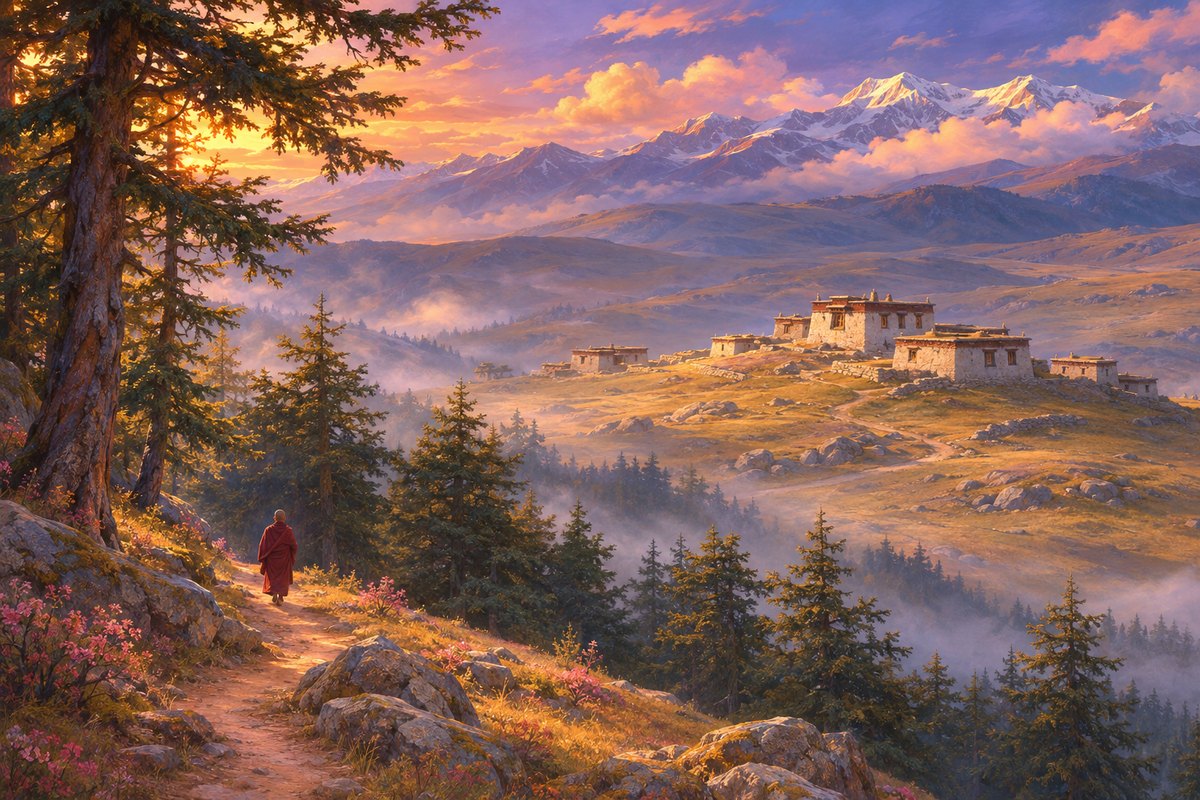
The same lineage account preserves an incident at Ari Forest. Patrul asked Lungtok whether he remembered his mother. Lungtok’s answer suggested that he did not remember her very much. Patrul then directed him to reflect on motherhood and maternal kindness. The account says that loving-kindness and compassion developed through this instruction.
We should leave the episode at the size the source gives it. There is no description of his mother’s face, no childhood scene, and no report of the words he thought in the forest. Those details would make an easy picture-book scene. They would also turn an inherited account into a story we had invented.
Compassion belongs here
For a reader, the forest episode changes the weight of the apprenticeship. A celebrated lineage is not being preserved only through difficult explanations. The account also remembers a teacher noticing where his student’s heart needed attention. This is a reflection on the episode, rather than a further event reported in Lungtok’s life.
Bodhicitta is the wish for awakening for the benefit of all beings. Lungtok’s own aspiration prayer gives that concern a central place. Its opening requests inspiration from the root and lineage teachers and from the awakened ones. The voice is a supplicant’s: even the master remembered by later generations asks for help in becoming like those he reveres.
An evening remembered
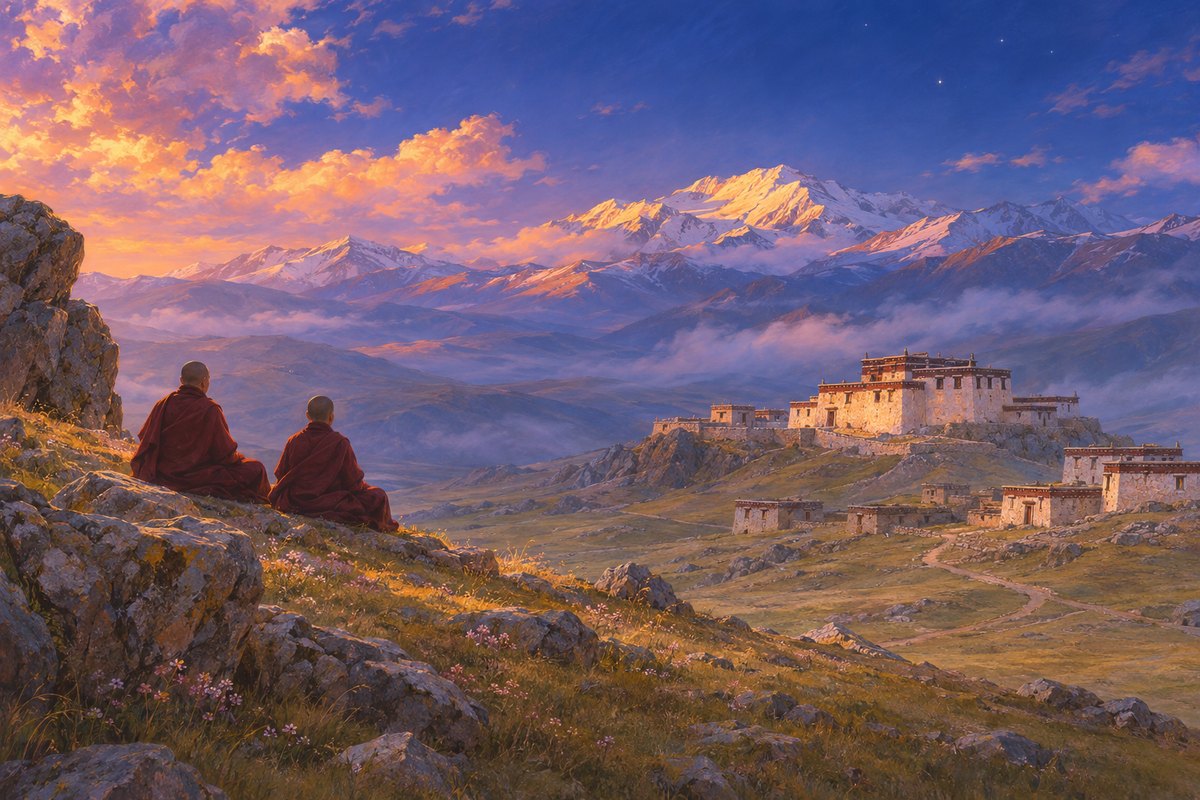
There is also a famous account of an evening with Patrul above Dzogchen Monastery. The lineage remembers it as a decisive moment in Lungtok’s realization. Its significance belongs within the long relationship of preparation and personal instruction that preceded it. It is not a method that a reader can obtain by copying the outward circumstances.
This page therefore does not recreate the exchange as a meditation lesson. Dzogchen, the Great Perfection, is a Nyingma teaching tradition received with appropriate guidance. Anyone who wishes to explore it should use the Find a Teacher page to begin looking for a qualified teacher. A biographical account can honour what happened without attempting to replace that relationship.
The prayer he left
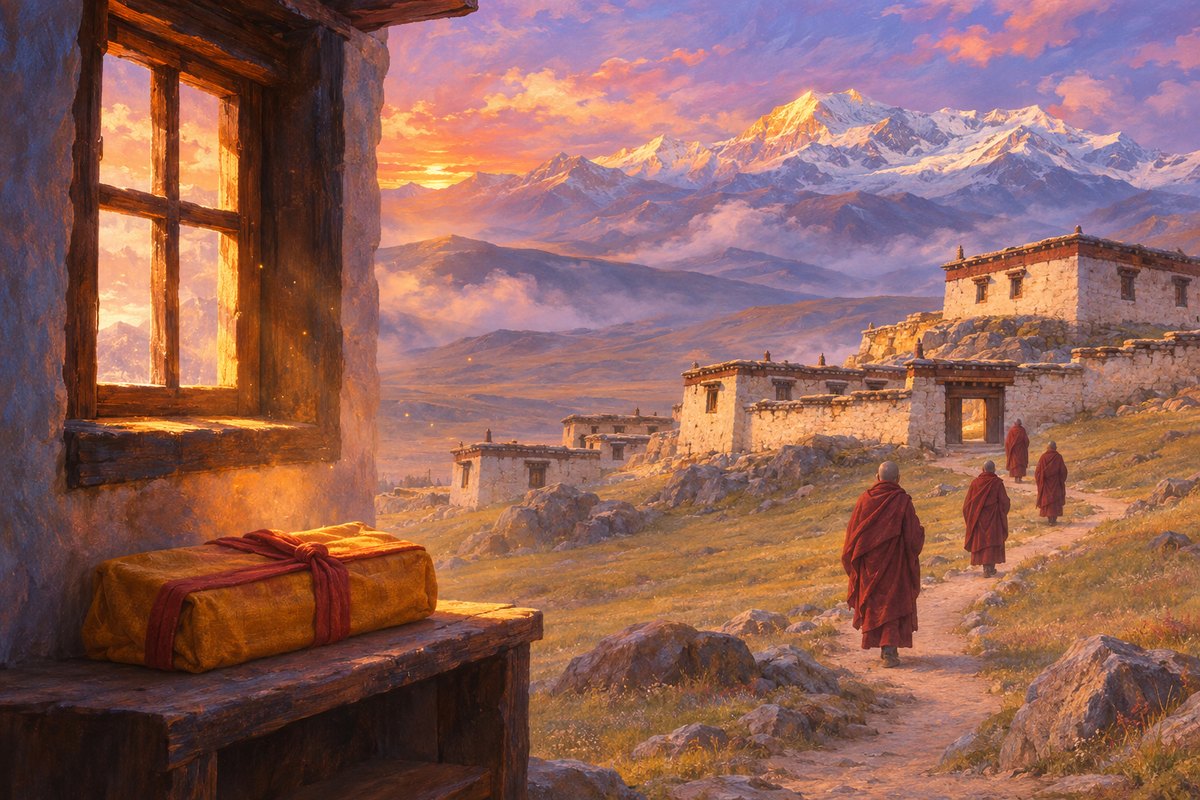
Lungtok’s Bodhicitta Aspiration offers a different way to meet him. In it, he asks that the intention toward awakening remain alive through favourable circumstances and hardship alike. The prayer includes strength and weakness, happiness and sadness, illness and dying. It does not reserve the path for the days on which a person feels capable.
Those few lines widen the setting beyond the remembered forest and hermitage. They speak to conditions a reader may recognize, without supplying a biography of any particular sufferer. Lungtok asks that difficulties become occasions for deeper practice. This is an aspiration, not a prediction that illness will disappear or that adversity will prove harmless.
A student becomes a teacher
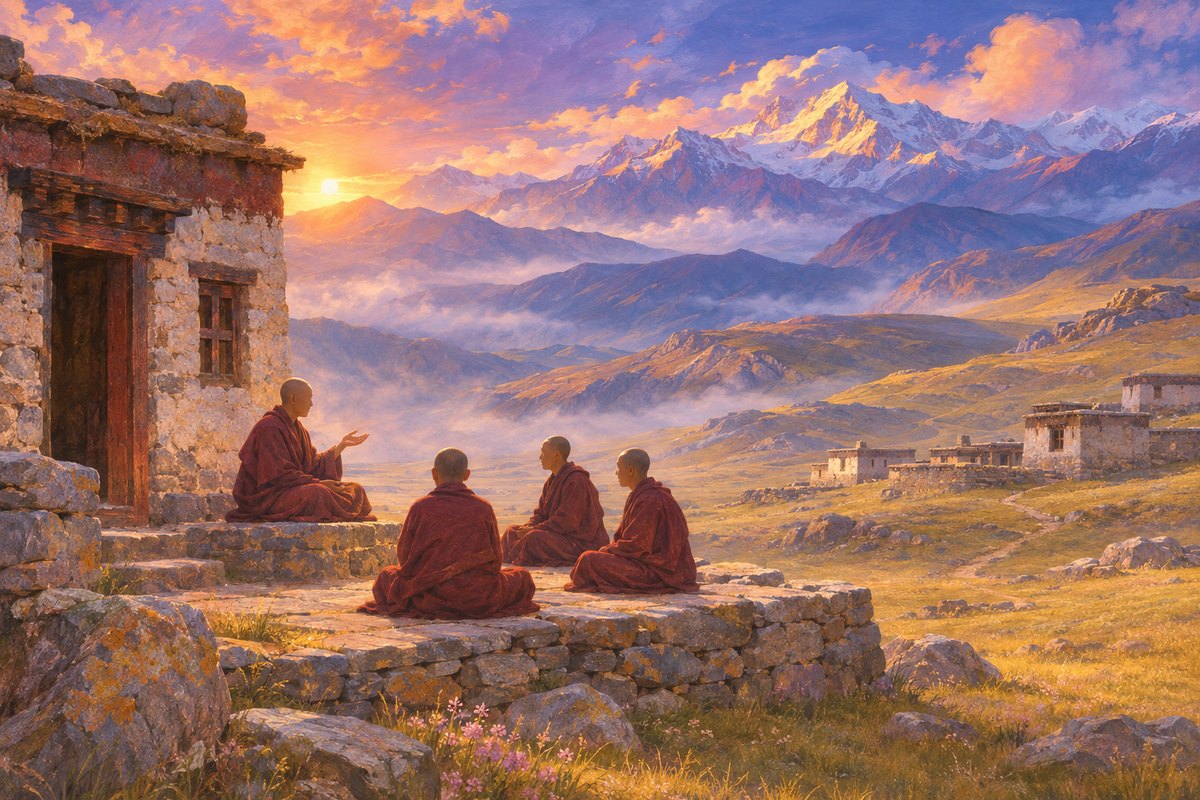
Amnyi Trulchung Rinpoche’s lineage account says that Lungtok shared Patrul’s teachings and, after fifty, taught Dzogchen as his teacher had directed. The story’s movement is therefore from receiving to carrying onward. A student who had stayed with his teacher became a teacher whom others approached.
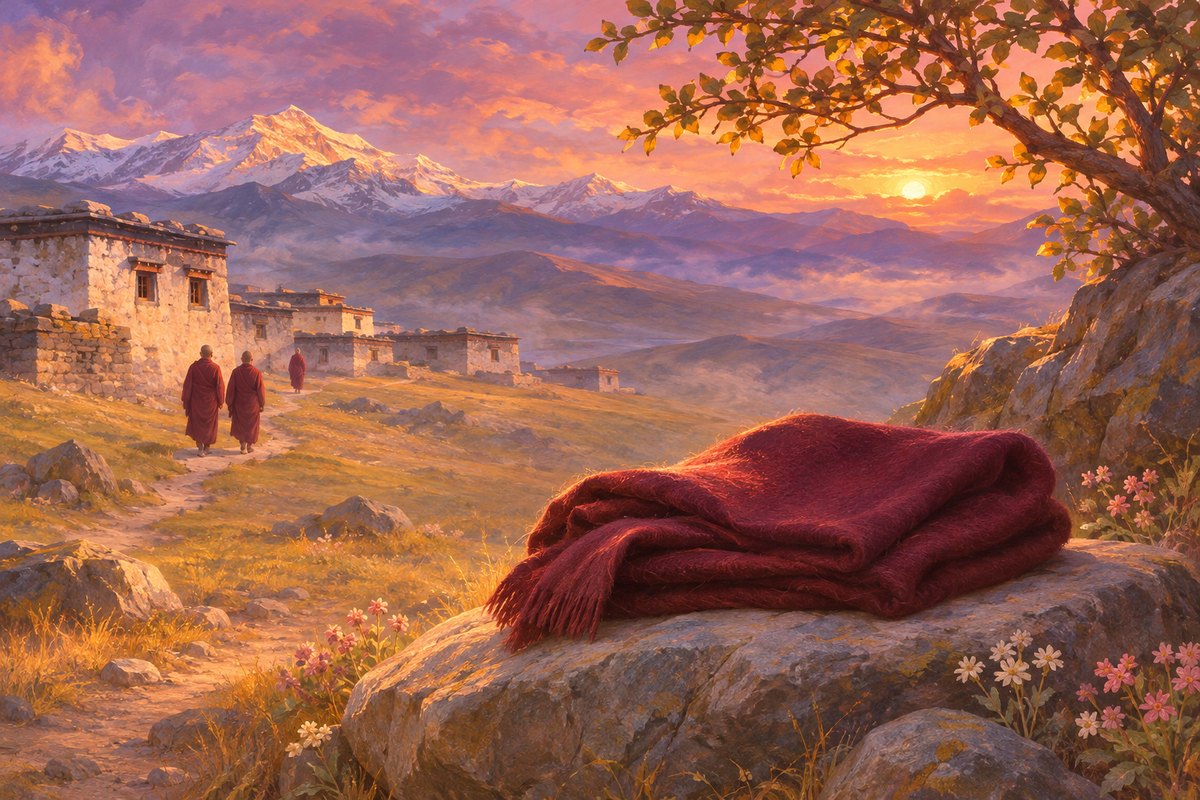
The paintings here use small, anonymous monastic figures. They suggest that movement without claiming to show the actual arrangement of a gathering or the appearance of a particular day. We know that teaching continued. We do not know the weather outside an unrecorded lesson, the number of listeners in its room, or the expression on each face.
The next name in the prayer
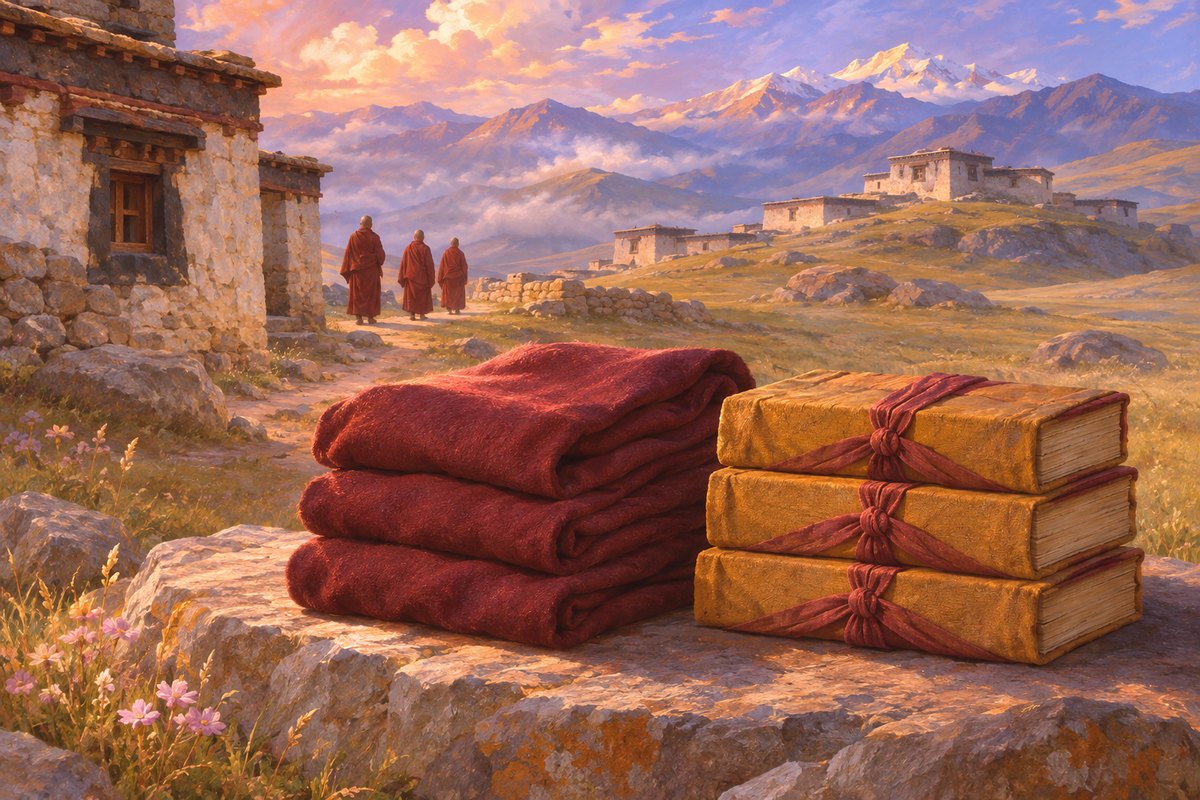
Khenchen Ngawang Palzang, also known as Khenpo Ngakchung, included Lungtok in a supplement to the Longchen Nyingtik lineage prayer. That text names Jigme Gyalwé Nyugu, Patrul, and Lungtok in succession. It gives the relationship a place in the devotional life of later practitioners, rather than leaving it only in historical prose.
A list can look still on the page. Read beside the apprenticeship, it carries a different sense of time. The names point toward people who received something and entrusted it onward. That is this page’s reflection on the lineage prayer; the prayer itself is linked below for readers who wish to see its wording and source.
What the dates leave open
Lotsawa House gives Lungtok’s dates as 1829–1901/2. That final uncertainty is worth keeping visible. A respectful retelling need not make the historical record tidier than it is. The traditional account also describes signs at his passing; such signs belong to the lineage’s remembrance, not to a modern verification this page can supply.
Neither the uncertain year nor an omitted wonder empties the story of its force. The enduring outline remains a long apprenticeship, an account of compassion, and the onward transmission of a Nyingma lineage. The particulars that cannot be established should be left open for a knowledgeable practitioner and historian to review.
Following
The sixth line of the Seven-Line Prayer expresses the wish to follow Guru Rinpoche. The connection here is thematic: this page does not claim that a particular recitation caused Lungtok’s realization, or invent an occasion on which he said the prayer. His apprenticeship offers one historical setting in which to consider what following can ask of a person.
For a reader returning after a long absence, there may be reassurance in a story whose first measure is years. There is room to learn again, to ask for guidance, and to let concern for others accompany devotion. Those are invitations offered by this retelling, not new words placed in the mouth of Lungtok or Patrul.
About the art
These AI-generated storybook paintings show nineteenth-century eastern Tibetan landscapes, wrapped books, and small anonymous monastic silhouettes. They do not claim to reproduce a named teacher’s face, exact monastery architecture, or a recorded gathering.
Maroon robes and modest stone-and-timber settings suggest the period. No sacred figures, ritual implements, halos, Tibetan script, or mantras appear. Scenic light is atmospheric rather than a sign of realization.
Why this matters for practice
The sixth line of the Seven-Line Prayer expresses a wish to follow Guru Rinpoche. This lineage story invites reflection on learning, devotion, and the care with which teachings pass between people. The connection is thematic; no particular recitation or promised result has been invented.

If something in this story moved you, you might pause and recite the Seven-Line Prayer once.
Sources and further reading
- Nyoshul Lungtok, Amnyi Trulchung Rinpoche / Rigdzin
- Nyoshul Lungtok Series, Lotsawa House
- Bodhicitta Aspiration, Lotsawa House
- Longchen Nyingtik Lineage Supplement, Lotsawa House
- Seven-Line Prayer, Lotsawa House
This retelling is waiting to be read by a knowledgeable practitioner. Where the traditional accounts differ, the story says so; if you notice a mistake, please tell us through Share Your Story.