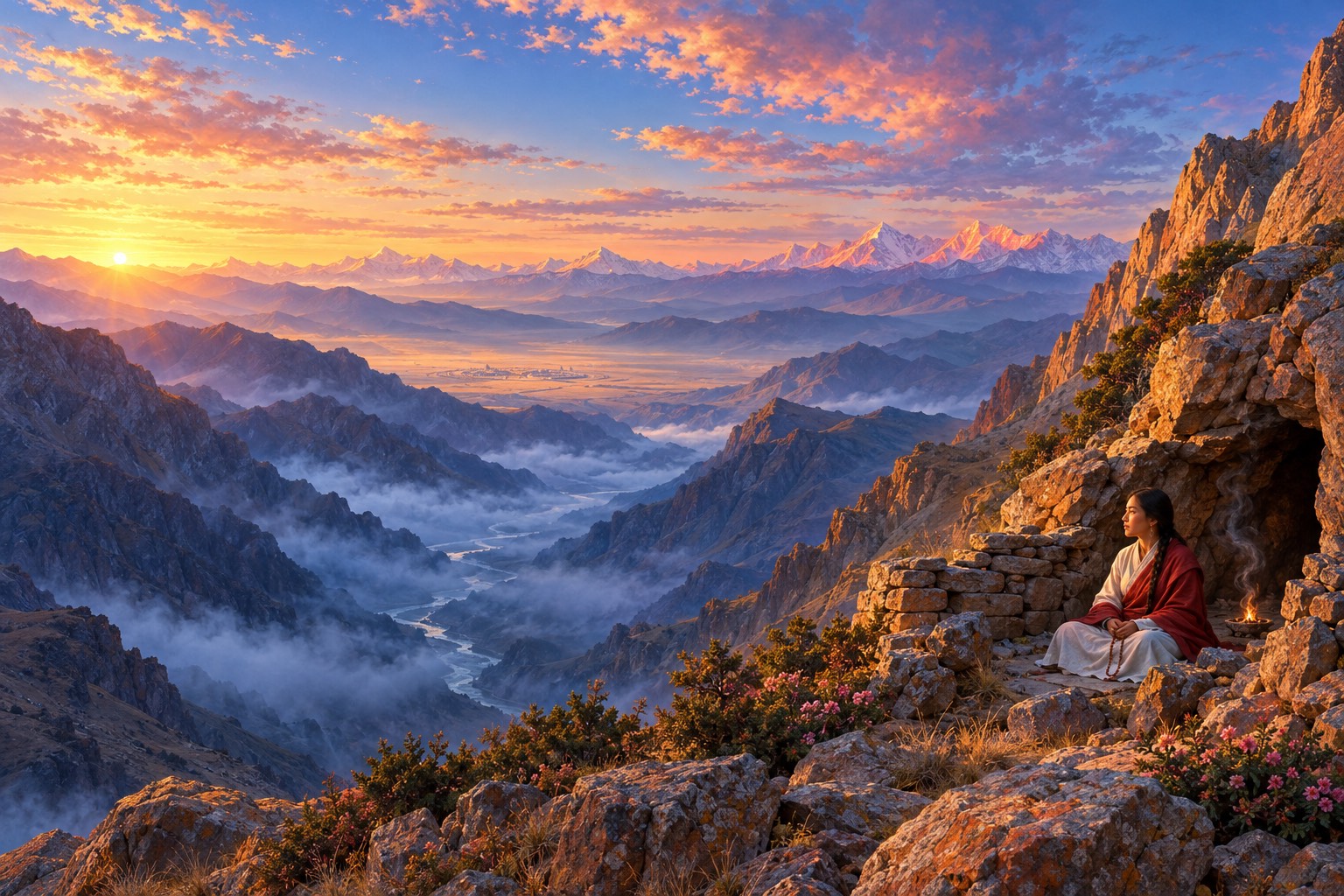
Some books reach us from a library shelf. The tradition says the best-loved life of Yeshe Tsogyal reached the world another way: it was found.
Yeshe Tsogyal was Guru Rinpoche's closest Tibetan disciple, and her own story has its own page on this site. This page is about the man who brought her story to light in the seventeenth century, a wandering yogi of eastern Tibet called Taksham Nüden Dorje. It is told as the traditional accounts tell it, and honestly about how little is certain.
A son of Lhorong
The Rangjung Yeshe Wiki says he was born in the Lhorong valley of Kham, the wide eastern country of Tibet, a land of high pastures, spruce forest and deep river gorges. Most sources give his birth year as 1655. One older note gives 1682 instead, which is also the birth year given for one of his students, so the dates may have been crossed somewhere along the way.
His names each say something. Nüden Dorje means roughly "vajra endowed with power"; a vajra is the tradition's symbol of what cannot be broken. As a treasure revealer he was called Samten Lingpa, samten meaning deep meditative stillness. Taksham is also the name of his monastery in the lower Ke-chu valley, near Riwoche, and one source explains it as "tiger-skin skirt."
A tertön, or treasure revealer, is someone the tradition believes was destined to find terma, "treasures": teachings that Guru Rinpoche and Yeshe Tsogyal are said to have hidden in rocks, lakes and minds for the sake of later times.
The Rangjung Yeshe Wiki notes an old prophecy. A sixteenth-century history by the scholar Pawo Tsuglag Trengwa, it says, foretold that a ngakpa named Nüden Dorje would reveal Guru Rinpoche's treasures in Kham. A ngakpa is a lay practitioner of mantra who lives outside monastic vows, often recognised by long hair and white robes.
 Illustration in preparation
A wise eccentric
He was no scholar. In his day, the same source says, he was regarded as a zhikpo, a "wisdom-eccentric," one whose free and unconventional ways are understood as a sign of realization rather than of carelessness. Yet the man who was far from academic wrote texts of great depth.
Rigpa Wiki names his teacher as Rigdzin Düddul Dorje (1615–1672), the great treasure revealer of Powo, who shared with him teachings and prophecies about the hidden land of Pemakö. If Taksham was born in 1655, he was about seventeen when that teacher died, so their time together came in his youth.
He also held the lineages of Katok, the old monastery of Kham, and of a master called Chöje Lingpa. Here the sources disagree gently. One calls Chöje Lingpa among Taksham's main teachers; Rigpa Wiki lists him, born in 1682, among his students.
Illustration in preparationThe one who came back
Why would this man be the one to find Tsogyal's story? The tradition's answer reaches back nine centuries. In Nepal, as told on the Atsara Salé page, Yeshe Tsogyal paid the ransom of a young man named Atsara Salé, who became her companion on the path.
Rigpa Wiki and the Rangjung Yeshe Wiki both say that Taksham was Atsara Salé reborn. The Rangjung Yeshe Wiki also counts Salé as Gyalwa Changchub, one of the two disciples credited with writing her life down, the other being Namkhai Nyingpo. So in the tradition's eyes, the one who helped set the story down was the one who came back to find it.
Illustration in preparationThe life story even carries a prophecy of its own finders. The scholar Janet Gyatso notes that it lists nine future revealers, among them a Dorje called Pawo, "hero," from Lhorong, and she suggests this may be Taksham himself.
The same passage, Gyatso writes, says the story was hidden in three versions: a long one at Zabbu, where Tsogyal is said to have passed away; a middle one in Lhorong in Kham, which is the one Taksham found; and a short one in Lhodrak, in the south.
Illustration in preparationDelivered by the waters
How did it come to him? The Rangjung Yeshe Wiki says it was placed in his hands by a protector, the Black Lord of the Waters, whom Guru Rinpoche and Tsogyal had bound by oath to deliver it at the right time.
That is the tradition's account, and it is passed on here in the tradition's words, not as something anyone can check. It is one way of saying that a treasure does not arrive by chance, but when it is needed.
Illustration in preparationThe book's long Tibetan title speaks of a hidden life made manifest, and of a garland of songs played on the lute of the celestial musicians. It is this book that most readers know as the life of Yeshe Tsogyal, translated into English as Mother of Knowledge and as Sky Dancer, and into French as well.
Illustration in preparationWhat the scholars see
Historians ask their own questions. Janet Gyatso points out that Taksham's book was written some nine hundred years after Tsogyal would have lived. She found a fourteenth-century life of Tsogyal by Drime Kunga that he clearly drew on, and notes that his prophecy of future finders includes a Kunga from the east, perhaps a nod to that older work.
Gyatso also shows how unusual the book is. In it Guru Rinpoche tells Tsogyal that, for one with a determined heart, a woman's body is actually superior for the path. She calls the book's empowerment of a woman "virtually unprecedented in Buddhist literature" (Gyatso, A Partial Genealogy).
The tradition and the historian are asking different questions. This page holds both, without forcing them into one answer.
Illustration in preparationTreasures of the Lotus-Born
Tsogyal's life was not his only treasure. The Rangjung Yeshe Wiki says he set down a life of Guru Rinpoche in the form called Dorje Drolö, "Wild Wrathful Vajra," one of the eight forms the Guru is said to have taken, pictured riding a tigress. Rigpa Wiki names a treasure cycle that unites the Three Roots, the Tsasum Yidam Gongdü.
The Treasury of Lives mentions a guru yoga, a devotional practice, centred on Yeshe Tsogyal from his treasures, and records that his collected treasures were still being transmitted in 1998. Those practices are given within a lineage, by a teacher.
Illustration in preparationThe sources also tangle over one more book. The Treasury of Lives credits Samten Lingpa, born 1655, with the account behind the English life of Princess Mandarava. Lotsawa House gives that work to a later Samten Lingpa of the nineteenth century. Two masters shared the name, and the attribution is uncertain.
In the land of Powo
Rigpa Wiki says he settled in Powo, a kingdom of deep forested valleys and glaciers in south-eastern Tibet, ruled by its own kings. There he revealed many treasures, some about Pemakö, the hidden land further south.
In one prophecy, Rigpa Wiki reports, he describes eight hidden lands opening across Tibet like the petals of a lotus, with Pemakö at the centre. His guidebooks later helped pilgrims find their way there. What those landscapes mean inwardly is a matter for teachers; the story of the hidden valleys is told on its own page.
Illustration in preparationStudents came. Rigpa Wiki and the Treasury of Lives list among them the Eleventh Karmapa, Yeshe Dorje (1676–1702), who died young, and the treasure revealer Pema Dechen Lingpa (1663–1713), who, the Treasury of Lives says, received all his transmissions from Taksham.
Illustration in preparationA thread through the centuries
When did he die? Rigpa Wiki and the Buddhist Digital Resource Center give 1708; the Treasury of Lives gives only his birth. As with so much here, the date is best held lightly.
His line did not end with him. Rigpa Wiki says that Dudjom Drakngak Lingpa (1871–1929), who also opened the ways into Pemakö, was recognised as his rebirth, and was likewise counted as Atsara Salé returning.
Seen whole, the tradition draws a long quiet thread: a servant set free in Nepal, a scribe at Tsogyal's side, a yogi of Kham who found her story, a guide to hidden valleys. Historians cannot follow such threads. The tradition holds them with love.
The fourth line of the Seven-Line Prayer gives Guru Rinpoche his name, Padmasambhava, the Lotus-Born. Taksham's life is full of names: his own several names, Tsogyal's, and the Guru's wrathful name, Dorje Drolö, which he wrote into a life story of its own. Each is a way of calling the same presence closer.
The practices his treasures hold belong with a qualified teacher, and the site's Find a Teacher page lists places to begin. Anyone, though, may recite the prayer.
Illustration in preparationAbout the art
No traditional portrait of Taksham Nüden Dorje could be viewed for this page, so he is painted as a careful reconstruction on the pattern of lay treasure revealers in later Tibetan art, not as a likeness. He wears the long hair in a topknot and the white robe and red-bordered white shawl of a ngakpa, a lay practitioner of mantra, which is what the old prophecy calls him. The small tiger-skin cloth at his hips is a gentle nod to one explanation of his name, Taksham, "tiger-skin skirt"; that explanation is uncertain.
In his portrait he holds a small vajra (dorje) at his heart, a ritual sceptre with five curved prongs at each end, symbol of what cannot be broken, and a small rolled yellow scroll in his lap, the usual sign of a treasure revealer. Treasure teachings are said to have been written in symbolic script on yellow scrolls; no script is shown anywhere on this page.
Guru Rinpoche appears once in his wrathful form, Dorje Drolö, as shown in traditional paintings: one face and two arms, maroon-red, a vajra raised in the right hand and a ritual dagger held downward in the left, riding a pregnant tigress and wreathed in flames of wisdom. Wrathful forms are understood in the tradition as compassion in its most powerful aspect, not as anger. Yeshe Tsogyal appears as a mature yogini in white with a dark red shawl, and Namkhai Nyingpo as a monk in ochre-red robes. Düddul Dorje is suggested by a generic figure of a treasure revealer with no likeness, and his student by a young monk seen from behind.
The Kham and Powo landscapes are reconstructions from the geography of eastern and south-eastern Tibet; the present-day buildings of Taksham Monastery are not shown. The casket by the river stands for the tradition's account of how the book reached him; no protector is pictured.
Why this matters for practice
The Seven-Line Prayer calls Guru Rinpoche by name, and Taksham spent his life bringing the names and stories of Guru Rinpoche and Yeshe Tsogyal back into the light. His story suggests that devotion can travel a very long way: a freed servant's gratitude, by the tradition's reckoning, became a book that still turns people toward practice. Reciting the prayer once is a small way of joining that same long thread.
If something in this story moved you, a book carried across nine centuries, or a freed servant who came back to finish the work, you might pause and recite the prayer once, and remember that what is precious is never truly lost.
Sources and further reading
- Taksham Nüden Dorje, Rigpa Wiki (archived snapshot)
- Taksham Monastery, Rigpa Wiki (archived snapshot)
- Dudjom Drakngak Lingpa, Rigpa Wiki (archived snapshot)
- Taksham Nuden Dorje; stag sham nus ldan rdo rje, Rangjung Yeshe Wiki (archived snapshot)
- Janet Gyatso, "A Partial Genealogy of the Life Story of Ye shes mtsho rgyal" (Journal of the International Association of Tibetan Studies 2, 2006), Tibetan Buddhist Encyclopedia (reproduction)
- Taksham Nuden Dorje (person page, P663), with excerpts from related biographies, Treasury of Lives (archived snapshot)
- Pema Dechen Lingpa, Treasury of Lives (archived snapshot)
- Nus ldan rdo rje (P663), Buddhist Digital Resource Center
- Samten Lingpa (author page), Lotsawa House
- Kingdom of Powo; Lhorong County, Wikipedia
- Mother of Knowledge (trans. Tarthang Tulku, 1983); Sky Dancer (trans. Keith Dowman, 1984)
This retelling is waiting to be read by a knowledgeable practitioner. Where the traditional accounts differ, the story says so; if you notice a mistake, please tell us through Share Your Story.