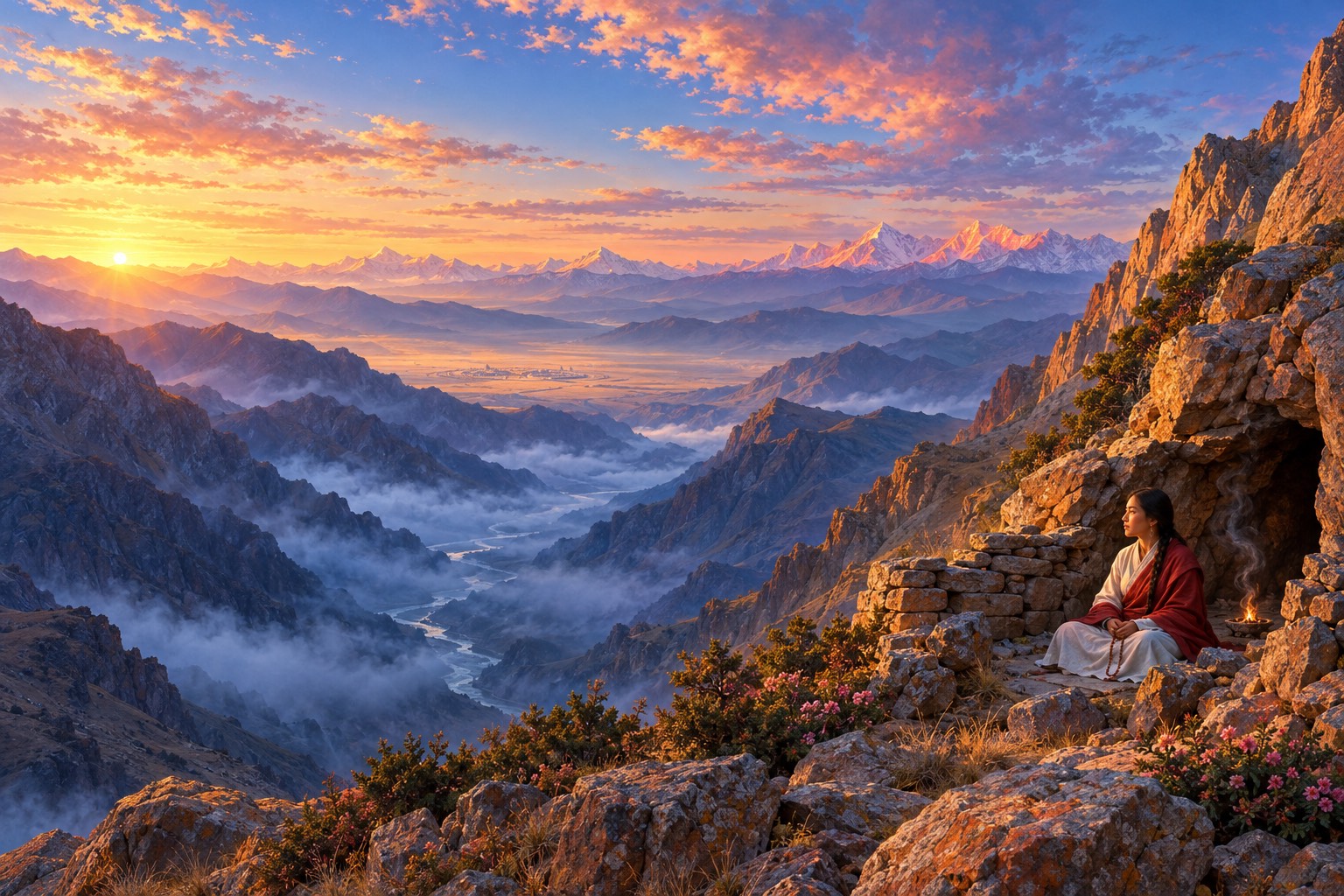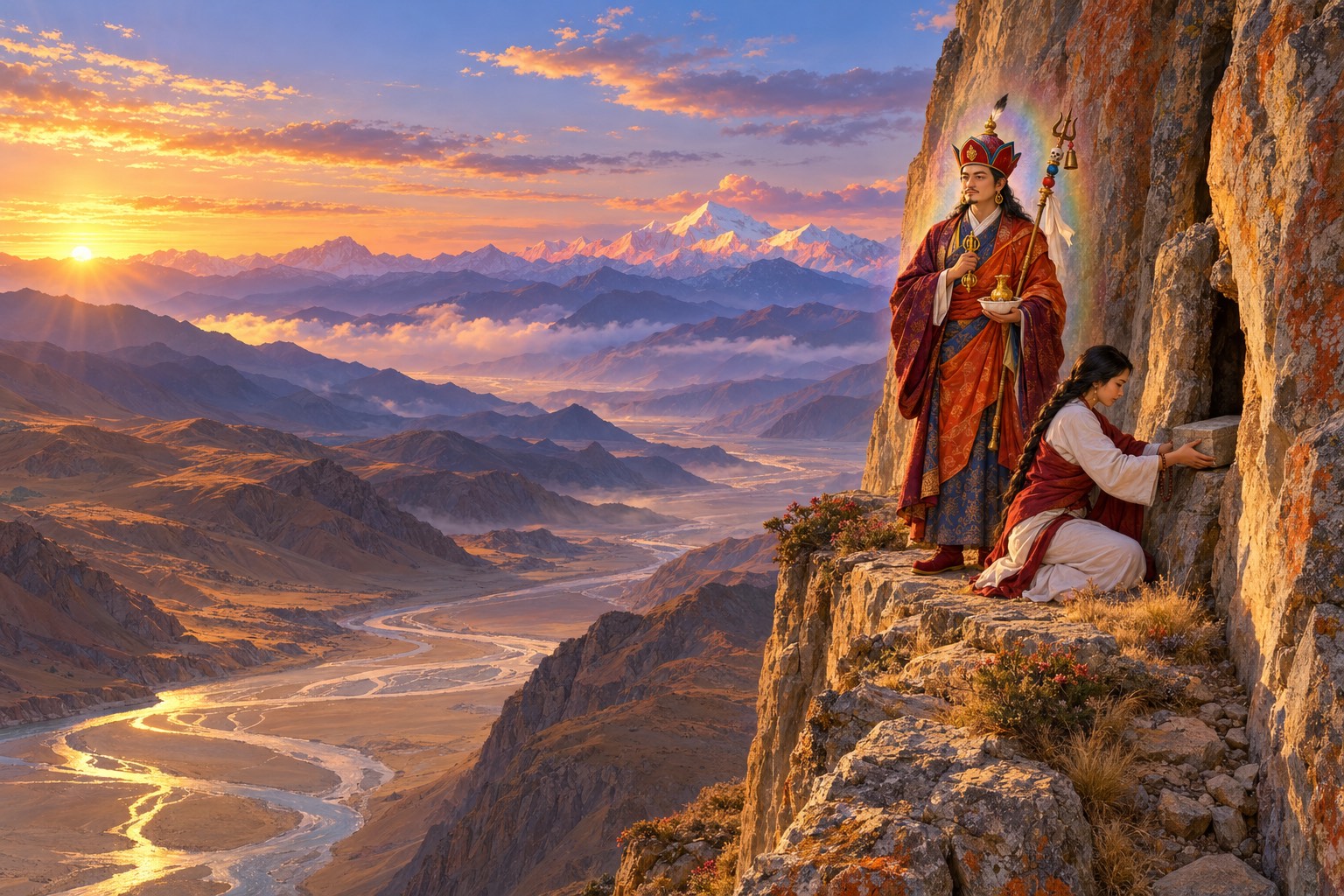
When Guru Rinpoche left Tibet, the traditional accounts say, one disciple went with him further than anyone else. Yeshe Tsogyal, his closest Tibetan student, travelled with him toward the southwest. Then she came back alone.
Her early life, her years in the caves, the young man she freed in Nepal and the hiding of the treasures with her teacher are told on other pages of this site. This one follows what came after: the long years when she was the teacher, and Tibet came to her.
Tsogyal is remembered as a dakini, a "sky-goer," the tradition's word for an awakened woman. Most of what follows comes from her life story, revealed as a treasure text in the seventeenth century, as the nineteenth-century master Jamgön Kongtrul sums it up in a verse prayer. Where other accounts differ, this page says so.
The parting
The notes to Kongtrul's prayer set the parting at Tsashö Rong, the "hot valley" in what is now Nuwakot in Nepal. There, they say, the two stayed three weeks. He gave her his last teachings, his testaments and his prophecies, and then he went on.
She turned back toward the snows. Kongtrul's prayer says she stayed for a while in Shang, a valley in the province of Tsang that runs down to the Tsangpo river, and in a side valley there called Zabbu, teaching those who came. That valley will return at the end of her story.
 Illustration in preparation
Teacher to a kingdom
Then she went back to Chimphu, the hermitage caves above Samye where she had studied for so many years. Now it was she who was asked for counsel. Kongtrul says she advised the king there, and his translator's note names him as Mutri Tsenpo, son of the Dharma King Trisong Detsen.
All the Guru's followers in Tibet, the prayer says, came to her for instruction. The one who had once kept every word of his teaching was now the one who explained it.
Illustration in preparationThe same verse tells a wonder of mercy. A minister named Shantipa is remembered for the harm he did, yet the tradition says she went down into the hell realms and led him out. It is told as a sign of how far her compassion was believed to reach, not as something anyone can check.
Beside that wonder the verse sets plainer gifts: food, clothing and medicine for those in need, and protection for those who were afraid.
Illustration in preparationWalking the land
The prayer places long journeys in these years. It gives their count in the great round numbers of sacred geography: a hundred major holy places, twenty-five snow mountains, twelve hidden valleys, and seven secret sites besides.
Illustration in preparationWherever she went, the accounts say, she left hand- and footprints in the rock. And she went on hiding treasures: caskets of teachings and sacred objects, sealed with prayers for the people who would one day find them. She had begun that work with Guru Rinpoche. In these years, the prayer suggests, she carried it on herself.
Illustration in preparationThe prince's teacher
One gathering is remembered by name. At a temple the translation calls Karchu Dorje Ying, Kongtrul says, she taught a circle of fortunate sons and daughters, and the prince was foremost among them. The translator's notes name seven students there, among them the princes Mutri Tsenpo and Murum Tsenpo and a queen, Ngangchung Pel.
While she taught there, the prayer says, Guru Rinpoche himself appeared to her and stayed seven days, to ripen the prince's understanding. In the tradition's telling, the teacher who had gone away still came when he was needed.
Illustration in preparationHistory remembers these princes less tidily. Trisong Detsen's sons go by several similar names, Mutri, Mutik and Murum, and the sources disagree about which of them ruled, and for how long. Wikipedia's summary says Mutri, the eldest, died early. The tradition's prince and the historian's are hard to match, and this page does not try.
Afterwards, the prayer says, she went south to Kharchu in Lhodrak, near the border of present-day Bhutan, where Guru Rinpoche had meditated in caves above a forested gorge. There she rested in meditation, and the tradition says her compassion went out in countless forms to beings everywhere.
Illustration in preparationTwo old friends
Then came a visit the tradition loves to tell. Mandarava, the Indian princess who had also been Guru Rinpoche's disciple and companion, came to Tibet from India. Kongtrul pictures the two women talking over the Dharma, the Buddha's teaching, comparing the instructions each had been given, and showering each other with praise.
Illustration in preparationIt is a small scene in a long life, and a warm one: two students of the same teacher, years after his going, still learning from each other.
The last gathering
At last she returned to the valley of Zabbu in Shang. There, the prayer says, she held a great tsok, a shared offering feast, with her eleven heart disciples, and gave them hundreds of oral instructions. Each of them asked her something in turn, and she answered with prophecies, advice and last words.
The lists of the eleven differ. The notes to Kongtrul's prayer include Kalasiddhi, a yogini of Nepal. Wikipedia's list, drawn from English summaries of the life story, has instead Atsara Salé, the companion she once freed. Both name Tashi Kyidren of Mön and Shelkar Dorje Tso. Wikipedia adds that some tellings count about a hundred people present.
Illustration in preparationHow long had she lived? Kongtrul's prayer says she stayed two hundred and eleven years to guide the Tibetans. Wikipedia gives about ninety-nine. The Dharma Fellowship's retelling places her passing around 837, or perhaps later. However long it was, every version remembers a life given to others.
The days of leaving
The life story counts the last days carefully. On the eighth day of the bird month, Kongtrul says, dakinis came from every world to greet her. She granted nine requests made by gods and people, and gave nine prophecies.
Two of her closest disciples were Tashi Kyidren of Mön and Kalasiddhi of Nepal. The life story, quoted in the notes to the prayer, says she touched each woman and each became a lotus, one blue and one red, and dissolved into her heart. It is one of the tradition's most mysterious images, and it is left here as the story gives it.
Illustration in preparationThen, on the tenth day, the accounts say, four dakinis came bearing a palanquin of light. Seated within it, she gave her disciples a last, loving testament, and she was carried away into the sky.
Illustration in preparationWhere did she go? Kongtrul's prayer says she went to the Palace of Lotus Light on the Copper-Coloured Mountain, Guru Rinpoche's pure land, a realm of awakened presence, and that there she is known as the dakini Blazing Blue Light. Rigpa Wiki says simply that she flew through the air and went straight there. A short verse life by the woman master Do Dasal Wangmo adds that she left no body behind.
Illustration in preparationStill within call
The story does not end with a leaving. As the scholar Holly Gayley summarizes it, before she vanished Tsogyal promised to go on answering the prayers of those who call on her, to appear in visions, and to keep sending her emanations into the world. Do Dasal Wangmo's verse says she still shows her face to those ready to see it.
Tibetans have taken her at her word. For centuries they have prayed to her, and remarkable women of later times, among them Machik Labdrön, Jomo Menmo, Mingyur Paldrön and Sera Khandro, have been honored as her emanations. Kongtrul closes his prayer by calling her "Tibet's one true Mother" (Samye Translations).
Gayley also notes the honest difficulty of knowing her as a figure of history, as with so many women in Buddhist writings. The tradition's way of knowing her is different: through the places she blessed, the prayers to her, and the women who carried her presence on.
The seventh line of the Seven-Line Prayer asks Guru Rinpoche to come and grant his blessing. Tsogyal's later years are the tradition's picture of that blessing at work in a human life: a student who became a teacher, stayed when her own teacher had gone, and promised in her turn to come when called.
The practices her story names belong with a qualified teacher, and the site's Find a Teacher page lists places to begin. Anyone, though, may recite the prayer.
About the art
Yeshe Tsogyal appears in most images as a yogini, in simple white cotton robes and a dark red woollen shawl, with a mala of 108 beads, as on her other pages. Because this page covers her later years, she is painted as a mature woman, but unlined and ageless: the notes to Kongtrul's prayer say her body was no longer subject to ageing. In the image of her departure she takes her dakini form, with a golden flower diadem, silks of white, sky blue and gold, a white skull cup lifted as an offering and a small wish-fulfilling jewel at her lap. The prayer says she is known in the pure land as the dakini Blazing Blue Light; that form is named in the text but not painted.
The prince wears eighth- to ninth-century Tibetan imperial dress as seen in Dunhuang murals: a tall cream turban and a long russet robe with wide triangular lapels. Mandarava, who came from India to visit, is shown as an Indian Buddhist nun in ochre-saffron robes, so the two women are never confused. Tashi Khyidren of Mön wears a striped handwoven wool wrap, and Shelkar Dorje Tso a plain oatmeal robe with a bamboo staff; both dress details are careful reconstructions, not likenesses. The temple and lamps are kept simple, without the gilded roofs, prayer flags and painted script of later centuries.
The two floating flowers stand for the moment, in the life story, when two disciples became a blue utpala and a red lotus and dissolved into Tsogyal's heart. The life story marks the flowers with sacred syllables; as everywhere on this site, the images contain no Tibetan script, mantras or syllables. The palanquin of light is drawn as an open canopy of rainbow rays borne by four dakinis, and the Copper-Coloured Mountain, Guru Rinpoche's pure land, is shown only from far away across the sea.
Why this matters for practice
The seventh line of the Seven-Line Prayer asks Guru Rinpoche to come and grant his blessing. Yeshe Tsogyal's later years show, in the tradition's telling, what that blessing can become in one life: a student who stayed when her teacher had gone, gave freely to everyone who came, and left with a promise of her own to answer those who call. Reciting the prayer is a small way of joining that long line of calling and answering.
If something in this story moved you, a teacher who stayed behind, or a promise to come when called, you might pause tonight and recite the prayer once, remembering the woman who stayed so that others would not be alone.
Sources and further reading
- The Tambura's Yearning Song of Devotion: A Prayer Summarizing Khandro Yeshé Tsogyal's Life and Liberation, by Jamgön Kongtrul Lodrö Tayé (tr. Stefan Mang, Samye Translations, 2017), Lotsawa House
- Tsogyal's Liberational Life in Brief, by Do Dasal Wangmo (tr. Adam Pearcey, 2023), Lotsawa House
- Yeshe Tsogyal, Rigpa Wiki (archived snapshot)
- Kalasiddhi, Rigpa Wiki (archived snapshot)
- Mutri Tsenpo, Rigpa Wiki (archived snapshot)
- Yeshe Tsogyal, Wikipedia
- Mutik Tsenpo, Wikipedia
- The Many Lives of Yeshe Tsogyal, by Holly Gayley (2007), Lion's Roar
- Yeshe Tsogyal, Princess of Karchen, Dharma Fellowship (archived snapshot)
- Lhodrak Kharchu, Nekhor
- Namling County, Wikipedia
- Lady of the Lotus-Born: The Life and Enlightenment of Yeshe Tsogyal, attributed to Gyalwa Changchub and Namkhai Nyingpo, revealed by Taksham Nüden Dorje, tr. Padmakara Translation Group (Shambhala, 1999)
This retelling is waiting to be read by a knowledgeable practitioner. Where the traditional accounts differ, the story says so; if you notice a mistake, please tell us through Share Your Story.